 EN
EN
 Deutsch
 Italiano
 Español
 Français
 日本語
日本語

The RV Power Calculator is the quickest way to figure out how much power your off-grid system needs, whether you’re going boondocking for the weekend or on a long caravan trip. This guide turns real-world loads, like 12V fridges, LED lights, vent fans, charging laptops, and even short air-conditioner runs, into easy-to-understand numbers that you can use. You will learn how to check your daily energy use in watt-hours (Wh), how to figure out how much power your AC appliances use through inverter efficiency, how to choose the right battery capacity (LiFePO₄ vs AGM), and how to turn Peak Sun Hours into useful solar array watts. We’ll also compare MPPT and PWM charge controllers and give you checklists to make sure your wiring, fusing, and mounting are all safe and up to code. This step-by-step calculator-driven guide will help you find the right amount of solar power for your RV, caravan camping, or running your RV AC on solar power. It will also help you find the right amount of solar power for your RV, caravan camping, or running your RV AC on solar power.
What’s the TL;DR for caravan solar power?
If you only remember three things about caravan / camping solar power:
Measure daily energy first (
Wh), not just panel watts.Battery ≈
daily Wh × days of autonomy ÷ (system V × usable DoD).Solar ≈
daily Wh ÷ (Peak Sun Hours × system efficiency); add ~20% headroom for shade, heat, and losses (long-tail: RV solar sizing formula, camping solar panels efficiency, caravan solar headroom).
To estimate sun availability for different seasons/locations, start with NREL solar resource maps and NOAA solar calculators.
Why does right-sizing your caravan or camping solar system matter?
If your system is too small, your 12V compressor fridge may sag at night; too big and you carry extra cost, roof load, wiring complexity. The “sweet spot” covers measured daily Wh with ~20% buffer and a realistic plan for cloudy days—ideal for weekend camping solar, caravan solar power setup, and off-grid RV energy planning.
Pro tip: Don’t design purely from nameplate watts; balance-of-system losses (wiring, controller, inverter) reduce deliverable energy (long-tail: inverter losses in RV solar, PV performance in real conditions).
How does the RV Power Calculator turn your caravan loads into a right-sized system?
List every load and note watts × hours × duty cycle. Intermittent devices (fridges/fans) often have 30–50% duty. Decide whether it’s DC (12/24V) or AC through an inverter.
Copy-ready mini-formulae
Daily Wh (DC device) =
W × hours × duty × quantityDaily Wh (AC device, DC side) =
(W × hours × duty × qty) ÷ inverter-η(use 0.90–0.95 for quality sine inverters)
This is the foundation for planning 12V fridge consumption, camping laptop charging, and caravan lighting wattage (long-tail: 12V fridge amp draw, caravan lighting watts, camping inverter efficiency).
Which inputs does an RV Power Calculator need
Choose days of autonomy (e.g., 1.0–1.5 for weekenders; 1.5–2.0 for winter/full-time). Convert energy to capacity using usable DoD:
LiFePO₄ is commonly sized around 80% DoD (operate ~20–90% SoC).
AGM/lead-acid is often planned at 50% DoD.
FormulaBattery Ah = (Daily Wh × Days × 1.2 buffer) ÷ (System Volts × usable DoD)
Pick 12/24/48V based on inverter size and cable runs (long-tail: 12V vs 24V caravan solar, RV inverter cabling size).
Cold-weather tip: Lithium capacity drops at low temps; add 10–15% extra headroom (long-tail: LiFePO4 winter camping, caravan battery thermal limits).
How many watts of solar power do you really need?
Array power is set by how much energy you must recharge during daylight. Use Peak Sun Hours (PSH) for your region/season, and a realistic system efficiency (panel → controller → battery).
FormulaArray W ≈ Daily Wh ÷ (PSH × system-η) → then add ~20% for real life (long-tail: camping solar panels 200W vs 400W, caravan rooftop solar in winter, RV shade losses).
Reality check: heat reduces panel output and partial shade can cripple a string. Anti-shade aware design (module-level mitigation, smart stringing) helps.
Which charge controller should you choose—and how big should it be?
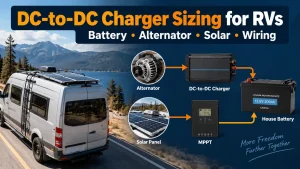
MPPT tracks the array’s maximum power point, effectively decoupling array voltage from battery voltage to harvest more energy—especially in cool temps, partial shade, or higher-voltage strings. PWM is simpler/cheaper but typically wastes energy when Vmp ≫ Vbatt—key for both small camping solar kits and high-yield caravan solar arrays.
Controller current ratingI_controller (A) ≈ Array W ÷ Battery V, then × 1.25 safety factor. Also verify Voc limits and stringing against the datasheet (long-tail: MPPT current calculator 12V, PWM vs MPPT caravan).
What real-world examples can you model for your own build?
A) Weekender (no air conditioning)
Loads: LED lights, 12V compressor fridge (~45W, 24h, 0.35 duty), vent fan, water pump, laptop charging.
Daily DC-side energy: ≈ 800–900 Wh.
Battery: 12V 200–300Ah LiFePO₄ (1.5 days + buffer).
Solar: With
PSH = 5handsystem-η = 0.75→900 ÷ 3.75 ≈ 240W; recommend 300–400W (long-tail: caravan solar 300W kit, camping fridge watts).
B) Short AC runs (13.5k BTU rooftop AC ≈ 2 h/day)
Extra energy: ~3.3 kWh DC side (includes inverter losses)
Total: ~4.1–4.3 kWh/day
Battery: 12V 600–800Ah LiFePO₄ (or 24V 300–400Ah) for 1.5 days + buffer
Solar:
PSH = 5h,η = 0.75→ ~1.1–1.2 kW; recommend 1.2–1.5 kWController: ~100–125A at 12V (two 60A MPPTs in parallel work well)
Inverter: 2,000–3,000W continuous; ≥5,000W surge (depends on compressor start)
(long-tail: run RV AC on solar, caravan lithium for air conditioner)
Which safety standards and best practices should you follow?
Wherever possible, align with recognized RV/caravan standards. In North America, NFPA 1192 guides RV construction; many installers borrow ABYC-style DC wiring practices (marine-grade lugs, correct fusing, chafe protection). Always verify wire gauges, over-current protection, disconnects, mounting, and ventilation—vital for RV electrical standards, caravan wiring code, lithium battery install safety.
What should you check before you buy anything?
Device-level daily Wh (include duty cycle & inverter losses).
Battery Ah from the formula (decide 12/24/48V early).
Solar W from
PSH × efficiency; add ~20% buffer.Charge controller sizing:
W ÷ V × 1.25; confirm Voc and stringing.Cables, fuses, disconnects, mounts, airflow, and standards alignment (long-tail: caravan solar wiring size, RV fuse selection, camping solar mounting tips).
Where can you find trustworthy sources to plan with confidence?
NREL Solar Resource Data & Maps — PSH baselines & resource layers: https://maps.nrel.gov/solar
NOAA Solar Position & Daylight Calculators — seasonal geometry/daylength: https://gml.noaa.gov/grad/solcalc/
U.S. DOE Solar Energy Technologies Office — PV performance/BOS context: https://www.energy.gov/eere/solar/solar-energy-technologies-office
Victron Energy (Tech blog/white papers) — PWM vs MPPT insights: https://www.victronenergy.com/blog/
Battery University — DoD, charging, cycle life basics: https://batteryuniversity.com/
NFPA (Standards portal) — RV-related standard orientation: https://www.nfpa.org/
Frequently Asked Questions
1) How do I use an RV Power Calculator to figure out how big my caravan battery should be?
List each device with watts, hours/day, and duty cycle (for intermittent loads like fridges/fans).
The calculator totals daily Wh, then applies:
Battery Ah = (Daily Wh × Days of Autonomy × 1.2 buffer) ÷ (System Volts × usable DoD)Use DoD ≈ 0.8 for LiFePO₄ and DoD ≈ 0.5 for AGM.
Tip: Decide 12/24/48V early (affects cable size and inverter choice).
2) How many watts of solar panels do I need to power a 12V fridge?
A typical 12V compressor fridge uses ~350–500 Wh/day.
With PSH ≈ 5 h and system efficiency ≈ 0.75, plan ~300–400 W of panels.
Adjust for season, latitude, and shading (winter or forested campsites may need more).
3) Is it possible to run a rooftop RV air conditioner on solar? If so, how big is the system?
Yes, for short daily runs.
A 13.5k BTU unit (~1,500 W) for ~2 h/day needs ~3.3 kWh DC (incl. inverter losses).
Expect ~1.2–1.5 kW of panels and ~600–800 Ah @12V LiFePO₄ (or equivalent capacity at 24/48V).
Also plan for: a 2,000–3,000 W pure-sine inverter with high surge.
4) Which is better for caravan solar power: MPPT or PWM?
MPPT: higher yield by tracking the maximum power point—better in cool temps, partial shade, and higher string voltages.
PWM: cheaper, but wastes potential when
Vmp ≫ Vbatt.Limited roof area? → Choose MPPT.
5) How do I figure out Peak Sun Hours (PSH) for a campsite?
Use national/regional solar resource maps or online PSH calculators.
Quick rule of thumb: summer 5–6 h, shoulder 3–5 h, winter 2–3 h.
Year-round camping? Size for your worst-case season.
6) If I start small, what’s the easiest way to upgrade later?
Start battery-first (e.g., 12V 200 Ah LiFePO₄) + 300–400 W panels.
Later add +200–400 Ah battery and +400–800 W panels.
From day one, pick an MPPT and wiring sized for the future array (controller current, cable gauge, fusing).