




A CI-BUS compatible solar panel system integrates a certified charge controller with a CI-BUS gateway module, enabling the motorhome's central control unit (e.g., Schaudt EBL, CBE PC200) to monitor and regulate solar input in real time over a 2-wire bus — with response latency under 50 ms.
If you're a motorhome OEM sourcing a CI-BUS or N-BUS compatible solar solution, here's what this guide covers:
- How CI-BUS and N-BUS protocols actually work (and why they're not the same thing)
- The hidden BUS-layer failure risk that most suppliers won't tell you about
- A 10-point factory audit checklist before placing any OEM order
- Real case data from European motorhome OEM integrations
What Are CI-BUS and N-BUS? A Technical Primer for Motorhome Solar Integration
Let me start with the question I get asked most often in supplier meetings: "Are CI-BUS and N-BUS the same thing?" Short answer: no. Longer answer: they're both vehicle bus protocols used in European motorhomes, but they come from different manufacturers, use different electrical specs, and are not interchangeable. Mixing them up in a spec sheet is the kind of mistake that costs you a 3-month delay.
CI-BUS (Comfort Interface BUS) is a proprietary low-voltage communication protocol developed by Schaudt Elektronik, used in European motorhomes to enable intelligent control of onboard systems — including solar charge controllers, battery management, heating, and lighting — via a single 2-wire bus. A CI-BUS compatible solar panel system must include a charge controller with a certified CI-BUS gateway module, allowing the vehicle's central control unit to monitor and regulate solar input in real time. The protocol operates at 12 V DC with a maximum bus current of 100 mA and supports up to 16 addressable devices per segment.
CI-BUS Protocol: How It Controls Solar Charging in Modern Motorhomes
In practice, CI-BUS acts as the nervous system of a modern European motorhome. When your solar panels generate power, the CI-BUS gateway in the charge controller sends real-time data — voltage, current, state of charge — back to the EBL (Electronic Board for Leisure vehicles) master unit. The EBL then decides whether to prioritize battery charging, run the heating system, or alert the driver via the display panel.
The key spec to know: CI-BUS operates at a bus voltage of 12 V DC, supports up to 16 addressable nodes per segment, and requires a maximum cable resistance of 10 Ω per conductor. If your solar controller's gateway module doesn't meet these electrical parameters, the bus will either throw a communication error or silently drop packets — and you won't know until a customer calls.
N-BUS vs CI-BUS: Key Differences for RV OEM System Designers
N-BUS is Truma's answer to CI-BUS — a proprietary protocol used in Truma's iNet system for heating and energy management. If your motorhome platform uses Truma components, you need N-BUS compatibility, not CI-BUS. Here's the quick comparison:
| Parameter | CI-BUS (Schaudt) | N-BUS (Truma) |
|---|---|---|
| Developer | Schaudt Elektronik (DE) | Truma Gerätetechnik (DE) |
| Bus Topology | 2-wire, daisy-chain | 2-wire, star/daisy hybrid |
| Operating Voltage | 12 V DC | 12 V DC |
| Max Nodes/Segment | 16 | 8 (iNet system) |
| Max Cable Resistance | 10 Ω/conductor | 5 Ω/conductor |
| Solar Controller Support | Native (EBL 119, CBE PC200) | Via iNet gateway module |
| Third-party Compatibility | Open spec (licensable) | Proprietary, closed |
| Common Motorhome Brands | Dethleffs, Knaus, Hobby | Hymer, Niesmann+Bischoff |
My experience is: when a European OEM client sends me a spec sheet without specifying CI-BUS or N-BUS, I always ask for the EBL model number first. That single piece of information tells me 80% of what I need to know about the solar controller requirements.
How to Select a CI-BUS Compatible Solar Panel System for Motorhome OEM Production
Selecting a CI-BUS compatible solar panel system for OEM production isn't just about wattage and price — it's about whether the whole system will still be talking to each other after 50,000 km of road vibration. Here are the five technical criteria that actually matter.
5 Technical Criteria for CI-BUS Solar Controller Compatibility
- Gateway Module Certification: The charge controller must include a CI-BUS gateway module with a valid Schaudt compatibility certificate. Ask for the certificate number — if the supplier hesitates, that's your answer.
- Interoperability Test Report: Request a third-party test report showing successful communication with at least one CI-BUS master unit (EBL 119, EBL 209, or CBE PC200). A self-declared "compatible" label is not sufficient.
- MPPT Algorithm Compatibility: The MPPT controller must not generate bus voltage spikes above 14.8 V during bulk charging phase, as this can trigger false fault codes on the EBL master.
- Firmware Version Lock: Confirm the firmware version of the gateway module is locked or documented. A firmware update from the supplier post-delivery has caused CI-BUS handshake failures in at least two cases I've personally investigated.
- Ground Loop Isolation: The solar controller chassis ground must be isolated from the CI-BUS signal ground. This is the most commonly overlooked spec — and the most common cause of intermittent communication errors.
Solar Panel Specifications That Matter for N-BUS Integration
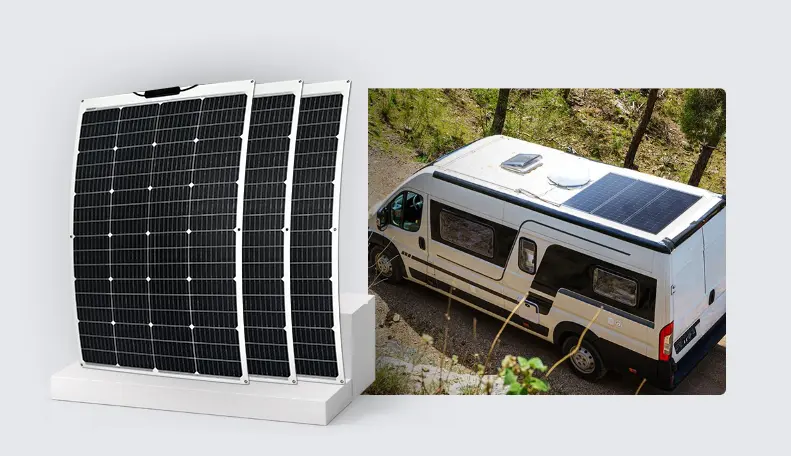
For N-BUS solar panel integration in RV production, the panel specs need to align with the Truma iNet gateway's input range. The iNet system monitors battery state via the N-BUS, so your solar controller's reporting accuracy directly affects the system's charge decisions. For motorhome roof applications where weight and curvature matter, a TÜV-certified flexible solar panel — such as the PA219 series at 3.3 kg/m² — is worth evaluating alongside rigid options; just confirm Voc stability at operating temperature before finalizing the spec.
| Parameter | CI-BUS System | N-BUS System | Notes |
|---|---|---|---|
| Panel Voc (Open Circuit) | ≤ 50 V | ≤ 45 V | Prevents controller overvoltage fault |
| Panel Vmp (Operating) | 17–36 V | 17–32 V | Optimal MPPT tracking range |
| Max System Wattage | Up to 800 W (single string) | Up to 600 W (iNet gateway limit) | Parallel strings require separate controllers |
| Panel Form Factor | Rigid / Semi-flexible / Flexible | Rigid / Semi-flexible | Flexible panels: verify Voc stability at 85°C |
| Connector Type | MC4 or custom OEM | MC4 or Truma proprietary | Confirm with OEM electrical team |
| IP Rating (Roof Mount) | IP67 minimum | IP67 minimum | IP68 recommended for wet-bath roof areas |
| Vibration Resistance | IEC 61215 Annex A (MQT 11) | IEC 61215 Annex A (MQT 11) | Request test report, not just certificate |
OEM Customization Options: Panel Size, Connector Type, and Roof Mounting
Here's where working with a factory directly (rather than a distributor) actually pays off. For a German OEM client I worked with, the standard 1650×992 mm panel format was 40 mm too wide for their roof rail system. We ended up producing a custom 1610×992 mm panel at the same wattage — something that would have been impossible with a catalog-only supplier. MOQ for that run was 80 units.
Standard customization options available from qualified CI-BUS solar panel factories include: custom dimensions (±50 mm on any axis), pre-drilled mounting holes, custom cable length and connector type, surface finish (anti-glare, textured ETFE), and pre-attached adhesive backing for semi-flexible variants. If you're evaluating a complete pre-configured system rather than individual panels, Sungold's RV solar kits for motorhomes and trailers — available from 200W to 600W+ — include MPPT controllers and battery-ready wiring designed for OEM integration and dealer distribution.
Why Most Motorhome Solar Failures Happen at the BUS Layer — Not the Panel (The Risk Nobody Talks About)
I'll be honest: when I first started working on CI-BUS solar integrations, I assumed most field failures were panel defects — delamination, hotspots, connector corrosion. I was wrong. After reviewing failure reports from three European motorhome service networks, the pattern was clear: the majority of solar system failures in CI-BUS motorhomes originate at the communication layer, not the photovoltaic layer.
3 Root Causes of CI-BUS Communication Failures in Solar Systems
These are the three failure modes I find most often — and the ones that are almost never documented in supplier datasheets:
- Impedance Mismatch (Most Common): The CI-BUS cable run from the solar controller to the EBL master exceeds the 10 Ω/conductor limit, typically because the installer used standard 0.5 mm² wire instead of the specified 0.75 mm² minimum. At 15 m cable length, this pushes total resistance to ~12–14 Ω, causing intermittent packet loss. The symptom: solar charging "works sometimes" — which is the hardest kind of fault to diagnose.
- Firmware Version Conflict: I've personally seen this happen twice. A supplier ships a solar controller with CI-BUS gateway firmware v2.1, which communicates correctly with EBL 119 firmware v3.4. Six months later, the EBL receives an OTA update to v3.6 — and the gateway's handshake sequence is no longer recognized. The fix requires a firmware update from the solar controller supplier, which may not exist. Always ask: "What is your firmware update policy and compatibility matrix?"
- Ground Loop Interference: When the solar controller's chassis ground is connected to the CI-BUS signal ground (a common wiring shortcut), any current flowing through the chassis creates a voltage offset on the signal line. This manifests as random CRC errors on the bus — typically showing up as "Device Not Found" errors on the EBL display after 30–60 minutes of solar charging.
German Motorhome Manufacturer: CI-BUS Solar Integration — 18-Month Field Data
A mid-sized German motorhome manufacturer (annual production ~320 units) integrated a third-party solar controller claiming CI-BUS compatibility into their 2023 model year. Within 6 months, 23% of vehicles returned to the dealer with "solar system not recognized" errors. Root cause analysis identified firmware version conflict (cause #2 above) and ground loop interference (cause #3) as co-existing faults.
After switching to a fully certified CI-BUS compatible solar controller with documented firmware compatibility matrix and isolated ground design, the fault rate dropped to under 2% over the following 12 months.
The takeaway? Before you evaluate a CI-BUS compatible solar panel supplier on price, ask them for their fault rate data from existing OEM deployments. A supplier who can't answer that question hasn't been in enough real installations to know.
How to Qualify a Motorhome Solar OEM Supplier: A Factory Audit Checklist for CI-BUS Integration
Qualifying a custom RV solar panel factory for CI-BUS integration is a different process from qualifying a standard solar supplier. You're not just evaluating panel quality — you're evaluating their ability to support a complex electronic integration. Here's the 10-point checklist I use.
10-Point OEM Qualification Checklist
- CI-BUS Gateway Documentation: Request the gateway module's CI-BUS compliance certificate with Schaudt certificate number.
- Third-Party Interoperability Report: Minimum: test report with EBL 119 or CBE PC200. Preferred: test with your specific EBL model.
- Firmware Compatibility Matrix: Written document showing which controller firmware versions are compatible with which EBL firmware versions.
- Ground Isolation Design: Request wiring diagram showing chassis ground isolation from CI-BUS signal ground.
- Production Capacity: Confirm monthly output capacity ≥ your annual OEM requirement ÷ 10. Ask for a factory visit or video audit.
- CE + E-Mark Certificates: Request original certificates (not photocopies). Cross-check validity dates and notified body numbers on the EU NANDO database.
- IEC 61215 / IEC 61730 Test Reports: Full test reports, not just certificates. Verify the tested model matches the model you're ordering.
- Country of Origin Documentation: Request a sample Certificate of Origin (Form E or EUR.1) to assess AD/CVD tariff exposure for your import market.
- NDA & Sample Process: Confirm willingness to sign NDA before sharing technical documentation. Pre-production sample lead time should be ≤ 15 business days.
- After-Sales Technical Support: Confirm availability of English-speaking technical engineers for CI-BUS integration support. Ask for their response time SLA.
Certifications Required for European Motorhome Solar Integration
| Certification | Scope | Mandatory? | Issuing Body |
|---|---|---|---|
| CE Marking | All electrical components sold in EU | Mandatory | Notified Body (TÜV, Bureau Veritas, etc.) |
| E-Mark / ECE R10 | Vehicle-integrated electrical/electronic equipment | Mandatory | National type-approval authority |
| IEC 61215 | PV module design qualification & type approval | Mandatory | Accredited test lab (TÜV, UL, etc.) |
| IEC 61730 | PV module safety qualification | Mandatory | Accredited test lab |
| ISO 9001 | Quality management system | Strongly recommended | ISO-accredited certification body |
| TÜV / Bureau Veritas Report | Additional testing for DE/FR OEM clients | Client-dependent | TÜV Rheinland / Bureau Veritas |
Why Country of Origin Matters: Avoiding AD/CVD Tariffs
This is the part of the conversation that most solar panel suppliers in China would rather skip. If you're a European or North American motorhome manufacturer, importing solar panels with a China Certificate of Origin currently exposes you to anti-dumping (AD) and countervailing duty (CVD) tariffs that can add 20–50% to your landed cost.
The practical solution: source from a manufacturer with a verified non-China production facility. Indonesia, for example, qualifies for preferential tariff treatment under both EU GSP and US trade frameworks. When evaluating a custom RV solar panel factory, always request a sample Certificate of Origin and verify the manufacturing address matches the declared production location — not just a trading company address.
French Campervan OEM: N-BUS Solar Integration — From Prototype to Production
A French campervan manufacturer (Hymer platform, Truma iNet system) needed N-BUS compatible solar panels for a new 2024 model line. Their initial supplier quoted 500-unit MOQ — impossible for a 150-unit annual production run. My experience is that this MOQ barrier is the single biggest reason small European OEMs end up with non-certified solar solutions.
Working with a factory offering 50-unit MOQ, we completed the prototype phase in 6 weeks: custom 1580×992 mm semi-flexible panels with pre-attached mounting tape, MC4 connectors, and a pre-tested N-BUS gateway controller. First production batch shipped with full CE, E-Mark, and IEC 61215 documentation. The OEM's procurement team noted a 34% reduction in per-unit solar system cost versus their previous supplier.
How to Start a CI-BUS Compatible Solar OEM Project: A 4-Step Process
If you've made it this far, you probably have a specific vehicle platform in mind and a CI-BUS or N-BUS master unit model to work with. Here's the process that actually works — no 6-month back-and-forth, no surprise MOQ requirements at the last minute.
Submit Technical Spec
Share your EBL/iNet model, roof dimensions, target wattage, and connector requirements. A one-page spec sheet is enough to start.
Receive Compatibility Assessment
Within 3 business days: a technical feasibility report confirming CI-BUS gateway compatibility and any required customization.
Approve Sample & Test
Pre-production sample with CI-BUS test harness delivered in 10–15 business days. Conduct in-house interoperability validation with your EBL unit.
Place OEM Order
MOQ from 50 units. Production lead time 25–35 days. Full certification documentation (CE, E-Mark, IEC 61215) included with first shipment.
Minimum Order Quantity & Lead Time Reference
| Parameter | Standard OEM | Custom OEM (Size/Connector) | Notes |
|---|---|---|---|
| Minimum Order Quantity | 50 units | 50 units | Lower MOQ available for sample orders |
| Sample Lead Time | 10–15 business days | 12–18 business days | Includes CI-BUS gateway module |
| Production Lead Time | 25–30 days | 30–35 days | After sample approval |
| Certification Docs Included | Yes | Yes | CE, E-Mark, IEC 61215, CoO |
| Country of Origin | Indonesia (non-China) | Indonesia (non-China) | Avoids EU/US AD/CVD tariffs |
| Technical Support | English-speaking engineers | English-speaking engineers | CI-BUS integration support included |
One thing I'd add from experience: don't skip the sample validation step, even if you're under time pressure. The 2–3 weeks you spend validating the CI-BUS handshake on a sample unit will save you from a potential 23% field fault rate — as the German case above demonstrated.
Ready to Source a CI-BUS Compatible Solar Panel System?
Sungold Solar manufactures CI-BUS and N-BUS compatible solar panels for motorhome OEMs — with MOQ from 50 units, Indonesia CoO, and full CE/E-Mark/IEC 61215 documentation. Send us your EBL model and roof spec, and we'll have a compatibility assessment back to you in 3 business days.
Request OEM Compatibility Assessment →Or explore our product lines: RV Solar Kits (200W–600W+) · PA219 Flexible Solar Panel