




What Are Flexible Solar Panels, Exactly?
Flexible solar panels worth it: the three checks this guide uses
Flexible solar panels are photovoltaic modules built without a rigid glass front sheet or aluminum frame. Instead, cells are laminated into a thin polymer or composite backsheet that can follow gentle curves on van roofs, RV tops, boat decks, and other surfaces where a standard framed module simply cannot go.
- Definition
- A flexible solar panel is a thin-laminate photovoltaic module designed for curved or weight-sensitive surfaces. It trades mechanical protection (glass front sheet, frame) for low mass, low profile, and the ability to conform to surfaces with a gentle radius. Whether it makes sense for your build depends on three things: the shape of your roof, how you manage operating temperature, and the replacement labor you are willing to budget over time.
People who type flexible solar panels worth it into a search box usually already know their roof is weird — curved, thin, or height-limited. The rest of this page is just engineering detail around that instinct.
People often picture "flexible" as rubbery or nearly fabric-like. In practice, most high-performance flexible modules use monocrystalline cells — the same cell technology found in rigid panels — embedded in a laminate package. The flexibility comes from the encapsulant and substrate materials, not from the cells themselves.
That distinction matters because it affects both what you gain and what you give up. The cells are still precision silicon devices. They still need clean, consistent electrical connections. And they still generate heat under load — heat that a glass-and-frame package dissipates differently than a bonded laminate does.
If you want to review actual module specifications before reading further, our flexible solar panel modules and specs page is the data-first starting point.
Who Should (and Should Not) Be Reading This?
This guide is written for two audiences who have a real install problem that rigid framed panels cannot easily solve. If the phrase flexible solar panels worth it is stuck in your head, start by deciding which bucket you are in below.
Van builders and RV owners — Your roof may be curved fiberglass, thin aluminum, or a surface where drilling bolted-rail mounts risks the waterproof membrane. Weight matters for fuel economy and axle ratings. Roof height matters for garages and low bridges. For you, flexible panels solve a physical constraint.
B2B integrators and procurement teams — You are speccing flexible modules for fleet vehicles, marine platforms, or specialty structures. Your "worth it" question is about batch repeatability, field failure modes, certification documentation, and total system cost over the platform's service life.
This guide is not optimized for homeowners with a wide, flat, load-bearing tile or shingle roof who simply want the cheapest electricity over 25 years. For that application, framed glass modules almost always win on economics and insurance simplicity. If that is your situation, use the energy you saved reading this paragraph to go compare rigid panel quotes instead.
What Does "Flexible" Actually Mean on a Manufacturer Spec Sheet?
"Flexible" on a datasheet covers more than the bend radius line. Understanding each relevant parameter helps you avoid three costly misreadings that I see in procurement conversations regularly.
STC Watts vs. Usable Watts on a Hot Roof
Standard Test Conditions (STC) — the wattage printed in large type on every module datasheet — are measured at 25 °C cell temperature, 1,000 W/m² irradiance, and 1.5 air mass. Your van roof on a July afternoon is not STC. It is closer to 60–75 °C cell temperature in many climates.
Every module has a published temperature coefficient of power (typically expressed as %/°C). For a module rated at −0.35 %/°C, a 45 °C rise above STC baseline costs about 15–16% of rated output. That is not a marketing footnote; it is a real watt-hour gap you need to account for when sizing your system.
I've found this to be the single most common sizing mistake in RV builds: the customer calculates their loads against 400 W STC and wonders why the fridge and fan fight each other on August afternoons. The answer is almost always the temperature derating, not a faulty panel.
Bend Radius and What the Datasheet Does Not Say
Flexible module datasheets list a minimum bend radius — often 200–400 mm depending on design. This is a static measurement made once in a lab. It does not describe what happens to the interconnects and cell solder joints over thousands of road-vibration cycles.
A van that covers 30,000 miles a year subjects its roof-mounted panels to continuous low-amplitude vibration. I've seen edge delamination and micro-crack signatures appear on panels that were installed within the published static bend radius specification but on a substrate that flexed with road input. The spec sheet and the installation context are two different documents.
Key Spec Lines to Check Before Purchasing
| Specification | What it tells you | What to do with it |
|---|---|---|
| Open-circuit voltage (Voc) | Upper voltage limit at cold morning temperatures | Size MPPT charge controller so cold-start Voc cannot exceed the controller's input maximum |
| Short-circuit current (Isc) | Maximum current the panel can deliver | Size wire gauge and overcurrent protection to 125% of Isc per standard wiring practice |
| Temperature coefficient of Pmax | Power loss per degree above STC baseline | Use it to calculate realistic hot-roof output; compare models on this number, not just nameplate watts |
| Minimum static bend radius | Laminate structural limit under one-time bending | Stay well within it, and evaluate whether your substrate flexes dynamically under load or vibration |
| IP / ingress protection rating | Resistance to water and particle intrusion at junction box and connectors | Marine and high-wash environments need IP67 minimum at all connection points, not just the module face |
Where Do Flexible Solar Panels Actually Win?
Flexible modules earn their place on specific builds — not because they are universally superior, but because they solve problems that rigid panels cannot.
Weight
A typical 100 W rigid framed monocrystalline panel weighs roughly 7–9 kg. A comparable flexible laminate weighs 1.5–3 kg. On a camper van with an axle weight budget, or a sailboat where topside weight affects stability, that difference is not trivial. Four flexible panels instead of four rigid panels can mean 20–25 kg less on a sensitive structure.
Profile and Aerodynamics
Framed rigid panels mounted on rail systems add 30–80 mm of height to a van roof. At highway speeds, that increases aerodynamic drag. A flush-bonded flexible panel adds 2–5 mm. For builds where garage clearance or motorway wind noise matters, this is a meaningful engineering benefit, not a style preference.
Curved Surface Compatibility
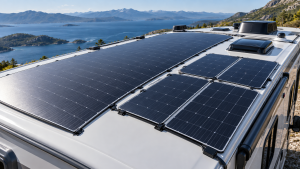
Rounded fiberglass RV roofs, curved van tops, boat bimini tops, and dome structures are simply not compatible with flat-bottomed rigid panels. Flexible modules conform to these surfaces, enabling installations that would otherwise require custom fabrication or be structurally impossible.
Installation Speed and Membrane Integrity
Bonded flexible panel installs — when done correctly with appropriate adhesive and edge sealant — do not require drilling through the roof membrane. For builds where leak risk around fastener penetrations is a concern, this is a genuine functional advantage over bracket-mounted rigid systems.
Bottom line on pros: Flexible panels win on mass, profile, and surface compatibility. These advantages are real, measurable, and specific. If your application does not need any of them, the pros are irrelevant to your decision.
What Do You Give Up With Flexible Panels?
An honest supplier tells you the trade-offs before the sale. Here are the ones that matter most in practice.
Mechanical Protection
The tempered glass front sheet on a rigid panel absorbs impacts that would damage or destroy a polymer-encapsulated flexible module. Tools dropped from above, tree branches, overhead clearance misjudgments, and accidental foot traffic all hit differently when there is no glass layer. Flexible panels are not designed for regular foot traffic, and their surface scratch resistance is lower than glass.
Heat Retention in Bonded Installs
This is the most underrated disadvantage in every "pros and cons" list online. A framed rigid panel mounted on raised rails has an air gap beneath it — natural convection removes heat, keeping the cells cooler and output higher. A flexible panel bonded flat to a metal substrate has no such convection path. The metal roof conducts heat, the laminate traps it, and cell temperature runs higher than it would in a vented rigid install.
Higher cell temperature means lower instantaneous power output (per the temperature coefficient) and — over years — accelerated degradation of encapsulant and edge seal materials. The heat problem does not make flexible panels a bad choice. It makes unventilated bonded installs a design choice with real performance and longevity consequences.
Shorter Typical Warranty Periods
Most rigid residential modules ship with 25-year performance warranties backed by manufacturer actuarial models. Flexible module warranties vary widely — typically 5–10 years for budget products, with some premium designs offering longer coverage. Shorter warranty periods reflect real material durability differences and the thinner manufacturing margin for warranty reserve. Read warranty terms carefully, including what triggers a claim and who pays for removal and reinstallation labor.
Edge Seal Vulnerability
Without a rigid frame protecting the perimeter, the laminate edge is the most vulnerable point for moisture ingress. UV exposure, thermal cycling, and mechanical flexing all stress edge sealants over time. Once moisture gets into the laminate stack, it accelerates delamination and cell corrosion. Proper adhesive selection, edge protection, and inspection intervals matter more in flexible panel installs than in framed rigid systems.
Bottom line on cons: The meaningful trade-offs are heat management, mechanical vulnerability, and edge sealing discipline. All three are manageable with good installation practice — but none of them disappear just because a product brochure does not mention them.
Why Thermal Management — Not Flexibility — Decides Whether These Panels Are Worth It
Most "pros and cons" articles treat heat as a footnote. I want to make it the main point, because in my experience from working on OEM builds and fleet specifications, heat is the variable that separates a successful flexible panel installation from one that disappoints within three years.
The Air-Gap Problem: Why "Flush Mount" Can Quietly Kill ROI
Consider two identical flexible panels, same model, same batch, installed on two different van roofs. Panel A is bonded directly to bare sheet metal with no standoff or foam riser. Panel B is mounted with 10 mm foam spacers that create a narrow air channel between the laminate and the metal skin.
I've seen this comparison play out on fleet builds. The fully bonded panel consistently shows lower afternoon output in summer — not because of the panel, but because the metal roof conducts heat into the laminate from below while the sun heats it from above. The thermal gradient compounds. Panel B, with its modest air channel, benefits from natural convection that Panel A cannot access.
The economic consequence: if Panel A runs 10°C hotter on average than Panel B across 200 summer days per year, and the temperature coefficient is −0.35%/°C, that is roughly 3.5% of rated annual output permanently lost. Over five years, the "savings" from the simpler bonded install may be consumed by the yield gap.
Micro-Cracking and Bend Fatigue: Static Spec vs. Dynamic Reality
Laboratory bend radius testing is done once, slowly, at room temperature. A mobile vehicle operates at variable temperatures, subject to road-induced vibration at frequencies that vary with surface quality and speed. The cells in a flexible module are not flexible — they are silicon, and silicon develops micro-cracks under repeated mechanical stress at cell edges and solder joints.
Micro-cracking typically does not kill a panel outright. It degrades it gradually — a few percent of rated power per year, accelerating over time as crack propagation continues. The visible symptom is a panel that measures lower Isc than its neighbors on a sunny day, with no visible physical damage.
I've had a B2B customer come back to us after an eight-month field deployment on commercial delivery vehicles. Sample batch had passed incoming inspection. Production batch had marginally tighter corner radii because of a substrate change, and the vehicles' constant stop-start vibration created micro-crack signatures by month six. The lesson: ask suppliers to document bend radius with margin, not just at the stated limit.
The Hidden TCO: When Replacement Labor Costs More Than the Panel
A 200 W flexible panel might cost $120–$180. Removing a bonded panel from a van roof without damaging the roof membrane, surface preparation, adhesive, and labor for a mobile installer can run $200–$400 depending on geography and installer access. If a panel fails at year four, you spend more on the service call than on the replacement unit.
This does not make flexible panels uneconomical — it makes serviceability planning a required part of the installation design. Adhesive selection matters (repositionable vs permanent). Edge accessibility for removal tools matters. Whether you are mounting one panel or eight matters for the labor amortization math.
The B2B Angle: Batch Consistency Matters More Than Peak Lab Efficiency
For fleet buyers standardizing on a flexible module, the panel that scores highest in a lab comparison may not be the best supply-chain choice. Tight power tolerance (ideally 0/+5 W or better), consistent encapsulant thickness across production runs, and documented edge-seal process controls are worth more over a 1,000-unit deployment than an extra half percent of peak efficiency on the sample batch.
Conclusion: Flexible panels are worth it when heat is managed, installation is designed for serviceability, and specification discipline extends from the sample batch to production. The technology is capable. The installation design is where most real-world outcomes are determined.
How Can You Decide if Flexible Panels Are Right for Your Build?
Use a two-gate decision process. First gate: does the installation have a physical constraint that rigid panels cannot accommodate? Second gate: can you design the install to manage heat and serviceability?
If both answers are yes, flexible panels are worth it. If the first answer is no, the case for flexible weakens significantly. If the second answer is no, you are likely setting yourself up for a replacement job before the panel reaches the end of its useful life.
Gate 1 — Physical Constraints (Check Any That Apply)
- The mounting surface is curved and cannot accept a flat-bottomed rigid frame
- Roof load capacity is limited by structure, not just preference
- Overall height is constrained by garage clearance or vehicle class regulations
- The installation requires no penetrations through a waterproof membrane
- The platform is marine and weight distribution and stability are design criteria
Gate 2 — Installation Design Readiness (Check Before Ordering)
- You have a plan for airflow — either a riser system, foam spacers, or a naturally vented surface
- The adhesive or fastener choice allows future panel removal without membrane damage
- Cable entry points are protected with drip loops and appropriate glands
- You have sized the charge controller and wiring for temperature-derated output, not just STC nameplate
- You have a realistic expectation for inspection and replacement intervals
Situations Where Flexible Is Usually the Wrong Choice
- Wide, flat, load-bearing roof where framed glass on raised rails is straightforward
- Applications requiring decades of near-zero-maintenance operation
- Environments with regular heavy mechanical impact (debris, hail-prone regions)
- Installations where LCOE over 20+ years is the primary selection criterion
How Do You Match Flexible Panels to an RV or Van Electrical System?
Matching flexible panels to a mobile electrical system starts with a load schedule, not a panel wattage number. Get the load math right first — then size the panels to cover it under realistic (not STC) conditions.
Step 1 — Build a Load Schedule
List every DC and AC load on the vehicle: compressor fridge, ventilation fans, lighting, water pump, device charging, inverter standby draw. Estimate daily hours of use for each. Multiply watts by hours to get watt-hours per day. Add a 20–25% overhead for inefficiencies in the charging chain. That number is your daily target generation minimum.
Step 2 — Apply a Realistic Derating Factor
Divide your daily watt-hour target by the usable peak sun hours at your typical location (usually 4–6 hours in mid-latitude summer). Then divide by your derating factor (0.75–0.80 accounts for temperature, wiring loss, and MPPT overhead). The result is the panel wattage you actually need — typically 25–40% higher than a naive STC-only calculation suggests.
I've seen builds where this step was skipped. The common result: a 400 W system that struggles to recover a 150 Ah battery on a warm, partly cloudy afternoon. The fix is almost never "buy more panels." It is usually "remove the phantom loads and shade the roof vent" — but that conversation is easier before the system is installed.
Step 3 — Electrical Sizing and Safety
Use an MPPT charge controller sized to handle the panel array's Isc at full sun. Select wire gauge appropriate for the run length and current, with a 25% safety margin on ampacity. Fuse each string close to the panel array, not only at the controller. Connector compatibility between panel-supplied MC4 connectors and your controller is worth confirming before components arrive on-site, not after.
For series vs. parallel string design: parallel strings are more shade-tolerant on van roofs where partial shadow from roof fixtures is common. Series strings deliver higher voltage for longer cable runs but require the whole string to perform at the lowest-performing panel's level.
If you want a pre-matched system that handles the sizing and component compatibility decisions for you, our RV solar kits are configured around real load scenarios, not just panel wattage headlines.
What Should B2B Buyers Ask Before Standardizing a Flexible Module?
For integrators and procurement teams, "worth it" is a supply-chain outcome, not a product feature. These are the questions that separate a good sample from a good production partnership.
Power Tolerance and Binning
Ask for the production power tolerance range — not just the best-case positive tolerance. A ±5 W tolerance on a 200 W module means production units can legally ship at 195 W. If you are building parallel strings with mixed batches, that 5 W floor matters for string current balance. Request that tolerance documentation be included in each production lot's quality records.
Thermal Cycling and Environmental Stress Testing
IEC 61215-1:2021 defines design qualification test methods for terrestrial PV modules, including thermal cycling, humidity-freeze, and damp heat test sequences.[1] Ask which tests the module has completed and at what test voltage. Completion of the full IEC 61215 and IEC 61730-1:2023 test sequences[2] represents a credible baseline for material durability — not a lifetime guarantee, but a shared quality vocabulary between factory and buyer.
Edge Seal Process Documentation
Ask how the manufacturer controls edge seal width, adhesive cure verification, and corner treatment. Flexible module longevity under field thermal cycling is disproportionately determined by edge seal quality. If a supplier cannot describe their edge seal process in specific terms, that is a meaningful risk signal for a fleet deployment.
Batch-to-Batch Consistency Commitment
Request that the production contract specify allowable substrate and encapsulant changes with prior written notice. This protects against the scenario where a substrate supplier change subtly tightens the effective bend radius or changes the thermal resistance of the laminate stack without triggering a new product qualification.
In my experience, the customers who are happiest with flexible panel supply partnerships are the ones who treated the specification document — not just the sample — as the contract. The extra hour of procurement conversation before the first purchase order prevents the expensive conversation at month eight.
How Do Flexible and Rigid Solar Panels Compare Side by Side?
Here is the honest comparison. No column wins across every row — the "right" answer depends entirely on your installation constraints and performance priorities.
| Dimension | Flexible laminate | Framed rigid glass |
|---|---|---|
| Mass | Typically 60–75% lighter than a comparable framed module — varies by cell size, encapsulant, and wattage class | Heavier; full glass front sheet plus aluminum frame; requires stronger mounting hardware |
| Profile height | 2–5 mm above mounting surface; aerodynamic; compatible with garage height limits | 30–80 mm above roof surface on standard rail mounts; higher drag; taller overall |
| Surface compatibility | Follows gentle curves; suitable for round fiberglass RV tops, boat decks, van roofs | Requires flat or very slightly sloped surface; cannot conform to curves |
| Mechanical protection | No glass front; more vulnerable to impact, abrasion, and heavy foot traffic | Tempered glass front; high resistance to impact and surface abrasion |
| Operating temperature | Runs hotter in flush-bonded installs with no air gap; heat directly affects output and longevity | Cooler when mounted on raised rails with natural convection underneath |
| Typical efficiency range | Monocrystalline flexible: ~19–22% at STC; lower in hot-roof conditions | Standard mono: ~20–23% at STC; advantage maintained by cooler operating temperature in field |
| Warranty period | Varies widely; budget products 5–10 years; premium products up to 15–25 years | Typically 25-year performance warranty standard for residential modules |
| Serviceability | Adhesive-bonded installs can be challenging to remove without roof damage; plan for this upfront | Bolted rail systems allow individual panel removal and replacement without membrane risk |
| Best for | Curved surfaces, weight-sensitive builds, mobile platforms, height-constrained installs | Flat stable structures, maximum long-term yield, lowest 20-year LCOE |
This comparison is the short version. A dedicated deep-dive on flexible vs. rigid panel selection walks through the trade-offs in more detail for specific use cases including marine, agricultural, and temporary structures.
What Is the Bottom Line From a Manufacturer's Perspective?
We make flexible panels. We also make rigid panels. The honest answer we give customers who ask "which should I choose" is always: describe your roof, describe your load, describe your service budget, and we will tell you which technology serves you better — even if that means recommending a competitor's rigid panel for a standard home roof application.
Flexible panels are worth it when:
- The surface requires it — curve, weight limit, height limit, or membrane integrity constraint
- The installation is designed for it — heat management, cable strain relief, appropriate adhesive system
- The performance expectation matches reality — not STC nameplate watts on a summer roof
They are not worth it when the only reason to choose them is "they look cleaner" or "I don't want to drill holes." Both of those are valid preferences that can also be satisfied with low-profile rigid rail systems and non-penetrating ballast mounts.
If you are a B2B buyer: the specification conversation is the product. A supplier who cannot answer your thermal cycling, edge-seal process, and batch-consistency questions in specific terms is a supply-chain risk on a fleet deployment, regardless of how good the sample looked.
Final verdict: The honest answer to "flexible solar panels worth it" on a curved van or marine deck is yes — when heat paths, strain relief, and realistic temperature derating are engineered, not guessed. On a standard flat home roof chasing minimum LCOE, framed glass still wins most of the time. Treat the installation design as seriously as the module selection.
Frequently Asked Questions About Flexible Solar Panels
What are the disadvantages of flexible solar panels?
Anyone researching flexible solar panels worth it should start here: you trade framed-glass toughness for low mass and conformability. The biggest downside in real installs is heat buildup when the module is bonded flat to metal with no air gap — higher cell temperature cuts output and ages materials faster. Edge seals, impact resistance, and shorter warranties round out the list. Manage heat and wiring, and the risks shrink.
How long do flexible solar panels last compared to rigid panels?
Service life is primarily driven by installation quality, not cell type. Rigid framed glass modules are engineered for 25-plus-year economics. Flexible laminates are better understood as platform-life components — sized to the vehicle or vessel they serve. A well-installed flexible panel with airflow management, proper edge sealing, and strain-relieved wiring will significantly outlast a poorly bonded one. Field longevity is also influenced by thermal cycling, road vibration, and moisture ingress risk at edge seals.
Are flexible solar panels as efficient as rigid solar panels?
Premium monocrystalline flexible modules can match rigid panel nameplate efficiency at STC. In the field, output depends more on operating temperature and mounting method than on cell type alone. A rigid panel on a ventilated mount typically generates more consistent power than a flexible panel bonded flat to a sun-baked roof, because it runs cooler. When comparing technologies, evaluate system yield under your actual conditions — not STC watts from a brochure.