Finding a reliable custom solar panel manufacturer with low MOQ shouldn’t be a gamble. This B2B-focused guide covers everything professional buyers need to navigate small-batch sourcing: from 100-piece minimums and 15-25 day delivery timelines to avoiding common factory “red flags”. We break down Level 1-3 customization options, compare ETFE vs. Glass materials, and explain how to leverage pre-certified IEC architectures to save thousands in compliance costs. Make informed decisions and partner with an OEM/ODM expert that scales with your niche projects.
You want 150 custom solar panels. Not 1,000. Not a full container. Just 150 pieces, built to your spec, with your logo on the backsheet. And every factory you’ve contacted either ghosts you or quotes a price that makes zero business sense.
Sound familiar? That’s the reality for most small and mid-size solar buyers trying to source custom panels. This guide breaks down how low-MOQ custom manufacturing actually works, what it really costs, and the stuff nobody talks about — the risks hiding behind every “low MOQ” claim on Alibaba.
What Are Custom Solar Panels with Low MOQ — And Who Actually Needs Them?
Let’s clear something up first. “Custom” doesn’t just mean “a different size.” It means the entire panel is configured to your requirements — dimensions, electrical output, cell type, encapsulation, frame color, junction box placement, even the connector type and cable length. That’s a fundamentally different product from what sits in a factory’s standard catalog.
Low MOQ means you can get that product without filling a shipping container. For context, a 40ft container holds roughly 700–800 panels. If you only need 100–200, you’ve been stuck in no-man’s land — too small for most factories to care, too specific for off-the-shelf products.
Here’s who we see running into this problem every week:
Standard vs. Custom: It's Not Just About Size
| Parameter | Standard Panels | Custom Panels (Sungold) |
|---|---|---|
| Dimensions | Fixed (e.g., 1722×1134mm) | Any size from 100×100mm to 2400×1200mm |
| Power Output | Fixed tiers (550W, 600W, etc.) | Any wattage from 5W to 700W |
| Voltage | Fixed (e.g., 30V, 40V) | Freely configurable: 5V–50V |
| Cell Type | Manufacturer's standard | Mono PERC / N-type TOPCon / HJT — your call |
| Backsheet Color | White or black | Any RAL color, custom prints |
| Junction Box Position | Center-top | Wherever your install needs it |
| Logo / Branding | Manufacturer's brand | Your logo, your model number, your datasheet |
| Certifications | Included | Included (IEC 61215, IEC 61730, CE, TÜV) |
| Typical MOQ | 500–1,000 pcs | 50 pcs (Sungold) |
The 4 Buyer Types We Work With Most
Regional retailers who need something different from the commodity panels flooding Amazon and eBay. Think a European balcony-solar seller who needs compact 80W all-black panels with their own brand. A generic 550W utility module doesn’t work here.
Specialty wholesalers in marine, RV, or off-grid markets. Standard panel dimensions are useless when you’re fitting a boat deck or an RV roof. These buyers typically need 15–20 SKUs, each in modest quantities.
Project installers dealing with weird roofs. Curved structures, weight-limited buildings, odd dimensions — they need panels that fit the space, not the other way around. Ordering 200 custom-sized panels beats wasting 15% of roof area trying to force-fit standard modules.
Entrepreneurs testing new markets. Portable solar kits, solar street furniture, BIPV facades — you can’t justify a 1,000-piece order when you’re still figuring out if the product sells. You need 50–100 units to test the water.
Why Do Most Solar Panel Manufacturers Require High MOQs?
Here’s something most “low MOQ” marketing pages won’t tell you: high MOQs exist for real reasons. Understanding those reasons helps you figure out which factories genuinely handle small orders well, and which ones just slap “low MOQ” on their website to get your inquiry.
Changeover time eats production hours. Every time a factory switches from one panel spec to another, the stringer needs recalibrating, the laminator temperature profile changes, the framing station resets, and the flash tester gets reprogrammed. On a conventional single-line factory, that’s 2–4 hours of zero output. A 100-piece custom order can cost half a production day just in setup.
Material suppliers have their own minimums. Cell manufacturers sell in lots of 1,000–5,000 pieces. EVA film and backsheet material come in rolls sized for big runs. If your order needs 100 panels’ worth of a specific cell, the factory might have to buy 500 panels’ worth — and sit on the rest.
Certification isn’t cheap. A full IEC 61215 + IEC 61730 test sequence runs $8,000–$15,000 per module variant. Spread that across 1,000 panels and it’s $8–$15 each. Spread it across 100 panels? That’s $80–$150 per panel. Most buyers don’t see this cost coming.
Shipping math works against you. A full container (FCL) is always cheaper per watt than a partial load (LCL). Small orders pay 30–50% more on logistics alone.
The Real Cost Breakdown Behind MOQ
| Cost Component | Per Panel @ 1,000 pcs | Per Panel @ 100 pcs | Impact |
|---|---|---|---|
| Line changeover (4 hrs lost production) | $1.20 | $12.00 | 10× higher |
| Material waste / dead inventory | $0.50 | $3.00 | 6× higher |
| IEC certification amortization | $12.00 | $120.00 | 10× higher |
| LCL vs. FCL shipping premium | $0.00 | $4.50 | New cost |
| Total overhead per panel | $13.70 | $139.50 | — |
Look at those numbers. That’s why most factories set high MOQs — the economics don’t work otherwise. So the real question becomes: how do you make small-batch custom production viable without cutting corners?
How Does Sungold Achieve Low MOQ for Custom Solar Panels?
We get asked this a lot, usually with some skepticism. Fair enough. If the numbers above show why small orders are expensive, how can any factory offer 50-piece minimums without losing money or compromising quality?
The short answer: it’s not a promotion. It’s how our factory is built.
Multiple short lines instead of one long one. Most factories run a single high-speed line optimized for one product. We run several shorter, reconfigurable lines in parallel. Changeover drops from 2–4 hours to under 30 minutes. One line handles a 500-piece standard run while another does your 50-piece custom batch at the same time. Factory throughput stays high. Your order doesn’t wait in line behind a mega-order.
Pre-certified electrical building blocks. This is the part that really matters. We maintain a library of electrical designs — cell string configurations, bypass diode layouts, wiring schemes — that have already passed IEC 61215 and IEC 61730 testing. When you order custom panels, we match your requirements to an existing certified electrical architecture and vary the physical parameters (size, color, frame, connector position) around it. No full recertification needed for most custom variations. That alone saves $8,000–$15,000 and weeks of lead time per order.
Modular Design Platform: Pre-Certified Flexibility
Here’s a concrete example. A 72-cell series string architecture certified at 40V open-circuit voltage stays valid whether the panel is 1600×1000mm or 1200×800mm. White backsheet or black — doesn’t matter to IEC. Junction box center-top or offset-left — still the same electrical architecture. The safety and performance characteristics that IEC actually tests remain identical.
Only when you need a fundamentally different electrical setup — say, switching from series to parallel stringing, or jumping from PERC to HJT cells — does a new certification cycle kick in. And even then, a delta test (partial retest) often covers it.
We keep materials on the shelf. The most-requested cell types (mono PERC, N-type TOPCon), encapsulants, and backsheet materials stay in rolling inventory. No 2–4 week wait for raw materials to arrive from suppliers. When your 50-piece order is confirmed, production starts — not procurement.
Digital workflow from inquiry to shipment. Sounds boring, but it matters. Every step from your first email to production scheduling runs through a system that cuts the coordination overhead. That’s the overhead that makes small orders unprofitable at factories still running on WeChat messages and Excel spreadsheets.
From Inquiry to Delivery: The 5-Step Process
| Step | Timeline | What Happens | What We Need From You |
|---|---|---|---|
| 1. Requirement Discussion | Day 1–2 | Our engineer reviews your specs, flags potential issues, suggests optimizations | Panel size, voltage, power, quantity, where you’ll use them |
| 2. Design Confirmation | Day 3–5 | You get an engineering drawing + electrical schematic | Your approval (or revision requests) |
| 3. Sample Production | Day 6–12 | Physical sample built and flash-tested | You approve the sample (we send EL image + IV curve) |
| 4. Batch Production | Day 13–22 | Full order manufactured with in-line QC | — |
| 5. QC + Shipping | Day 23–25 | Final inspection, EL testing, packing, dispatch | Confirm shipping details |
Total: 15–25 working days from confirmed order to dispatch. If you’re reordering an existing design, skip Step 3 and you’re looking at 15–18 days.
What Most "Low MOQ" Claims Don't Tell You — The Hidden Risks Buyers Must Know
Now for the part that might make some manufacturers uncomfortable. We’re going to talk about what goes wrong — because if you’ve sourced solar panels from China before, you probably already know that “low MOQ” on a website doesn’t always mean what you think it means.
We’ve seen these five problems come up again and again with buyers who come to us after a bad experience elsewhere.
Red Flag #1: "Low MOQ" with a 200% Price Markup
Some factories will happily accept your 100-piece order. They’ll also quote you 200–300% above their standard rate. Technically, the MOQ is low. Practically, the price is telling you to go away.
A fair small-batch premium is 10–25% above standard pricing. That covers the real extra costs — changeover, material minimums, certification amortization. Anything beyond 30%? The factory isn’t set up for small runs. They’re just willing to take your money at an inflated rate.
Quick check: Ask for pricing at 100, 300, and 1,000 units. Compare the spread. If the 100-unit price is more than 30% above the 1,000-unit price, keep looking.
At Sungold, our small-batch premium runs 15–20%. That’s the real cost difference, not a surcharge designed to push you toward a bigger order.
Red Flag #2: Certification Shortcuts on Small Orders
This one’s serious, and almost nobody talks about it.
IEC 61215:2021 is clear: any module specification change that goes beyond the scope of the original test report needs either a full retest or a delta test (sometimes called a “similarity assessment”). Some factories skip this for small custom orders. They ship your panels under a certificate that was actually issued for a different product — different dimensions, different power rating, maybe even different cell type.
Why does this matter? If that panel fails in the field and the insurance company checks the IEC test report, they’ll see the certificate doesn’t match the product. Claim denied. And the liability usually falls on the distributor or installer — not the factory in Shenzhen.
Quick check: Ask for the IEC test report (not just the certificate) for your specific custom configuration. The report lists the exact model number, dimensions, and electrical parameters that were tested. If those don’t match what you’re ordering, ask about delta test documentation. No documentation? Walk away.
Our modular design platform exists partly to solve this problem. Most custom variations fall within pre-certified electrical architectures. When they don’t, we run the delta test ourselves and include the documentation with your shipment. No grey areas.
Red Flag #3: Quality Inconsistency in Small Batches
Big production runs have a built-in advantage: statistical smoothing. Over 1,000 panels, minor variations average out. A 50-piece batch doesn’t get that luxury. Factories without tight small-batch QC protocols can ship panels with 3–8% more variance in power output than their large-run production.
You might not notice this until your end customer complains that half the panels in their system underperform.
Quick check: Ask for the flash test report for every single panel in your order — not just a random sample. If more than 5% fall outside the stated ±3% power tolerance, the factory has a small-batch quality problem.
We flash-test and EL-image 100% of panels, every order, every size. The reports ship with your panels. No exceptions for small orders.
Red Flag #4: Your Order Gets Bumped
Picture this: the factory has a 5,000-piece order and your 100-piece order on the same production line. Capacity gets tight. Guess which order gets delayed?
Small orders routinely get pushed back 2–4 weeks because large orders take priority. The factory quoted you 20 days. You’re now at day 40 and getting vague excuses over email.
Quick check: Get the delivery commitment in writing. Include a penalty clause for delays beyond 5 working days. Factories that are serious about small-order scheduling will agree. The ones that routinely bump small orders will push back on this.
We run dedicated short-run production lines. They don’t share scheduling with high-volume orders. Your 50-piece batch has its own production slot.
Red Flag #5: After-Sales Goes Silent
The 5,000-panel buyer gets a dedicated account manager and priority warranty processing. The 100-panel buyer? Warranty claims take months. Replacement panels are “not available in that custom specification.” Emails go unanswered.
Quick check: Before placing your order, ask the factory for contact details of 2–3 existing small-order customers. Call them. Ask about what happened after delivery, not just before.
At Sungold, every customer gets the same warranty terms regardless of order size: 10-year product warranty, 25-year linear power warranty, same engineer contact, same response time. We don’t have a VIP tier that leaves small buyers behind.
What Customization Options Are Actually Available for Solar Panels?
Level 1 Basic Customization (Most Factories Can Handle This)
- Panel dimensions — adjusting length and width within standard cell-count configurations
- Power output — more or fewer cells to hit your target wattage
- Operating voltage — series/parallel cell string configuration to match your inverter or controller
- Cable length — longer, shorter, whatever your install needs
Nothing exotic here. These changes don’t touch the fundamental panel architecture. If a factory can’t do Level 1, they’re not really a custom manufacturer.
Level 2 Advanced Customization (Needs Real Production Flexibility)
- Backsheet color — custom RAL colors, not just white or black
- Frame color and profile — anodized colors, slim profiles, frameless options
- Junction box position — moved to wherever your mounting system needs it
- Connector type — MC4, Amphenol, or something specific to your system
- Logo and branding — screen-printed or laser-etched, your brand on the backsheet and frame
- Packaging — custom carton printing, pallet configuration, retail-ready labeling
This is where factories start to separate. Plenty can do one or two of these. Doing all of them on a 100-piece order? That takes a factory with multiple material variants in stock and flexible tooling.
Level 3 Deep Customization (Requires Actual R&D)
- Cell technology selection — mono PERC, N-type TOPCon, HJT, or back-contact cells
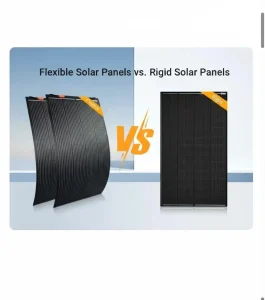
- Encapsulation material — glass-glass, glass-backsheet, ETFE flexible, PET flexible
- Non-rectangular shapes — triangular, trapezoidal, L-shaped, curved for architectural integration
- Integrated electronics — built-in MPPT controllers, LED indicators, IoT sensors
- Special environmental ratings — salt mist resistance (IEC 61701), ammonia resistance (IEC 62716)
Level 3 is where the gap between marketing and reality gets widest. Lots of factories claim deep customization. Few have the in-house R&D team, testing equipment, and certification experience to actually deliver it. Sungold covers all three levels — we’ve shipped custom projects for marine, BIPV, off-grid, and industrial applications.
Customization Specs at a Glance
| What You Can Customize | Available Range | Sungold | Typical Use |
|---|---|---|---|
| Panel Size | 100×100mm – 2400×1200mm | ✅ Any dimension | Irregular roofs, vehicles, boats |
| Power Output | 5W – 450W | ✅ Full range | IoT devices to commercial rooftops |
| Voltage | 5V – 48V | ✅ Free configuration | Match any inverter or charge controller |
| Cell Type | Mono PERC / TOPCon / IBC | ✅ All types | Efficiency-first or cost-first |
| Encapsulation | Glass-Glass / Glass-BS / ETFE / PET | ✅ All types | Rigid, semi-flex, fully flexible |
| Appearance | All-black / white / custom color / logo | ✅ Full OEM | Branding, architectural integration |
| Shape | Rectangle / triangle / trapezoid / L-shape | ✅ Non-standard | BIPV, custom installs |
| MOQ | — | 50 pieces | Trial orders, niche projects |
How Much Do Custom Solar Panels with Low MOQ Actually Cost?
Every buyer wants to know this. Almost every manufacturer’s website dodges it. We can’t give you an exact number — specs, quantity, and market conditions all matter — but we can give you a framework so you know whether a quote makes sense or someone’s padding their margin.
Here’s how custom panel pricing works:
- Base cost = market price for standard panels of equivalent wattage. As of 2025–2026, that’s roughly $0.10–$0.22/W for mainstream specs (per PV InfoLink and EnergyTrend trackers).
- Customization premium = 10–25% on top, depending on complexity. Basic size changes at the low end, deep R&D customization at the high end.
- Small-batch premium = another 5–15%, depending on quantity. 50 pieces at the high end, 200+ at the low end.
- Realistic total = $0.13–$0.32/W for custom low-MOQ orders.
Real example: a custom 100W panel (non-standard size, all-black, your logo, 100-piece order) might land at $0.25–$0.30/W. A standard 550W commodity panel goes for $0.15–$0.18/W. The per-watt gap looks big, but your custom panel opens a market that standard panels literally can’t serve. That’s where the margin is.
Price vs. Value: Why the Cheapest Quote Usually Costs More
Chasing the lowest price is tempting. It’s also how a lot of buyers end up with panels they can’t sell or warranty claims they can’t collect on.
Degradation tells the real story. NREL field studies show high-quality modules degrade at 0.3–0.5% per year. Cheap ones? 1.5–2.0% per year. Run that math over 25 years: the good panel still puts out 88% of its original power. The cheap one is down to 68%. That 20-point gap means 20% less energy over the panel’s lifetime — a cost that dwarfs any upfront savings.
And if the certification doesn’t match the product (Red Flag #2), your warranty claim gets denied when something goes wrong. The cheapest panel on your invoice becomes the most expensive panel in your business.
We don’t try to be the cheapest option. We aim for the lowest cost per kilowatt-hour over the panel’s actual lifetime. That means real certifications, honest degradation specs, and warranty terms we stand behind.
How Can You Verify a Custom Solar Panel Manufacturer's Quality?
on’t take anyone’s word for it — ours included. Here’s a five-step process we recommend to every buyer evaluating a custom panel supplier. It takes some effort upfront. It saves a lot of pain later.
Step 1: See the factory. Request a live video tour or visit in person. Count the production lines (multiple lines = small-batch capability). Look at automation level — automated stringers and laminators produce more consistent quality than manual operations. Check for dedicated QC stations with EL testing and flash testing equipment. A factory that shows you everything has nothing to hide.
Step 2: Verify certifications independently. Don’t just accept a PDF. Check it yourself:
- IEC certificates → IECEE CB Scheme database at iecee.org
- TÜV certificates → Certipedia at certipedia.com
- UL certificates → Product iQ at productiq.ulprospector.com
Match the certified model numbers to your specific custom configuration. If they don’t line up, ask for delta test documentation.
Step 3: Test before you commit. Order samples first. With the sample, you should receive:
- Flash test report (power output under Standard Test Conditions)
- EL image (shows micro-cracks and soldering defects you can’t see with your eyes)
- IV curve (confirms electrical characteristics match the datasheet)
If a factory pushes back on providing these for a sample order, that tells you something.
Step 4: Talk to their other customers. Ask for contact details of 3+ existing buyers who’ve ordered custom low-MOQ products. Call them. The question that matters most: “What happened after delivery?” Pre-sale communication is always good. Post-sale support is where the truth comes out.
Step 5: Read the contract carefully. Make sure it includes:
- Your exact product specifications (not vague descriptions)
- Delivery timeline with a penalty clause for delays
- Measurable quality acceptance criteria
- Warranty terms that explicitly cover your custom spec
- A dispute resolution mechanism you can actually use
What Real Projects Look Like: Custom Low-MOQ Solar Panel Use Cases
Numbers and frameworks are useful. But nothing beats seeing how this works in practice.
A German balcony-solar retailer needed 100 panels — 80W, all-black, 680×680mm.
The balcony solar market in Europe is booming thanks to simplified grid-feed regulations. But no standard panel fits a balcony railing. This retailer needed compact panels with their own brand, retail-ready packaging, and MC4 connectors pre-installed. We built 100 units. They tested the market with minimal risk, sold through in six weeks, and came back with a 500-piece reorder.
A Thai installer needed 200 custom-size panels for a metal roof project.
The building had non-standard roof dimensions. Standard 1722mm panels left gaps everywhere — 15% of usable roof area wasted. We engineered 200 panels at 1480×990mm using N-type TOPCon cells at 21.8% efficiency. System output went up 12% compared to the standard-panel layout the installer originally quoted.
An RV dealer in North America needed 150 flexible panels — 12V, ETFE, with their brand.
Every flexible panel on the market was either too big or configured for 24V systems that don’t play well with most RV charge controllers. We built 150 panels at 1060×540mm, 12V nominal, ETFE front sheet, with marine-grade adhesive kits and the dealer’s logo on each unit.
An East African off-grid developer needed 300 panels at a specific voltage.
Their solar home system used a proprietary charge controller optimized for 18V input. Every 50W panel on the market was configured at 22V — it worked, but the voltage mismatch cut charge efficiency by 8–10%. We built 300 panels at 18V nominal. Same cost per panel. Better system performance.
Frequently Asked Questions About Custom Solar Panels with Low MOQ
Q: What is the typical minimum order quantity for custom solar panels?
Most factories require 500–1,000 units for custom specs. Sungold’s minimum is 50 pieces for non-standard sizes, voltages, and designs. That makes custom panels accessible to small retailers, regional distributors, and project developers who don’t need — or can’t commit to — container-load quantities.
Q: Do custom solar panels with low MOQ come with real certifications?
They should. At Sungold, every panel ships with valid IEC 61215, IEC 61730, CE, TÜV, or UL documentation — regardless of order size. Our modular design platform uses pre-certified electrical architectures, so most custom physical variations don’t require full recertification. Ask any manufacturer for the test report matching your exact custom spec. If they can’t provide it, that’s a problem.
Q: How long does it take to get custom panels delivered?
Plan for 15–25 working days from order confirmation: design sign-off takes 2–3 days, sample approval 5–7 days, production and QC 10–15 days. We keep common materials in stock to avoid the raw-material delays that push less-prepared factories to 45–60 day lead times. Reorders on existing designs ship in 15–18 days.
Get Your Custom Solar Panel Quote in 24 Hours
If you’ve read this far, you probably have a project in mind. Here’s how to move forward:
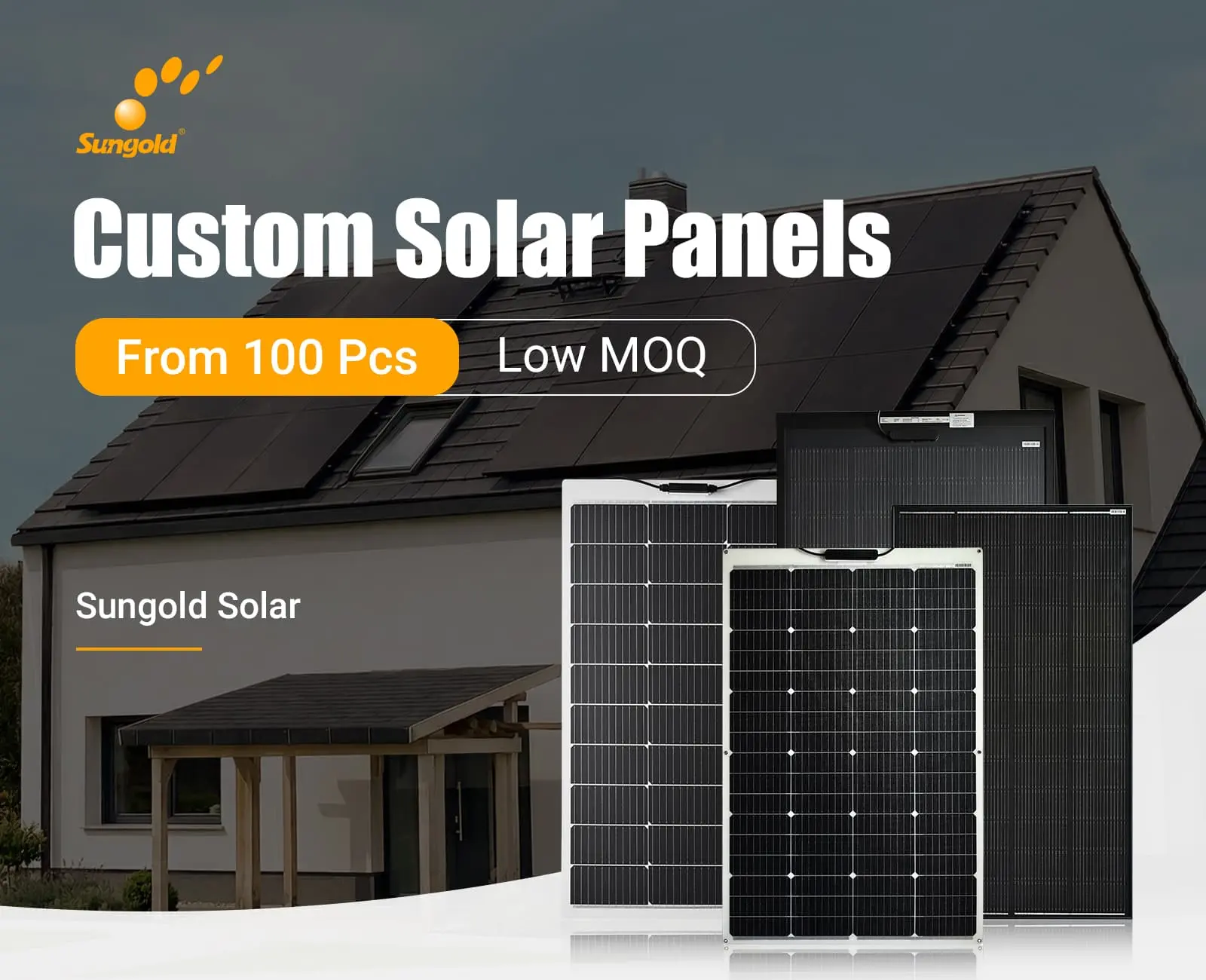
Sungold Solar — 100 pieces minimum. 15–25 day delivery. Full IEC certification. No excuses.