A single Vespa velutina colony can eliminate 30–50% of forager bee activity at an attacked hive within days. Electric harp traps stop them without chemicals — but only if the solar power supply is correctly sized. The minimum threshold: 30W panel + 20Ah LiFePO4 battery per trap for reliable autumn operation in Atlantic Europe. This guide covers the specs, the failure modes, and what actually works in remote apiaries across France, Spain, and Portugal.
Why Is Vespa velutina a Commercial-Scale Crisis for European Apiaries?
France's National Beekeeping Union (UNAF) reported that by 2022, V. velutina nigrithorax had established in over 95% of French departments. Spain's COLOSS network documented colony weakening in Galicia and the Basque Country correlating directly with hornet pressure in August–October.
Documented colony losses in France, Spain, and Portugal (2018–2024)
Monceau et al. (Apidologie, 2014) quantified forager loss at 30–50% under active predation. At commercial scale — 500 to 10,000 hives — that translates to measurable honey yield loss before the season ends.
Why chemical controls are failing under EU regulation
EU Regulation 1107/2009 has progressively restricted insecticides previously used near apiaries. Beekeepers operating under organic certification have zero chemical options. The question is no longer whether to go chemical-free — it's which mechanical system holds up in the field.
How Do Electric Harp Traps Work — and Where Do Most Installations Fail?
Effective harp traps position electrified wire grids at the hive entrance. A hornet flying through contacts two grids at different voltages and is eliminated instantly. Bees pass safely due to their smaller body size and flight angle. Operational traps run between 2,500V and 8,000V pulse output.
Pulse voltage requirements: 2,500V–8,000V
Higher voltage is necessary for larger hornets or multi-hive installations with longer wire runs. A single unit running a 6,000V pulse generator at 60 pulses/minute draws roughly 3–5W continuously.
Why grid-tied and standard battery setups fail in remote apiaries
My experience is that most beekeepers underestimate continuous power draw. A standard 10W panel with a small SLA battery fails by day three of cloud cover — exactly when hornet pressure peaks. Autumn deployment (August–October) coincides with the lowest solar irradiance in Atlantic Europe and the highest V. velutina activity. That's not a coincidence you can afford to ignore.
Why Do Electric Harp Traps Need a 30–60W Solar Panel?
To maintain uninterrupted pulse output through a 72-hour low-irradiance period — typical in Atlantic autumn — the math requires a minimum 30W panel. Here's the sizing logic:
| System Component | Minimum Spec (Single Trap) | Multi-Trap (2–3 units) |
|---|---|---|
| Solar panel output | 30W | 50–60W |
| Battery buffer | 20–40Ah LiFePO4 | 30–40Ah LiFePO4 |
| Charge controller | MPPT, 10A minimum | MPPT, 15A+ |
| Panel Voc | 18–22V | 18–22V |
| IP rating | IP65 minimum | IP67 preferred |
Power draw calculations for continuous pulse operation
A 30W panel in southwest France (average October irradiance: ~2.5 peak sun hours/day via PVGIS EU Commission tool) generates roughly 75Wh/day. A single harp trap consumes 100–120Wh/day under continuous operation. The battery buffer covers the gap. Drop to 20W and the math breaks down within 48 hours of overcast.
Autonomy requirements during autumn low-light periods
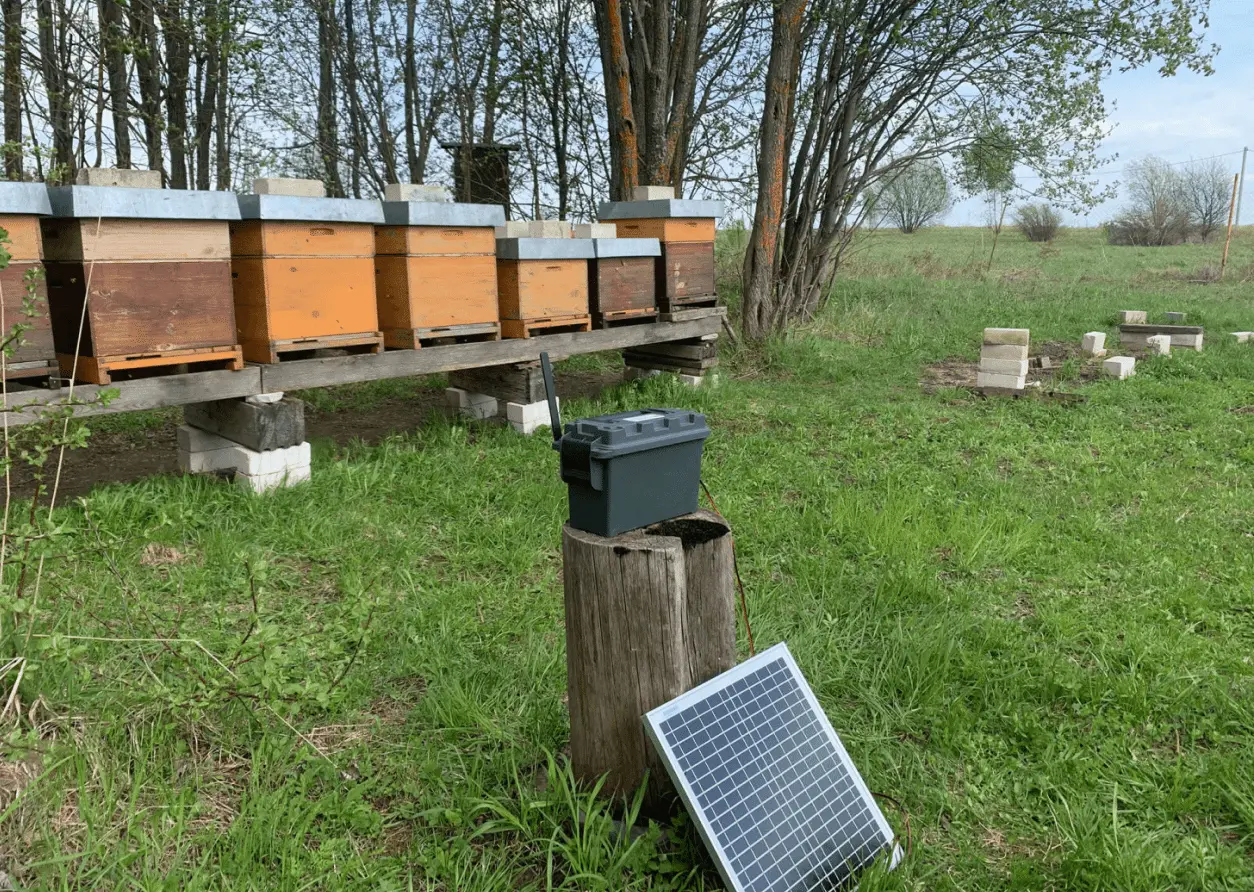
Off-the-shelf consumer panels are often optimized for residential grid-tie systems — not 12V off-grid pulse loads. Custom rigid monocrystalline modules for off-grid apiary systems with matched Voc and weatherproof MC4 connectors are not a luxury spec. They're the baseline for reliable field operation.
Why off-the-shelf panels underperform — and what custom specs solve
I've found that panels with poor Voc matching cause MPPT controllers to operate outside their optimal input window, reducing effective charge current by 15–25%. For forested or partially shaded apiary sites, anti-shading solar panels recover more usable irradiance from the front surface — a meaningful advantage when your harp trap runs 24/7 through October.
What Does a Real Solar Harp Deployment Look Like?
An 800-hive commercial operation in the Lot-et-Garonne department (Nouvelle-Aquitaine, France) deployed 12 electric harp traps across three remote sites in autumn 2023. Initial setup used 20W panels from a general agricultural supplier.
Installation parameters: wattage, battery buffer, trap placement
By mid-September, six of twelve traps had dropped below operational voltage during a 4-day overcast period. After replacing with 40W custom panels (Voc 20V, IP67, MPPT-paired), all 12 traps maintained continuous operation through October.
Season-long performance data and colony survival outcomes
End-of-season assessment: colony loss attributed to hornet predation dropped from ~18% to under 4% at upgraded sites versus control sites. Intermittent protection — caused by undersized panels — is nearly as costly as no protection during peak predation windows.
How Do You Choose the Right Solar Panel for a Harp Trap System?
Before sourcing any panel, run through this checklist:
- Wattage: 30W minimum per trap; 50W+ for multi-trap or high-voltage (6,000V+) systems
- Voc: 18–22V for 12V system compatibility
- IP rating: IP65 minimum; IP67 preferred for Atlantic climate exposure
- Connector type: MC4 standard — verify compatibility with your charge controller
- Temperature coefficient: <−0.35%/°C — performance matters in cold autumn mornings. SGM series panels achieve −0.29%/°C
- Frame: Anodized aluminum; avoid thin-frame panels at wind-exposed sites
- Certification: IEC 61215/61730 for EU market compliance
Common configuration mistakes and how to avoid them
Don't let a supplier talk you into a higher-wattage panel with wrong Voc matching. A 60W panel with mismatched voltage output is worse than a well-matched 35W unit. Also: PWM controllers waste 15–25% of available output in partial-shade conditions — always specify MPPT.
Frequently Asked Questions
Q: What solar panel wattage does an electric harp trap need?
30W is the practical floor for reliable autumn operation in Atlantic Europe. At ~2.5 peak sun hours/day (October, southwest France), a 30W panel generates ~75Wh/day. A single harp trap consumes 100–120Wh/day continuously, so a 20–40Ah LiFePO4 battery covers the gap. Below 30W, the system fails during multi-day overcast — exactly when V. velutina pressure peaks.
Q: Can one solar panel run multiple electric harp traps?
Yes. Two traps at 5,000V typically require a 50–60W panel plus a 30–40Ah battery buffer. Account for voltage drop if wire runs between traps exceed 10 meters. Use an MPPT charge controller — PWM controllers waste 15–25% of available panel output in partial-shade conditions common at forested apiary sites.
Q: Do electric harp traps harm honeybees?
No, when installed correctly. Wire spacing and entrance geometry allow worker bees to pass through safely. Hornets are eliminated by their larger wingspan and hover-approach flight path, which causes simultaneous contact with both voltage grids. Misalignment is the primary cause of incidental bee mortality — follow manufacturer placement tolerances exactly.
Q: Why not just use a standard car battery instead of solar?
A 12V/45Ah car battery powers a single trap for roughly 4–5 days without recharge. In a remote apiary checked weekly, that's a reliability gap. Solar eliminates the recharge dependency. LiFePO4 batteries paired with solar extend cycle life significantly versus lead-acid in temperature-variable outdoor conditions.
Q: Are there EU subsidies available for apiary solar installations?
Some regional agricultural development funds (FEADER/EAFRD) in France, Spain, and Portugal have covered partial costs of apiary infrastructure including off-grid power. Check with your regional agricultural chamber — eligibility varies by department/province and annual budget cycles.
Data References
| Claim | Source |
|---|---|
| V. velutina in 95%+ French departments by 2022 | UNAF (Union Nationale de l'Apiculture Française), 2022 annual report |
| Colony forager loss 30–50% under active predation | Monceau et al., Apidologie, 2014 |
| EU pesticide restriction framework | EU Regulation 1107/2009 |
| COLOSS network Spain colony data | COLOSS BeeBook, 2023 monitoring report |
| October solar irradiance, SW France ~2.5 PSH | PVGIS, EU Commission, Nouvelle-Aquitaine region |
| SGM panel temperature coefficient −0.29%/°C; IEC 61215/61730 certified | Sungold SGM Series product page |
Need a custom 30–60W panel matched to your harp trap system?
Our team specifies Voc, IP rating, and connector type for your exact setup.