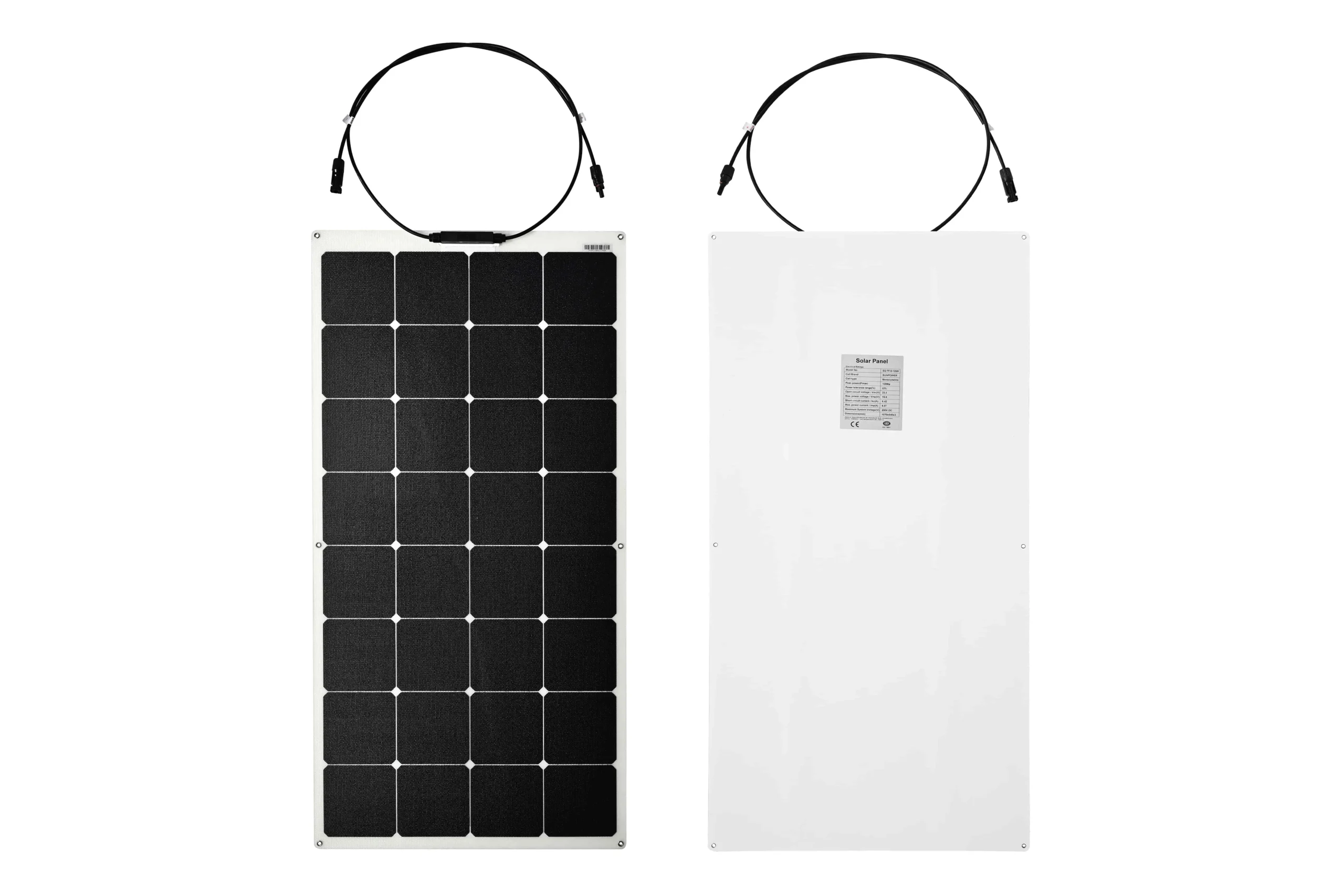
Engineer’s Verdict
If you must use ETFE flexible panels for your off-grid project, read these four conclusions first.
Material is Everything: Only buy ETFE materials. PET materials will fail outdoors within 2 to 3 years.
Solve Heat to Extend Life: Sticking panels directly to metal is a mistake. We recommend adding a polycarbonate twin-wall sheet underneath to allow airflow.
They Can Be Tough: Our lab data shows that qualified reinforced panels withstand 14,700 steps without power loss.
Certifications Matter: Check for the latest IEC 61215/61730 dual standards. Products without this data are not worth the risk.
What Are ETFE Flexible Solar Panels?
💡 Technical Definition
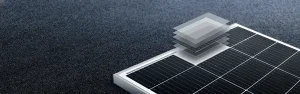
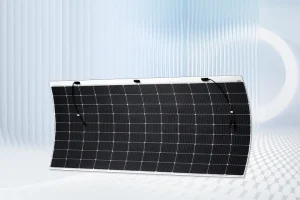
Flexible solar panels are photovoltaic modules encapsulated with polymers like ETFE instead of glass. They are about 80% lighter than traditional rigid modules. They can bend up to 30 degrees. This makes them the only choice for curved RV roofs or marine decks where weight is a limit.
Material Testing: Why ETFE Flexible Solar Panels Survive Salt Fog
Customers often ask why PET panels are cheap. PET is essentially plastic bottle material. It cannot withstand UV rays. We only recommend ETFE. Here is the real difference we see in the lab.
1. Salt Spray Test (For Marine Environments)
We tested according to the highest IEC 61701 standards. We placed panels in a 5% NaCl salt mist environment for 672 continuous hours.
Visual Result: No defects.
Power Degradation: Only -1.2% to -1.9%.
Comparison: The industry passing line allows ≤ 5% loss. ETFE performance far exceeds the standard. This means it generates power stably even after years at sea.
2. Mechanical Load Test (For Wind and Snow)
Flexible panels look soft. Their structural strength can be high. We performed ±5400 Pa front and back cycle testing. Each cycle lasted 1 hour. We repeated this 3 times. This is triple the minimum IEC requirement.
Result: Power degradation was -2.1%. No visual defects.
Insulation: Passed the 8000 V impulse test afterward.
Heat Engineering for ETFE Flexible Solar Panels
(This is engineering advice from us as a source factory)
The Core Problem: Flexible panels are thin. Heat cannot escape if you stick them directly to a roof. Panel temperatures can hit 70°C in summer. Power output drops by 0.4% for every 1°C rise. Long-term heat buildup causes hot spots and burns out cells.
Engineer Recommended Solution: Polycarbonate Installation
Do not use glue directly on metal sheets.
Get Materials: Buy 4mm to 6mm polycarbonate twin-wall sheets. These are often used for greenhouses.
Create a Sandwich: Fix the polycarbonate sheet to the roof first. Then adhere the flexible panel to the polycarbonate.
The Result: The hollow structure creates an air gap. Airflow removes heat. This structure also buffers stress from roof thermal expansion. Our test data shows this method lowers operating temperatures by 10-15°C. Generation efficiency improves by 5% to 8%.
Destructive Testing: Can You Walk on Them?
This is a controversial topic. You definitely cannot walk on standard flexible panels. One step will crack the cells.
This is only achievable with specific materials and cell designs. Only marine-grade products with thickened ETFE, high-rebound composite backsheets, and dense grid lines can distribute foot pressure effectively. We simulated extreme usage in the factory for these reinforced designs.
Walkable Limit Data
We conducted a continuous test for 49 days. A person walked on the panel 300 times per day. The total was 14,700 steps.
EL Test Result: No new micro-cracks in internal cells.
Power Degradation: ≤ 3%.
Conclusion: You can walk on them with soft-soled shoes if you install them on a flat, hard deck.
Safety and Certification: More Than Just Power
Safety is the baseline. This is critical for high-voltage DC systems. We built massive redundancy into our electrical safety designs.
1. Electrical Insulation Test
We used 8000 V for impulse testing and 2800 V for normal insulation testing.
Standard Line: ≥ 18.9 MΩ is qualified.
Our Test: Insulation resistance was > 1000 MΩ.
Wet Leakage: Passed on the first attempt. This means you face no leakage risks even in wet rainy conditions.
2. Authoritative Endorsement (TÜV Nord)
Do not just listen to manufacturers. Look at the certificates. We hold the latest TÜV Nord IEC 61215 / IEC 61730 dual standard certificate (No. 4478025406749-033R1).
Validity: Valid until January 20, 2030.
Coverage: The entire TOPCon series from 32 to 132 cells.
Fire Rating: UL 790 Class C.
System Voltage: Supports 1500 V high voltage systems.
Best Applications for ETFE Flexible Solar Panels
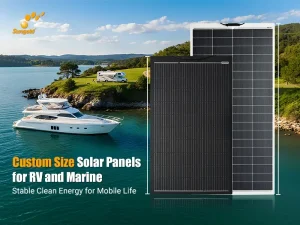
1. For Marine and Yachts
The ocean is the ultimate trial for solar panels. Salt Spray Resistance and non-slip capabilities are hard requirements here.
Resist Corrosion: You must use ETFE materials. As shown in our data, only ETFE withstands long-term high-concentration salt mist. Regular PET panels delaminate after a few months at sea.
Marine Grade Grip: Choose panels with textured surfaces for compact sailboat decks where people walk often. Install them on a flat rigid deck to provide excellent grip and support foot traffic.
2. For RVs and Teardrop Trailers
Rigid panels are hard to install on Airstreams or teardrop trailers. They also ruin the aerodynamic profile.
Aerodynamic Efficiency: Flexible panels are only 2-3mm thick. They sit flush with the roof. Wind resistance is near zero. This prevents driving wind noise.
Curved Fit: They bend to match the roof arc. This covers areas rigid panels cannot use and maximizes power generation area.
Looking for custom-sized panels for your manufacturing line? We offer OEM solutions.
(Need special dimensions, voltages, or layouts? We support full customization.) 👉
Engineer Q&A
Q1: Can I cut flexible panels myself?
Absolutely not. The panel is full of circuit busbars. One cut breaks the circuit loop. The entire panel becomes useless. It may even cause short circuits or fire. We support customization at the factory level if you need special sizes. This requires changing production line layouts.
Q2: How do I choose adhesive?
Look at the substrate. Use 3M VHB double-sided tape for smooth surfaces like fiberglass. It has excellent heat resistance. Use Sikaflex 252 for rough surfaces or permanent fixing. This structural adhesive is very strong. Do not expect to remove it without damage once cured.
Conclusion
Data does not lie. Flexible panels might have been “consumables” in the past. Material and process advances have made them reliable energy sources today. The prerequisite is that you choose the right ETFE and install it like an engineer.