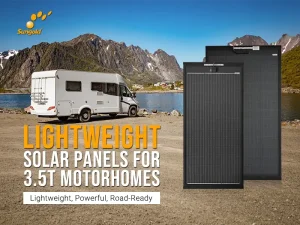

A flexible 400W solar panel for RV roof is a lightweight, low-profile power solution (typically <5kg) designed to conform to curved roofs without drilling. While they offer superior aesthetics and weight savings, their long-term success depends on using ETFE lamination and creating an artificial air gap to prevent the 25% power loss common in direct-bond installations.
If your RV roof is curved (like an Airstream or Teardrop) or you are nearing your payload limit, Flexible 400W panels are your best bet. However, to avoid replacing them in 2 years, you must use the “Polycarbonate Backing Hack” to manage heat. For flat, heavy-duty roofs, Rigid panels still offer a better ROI.
People Also Ask (PAA) - Quick Answers /
How long does a flexible 400W solar panel last on an RV roof?
High-quality ETFE flexible panels last 8-12 years. Cheap PET alternatives often fail within 2-3 years due to UV yellowing and micro-cracks. To maximize life, ensure airflow underneath to prevent thermal stress on the cells.
Is one 400W panel better than four 100W panels?
Yes. A single 400W panel reduces the number of roof penetrations and MC4 failure points. More importantly, its higher Open Circuit Voltage (Voc) helps your MPPT controller start charging earlier in the morning compared to parallel 100W strings.
Will a flexible panel damage my RV’s rubber roof?
Direct bonding can trap high heat (70°C+), which may degrade TPO or EPDM membranes over time. Using a sacrificial layer or a backing board acts as a thermal shield, protecting both the panel and your roof.
Key Takeaways
Material: Demand ETFE (Self-cleaning & UV resistant), never PET.
The Air Gap: Use 6mm twin-wall polycarbonate backing to fix overheating.
Wiring: Single 400W is superior for high-voltage MPPT efficiency.
Installation: VHB Tape + Lap Sealant = 80 MPH wind security. /
Add Your Heading Text Here
Most guides warn that Flexible 400W solar panels lose 25% efficiency when they get hot. None tell you how to fix it.
The “Artificial Air Gap” Solution
To prevent your cells from “cooking” against the white roof:
Purchase 6mm Twin-wall Polycarbonate: These are lightweight, UV-stable sheets with hollow channels
Mount the Panel to the Board: Use industrial adhesive to bond the panel to the polycarbonate sheet.
The Result: The hollow channels act as mini wind tunnels. As you drive or when a breeze hits, air flows under the cells, dropping temperatures by up to 15°C (27°F) and boosting your Amp-hour harvest significantly
Material Science: Why ETFE is Non-Negotiable
Don’t be fooled by “Flexible 400W Kits” priced under $300. These almost always use PET (Polyethylene Terephthalate) lamination.
PET Failure: It starts yellowing and becoming hazy within 24 months, blocking sunlight and reducing output.
ETFE Advantage: This high-strength polymer is used in professional stadium roofs. It is self-cleaning, has better light transmission, and handles the extreme thermal expansion of a 400W array without delaminating.
Configuration Strategy: 1x400W vs. 4x100W
If you have the roof space, a single flexible 400W solar panel for RV roof setups is technically superior.
Start-up Voltage: A single 400W panel typically has a $V_{oc}$ around 45-50V. An MPPT controller requires $V_{batt} + 5V$ to wake up. This means the 400W panel starts charging at dawn, while a parallel 100W setup (18V-20V) might wait until 9:00 AM.
Simplified Maintenance: Two wires vs. eight. Fewer MC4 connectors mean fewer places for water to get in and fewer resistance-based “hot spots” that can lead to fire hazards.
Is a Flexible 400W solar Panel Right for You?
If you prioritize aerodynamics, weight management, and stealth aesthetics, the answer is yes. Just remember: ETFE material is your insurance policy, and a polycarbonate backing is your performance secret.
Internal Links for Further Reading:
Battery Pairing: Professional 400W Solar Kit with Battery: Sprinter Guide
Control Center: Best MPPT Charge Controller for 400W Solar Panel
Tech Comparison: Flexible vs Rigid 400W Solar Panel: The Expert Guide 2026