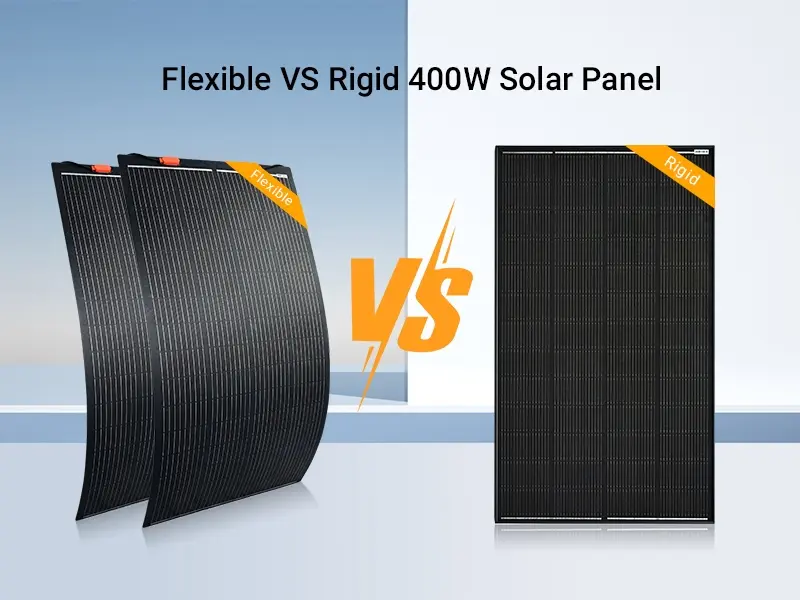
When weighing your options for a Flexible vs Rigid 400W Solar Panel, the choice boils down to your mounting surface and longevity goals. For most users, Rigid 400W solar panels are the superior choice due to their 25-year lifespan, lower cost, and natural air cooling. However, if your roof is curved or has strict weight limits, a Flexible 400W panel is the only viable option. The Pro Move: If you go flexible, you must create an artificial air gap to prevent the common 20% heat-induced power drop
People Also Ask
1. Are flexible 400W solar panels as good as rigid ones? Not in terms of longevity. While they provide the same rated 400W output initially, flexible panels degrade faster due to thermal stress and plastic delamination. Expect 5-8 years of peak performance from flexible panels compared to 25+ years for rigid glass panels.
2. Why do flexible solar panels fail so often? The primary killer is heat. Unlike rigid panels that have an air gap underneath, flexible panels are often glued directly to surfaces. This traps heat, causing cells to micro-crack and the efficiency to plummet by up to 25% on summer days.
3. Is one 400W panel better than four 100W panels? Yes. A single 400W panel reduces wiring complexity, has fewer failure points (MC4 connectors), and typically offers a higher “Open Circuit Voltage” (Voc), which helps your MPPT controller start charging earlier in the morning light.
Key Takeaways
Rigid Panels: Best ROI, higher heat tolerance, heavy (20kg+).
Flexible Panels: Lightweight (5kg), aerodynamic, require custom backing for heat management.
The Heat Hack: Using twin-wall polycarbonate backing can save your flexible panels from burnout.
Configuration: 1x400W beats 4x100W in efficiency and ease of installation.
The "Silent Killer" of Flexible Panels: Heat Decay
Almost every reviewer warns that Flexible 400W solar panels overheat, but few tell you how to fix it. When a panel is bonded directly to an RV roof, the temperature can soar above 70°C (158°F), causing the solar cells to lose voltage.
The Industry Secret: The “Low-Profile Air Gap” Hack
To maximize the life of your flexible panel, do not glue it directly to your vehicle. Instead:
Use Twin-Wall Polycarbonate Sheets: Cut a sheet of 6mm hollow polycarbonate to the size of your panel.
Bond the Panel to the Sheet: Use VHB tape to attach the panel to the plastic sheet.
Mount the Sheet to the Roof: The hollow channels in the polycarbonate act as “mini wind tunnels,” allowing air to flow under the cells. This retains the flexibility and lightweight nature while providing the crucial cooling gap usually only found in rigid setups.
Strategy: 1x400W Single Panel vs. 4x100W Array
When designing a 400W system, many beginners default to a “4-pack” of 100W panels. Here is why the Single 400W Rigid or Flexible panel is usually the smarter move:
1. Wiring & Failure Points
A 4-panel array requires 3 pairs of Y-branch connectors and 8 MC4 connections. Every connection is a potential point for water ingress or resistance-based heat. A single 400W panel requires only two connections.
2. The Voltage Advantage
Modern MPPT controllers require the solar voltage to be at least 5V higher than the battery voltage to begin charging.
4x100W (Parallel): Voltage stays low (~18-20V), meaning the charger stops working the moment a cloud appears.
1x400W: Usually has a Voc of 40V-50V. This high-pressure “voltage push” allows your system to charge even in low-light, overcast conditions.
Flexible vs Rigid 400W Solar Panel:
Feature | Rigid 400W | Flexible 400W (With Hack) |
|---|---|---|
Material | Tempered Glass / Aluminum | ETFE / CPC |
Weight | High (Hard for 1 person) | Ultra-light (One-hand carry) |
Aesthetics | Bulky, high-profile | Stealthy, aerodynamic |
Shade Tolerance | Moderate | Poor (Micro-cracks block paths) |
Installation Cost | High (Brackets/Drilling) | Low (Adhesives/Tape) |
Final Recommendation
Choose Rigid 400W if:
You have a flat mounting surface (Home, Van, or Shed).
You want a “install it and forget it” system for the next two decades.
You are on a budget and want the best price-per-watt.
Choose Flexible 400W if:
You are mounting on a curved Teardrop trailer or a Boat Bimini.
Every kilogram of weight counts (Payload limited vehicles).
You are willing to perform the polycarbonate backing hack to ensure your investment doesn’t cook itself in two summers.
Internal Links for Further Reading:
Pillar Guide: 400W Solar Panel Guide: TOPCon and BC Tech for RV and Off Grid
Compatibility Check: Can a 400W Solar Panel Charge a 12V Battery?