Flexible panels weigh 70–80% less than rigid glass panels and require zero roof penetration — but rigid panels still win on efficiency and lifespan. For OEMs and retrofitters, the right choice depends on roof geometry, climate zone, and total cost of ownership. This guide covers all six key dimensions with real B2B data and the angles most comparison articles won't tell you.
Why Does This Choice Matter More Than Most Buyers Realize?
The flexible vs. rigid solar panel decision for motorhomes isn't just a spec sheet exercise. It touches vehicle compliance, roof integrity, insurance liability, and long-term fleet economics. I've seen OEMs make the wrong call here and pay for it — not at the point of sale, but 18 months later when warranty claims pile up.
If you're sourcing for a production line, a retrofit catalog, or a distribution portfolio, the stakes are different from a DIY camper van build. You're not just buying panels — you're buying a risk profile.
Who this guide is for: OEM motorhome manufacturers, aftermarket retrofitters, solar distributors, and fleet procurement managers. If you're buying 50+ units, the economics here are very different from a single-unit install.
How Do Flexible and Rigid Solar Panels Actually Compare Across 6 Key Dimensions?
Here's the master comparison table. Each dimension is broken down with the nuance the table alone can't capture.
| Dimension | Flexible (ETFE) | Rigid (Tempered Glass) | B2B Procurement Insight |
|---|---|---|---|
| Weight (200W typical) | ~1.8–3.5 kg | ~10–14 kg | Save 8–10 kg/panel; critical for 3.5t GVW compliance ★ Flex wins |
| Power Conversion Efficiency | 18–21% (mono ETFE) | 21–23% (mono glass) | Gap narrowing; top-tier flexible now ≥20% ★ Rigid wins (marginally) |
| Temperature Coefficient (Pmax) | -0.29%/°C (typical) | -0.35%/°C (typical) | Flexible outperforms in >35°C climates (AU, ME, EU summer) ★ Flex wins in heat |
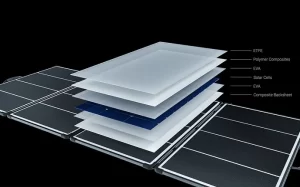
| Surface Material | ETFE (99%+ transmittance) | Low-iron tempered glass | ETFE: self-cleaning, UV-resistant, no shattering risk |
| Lifespan (Warranty) | 10–15 yr (ETFE grade: up to 20 yr) | 25 yr standard | ETFE grade determines longevity; verify with supplier ★ Rigid wins |
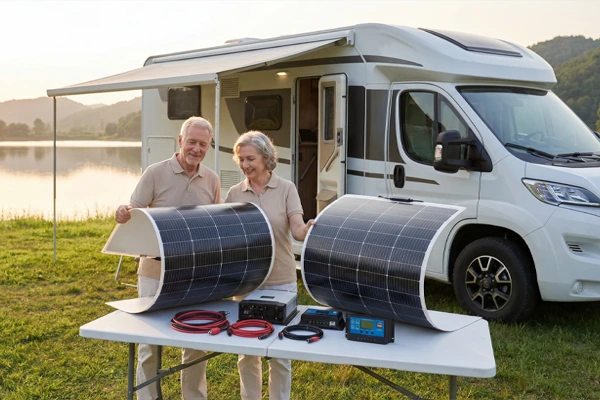
| Installation Method | Adhesive / no roof penetration | Mounting rails + roof bolts | No-penetration = roof warranty preserved for OEMs ★ Flex wins for OEM |
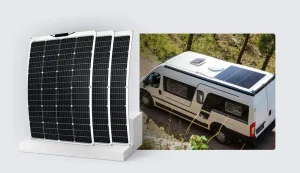
| Curved Roof Compatibility | Yes (up to 30° arc) | No (flat surface only) | Class B vans: flexible is the only viable option |
| Wind/Snow Load Rating | Lower (check spec sheet) | IEC 61215: 5400 Pa standard | Rigid preferred for high-load stationary applications ★ Rigid wins |
| Typical MOQ (B2B) | 50–200 pcs (custom) | 100–500 pcs (standard) | Flexible offers lower MOQ entry point for distributors |
| Unit Cost (FOB reference) | USD 0.45–0.65/W | USD 0.28–0.45/W | Flexible premium justified by installation cost savings ★ Rigid wins on unit cost |
| TCO (5-year estimate) | Moderate (lower install cost) | Lower unit cost, higher install | Calculate total: panel + mounting + labor + roof repair risk |
| Country of Origin Option | China / Indonesia | China / Indonesia | Indonesia CoO: AD/CVD duty-free for US/EU buyers |
| Data based on Sungold Solar engineering specifications and IEC 61215/IEC 61730 standard parameters. Individual product specs may vary. Request product datasheets for verified figures. | |||
Dimension 1 — Weight & Structural Load: The Number That Changes Everything
A standard 200W flexible solar panel weighs roughly 1.8–3.5 kg. The equivalent rigid glass panel? 10–14 kg. That's a 4–7x difference. For a 3.5-tonne GVW motorhome running four panels, you're looking at saving 32–48 kg by going flexible.
On a 3.5t GVW vehicle, every kilogram of payload matters for regulatory compliance in the EU and UK markets. For a fleet operator running 50 motorhomes, this is a systemic issue, not an edge case. The IEC 61215 standard governs mechanical load testing for rigid panels (5400 Pa snow/wind load), but flexible panels are tested differently — always request the specific mechanical spec sheet from your supplier.
Dimension 2 — Conversion Efficiency: Rigid Still Leads, But the Gap Is Closing Fast
Rigid monocrystalline glass panels currently hit 21–23% efficiency. Premium ETFE flexible panels are at 18–21% — a gap of roughly 2–3 percentage points. In real terms on a 200W panel, that's maybe 4–6W of difference at STC. The more important story is the trajectory: three years ago, the gap was 5–7 percentage points. If you're locking in a 5-year supply agreement today, factor in that the efficiency argument for rigid panels is weakening every product cycle.
Dimension 3 — Thermal Performance: Where Flexible Panels Quietly Win
Here's the data point most comparison articles skip: temperature coefficient. Rigid glass panels typically carry a Pmax temperature coefficient of -0.35%/°C. ETFE flexible panels average -0.29%/°C. At 75°C roof surface temperature (50°C above STC), a rigid panel loses 17.5% of rated power; a flexible panel loses 14.5%. On a 400W system, that's a real-world difference of 12W — continuously, during peak hours.
Dimension 4 — Durability & Lifespan: ETFE vs. PET vs. Glass
Rigid glass panels: 25-year linear power warranty is industry standard. This is where rigid panels have a genuine, undisputed advantage.
Flexible panels are more nuanced. PET-based flexible panels (the cheap ones) degrade fast — expect 5–8 years of real performance. ETFE-based flexible panels from reputable manufacturers can reach 10–15 years with warranty, and premium-grade ETFE products are pushing toward 20+ years. The procurement lesson: never buy flexible panels without asking specifically whether the encapsulant is ETFE or PET.
Dimension 5 — Installation & OEM Integration: The Hidden Cost Calculation
Rigid panels require mounting rails, roof bolts, and cable management — plus roof penetrations. Flexible panels bond with adhesive or VHB tape. No drilling, no penetrations, no sealant work. In a high-volume motorhome factory, the difference between a 45-minute rigid panel installation and a 20-minute flexible panel installation, multiplied across 500 units per year, is significant.
Dimension 6 — Total Cost of Ownership: Why Unit Price Is the Wrong Metric
Rigid panels cost USD 0.28–0.45/W FOB. Flexible ETFE panels run USD 0.45–0.65/W. On unit cost alone, rigid wins. But total cost of ownership over 5 years includes: panel cost + mounting hardware + installation labor + roof repair risk + potential warranty claim exposure. When you add those factors, the gap narrows considerably.
What Most Comparison Guides Get Wrong: 4 Counter-Intuitive Truths
The standard "flexible vs rigid" articles all cover the same ground: weight, efficiency, cost. But there are four angles that almost nobody talks about, and they matter a lot for B2B buyers.
Flexible Panels Can Outperform Rigid in Real-World Summer Output
Due to better temperature coefficient (-0.29% vs -0.35%/°C), at a roof surface temperature of 75°C, flexible panels lose ~3% less power than rigid. In Mediterranean or Australian summer conditions, this thermal advantage can close — or even reverse — the efficiency gap. The spec sheet efficiency is measured at 25°C. Your motorhome roof is not 25°C.
Roof Penetration = Legal Risk for OEMs (Nobody Talks About This)
In EU and North American markets, drilling through a motorhome roof to mount rigid panels can void the vehicle manufacturer's waterproofing warranty. If a customer files a water ingress claim 2 years post-installation, and the installer drilled 8 holes in the roof, you have a liability problem. Flexible adhesive mounting eliminates this risk entirely.
Weight Savings = Quantifiable Revenue for Fleet Operators
Four 200W rigid panels weigh ~48 kg. Four flexible panels weigh ~12 kg. That's 36 kg of recovered payload. On a rental motorhome fleet, 36 kg = roughly one additional passenger's luggage allowance per trip. Annualized across a 50-vehicle fleet at 120 rental days/year, the revenue implication is material.
ETFE Is Not Just "Waterproof" — It's an Engineering Material
ETFE (ethylene tetrafluoroethylene) has 99%+ light transmittance, is self-cleaning due to its non-stick surface, resists UV degradation for 20+ years, and is the same material used in stadium roofs and architectural glazing. The reason premium flexible panels last significantly longer than cheap PET panels is almost entirely the encapsulant material. Ask your supplier: ETFE or PET?
Which Panel Type Should You Specify for Each Motorhome Category?
The "right answer" isn't universal — it depends on the vehicle class. Here's a practical decision framework for OEMs and distributors.
Large Flat-Roof Motorhomes
★ Rigid or High-Efficiency FlexibleFlat roofs accommodate rigid panels without issue. If payload margin is tight or the customer wants a low-profile aesthetic, ETFE flexible is a strong alternative. Consider rigid for maximum watt-per-sqm density.
Curved-Roof Vans & Campers
★ ETFE Flexible — Only Viable OptionCurved roofs physically cannot accommodate rigid panels. ETFE flexible panels with up to 30° arc flexibility are the engineering solution. Non-negotiable recommendation for Transit, Sprinter, and Ducato-based builds.
Mixed-Roof Motorhomes
★ Hybrid: Rigid Main + Flexible FillSemi-integrated motorhomes often have a flat cab-over section and a curved main body. Optimal solution: rigid panels on the flat section for maximum output, flexible panels on curved areas to maximize total roof coverage.
Distributors & Installers
★ Flexible-First for RetrofitFor aftermarket installation, flexible panels dramatically reduce installation complexity and roof penetration risk. Stock ETFE flexible panels as your primary SKU; offer rigid as an upsell for flat-roof, high-power applications.
Case scenario: A European camper van OEM building 300 units/year on a Ford Transit base switched from rigid to ETFE flexible panels. Result: installation time per unit dropped from 52 minutes to 23 minutes, zero roof warranty claims in the following 18 months (vs. 4 claims in the prior year), and a 3.2 kg/unit weight reduction that helped them stay within 3.5t GVW on their entry model. The panel cost premium was recovered in labor savings within 8 months.
What Should B2B Buyers Ask Before Signing a Supply Agreement?
Eight questions that separate a reliable supplier from a costly mistake — specific to motorhome solar procurement.
- What is the encapsulant material — ETFE or PET? This single question determines whether you're buying a 15-year asset or a 5-year consumable. Insist on ETFE for any permanent motorhome installation.
- What certifications does the panel carry? Minimum requirement: IEC 61215, IEC 61730, CE (EU market), RoHS. For North American distribution, add UL or CSA. Verify certificates directly — don't accept copies without checking the certification body's database.
- What is the temperature coefficient (Pmax)? Ask for the actual datasheet value. Anything worse than -0.35%/°C for rigid or -0.32%/°C for flexible is below market standard.
- Can you provide custom dimensions and low MOQ? Standard panel sizes rarely fit motorhome roof layouts optimally. A manufacturer offering custom sizing from 50 units MOQ gives you a significant competitive advantage.
- What is the country of origin — do you have Indonesia manufacturing? For US and EU buyers, panels manufactured in Indonesia qualify for non-China CoO certificates, avoiding AD/CVD anti-dumping duties. This is a material cost consideration at volume.
- What is the warranty structure — product warranty vs. power warranty? A 10-year product warranty + 25-year linear power warranty (rigid) is very different from a 6-year product warranty + 10-year power warranty (entry flexible). Match warranty terms to your customer's vehicle lifecycle expectations.
- What mechanical load testing has been performed on flexible panels? Ask specifically for vibration test data (road vibration simulation) and peel strength data for the adhesive system. Critical for motorhome applications where panels experience continuous mechanical stress.
- What after-sales and engineering support is available? For OEM integration, you need a supplier who can provide wiring diagrams, mounting specifications, and responsive technical support.
Certifications & Compliance Reference
| Certification | Applies To | Required For | Notes |
|---|---|---|---|
| IEC 61215 | Rigid & Flexible | EU, North America, Global | Performance & durability standard; thermal cycling, humidity, UV |
| IEC 61730 | Rigid & Flexible | EU, North America, Global | Safety qualification; fire, electrical safety |
| CE Marking | Rigid & Flexible | EU / EEA market | Mandatory for EU distribution; covers EMC and LVD |
| RoHS | Rigid & Flexible | EU market | Restricts hazardous substances; required for EU import |
| UL / CSA | Rigid & Flexible | North America | Required for US/Canada distribution; UL 1703 or UL 61730 |
| TÜV Certification | Rigid & Flexible | EU (premium) | Third-party verification; strong market signal for B2B buyers |
| IEC 61701 (Salt Spray) | Flexible (Marine) | Marine / coastal RV | Corrosion resistance; critical for coastal motorhome applications |
| Source: IEC International Electrotechnical Commission standards. Always verify current certification status with the issuing body. | |||
Tariff alert for US/EU buyers: Solar panels manufactured in China are subject to AD/CVD anti-dumping duties in both the US and EU markets. Panels manufactured in Indonesia (non-China CoO) are exempt. At volume, this can represent a 15–30% landed cost difference. Always ask your supplier for the manufacturing origin certificate, not just the brand origin.
How Should You Make the Final Call Between Flexible and Rigid?
There is no universally correct answer. If your vehicles have curved roofs, flexible ETFE panels are not optional — they're the only engineering solution. If you're operating in hot climates and payload is tight, flexible panels' thermal and weight advantages are genuine and quantifiable. If you need the longest possible warranty and maximum watt-per-sqm on a flat roof with no weight constraints, rigid glass panels are the right call.
For most B2B buyers in the motorhome space, the answer is application-specific segmentation: stock both, specify correctly by vehicle class, and train your sales team to ask the right questions — roof geometry, climate zone, GVW margin — before recommending a product.
FAQ: Flexible vs. Rigid Solar Panels for Motorhomes
Q: Are flexible solar panels less efficient than rigid panels for motorhomes?
Yes, but the gap is narrowing fast. Premium ETFE flexible panels now achieve 20–21% efficiency, compared to 21–23% for top-tier rigid monocrystalline panels — a difference of just 1–3 percentage points. More importantly, flexible panels carry a better temperature coefficient (-0.29%/°C vs. -0.35%/°C), meaning they lose less power in hot weather. For motorhomes operating in warm climates, flexible panels can deliver comparable or higher real-world output during peak summer months.
Q: How much weight do flexible solar panels save compared to rigid panels on a motorhome?
A standard 200W flexible solar panel weighs approximately 1.8–3.5 kg, while an equivalent rigid glass panel weighs 10–14 kg. Installing four panels saves roughly 32–48 kg — enough to meaningfully impact payload capacity on a 3.5-tonne GVW motorhome. For fleet operators and rental companies, this translates directly to increased revenue potential: more passenger capacity or additional equipment without exceeding legal weight limits.
Q: What is the lifespan difference between ETFE and glass solar panels on a caravan?
Tempered glass rigid panels carry a standard 25-year linear power warranty. ETFE flexible panels typically come with 10–15 year warranties, though premium-grade ETFE products can achieve 20+ years due to ETFE's exceptional UV resistance. PET-based flexible panels have shorter lifespans (5–10 years) and are not recommended for permanent caravan installations. Factor in replacement cycles when calculating total cost of ownership.
Related Resources for B2B Motorhome Solar Buyers
Grace Hu — Marketing Director & PV Engineer, Sungold Solar
14 years of experience in photovoltaic engineering and global B2B solar sales. Specialized in custom off-grid solar systems for RV, Marine, and portable applications. Sungold Solar: 18-year B2B manufacturer with facilities in Shenzhen, China and Batam, Indonesia.
References:
[1] IEC 61215 — Terrestrial photovoltaic (PV) modules: Design qualification and type approval
[2] IEC 61730 — Photovoltaic (PV) module safety qualification
[3] IEC 61701 — Salt mist corrosion testing of photovoltaic (PV) modules
[4] Sungold Solar RV Solar Kits
[5] Sungold Solar Custom Size Solar Panels for RV and Marine