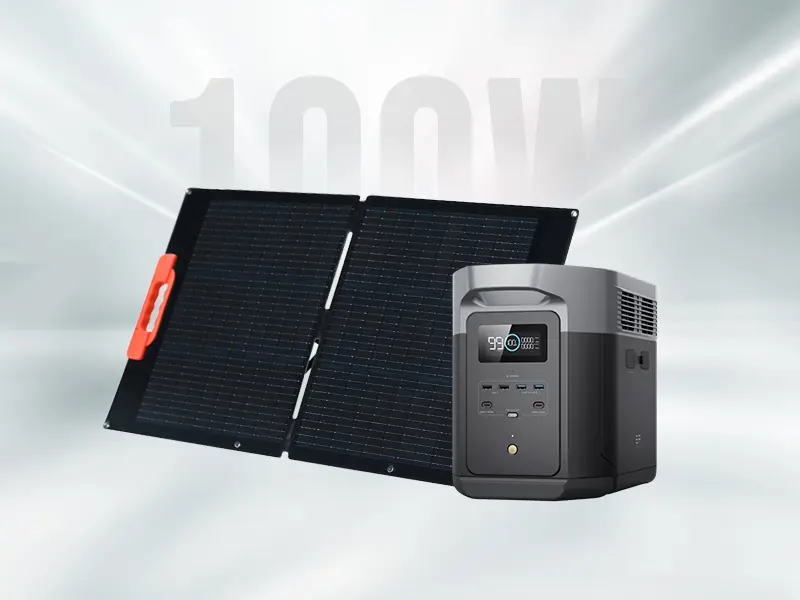
For a 1kWh (1,000Wh) portable power station, 200W of solar panel (STC label rating) is the practical minimum for a realistic full recharge in one sunny day. Real-world harvest runs 70–80% of rated watts, so 200W delivers ~140–160W to your MPPT—enough to fill 1kWh in roughly 7–9 hours of usable sun.
Want faster? Size up to 300–400W—but only if your station's max solar input and MPPT voltage window can actually accept it. That's the part most guides skip.
Every week someone posts on Reddit: "I bought a 200W panel for my 1kWh station and it's only showing 120W input—am I getting scammed?" The answer is almost always no. The panel is doing exactly what physics allows. The problem is that nobody explained what "200W" actually means in the real world, or how the MPPT controller between your panel and your battery decides what it will and won't accept.
This guide fixes that. We'll work through the math, the real-world derating factors, the MPPT voltage trap that silently kills efficiency, and—once you understand the rules—which Sungold portable panel makes sense for your specific setup.
How Do You Actually Calculate the Solar Watts You Need for a 1kWh Station?
The naive math says: 1,000Wh ÷ 200W = 5 hours. Done. Except that assumes your 200W panel delivers exactly 200W the entire time, your MPPT wastes nothing, and your battery accepts every joule without losses. None of those things are true simultaneously.
Here's the formula that actually holds up:
Where System Efficiency = Panel derating (0.75–0.80) × MPPT efficiency (0.93–0.97) × Battery round-trip (0.88–0.95)
Combined real-world factor ≈ 0.62–0.74 (use 0.65 as a conservative estimate)
Plugging in a 1,000Wh station, 5 peak sun hours (typical for much of the US South and Southwest), and a 0.65 system factor:
1,000 ÷ 5 ÷ 0.65 = 308W of label-rated panel
That's the honest number for a "full recharge in one day" target. 200W gets you there on a good day in a sunny location. In Seattle in October? You'd want 300W+ or accept a two-day cycle. The table below shows how this plays out across different sun hour scenarios.
| Daily peak sun hours | Panel watts needed (0.65 factor) | What this looks like | Verdict |
|---|---|---|---|
| 3 hours (cloudy / PNW winter) | ~513W | Overcast Pacific Northwest, UK, Germany winter | 200W won't do it in one day |
| 4 hours (moderate) | ~385W | Midwest spring/fall, coastal California | 200W = partial fill; 400W = comfortable |
| 5 hours (good) | ~308W | US Southwest, Texas, Florida summer | 200W = close; 300W = reliable full charge |
| 6 hours (excellent) | ~256W | Arizona, Southern California peak summer | 200W works well; 250W gives comfortable margin |
Peak sun hours ≠ daylight hours. A 6-hour sunny day might only have 4.5 peak sun hours at 1,000 W/m² equivalent. Check NREL's PVWatts calculator for your zip code.
The 20–30% Rule of Thumb (and Why It Works)
You'll see this shortcut everywhere: panel watts ≈ 20–30% of battery watt-hours. For 1,000Wh that's 200–300W. It works because it implicitly assumes 5–6 peak sun hours and a ~0.65–0.75 system efficiency—conditions that describe a reasonable sunny day in most of the US and Europe.
Use 20% (200W) as your floor for good-sun regions. Use 30% (300W) as your target if you're in a cloudier climate, you're camping in trees, or you want the comfort of finishing before dinner rather than after sunset.
Why Is My 200W Panel Only Showing 120–150W on My Power Station Screen?
This is the question that generates the most frustrated Reddit posts. The panel isn't broken. The power station isn't lying. Here's what's actually happening:
Culprit 1: Panel Temperature Derating (The Biggest Surprise)
STC ratings are measured at 25°C cell temperature. On a hot summer day, a black panel sitting in full sun can reach 60–70°C. Most monocrystalline panels lose roughly 0.3–0.4% of output per degree Celsius above 25°C.
At 65°C cell temperature: (65 − 25) × 0.35% = 14% power loss. Your "200W" panel is now a 172W panel before any other losses. I discovered this the hard way testing a panel on a black truck bed in August—the station was reading 118W from a 200W panel at noon. Moved the panel to a white surface with airflow underneath, and it jumped to 148W within 20 minutes. Same sun, same angle, 25% more power just from cooling the cells.
Culprit 2: Tilt Angle and Orientation
A panel lying flat on the ground loses 10–20% compared to one tilted at your latitude angle facing south (or north in the Southern Hemisphere). Most portable panel stands only offer one or two fixed angles—usually 30–45°. That's fine for most of the day, but at 8 a.m. and 4 p.m., you're leaving 20–30% on the table compared to tracking the sun manually.
My experience: adjusting a folding panel's angle twice a day (morning, midday) adds a meaningful amount of harvest over a full day—roughly 15–20% more than "set it and forget it." Worth it if you're trying to squeeze a full charge out of a 200W panel.
Culprit 3: Partial Shading (The Disproportionate Killer)
This one surprises people. A shadow covering just 10% of a panel's surface area can reduce output by 30–50% in traditional cell configurations, because shaded cells act as resistors that drag down the entire string. Modern half-cut cell designs (like those in Sungold's SPC and Hi-Power series) mitigate this significantly—a shaded cell only affects half the string instead of the whole panel.
If you're camping under trees or near a building, this matters more than any other factor. A 200W half-cut panel in partial shade can outperform a 200W standard panel in full sun.
Culprit 4: MPPT Voltage Mismatch (The Silent Efficiency Killer)
This is the one nobody talks about in buying guides. Every portable power station has an MPPT (Maximum Power Point Tracking) controller with a specific input voltage window. If your panel's operating voltage (Vmp) falls outside that window—even slightly—the MPPT can't lock onto the maximum power point and efficiency drops significantly.
| Power station brand / model class | Typical MPPT voltage range | Max solar input | Connector type |
|---|---|---|---|
| EcoFlow DELTA series (~1kWh class) | 11–60V DC | 400–500W (model dependent) | MC4 |
| Jackery Explorer 1000 series | 12–30V DC | 200–400W (model dependent) | Proprietary DC7909 / Anderson |
| Bluetti AC70 / AC180 class | 12–60V DC | 200–500W (model dependent) | MC4 |
| Anker SOLIX C1000 | 11–50V DC | 600W | MC4 |
| Generic / budget 1kWh stations | Often 18–50V DC | Often 100–200W | DC5525 or MC4 |
A 200W panel with a Voc (open-circuit voltage) of 24V is fine for most stations. But a 200W panel wired in series with another 200W panel has a combined Voc of ~48V—which exceeds the MPPT range of some stations (like older Jackery models capped at 30V). The MPPT controller will either reject the input entirely or clamp it hard, and you'll see 0W or very low watts on the screen despite having 400W of panels connected.
Before you buy any panel, look up your station's MPPT voltage range in the manual and compare it to the panel's Voc spec.
What Happens When You Connect a 400W Panel to a 1kWh Station That Only Accepts 200W?
This is a common question, and the answer is more nuanced than "don't do it." The MPPT controller in your power station is designed to accept up to its rated maximum—say 200W. If you connect a 400W panel, the controller will draw what it needs and ignore the rest. The panel operates at a higher voltage point than its maximum power point, which means it's not running at peak efficiency, but it's not damaged.
The real-world outcome: you'll see your station charging at ~180–200W (near its cap) instead of the ~150W you'd get from a 200W panel on the same day. So there is a benefit—you're getting closer to the station's maximum input even on suboptimal days. But you're paying for 400W and using maybe 200W of it.
When Oversizing Actually Makes Sense
There's a legitimate strategy here called "clipping tolerance." If you're in a location with inconsistent sun—partly cloudy days, morning fog, late afternoon shade—a larger panel ensures you hit the station's input cap during the good windows, compensating for the lost time. A 300W panel in a 4-peak-sun-hour environment with 30% cloud interruption might deliver the same daily harvest as a 200W panel in a clean 5-hour day.
The math: 300W × 4h × 0.75 (derating) × 0.7 (cloud factor) = 630Wh. Compare: 200W × 5h × 0.75 = 750Wh. So in this case, the 200W panel in better conditions wins. But if your clouds are worse—say 50% coverage—the 300W panel starts to pull ahead.
When Oversizing Is Just Wasted Money
If your station's max solar input is 200W and you're in Arizona with 6 peak sun hours, a 400W panel gives you exactly the same charge rate as a 200W panel. You've paid double for a panel that spends half its day being throttled. Save the money, or put it toward a second battery.
How Does Connector Type and Cable Length Affect Charging Efficiency?
I've seen people lose 15–20W of harvest to a 10-meter extension cable with undersized wire. At 18V and 11A (a typical 200W panel output), a 5Ω cable resistance drops 55V—which is physically impossible at 18V, meaning the MPPT simply can't maintain the operating point. Even a 0.5Ω cable at those specs costs you ~6W, or about 4% of your harvest. Over a 7-hour day, that's 42Wh—enough to run a phone for a day.
Connector Compatibility Matrix
| Panel connector | Station connector | Compatibility | Solution if mismatched |
|---|---|---|---|
| MC4 (industry standard) | MC4 | ✓ Direct connect | — |
| Anderson connector | Anderson | ✓ Direct connect | — |
| MC4 | Anderson | ⚠ Adapter needed | MC4-to-Anderson adapter; verify current rating ≥ panel Isc |
| MC4 | Jackery DC7909 proprietary | ✗ Incompatible without OEM cable | Use Jackery's official MC4 adapter cable; third-party adapters vary in quality |
| XT60 | XT60 | ✓ Direct connect | — |
| DC5525 | MC4 | ✗ Different voltage/current spec | Not recommended; DC5525 typically rated for lower current |
Cable Length and Wire Gauge Rules
For portable solar setups, keep cable runs under 3 meters where possible. If you need longer runs (RV roof to interior), use at minimum 10AWG wire for 200W panels. For 400W+ setups, go 8AWG. The goal is to keep total cable resistance under 0.2Ω for the round trip.
Why Does a 100W Panel Feel So Slow for a 1kWh Station—and When Is It Actually Fine?
Here's the scenario where 100W works perfectly: you have a 1kWh station that you use for 200–300Wh per day (charging phones, running a fan, powering a small light setup). You're not draining it to zero. A 100W panel, delivering ~75W of real harvest, puts back 300–375Wh on a 4–5 hour sun day. That covers your daily draw with a small surplus.
Here's where 100W fails: you run your 1kWh station down to 20% overnight (used 800Wh), and now you need to recover 800Wh. At 75W real harvest and 5 sun hours, you're putting back 375Wh. After two days of good sun, you're back to full. That's fine for a basecamp setup where you're not moving. It's miserable for a weekend camping trip where you need the station ready each morning.
Choose 100W if: Daily draw < 300Wh · You rarely start from below 50% · Weight/packability is the #1 priority · You have 2+ days to recover from a deep discharge
Choose 200W if: Daily draw is 300–600Wh · You want same-day recovery from most discharge levels · You're in a moderate-sun region · This is your primary power source, not a backup
Choose 300W+ if: Daily draw exceeds 600Wh · You're in a cloudy region · You want the station full before noon · You're running appliances (mini-fridge, CPAP, power tools)
What's the Hidden Reason OEM Solar Bundles Often Underperform—and What to Look for Instead?
This is the part that most buying guides are too polite to say. When a brand bundles a 200W panel with a 1kWh station and calls it a "solar generator kit," the 200W figure is often chosen because it matches the station's 200W solar input cap—not because 200W is the optimal size for that battery in real-world conditions. It's a clean marketing story: "200W panel, 200W input, perfect match." But as we've established, a 200W panel delivers ~150W on a typical day, and 150W into a 1,000Wh battery takes 7–9 hours.
The brands that are honest about this will tell you their station accepts up to 400W of solar and recommend a 200W panel as the "standard" option and a 400W panel as the "fast charge" option. The ones that aren't will just say "pairs perfectly with our 200W panel" and leave you to figure out why it takes all day.
What Actually Differentiates a Good Portable Solar Panel
Beyond wattage, here's what separates panels that perform in the field from ones that look good on spec sheets:
- Cell technology: Half-cut monocrystalline cells reduce shading losses by ~50% compared to full-cell designs. PERC cells add 5–8% efficiency over standard mono. These matter more than the headline wattage number in real-world conditions.
- Surface material: ETFE (ethylene tetrafluoroethylene) transmits more light than PET and is more scratch-resistant. PVF offers excellent UV resistance and durability. Both outperform basic PET laminate for outdoor longevity.
- Temperature coefficient: Look for -0.30%/°C or better. The difference between -0.30% and -0.45%/°C is ~6W on a hot day from a 200W panel—that's meaningful over a full charging session.
- IP rating: IP67 means the panel can handle rain and brief submersion. For RV, marine, and camping use, this is a baseline requirement, not a premium feature.
- Connector type and cable quality: MC4 is the industry standard for a reason—it's weather-sealed, rated for 30A, and universally compatible with adapters. Anderson connectors are excellent for high-current applications. Proprietary connectors are a red flag for third-party compatibility.
Which Sungold Portable Solar Panel Is Right for Your 1kWh Setup?
Once you've done your MPPT homework and know your target wattage, here's how Sungold's portable panel lineup maps to the three main 1kWh use cases. These aren't vague marketing tiers—each series has a specific engineering focus that makes it better or worse for different scenarios.
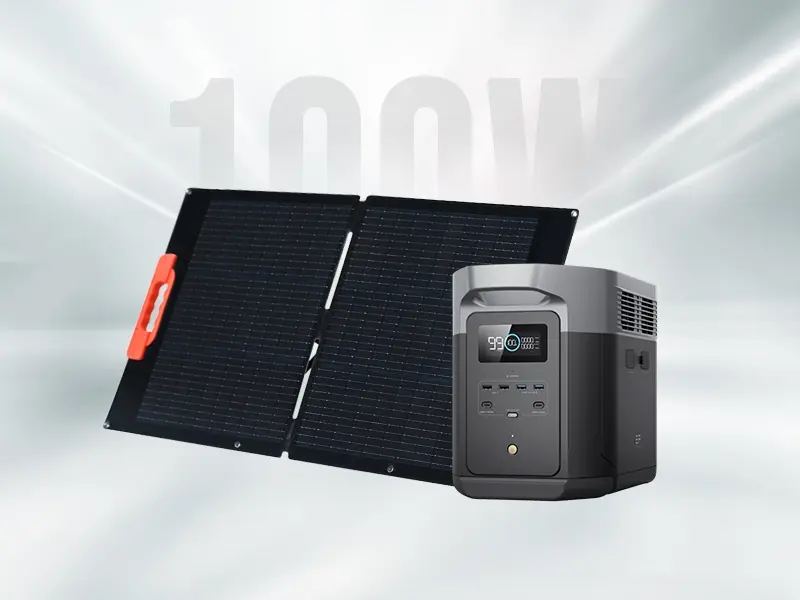
BXF-Plus Series · 2×50W (~100W)
PVF surface + integrated lamination — 30% lighter than conventional panels. 3.5 kg unfolded. Best for daily top-ups (<300Wh/day).
- Cell efficiency >22.7% monocrystalline
- IP67 waterproof · adjustable kickstands
- Anti-hot-spot 4-cut cell tech
- CE / RoHS / FCC certified
Best for: Backpackers & weekend campers who prioritize weight over charge speed.
View BXF-Plus Series →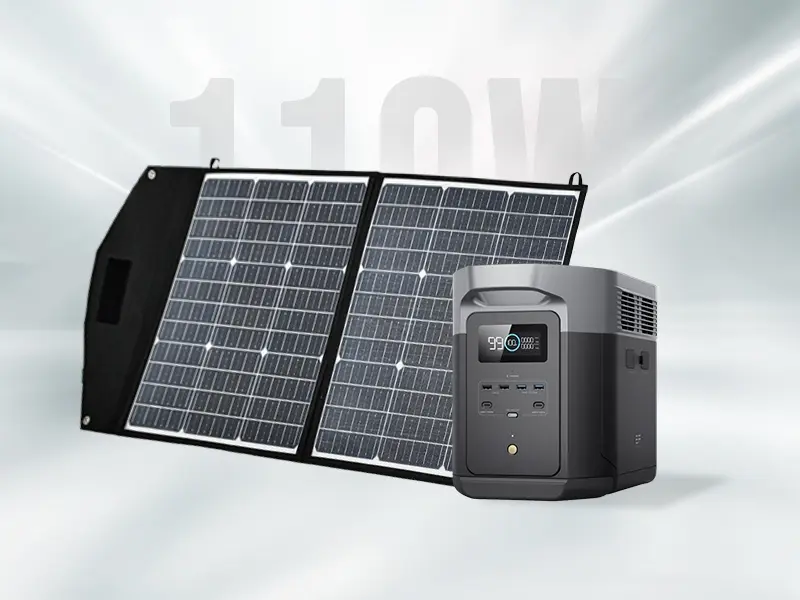
SPC Series · 2×55W (~110W)
ETFE lamination + high-polymer composite backsheet for superior shade tolerance. Voc ~23.3V fits most 1kWh MPPT windows. 3.5 kg.
- PERC shingled / SunPower cells (>24.4%)
- IP67 · 840D Oxford fabric
- Anderson connector (MC4 customizable)
- Handles partial shading better than standard mono
Best for: RV owners & van-lifers in mixed sun/shade environments.
View SPC Series →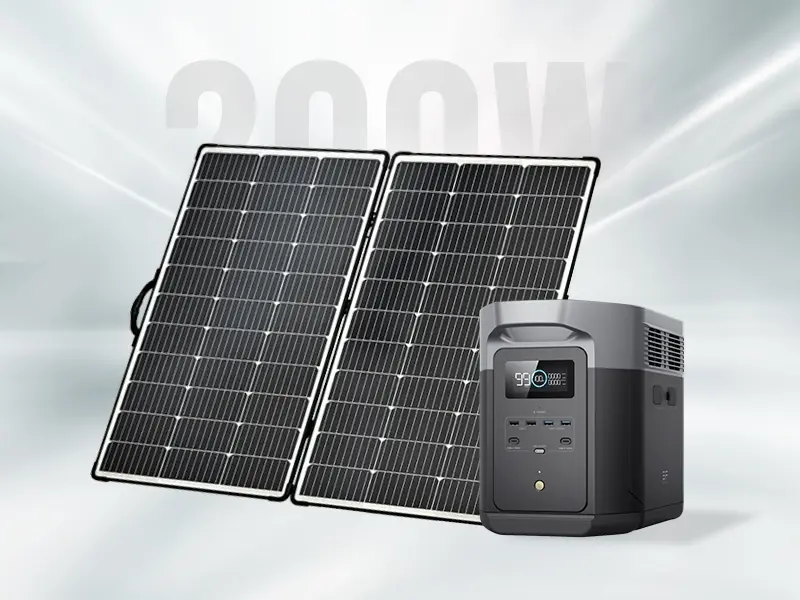
Hi-Power Series · 200W–400W+
TÜV + IEC TS 63163 certified. Designed for rapid 1kWh recharge; scalable via series/parallel. 5-year warranty (2× industry standard).
- Cell efficiency >22.8–23% monocrystalline
- IP67 / IP68 full-immersion tested
- MC4 / Anderson / XT60 connectors
- Compatible with EcoFlow, Jackery, Bluetti
Best for: Users needing same-day full recharge or planning to scale to 2kWh.
View Hi-Power Series →| Series | Config example | Approx. real-world harvest | Time to fill 1kWh (5h sun) | Best use case |
|---|---|---|---|---|
| BXF-Plus | 2×50W (~100W) | ~75W avg | ~14–16h sun (2 days) | Ultralight / daily top-up |
| SPC | 2×55W (~110W) | ~82W avg | ~12–14h sun (1.5–2 days) | RV / shade-mixed camping |
| Hi-Power | 2×100W (200W) | ~150W avg | ~7–9h sun (1 day) | Fast recharge / primary power |
| Hi-Power | 4×100W (400W)* | ~280W avg | ~4–5h sun (same day) | Max speed / 2kWh expansion |
*400W config only makes sense if your station accepts 400W solar input. Verify your station's spec sheet before ordering multiple panels.
What's Your Pre-Purchase Checklist Before Buying a Solar Panel for a 1kWh Station?
Print this out. Seriously. I've watched people skip this list and spend $200 on a panel that delivers 40% of its rated watts because one spec was off.
- Max solar input (watts): Find this in your station's manual or spec sheet. This is the hard ceiling. Buying a panel rated above this number means the excess is wasted.
- MPPT voltage range (Voc and Vmp): Your panel's open-circuit voltage (Voc) must be below the station's maximum MPPT input voltage. Your panel's operating voltage (Vmp) should sit comfortably within the MPPT range for efficient tracking. A panel with Voc = 24V and Vmp = 20V is fine for a station with a 12–60V MPPT range. The same panel wired in series with another panel (Voc = 48V) might exceed the MPPT max on some stations.
- Connector type: MC4 is the safest choice for compatibility. If your station uses a proprietary connector, verify that a quality adapter exists before buying a panel with a different connector.
- Cable length: Measure the distance from where you'll place the panel to where the station sits. Add 20% buffer. For runs over 3 meters, check the cable gauge—10AWG minimum for 200W panels.
- Future expansion: If you might add a second panel later, check whether your station supports parallel input (two panels with same voltage, doubled current) or series input (two panels with doubled voltage). This affects which panel you buy now.
FAQ: People Also Ask About Solar Watts for 1kWh Power Stations
200W (STC label rating) is the practical minimum for a full recharge in one sunny day in a good-sun location. Real-world output is ~70–80% of rated watts, so 200W delivers ~140–160W to your MPPT—enough to fill 1kWh in 7–9 hours of usable sun. In cloudier climates or if you want faster fills, size up to 300W. Always verify your station's max solar input and MPPT voltage window first.
With a 200W panel delivering ~150W of real harvest (75% of rated), charging a 1,000Wh station takes roughly 7–9 hours of usable sunlight, accounting for MPPT and battery losses. In ideal conditions (clear sky, cool panel, optimal tilt), you might hit 6–7 hours. On a hazy day with a warm panel, expect 9–11 hours. This is why 200W is the minimum comfortable size—not the ideal size—for a 1kWh station.
Yes, if your station's maximum solar input rating supports it—many 1kWh-class stations accept 200–500W. The MPPT will cap input at its rated maximum, so excess watts are rejected (not damaging, just unused). Also verify the panel's Voc falls within the station's MPPT voltage range. A 400W panel can be worth it in cloudy conditions where you want to maximize harvest during limited sun windows.
Sources & references:
- NREL PVWatts Calculator — pvwatts.nrel.gov — for location-specific peak sun hours and system performance estimates.
- Pew Research Center, How Americans View Energy Choices (June 2024) — context on portable solar adoption trends in the US.
- Sungold Solar product pages: BXF-Plus series · SPC series · Hi-Power series