Here's a scenario I've seen more than once: a motorhome owner spends months planning a solar upgrade — picks a quality 400W rigid panel kit, orders the aluminium mounting frames, buys a 100Ah lithium battery — and only after installation discovers the vehicle is sitting 30 kg over its Maximum Authorised Mass. The solar system alone added 38 kg. The battery added another 14 kg. Nobody told them to check the GVWR first.
This guide is the one I wish existed back then. We'll cover the weight per watt data most comparison articles skip, walk through a 5-step GVWR compliance calculation, and give you an honest look at flexible vs rigid panels — including one counterintuitive finding that changes how most people think about "lightweight" solar.
Why Does Weight Matter More on a 3.5t Motorhome Than Any Other Vehicle?
The 3.5-tonne threshold isn't arbitrary. In the UK, it's the upper limit for a standard Category B driving licence — go over and you legally need a Category C1 licence to drive. Across Europe, 3.5t is also the dividing line for toll categories, tachograph requirements, and commercial vehicle regulations. Cross it, even by 10 kg, and you're in a different legal universe.
The 3.5t Threshold: What It Actually Means for Your Payload
Your vehicle's Maximum Authorised Mass (MAM) — sometimes called GVWR — is stamped on the VIN plate. But the number that really matters is MIRO: Mass in Running Order. Under EU regulations, MIRO includes the driver (standardised at 75 kg), a 90%-full fuel tank, 20 litres of fresh water, and a 16 kg gas cylinder. It's the weight of your motorhome ready to drive, before you load a single bag.
My experience is that most 3.5t motorhomes leave the factory with a MIRO somewhere between 2,900 kg and 3,200 kg. That leaves you a payload budget of just 300–600 kg. Sounds like a lot — until you start adding it up:
- Two adults + luggage: ~200 kg
- Full fresh water tank (100L): 100 kg
- Spare gas cylinder: 16 kg
- Food, tools, bikes, awning: 60–100 kg
In a realistic two-person touring setup, you can easily consume 376–416 kg of that budget before a single solar panel goes on the roof. If your MIRO is 3,100 kg, you've got under 100 kg left for your entire solar system — panels, battery, inverter, cabling, and all.
How a Solar System Eats Into That Budget
The mistake most guides make is only counting the panels. A complete solar installation includes:
- Panels: 8–40 kg depending on type and wattage
- Mounting frames / adhesive: 0.2–12 kg
- Cabling (10m run, 6mm²): ~1.5 kg
- MPPT charge controller: 0.8–2 kg
- Battery (100Ah LiFePO4): 10–14 kg
- Inverter (1kW): 3–6 kg
Add it up and a "modest" 400W rigid panel system with a 100Ah battery can weigh 55–75 kg total. A comparable flexible panel system? Around 25–35 kg. That 30–40 kg difference is the entire reason this conversation exists.
Already know your payload budget and want to explore panel options? See Lightweight Panel Specs →
What Is Weight Per Watt — and Why Is It the Only Metric That Matters?
Weight per watt (g/W) measures how many grams a solar panel weighs for every watt of power it produces. Formula: total panel weight (g) ÷ rated power (W). A lower g/W value means more power for less weight — the key metric for weight-sensitive installations like 3.5t motorhomes. Flexible panels typically achieve 14–20 g/W; standard rigid glass panels run 55–62 g/W.
Here's why "total panel weight" is a useless comparison: a 100W panel weighing 3 kg looks lighter than a 400W panel weighing 22 kg. But to get 400W of power from those 3 kg panels, you'd need four of them — totalling 12 kg. The 400W rigid panel at 22 kg is suddenly heavier by 10 kg, but it's a much fairer fight. g/W normalises everything.
Weight Per Watt Comparison: Flexible vs Rigid Solar Panels for Motorhomes
| Panel Type | Example | Power (W) | Weight (kg) | g/W | 3.5t Suitable? |
|---|---|---|---|---|---|
| Standard Rigid Mono (Al frame) | Generic 400W Mono | 400 | 22–25 | 55–62 | ✗ Heavy |
| Lightweight Rigid (frameless) | SunPower Maxeon 3 | 400 | 17–19 | 42–47 | ⚠ Marginal |
| ETFE Flexible Mono | Renogy 200W Flex | 200 | 2.8–3.5 | 14–17 | ✓ Recommended |
| Semi-Flex Composite (HPC) | Sungold PA621 200W | 200 | 4.93 | 24.7 | ✓ Recommended |
| CIGS Thin-Film Flexible | MiaSole FLEX-02N | 300 | 3.0–4.5 | 10–15 | ✓ Lightest |
Data represents typical market ranges. Verify against individual product datasheets. Sungold PA621 weight from published specifications.
Don't Forget: Mounting Systems Add More Weight Than You Think
I've found that people consistently underestimate mounting hardware weight. A set of aluminium tilt brackets for four rigid panels adds 6–12 kg before a single panel goes up. Flexible panels bonded with structural adhesive? Under 0.5 kg for the same footprint. That gap is often bigger than the weight difference between the panels themselves.
Cable weight is another one. A 10-metre run of 6mm² solar cable weighs around 1.5 kg. Swap to 4mm² where the run length allows and you save roughly 500g — small, but every gram counts when you're working with a 94 kg solar budget.
How Do You Calculate GVWR Compliance Before Installing Solar Panels?
This is the section most solar guides skip entirely — and it's the one that gets people into legal trouble. Here's the exact process I'd walk through with any motorhome owner before recommending a panel type.
5-Step GVWR Payload Calculation for Solar Installations
-
Find your MAM (Maximum Authorised Mass)
Check the VIN plate — usually on the driver's door sill or engine bay. For most 3.5t motorhomes: 3,500 kg. -
Record your MIRO (Mass in Running Order)
Found on your registration document (V5C in the UK) or manufacturer's handbook. Typical range: 2,900–3,200 kg. -
Calculate your base payload
Base Payload = MAM − MIRO. Example: 3,500 − 3,100 = 400 kg available. -
Subtract fixed loads
Passengers (×75 kg each) + full water tank (×1 kg/litre) + gas cylinders + luggage + bikes + tools. A typical two-person touring load: 306–376 kg. -
Remaining budget = your solar system weight limit
Example result: 400 − 340 = 60 kg for the entire solar system (panels + battery + inverter + cabling).
What Are the Legal Consequences of Overloading a Motorhome in the UK and Europe?
In the UK, driving an overloaded vehicle is a criminal offence under the Road Vehicles (Construction and Use) Regulations 1986. Consequences include: insurance invalidation (your insurer can refuse any claim), penalty points, fines up to £300 per axle, and potential vehicle prohibition. In France, Germany, and Italy, overloading can be treated as toll evasion if it pushes you into a higher vehicle category — fines can exceed €1,000.
My practical advice: weigh the vehicle at a public weighbridge before and after installation. Keep a written record of your solar system components and their weights. If you're a conversion builder or OEM, this documentation is increasingly expected by insurers and type-approval bodies.
Flexible vs Rigid Solar Panels for 3.5t Motorhomes: What's the Real Trade-Off?
The honest answer is: neither type wins outright. The right choice depends on your payload budget, how often you use the motorhome, and whether you're parking in shade. Here's the full picture.
Side-by-Side Comparison
| Comparison Factor | Flexible / Semi-Flex Panels | Lightweight Rigid Panels |
|---|---|---|
| Typical g/W | 14–25 g/W | 42–62 g/W |
| Mounting method | Adhesive bond (no roof penetration) | Aluminium brackets, bolted |
| Curved roof compatibility | ✓ Excellent | ⚠ Flat roofs only |
| Expected lifespan | 8–15 years | 25–30 years |
| Cell efficiency | 16–22.7% | 20–23% |
| Heat management | ⚠ Needs air gap | ✓ Natural convection |
| Shade tolerance | Varies (anti-shade tech available) | Standard bypass diodes |
| Cost per watt | Higher | Lower |
| OEM integration | ✓ Easier | ⚠ More complex |
When Rigid Panels Are Still the Right Call
If your payload budget allows it (more than 150 kg remaining after passengers and essentials), and your roof is flat, lightweight frameless rigid panels are worth serious consideration. They're cheaper per watt, last three times longer, and perform more consistently in hot weather. For full-time or frequent motorhome users who park in sunny, open locations, the long-term economics favour rigid.
The Hybrid Approach: Best of Both Worlds
I've seen this work well in practice: use one or two lightweight rigid panels in the flat central section of the roof (where you get the most area and best structural support), and fill the curved edges and obstacle-heavy zones with flexible panels. A 400W hybrid system — two 150W lightweight rigid panels plus one 100W flexible panel — can come in at around 16–20 kg total, versus 38–45 kg for a pure rigid setup. You get the efficiency and longevity of rigid where it counts, and the weight savings of flexible where it matters.
Why "Lightest Panel" Doesn't Always Mean "Most Power Per Kilogram" — The Counterintuitive Truth
Almost every article about lightweight solar panels for motorhomes stops at installation weight. None of them ask the more important question: over the life of the system, which panel type actually delivers the most energy per kilogram installed? The answer might surprise you.
The Heat Problem Nobody Talks About
Here's the physics: monocrystalline silicon cells lose approximately 0.35–0.45% of output for every 1°C rise above 25°C (this is the temperature coefficient, listed on every panel datasheet). On a motorhome roof in summer, surface temperatures can reach 60–80°C. That's a 35–55°C rise above the test standard.
For a flexible panel bonded directly to the roof with no air gap, there's nowhere for that heat to go. The panel soaks it up. In my experience, a nominally rated 200W flexible panel in peak summer conditions can output as little as 155–170W — a real-world loss of 15–22%.
A rigid panel on brackets, with 30–50mm of air beneath it, runs 10–15°C cooler under the same conditions. That same 200W rigid panel might output 183–192W. The "heavier" panel is actually delivering more power.
This is exactly why Sungold's PA621 semi-flexible composite panel uses a patented low-conductivity backsheet (0.2 W/m·K thermal conductivity) — it creates a thermal barrier even when bonded to the roof, keeping cell temperatures approximately 5°C lower than standard flexible panels in controlled testing. That's not marketing copy; it's the engineering reason semi-flex composite panels are gaining ground with OEM builders.
The Lifespan-Adjusted Power Calculation: What 10 Years Really Looks Like
Most guides compare panels at the point of installation. Let's compare them over a decade — which is how long you'll actually own the motorhome.
| Metric | Standard Flexible (200W) | Semi-Flex Composite (200W) | Lightweight Rigid (200W) |
|---|---|---|---|
| Installed weight | 3 kg | 4.93 kg | 9 kg (incl. brackets) |
| Expected lifespan | 5–10 years | 12–18 years | 25+ years |
| Annual degradation | 1.5–2.0% | 0.8–1.0% | 0.4–0.5% |
| Est. 10-yr output | ~1,380 kWh | ~1,620 kWh | ~1,750 kWh |
| 10-yr kWh per kg | 460 kWh/kg | 329 kWh/kg | 194 kWh/kg |
| Replacements in 10 yrs | 1–2× | 0× | 0× |
Estimates based on 4 peak sun hours/day average, 365 days/year usage. Actual output varies by location and installation quality.
Why OEM Builders Are Switching to Semi-Flexible Composite Panels
I've spoken with conversion builders who've moved away from standard flexible panels after experiencing return rates of 15–20% within the first two years — primarily from delamination and heat-induced micro-cracking. The Sungold PA621, for example, uses a fiberglass-reinforced composite backsheet with bending strength ≥20 MPa and vibration resistance rated to 10–60 Hz — specifically engineered for the mechanical stress of road travel. Their published field return rate is under 1.8%.
For a 3.5t motorhome OEM, the calculus is straightforward: a panel that weighs 4.93 kg at 200W (24.7 g/W) and lasts 15+ years with a 10-year warranty is a better product story than a 3 kg panel that needs replacing in year seven.
Which Lightweight Solar Panels Are Best for a 3.5t Motorhome?
Based on the g/W data and the lifespan analysis above, here's how I'd categorise the options by use case. These aren't affiliate recommendations — they're based on what the specs actually show.
When Payload Is Critically Tight (Under 60 kg Solar Budget)
Go flexible, prioritise g/W. CIGS thin-film panels (10–15 g/W) are the absolute lightest option. ETFE flexible monocrystalline panels (14–17 g/W) offer a good balance of weight and efficiency. Accept the shorter lifespan as a trade-off for staying legal.
Key spec to check: temperature coefficient. Look for panels rated at −0.35%/°C or better. Avoid panels with no published temperature coefficient — it usually means the manufacturer doesn't want you to know.
When You Have 60–120 kg Available (Most Common Scenario)
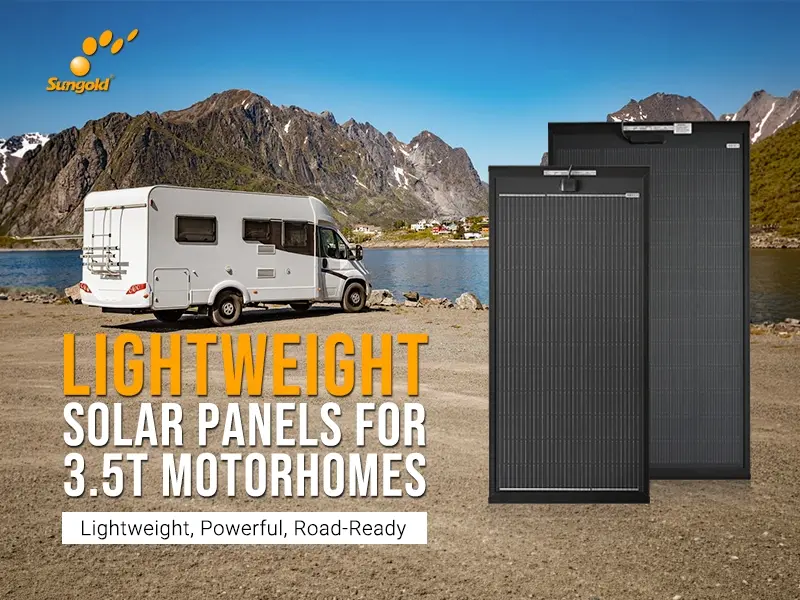
Semi-flexible composite panels hit the sweet spot. The Sungold PA621 series (100W–200W, 24.7 g/W at 200W, 22.7% cell efficiency, 10-year warranty, CE + IEC 61215 certified) is a strong candidate here. The patented low-conductivity backsheet addresses the heat problem directly. At 4.93 kg for 200W, a 400W system weighs under 10 kg in panels alone.
Also worth considering: panels with anti-shading technology. If you park under trees or near buildings, partial shading can collapse the output of a conventional string by 30–100%. Cell-level shade management (like Sungold's Shade-Smart™ architecture) prevents whole-string collapse and maintains output even when 25% of the panel surface is shaded.
For OEM and Conversion Builders
Prioritise: CE + IEC 61215 + IEC 61730 certification (required for European market), published field return rates, and a manufacturer that offers custom sizing. The Sungold RV Solar Kit range (200W–600W pre-configured systems) includes Cool-Back™ thermal management and Shade-Smart™ cell-level optimisation, with MOQ from 100 units for standard models and 500 units for OEM custom SKUs.
How Can You Install Solar Panels to Minimise Weight and Stay GVWR Compliant?
Choosing the right panel is half the battle. How you install it determines whether the weight savings actually materialise — and whether the system performs as expected.
The Air Gap Rule: Why 10mm Changes Everything
If you're bonding flexible panels directly to the roof, leave a minimum 10mm air gap using aluminium spacer strips or purpose-made mounting pads. Field data consistently shows panels with ≥10mm air gap experience less than 5% annual power degradation, while flush-bonded panels can exceed 20% annual degradation from heat-induced micro-cracking.
Yes, the spacers add a small amount of weight — typically 200–400g for a 400W system. That's a worthwhile trade-off for a system that performs correctly for 12+ years instead of 5.
Cable Sizing: The Overlooked Weight Variable
For runs under 5 metres, 4mm² cable is usually sufficient for a 400W system at 12V. For longer runs, 6mm² is safer for voltage drop. The weight difference is about 50g per metre — over a 10-metre run, that's 500g saved by using 4mm² where the run length allows. Not huge, but if you're working within a tight weight budget, it adds up.
Aluminium mounting hardware saves 30–40% weight versus stainless steel equivalents. For a full rigid panel mounting kit, that can mean 3–5 kg saved.
Roof Load Distribution: Don't Ignore Axle Weight
GVWR compliance isn't just about total vehicle weight — it's also about axle weight limits. Concentrating all your solar panels at the rear of the roof (where most motorhome roofs have the most flat space) shifts weight onto the rear axle. Keep panels as close to the vehicle's centre of gravity as possible. On a typical motorhome, that means the section between the cab and the rear bedroom — roughly above the rear axle or slightly forward of it.
FAQ: Lightweight Solar Panels for 3.5t Motorhomes
The 3-Step Decision Framework
- Step 1: Calculate first. Run the 5-step GVWR calculation before you look at a single panel. Know your solar weight budget before you shop.
- Step 2: Choose by g/W, not total weight. If your budget is under 60 kg, go flexible (14–20 g/W). If you have 60–120 kg, semi-flex composite panels give you the best long-term value. Over 120 kg? Lightweight rigid panels are worth the extra weight for their efficiency and lifespan.
- Step 3: Install correctly. Leave the air gap. Use aluminium hardware. Distribute weight centrally. Document everything for your insurer.
IEC 61215:2021 — Terrestrial photovoltaic (PV) modules: Design qualification and type approval.
EU Regulation (EU) 2018/858 — Approval and market surveillance of motor vehicles.
UK Road Vehicles (Construction and Use) Regulations 1986, Regulation 80 (weight).
Sungold PA621 Series Technical Specifications — published product datasheet, accessed March 2026.
Sungold RV Solar Kits — Engineering Overview, accessed March 2026.