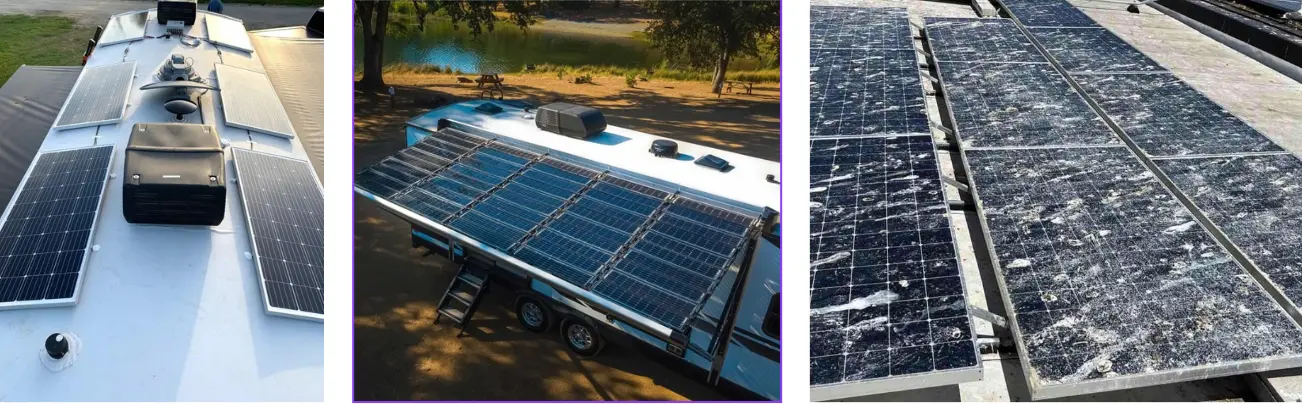
In mobile use, rv solar panel shading is normal—not rare. Tree shade, rooftop equipment shadows, and small soiling (like bird droppings) can reduce output more than most owners expect. The key reason is electrical grouping: modules are protected by bypass diodes, and partial shading can force a protected group to be bypassed, so the “effective loss” can be much larger than the shadow area.
A measured example from NREL shows how strong this non-linear effect can be: shading more than ~40% of a single cell can lead to total power loss of the cell group protected by that bypass diode (in the tested configuration). That’s why “a small shadow” can become “a big power drop.”
Internal links (topic cluster):
C1: Series vs Parallel Wiring for RV Solar Panels (anchor idea: series vs parallel shading RV)
C4: RV Solar Heat Derating (Temperature Coefficient)
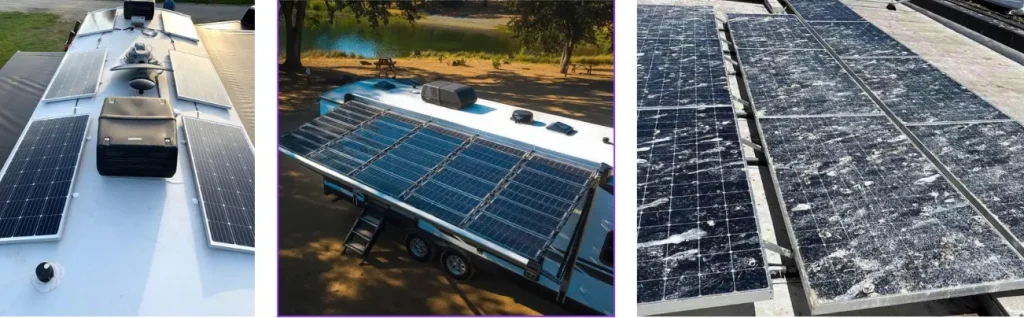
Real-world rv solar panel shading
Type A: Environmental shading (RV solar panels under trees, buildings, fences)
In real RV use, the most common shading is not “a rare event”—it’s where people actually like to park. Tree shade is common at campgrounds. Buildings, walls, and nearby vehicles can also create partial shade in lots and urban stops.
From an engineering perspective, this category is low-control. You can’t assume “perfect parking conditions.” The system must be designed so shade affects one zone, not the entire roof array.
Type B: Surface soiling (bird droppings shading solar panel RV, dust bands)
Bird droppings and dust bands are often small-area, but they create localized shading that can trigger uneven current paths and unstable output. Owners also miss these more easily than a tree shadow.
Soiling is the good news category: it’s high-frequency but also highly manageable with a short routine.
Type B: Surface soiling (bird droppings shading solar panel RV, dust bands)
Bird droppings and dust bands are often small-area, but they create localized shading that can trigger uneven current paths and unstable output. Owners also miss these more easily than a tree shadow.
Soiling is the good news category: it’s high-frequency but also highly manageable with a short routine.
Why small rv solar shade causes big power loss
What’s happening electrically (without a textbook lecture)
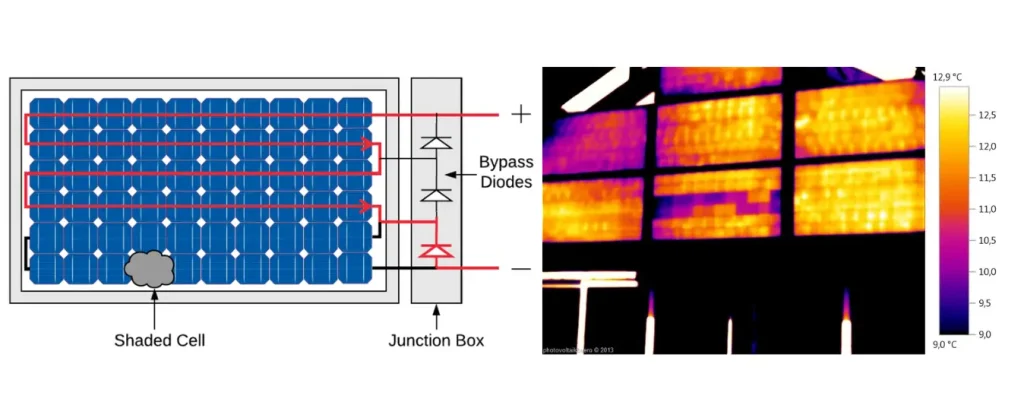
Most crystalline modules use bypass diodes to protect groups of cells from damaging reverse-bias stress when part of the module is shaded.
This protection works in groups (substrings). When shading drives one group into a condition where the bypass diode conducts, that group’s contribution is effectively removed. So the power loss is not proportional to “shadow area”—it is often proportional to which group the shadow hits.
The important measured takeaway
NREL reported that shading greater than 40% of a single cell can cause total loss of power for the bypass-diode-protected group (for the tested configuration). This is a clean, engineer-friendly way to explain why “small shade” can cause “big loss.”
What customers should understand
A small shadow in the wrong place can cut output a lot.
This is normal PV behavior—not a defect.
The right system design makes the loss local, predictable, and easier to manage.
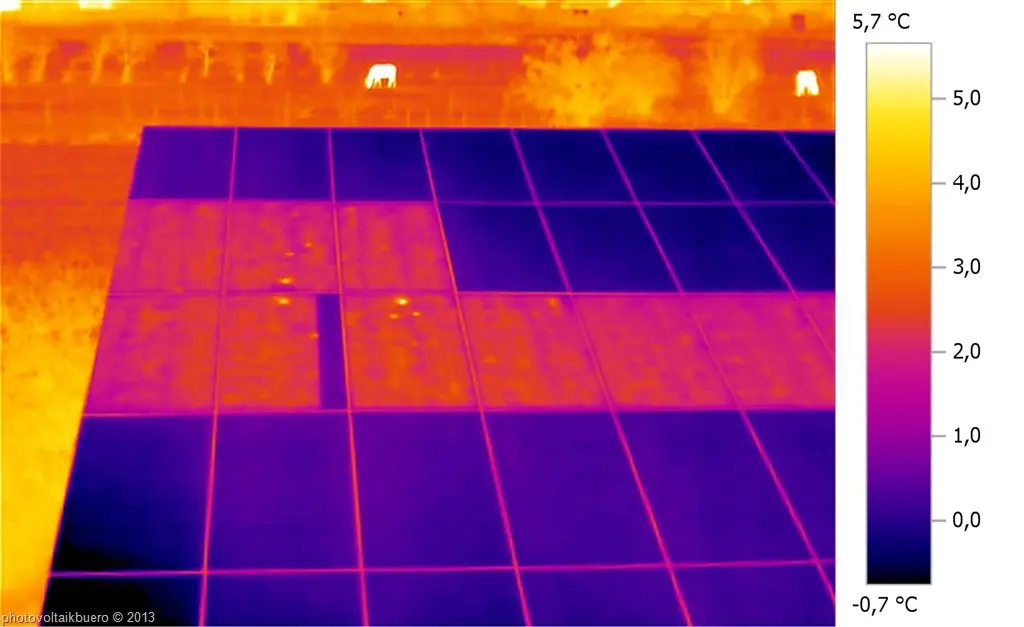
Solution 1: Roof zoning layout for RV solar
If you only do one thing to improve shade tolerance, do roof zoning layout for RV solar. Zoning is not “extra complexity”—it is the simplest way to prevent one shaded area from collapsing the whole roof.
RV roof shade map template (fast method)
Take roof photos morning / midday / late afternoon from the same angle.
Mark where shadows sweep and where fixed shadows exist.
Define zones:
Fixed-shadow zone: around AC units / racks / vents
Edge sweep zone: roof edges that often catch tree shade
Main sun zone: the most consistently exposed area
Practical zoning rules
Isolate fixed shadows first.
Keep “high-risk edges” separate from the main sun zone.
When in doubt in mobile environments, prefer clearer zones (slightly more zones) over fewer zones.
NREL’s partial shading work across a large sample of systems reinforces that partial shading contributes meaningful performance loss in real installations—so designing for it is justified.
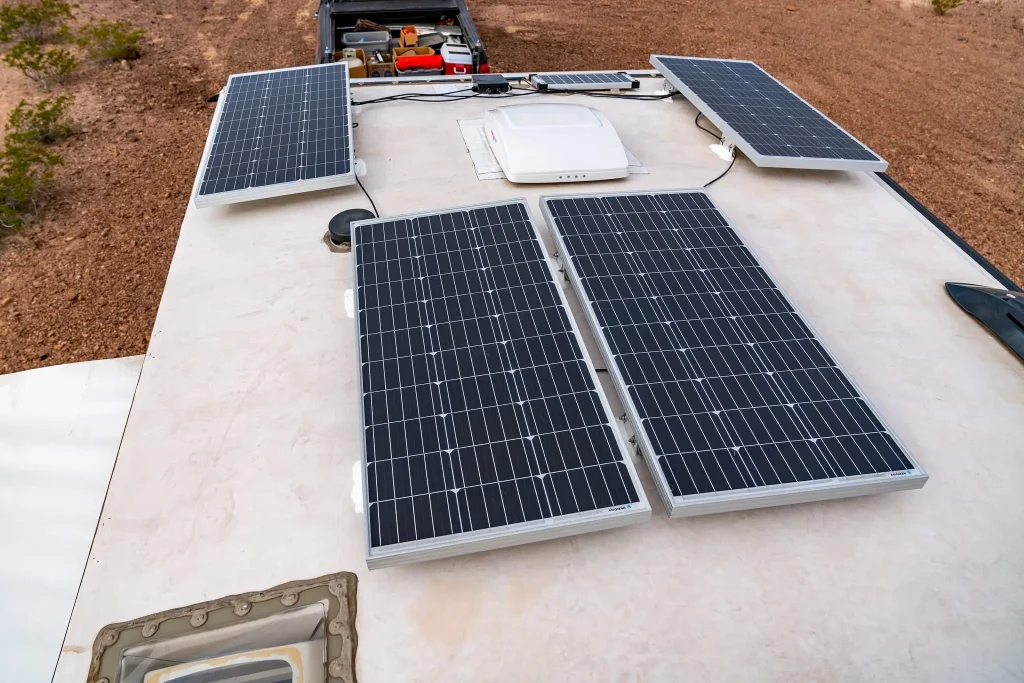
Solution 2: Bypass diode hotspot prevention
This section is the technical “trust anchor” for solar panel hotspots and bypass diode hotspot prevention.
What bypass diodes do (and what they don’t)
Bypass diodes help reduce reverse-bias stress and can mitigate severe hotspot heating when parts of a module are shaded.
However, bypass diodes do not “remove” shading loss. They change how the module behaves under shading. That’s why we design with zoning and grouping: to make the shading impact predictable and localized.
Evidence-based note on hotspot risk
Industry reliability discussions (e.g., PV reliability reports) treat hotspots and bypass components as relevant under partial shading/mismatch conditions, especially when shading persists. The practical takeaway is consistent: avoid persistent shading where possible, and design the system so shading does not stress the same area repeatedly.
Delivery “three-pack” (what installers should hand over)
Electrical map: zones and grouping shown clearly.
Shading demo: cover a small area on one zone and record output change.
Owner explanation: small shade can cause big loss due to bypass grouping; it’s normal physics and here’s how we manage it (parking tips + cleaning + zoning logic).
Solution 3: How to reduce shading loss RV solar
You don’t need a long guide. You need a short habit.
30-second self-check card
Look: bird droppings, dust bands, leaves, rack shadow lines
Rinse: quick water rinse → see if output improves
Note: occasionally photo “before vs after” readings
This turns soiling-related shading into a controllable variable rather than a mystery.
Dealer delivery checklist for shading risk
Most “the system is weak” complaints are expectation gaps. Fix the expectation at handover with documentation and a demo.
Checklist (copy/paste)
Roof shading sources identified (tree/gear/soiling)
Roof zoning plan documented (shade map + zones)
Wiring approach matches zones (series / parallel / series-parallel combo)
Shading demo completed (photo evidence of readings)
Owner handout: parking tip card + 30-second self-check routine
Optional (advanced): partial shading can create multiple maximum power points on the PV curve; MPPT strategy and zoning can matter in complex shading. Victron documents this behavior and the need to track the optimum MPP under certain partial-shading conditions.
FAQ (8 quick answers)
1) Why does small shade cause big power loss on solar panels?
Because bypass diodes protect groups of cells. Shading can force an entire protected group to be bypassed, so loss can be much larger than the shadow area. NREL measured this effect clearly.
2) RV solar panels under trees: what’s the practical fix?
Assume tree shade will happen and design roof zoning so shaded sections don’t drag down the whole roof array.
3) Bird droppings shading solar panel RV: does it really matter?
Yes. Small soiling can cause localized shading and unstable output. Use the 30-second self-check routine.
4) What are shading hotspots on solar panels?
Hotspots are localized heating areas that can occur under partial shading/mismatch conditions. Bypass diodes help mitigate harmful stress, but persistent shading should still be avoided.
5) How to avoid hotspots on solar panels (RV rooftop)?
Use zoning, isolate fixed shadows, keep the surface clean, and avoid repeated persistent shading on the same area whenever possible.
6) Bypass diode solar panel: does it eliminate shading loss?
No. It helps protect the module and changes shading behavior, but it does not make shading losses disappear. Zoning is still required.
7) Shading test IV curve solar panel: what should I demonstrate at delivery?
Cover a small area on one zone and record controller/app readings. If you have IV-curve tools, show shaded vs unshaded I–V/P–V curves; otherwise, a controlled before/after measurement still helps prevent misunderstandings.
8) Series vs parallel shading RV: does wiring change shade sensitivity?
Yes. Series strings are typically more sensitive to partial shading, so shaded campsites often benefit from zoning and parallel or series-parallel grouping. See C1 for wiring decisions and diagrams.