Solar Panel Lifespan in -40°C Arctic Conditions: Engineering for the Final Frontier
For scientific researchers in the Svalbard archipelago or high-altitude mountaineers in the Canadian Rockies, energy is a survival asset. However, the Arctic is a graveyard for standard solar hardware. When temperatures plummet to -40°C (-40°F), the physical properties of common polymers change, leading to catastrophic system failures.
At Sungold Solar, we recognize that “off-grid” often means “extreme.” Understanding the solar panel lifespan in -40°C Arctic conditions requires looking beneath the surface at the material science of encapsulation and thermal expansion.
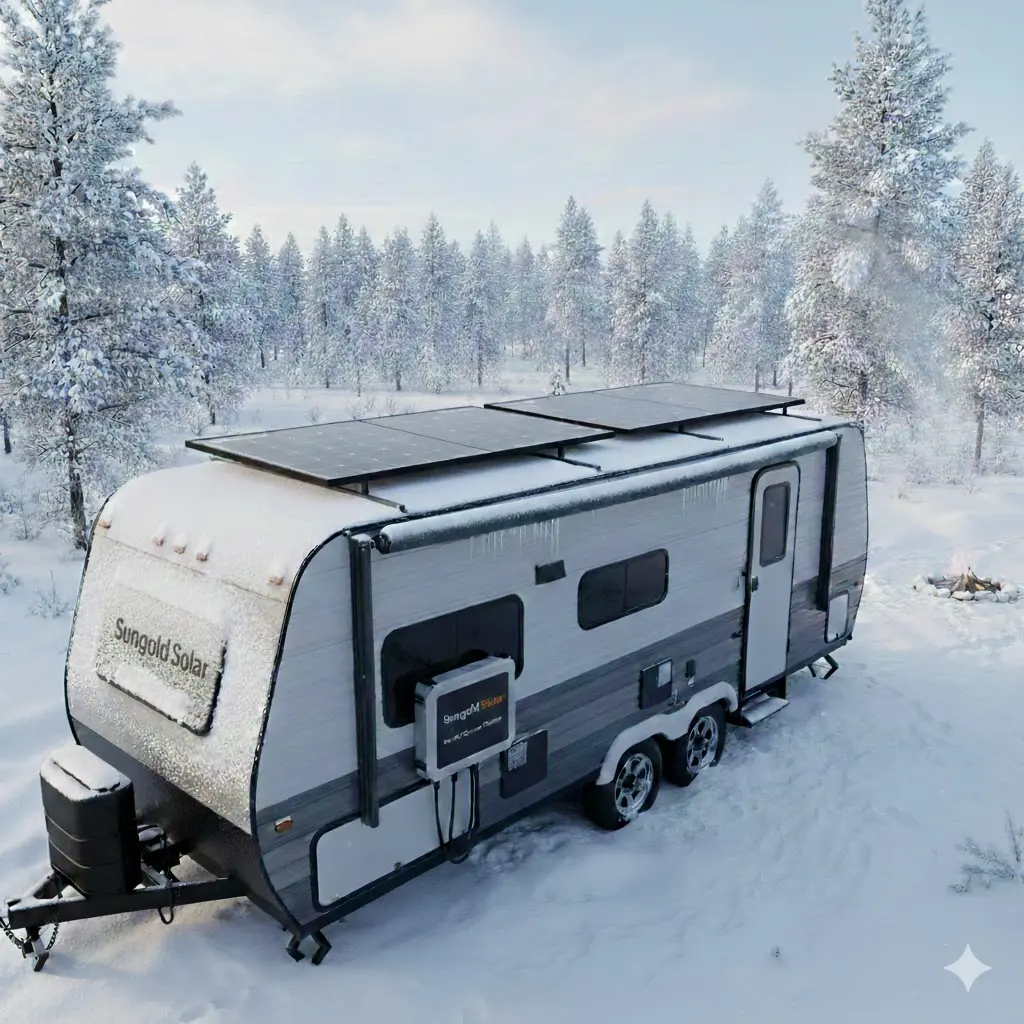
The “Cryogenic Challenge”: Why Standard Panels Fail in the Cold
Most commercial solar panels are designed for temperate climates (STC 25°C). In the Arctic, two primary physical phenomena threaten a panel’s lifespan:
A. The Glass-Transition Temperature (Tg)
Every polymer used in solar encapsulation—such as standard EVA (Ethylene Vinyl Acetate)—has a glass-transition temperature. Below this point, the material shifts from being flexible and rubbery to being hard, brittle, and “glass-like.” In standard panels, reaching -40°C often exceeds the $T_g$ limit, causing the internal layers to crack under the slightest mechanical vibration or wind load.
Coefficient of Thermal Expansion (CTE) Mismatch
A solar panel is a “sandwich” of different materials: glass/polymers, silicon cells, and copper busbars. Each expands and contracts at different rates. In extreme cold, the contraction forces are immense. If the encapsulation material cannot absorb these shearing forces, the result is delamination—the peeling apart of layers—which allows moisture to enter and destroy the electrical circuit.
Sungold’s Solution: Polar-Grade Encapsulation Materials
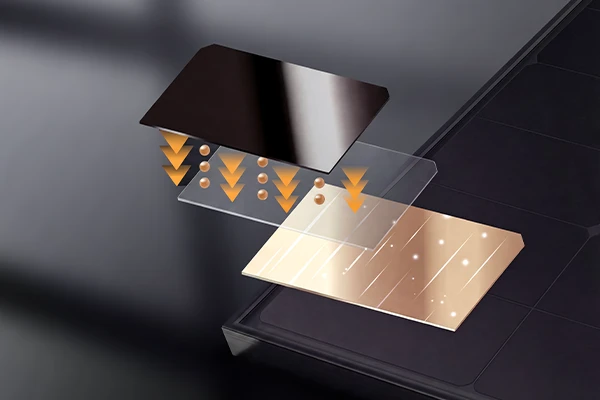
To maximize solar panel lifespan in -40°C Arctic conditions, Sungold has re-engineered the encapsulation stack. We utilize advanced materials specifically selected for their low-temperature resilience.
High-Performance POE (Polyolefin Elastomer)
Unlike standard EVA, Sungold utilizes high-grade POE encapsulation for our polar-series modules. POE maintains its elasticity and structural integrity far below -40°C.
-
Anti-Delamination: POE has superior adhesion strength and lower water vapor transmission rates (WVTR), ensuring the “sandwich” stays sealed even when the frame contracts in the cold.
-
Zero Brittle-Fracture: POE does not undergo the same radical embrittlement as lower-quality polymers, protecting the fragile silicon cells from mechanical stress.
Specialized ETFE Surface Protection
For our flexible polar lines, we utilize a high-tensile ETFE (Ethylene Tetrafluoroethylene) film. ETFE is chemically inert and remains stable across a massive temperature range (-200°C to +150°C). In Arctic conditions, ETFE won’t become “cloudy” or crack like PET surfaces, ensuring maximum light transmittance even after years of sub-zero exposure.
Quantifying Durability: The -40°C Thermal Cycle Test
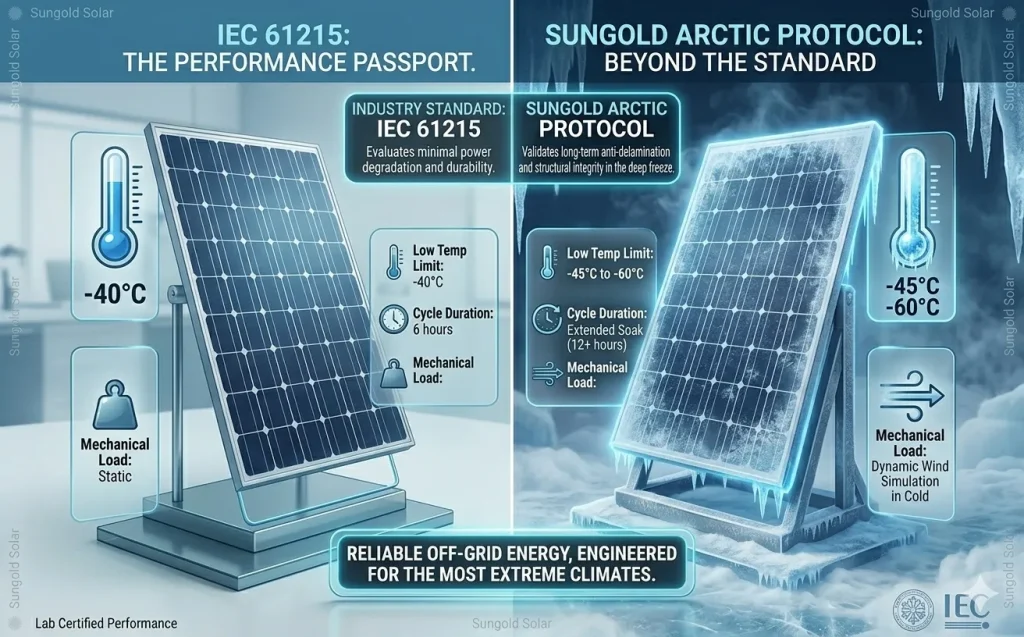
Sungold’s commitment to Arctic reliability is backed by rigorous lab simulation. While the IEC 61215 standard requires 200 thermal cycles, our polar-grade R&D involves:
| Test Parameter | Standard Requirement | Sungold Arctic Protocol |
| Low Temp Limit | -40°C | -45°C to -60°C |
| Cycle Duration | 6 hours | Extended Soak (12+ hours) |
| Mechanical Load | Static | Dynamic Wind Simulation in Cold |
The Result: Sungold modules show less than 2% power degradation after 500+ extreme thermal cycles, whereas generic panels often suffer from cell-to-busbar disconnection or backsheet cracking within the first 100 cycles.
Arctic Operational Advantages: Why Cold is Actually an Asset
Interestingly, if the panel survives the physical stress of the cold, the Arctic environment actually offers a unique performance advantage.
The Negative Temperature Coefficient
Solar cells are more efficient in the cold. Silicon’s bandgap widens at low temperatures, allowing for higher voltage output ($V_{oc}$). A Sungold 100W panel operating at -40°C can actually output significantly more power than its rated capacity, provided the charge controller can handle the increased voltage. Our Arctic-ready materials ensure that you can capitalize on this “cold-boosted” efficiency without risking structural failure.
Albedo Effect Synergy
In snow-covered Arctic regions, the high “Albedo” (reflectivity of the snow) increases the amount of light hitting the panel. Sungold’s ETFE textured surfaces are designed to capture this reflected light from wide angles, maximizing the daily energy harvest even when the sun is low on the horizon.
FAQ: Solar Reliability in the Deep Freeze
Q: Will the panel’s wires crack in -40°C?
A: Sungold utilizes specialized UV-stabilized, low-temp-rated PV cables. These cables feature insulation that remains flexible at -40°C, preventing the outer jacket from splitting and exposing live wires to the snow.
Q: Does snow buildup damage the panel?
A: Our rigid panels are designed for high static snow loads (up to 5400 Pa). For flexible panels, the ETFE surface has low friction, allowing snow to slide off more easily than on traditional glass or PET panels.
Q: How do I mount panels on frozen ground or ice?
A: We recommend our lightweight flexible series for expeditions. They can be tethered to sleds (pulks) or tents using reinforced eyelets, eliminating the need for heavy metal mounting structures that become brittle in the cold.
Conclusion: Trusted by Modern Explorers
The solar panel lifespan in -40°C Arctic conditions is determined at the molecular level. By choosing Sungold’s POE and ETFE composite technology, you are investing in hardware that refuses to crack under pressure. Whether you are powering a remote weather station or a cross-continental ski expedition, Sungold provides the energy security required for the world’s most unforgiving climates.