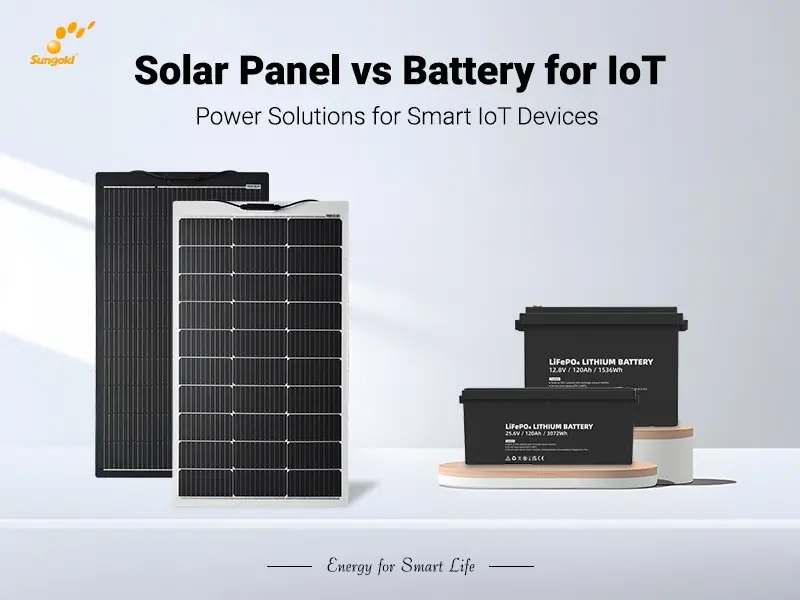
Solar Panel vs Battery for IoT Devices — A 5-Year Cost Reality Check
What's the Real Cost Difference Between Solar and Battery for IoT?
The difference is massive — but it hides in operational expenses, not hardware prices. A battery-only IoT node looks cheaper on the purchase order. It is cheaper on the purchase order. The problem shows up 24 months later when somebody has to physically visit each device and swap cells.
According to IoT Business News' 2026 TCO analysis, operational costs — not hardware — dominate IoT budgets by Year 3. Battery replacement is the single largest line item for sensor networks exceeding 500 nodes.
The $0.35 Battery That Costs $50 to Replace
A CR2032 coin cell costs $0.35. Deploying 2,000 of them costs $700. Sounds great on a spreadsheet.
That $15–$50 per truck roll includes travel time, safety procedures, device downtime, and the occasional sensor that gets damaged during the swap. Multiply that across thousands of nodes and the math gets ugly fast.
Solar Panel Upfront vs. Battery Lifetime — The 5-Year TCO Table
Here's the comparison nobody in the SERP is showing you with actual numbers. I've modeled three architectures across a 1,000-node outdoor deployment:
| Cost Item | Battery-Only (CR2450) | Solar + Supercapacitor | Solar + LiFePO4 |
|---|---|---|---|
| Hardware cost per node | $1.20 | $8.50 | $12.00 |
| Annual maintenance per node | $16.70 (incl. labor) | $0.50 | $0.80 |
| 5-Year TCO per node | $84.70 | $11.00 | $16.00 |
| 5-Year TCO / 1,000 nodes | $84,700 | $11,000 | $16,000 |
| Break-even point | — | ~14 months | ~17 months |
Stare at that 5-year column. The "expensive" option saves you 80%.
Why Do Batteries Fail Faster Than Spec Sheets Promise?
Batteries fail early because spec sheets test at 25°C — your rooftop sensor lives at 60°C in summer and -15°C in winter. That controlled-lab number on the datasheet has almost nothing to do with your deployment reality.
A 2024 multi-scale degradation study published in ScienceDirect documented how low-temperature exposure accelerates irreversible capacity loss through NMC particle cracking, dead lithium accumulation, and electrolyte overconsumption. These aren't temporary performance dips — they're permanent damage.
The Cold-Weather Capacity Killer Nobody Warns You About
Here's the part that'll ruin your day: cold charging is way worse than cold discharging. Your battery doesn't just perform badly in winter — it dies a little, permanently. Below 0°C, lithium ions can't properly intercalate into the graphite anode. Instead, they plate as metallic lithium — an irreversible process. Each cold-charging event costs 0.5–2% permanent capacity loss.
| Temperature | LFP Capacity Retention | NMC Capacity Retention | LTO Capacity Retention |
|---|---|---|---|
| 25°C (baseline) | 100% | 100% | 100% |
| 0°C | 82–88% | 88–92% | 95–98% |
| -10°C | 65–75% | 78–85% | 92–95% |
| -20°C | 50–61% | 70–78% | 88–92% |
Data sources: Polinove lithium battery cold-weather performance report; ScienceDirect multi-scale degradation study (2024).
How Does Solar Actually Power an IoT Device 24/7?
Solar doesn't power your device directly — it charges a buffer (battery or supercapacitor) that powers the device around the clock. Think of it like a water tower: the solar panel is the pump, the storage is the tank, and your IoT sensor is the faucet. The faucet doesn't care whether the pump is running right now — it cares whether the tank has water.
The signal chain looks like this: Solar Panel → MPPT Charge Controller → Energy Storage → DC-DC Converter → MCU & Sensors. The MPPT (Maximum Power Point Tracking) controller is the unsung hero here — it squeezes up to 30% more energy from the same panel compared to a simple linear charger. For a tiny IoT panel, that 30% can be the difference between "works" and "doesn't."
My experience is that the storage buffer should support 3–5 days of autonomy. Not because you'll get five consecutive cloudy days often, but because when you do, that's exactly when your sensor data matters most — storms, cold snaps, equipment failures. Murphy's Law has a special fondness for IoT deployments.
Indoor vs. Outdoor — The 100× Power Gap You Must Plan For
Outdoor sunlight delivers 50,000+ lux. A typical office sits at 300–500 lux. That's a 100× difference in available energy, and it completely changes your panel selection.
Monocrystalline silicon — the default choice for outdoor solar — is nearly useless indoors. Its spectral response doesn't match LED or fluorescent lighting. For indoor IoT, you need amorphous silicon panels, which deliver 10–20 µW/cm² at office lighting levels. A 4–6 cm² amorphous panel at 300 lux provides roughly 60 µW average power — enough for a well-designed sensor transmitting every 60 seconds.
What's the Hybrid Approach That Outperforms Both?
The best IoT power system isn't solar or battery — it's a solar-battery hybrid sized for your worst month, not your best. Most comparison articles frame this as an either/or decision. It isn't. The data points to a third path that outperforms both standalone approaches on cost, reliability, and lifespan.
Here are three things I've learned the hard way that most guides won't tell you:
The "Worst Month" Sizing Method
Here's the formula I use for every solar IoT project. It's simple, conservative, and it works:
Storage Capacity = Daily Consumption × Autonomy Days (3–5)
Worked example: A LoRaWAN temperature/humidity sensor transmitting every 60 seconds draws ~58 µW average. In Berlin (worst month: December, ~1.0 peak sun hour), you'd need:
Panel: (0.058 mW × 24h × 1.3) ÷ (1.0h × 0.85) = ~2.13 mWh panel capacity — roughly a 3 cm² monocrystalline cell.
Storage: 0.058 mW × 24h × 5 days = 6.96 mWh — a small supercapacitor handles this easily.
When Battery-Only Still Wins (Yes, Sometimes It Does)
Look, I'm not here to sell you solar panels for every project. Battery-only is the right call when:
- Deployment lifespan < 2 years — construction site monitoring, event tracking, seasonal campaigns. The battery will outlast the project.
- Zero light access — underground pipes, sealed enclosures, deep-sea buoys. No photons, no solar. Simple as that.
- Ultra-low power with long sleep — an NB-IoT sensor that wakes once per day on a lithium thionyl chloride cell can run 10+ years. The battery will outlast the pipe it's monitoring.
The honest answer is: if your sensor lives in a sewer pipe and only wakes up once a day, a lithium thionyl chloride battery will outlast the pipe itself. Know when to keep it simple.
How Can Small Businesses Start With Custom Solar IoT Panels?
You can start testing custom solar panels for IoT with as few as 100 units — no need to commit to 10,000-piece orders upfront. That's the part most small teams don't realize. The barrier to entry has dropped dramatically.
I hear the same three concerns from every startup and small distributor I talk to: "The MOQ is too high." "Customization takes forever." "How do I know the quality is real?" Fair questions. Here's what I've found works:
Manufacturers like Sungold Solar have built their business around this exact model — low-MOQ custom panels with full specification flexibility. They support customization across voltage, power output, physical dimensions, color, connector type, and wiring configuration, with production starting at 100 pieces and delivery within 20 days. All panels carry TÜV, CE, and IEC 61215 certification with degradation rates under 2%.
What to Specify When Ordering Custom Solar Panels for IoT
When you reach out to a manufacturer, have these six parameters locked down. Vague specs lead to wasted samples and delayed timelines:
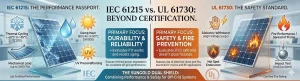
Validation checklist: Before signing off on production, request the supplier's IEC 61215 test report and an I-V curve measured under your actual deployment lighting conditions — not just STC (Standard Test Conditions). STC numbers look great on paper but mean nothing if your panel lives under warehouse LEDs.
What Are the Key Specs to Compare? (Solar vs Battery Decision Matrix)
Here's the full decision matrix. Print this out, stick it on your wall, and reference it every time a new IoT project lands on your desk:
| Decision Factor | Solar Panel | Battery-Only | Hybrid |
|---|---|---|---|
| Upfront cost | $$$ | $ | $$$$ |
| 5-Year TCO (1,000 nodes) | $11K | $85K | $14K |
| Maintenance frequency | Near zero | Every 2–3 years | Near zero |
| Environment requirement | Needs light access | Any | Needs light access |
| Extreme temperature | Efficiency drops, still functional | Capacity crash / permanent damage | Complementary |
| Device volume impact | Needs panel surface area | Battery occupies 25%+ of volume | Moderate |
| Failure mode | Gradual degradation (predictable) | Sudden death (no warning) | Gradual degradation |
| Environmental impact | Low (renewable) | High (battery disposal) | Moderate |
| Scalability | Excellent | Poor (linear maintenance cost) | Excellent |
The pattern is clear: battery-only wins on upfront cost and environment flexibility. Solar and hybrid win on everything else. For any deployment that needs to last more than 2 years with more than a few hundred nodes, the TCO math isn't even close.
Ready to Test Custom Solar Panels for Your IoT Project?
Start with as few as 100 custom panels. Full spec customization. 20-day delivery. TÜV & IEC certified.
Get a Custom Quote →Frequently Asked Questions
Can solar panels power IoT devices at night?
Solar panels alone cannot power devices at night. A properly designed solar IoT system pairs panels with energy storage — either a rechargeable battery or supercapacitor — that stores daytime energy for nighttime use. Size your storage for 3–5 days of autonomy to handle consecutive cloudy days. Most commercial solar IoT nodes use LiFePO4 batteries for outdoor deployments due to their excellent cycle life and thermal stability.
How long do batteries last in IoT devices compared to solar panels?
Primary lithium batteries (like CR2450) typically last 2–5 years in low-power IoT devices, but cold weather can cut that to under 18 months. Solar panels with proper encapsulation (ETFE or glass) last 10–25 years. The real comparison isn't lifespan alone — it's total cost. At 1,000+ nodes, battery replacement labor costs 5–8× more than the solar hardware investment over five years.
What is the minimum solar panel size to power an IoT sensor?
It depends on your power budget and light conditions. For a typical outdoor LoRaWAN sensor transmitting every 60 seconds (~58 µW average), a 2–3 cm² monocrystalline panel is sufficient in direct sunlight. For indoor deployment at 300–500 lux, you'll need 4–6 cm² of amorphous silicon. Always size for your worst-month conditions, not annual averages.
Sources & References
- IEC 61215-2:2021 — Design qualification and type approval for crystalline silicon terrestrial photovoltaic modules. International Electrotechnical Commission. webstore.iec.ch
- IoT Business News (2026) — "IoT Total Cost of Ownership (TCO) Models: From CapEx to OpEx in 2026." iotbusinessnews.com
- ScienceDirect (2024) — "Impact of Low Temperature Exposure on Lithium-Ion Batteries: A Multi-Scale Study of Performance Degradation." Chemical Engineering Journal. sciencedirect.com
- Hubble Network Community — "Designing Battery-Free IoT Devices: Energy Harvesting for Embedded Engineers." hubble.com
- IEC TS 63209-1:2021 — Extended-stress testing of photovoltaic modules. webstore.iec.ch