Sourcing UL-certified RV solar panels comes down to three non-negotiables: the panel carries UL 61730 (not the obsolete UL 1703), the certificate is traceable on UL Product iQ, and the country of origin is confirmed — Indonesia-made panels skip US/EU AD/CVD duties entirely. Custom sizing starts from 50 units MOQ. Everything else in this guide is how you get there without making expensive mistakes.
Why Does UL Certification Matter More Than Most RV Solar Buyers Realize?
UL certification isn't a nice-to-have sticker. For North American market access, it's the hard gate. I've seen distributors receive a container of panels, get to the installation stage, and discover their insurance policy explicitly excludes non-UL-certified equipment. That's not a paperwork problem — that's a $40,000 problem.
Here's the thing most sourcing guides gloss over: there are two UL standards for solar panels, and confusing them is an easy mistake that costs real money.
UL 1703 vs UL 61730 — Which Standard Do You Actually Need?
UL 61730 is the current applicable standard for RV solar panels in North America, replacing UL 1703 which ceased new certifications in 2022. If a supplier hands you a UL 1703 certificate for a panel manufactured after 2022, that's a red flag — not a compliance document.
| Item | UL 1703 (Legacy) | UL 61730 (Current) |
|---|---|---|
| Status | Ceased new certs 2022 | Active — required for new products |
| Alignment | North America only | Aligned with IEC 61730 (global) |
| Scope | Flat-plate PV modules | All PV module types incl. flexible |
| Market Acceptance | Existing panels only | Required for all new North America distribution |
| RV Application | No longer certifiable | Correct standard to request |
| Source: UL Standards & Engagement, IEC 61730 harmonization timeline | ||
What Actually Happens If You Install Non-UL-Certified Panels on a Motorhome?
My experience is that the risk doesn't show up at installation — it shows up 14 months later. A fleet operator I spoke with had 22 motorhomes fitted with panels that carried CE and TÜV but no UL certification. When one unit had an electrical fault, the insurer denied the claim citing non-compliant components. The total cost of retrofitting all 22 vehicles exceeded the original panel savings by a factor of three.
Beyond insurance, some US states require UL-listed equipment for RV electrical systems under NEC Article 690. If you're selling into California or New York, this isn't optional.
How Do You Verify a Supplier's UL Certification Before Placing an Order?
This is where I see the most mistakes. A supplier sends a PDF of a UL certificate — it looks official, has the UL logo, has a certificate number. And it might still be fake, expired, or cover a completely different model than what you're buying. Here's how to actually check.
Step-by-Step: Using UL Product iQ to Confirm Certification Status
- Go to UL's Product iQ database (productiq.ul.com) — this is UL's official public database, free to use.
- Search by manufacturer name or certificate number — use the exact name as it appears on the certificate PDF.
- Check the model scope — confirm the specific panel model you're ordering is listed under the certificate, not just the manufacturer's name.
- Verify the expiry date — certificates have validity periods. An expired certificate is not a valid certificate.
- Cross-reference with the PDF — the certificate number, issue date, and covered models must match exactly between the PDF and the database record.
Real scenario: I once found a supplier whose certificate covered their 100W and 200W rigid panels — but the 300W flexible panel they were selling under the same "UL certified" marketing was not in the certificate scope at all. The certificate was real; the claim was misleading. Product iQ caught it in 90 seconds.
5 Red Flags in Fake or Misrepresented UL Certificates
- Certificate number format is wrong — genuine UL cert numbers follow a specific alphanumeric format; anything that looks hand-edited is suspicious
- The panel model on the certificate doesn't match what you're ordering — the most common "legitimate-looking" misrepresentation
- Certificate is expired but presented as current — always check the validity date, not just the issue date
- Certificate says "UL Listed" but the product is "UL Classified" — these are different designations with different implications
- No UL file number (E-number) — every genuine UL certification has an E-number traceable in Product iQ
What Are the 6 Dimensions Every OEM Buyer Should Evaluate?
Certification is just one dimension. I've built out a 6-dimension framework after watching too many procurement decisions go sideways because buyers only checked the spec sheet and the price. Ask yourself: are you buying a panel, or are you buying a risk profile?
Dimension 1 — Certification Stack: UL 61730 Is the Floor, Not the Ceiling
For North American distribution, UL 61730 is mandatory. But if you're also selling into Europe, you need CE + TÜV. My recommendation: require suppliers to hold both, even if you're only selling in one market today. Switching suppliers mid-season because you expanded into Germany is not a fun experience.
| Certification | Required For | Applies To | Notes |
|---|---|---|---|
| UL 61730 | USA / Canada | Rigid & Flexible | Mandatory for North American market; replaces UL 1703 |
| IEC 61215 | Global baseline | Rigid & Flexible | Performance & durability; thermal cycling, UV, humidity |
| CE Marking | EU / EEA | Rigid & Flexible | Mandatory for EU distribution |
| TÜV | EU (premium signal) | Rigid & Flexible | Third-party verification; strong B2B trust signal |
| RoHS | EU market | Rigid & Flexible | Restricts hazardous substances; required for EU import |
| IEC 61701 (Salt Spray) | Coastal / Marine RV | Flexible (Marine) | Critical for coastal motorhome and marine applications |
| Source: IEC International Electrotechnical Commission; UL Standards & Engagement | |||
Dimension 2 — Country of Origin: Why Indonesia Changes Your Landed Cost
Solar panels manufactured in Indonesia qualify for non-China Country of Origin certificates, exempting US and EU buyers from AD/CVD anti-dumping duties that can add 15–30% to landed costs. This isn't a workaround — it's a legitimate supply chain strategy fully compliant with WTO origin rules.
At 500 units of 200W panels, the duty difference between China-origin and Indonesia-origin can exceed $15,000 on a single order. That's not a rounding error — that's a margin line item. Always ask your supplier for the manufacturing origin certificate, not just the brand origin.
Tariff alert: Solar panels manufactured in China are subject to AD/CVD anti-dumping duties in both the US and EU markets. Some suppliers list a non-China brand address but manufacture in China — always request the factory audit report or manufacturing CoO, not just the company registration address.
Dimension 3 — Custom Sizing & Low MOQ: What's Actually Possible
Here's a misconception I hear constantly: "UL-certified panels only come in standard sizes." Not true. Custom sizing doesn't require a new UL certification if the cell configuration and encapsulant materials remain within the certified product family. A reputable manufacturer can confirm this in writing before you commit.
For OEM motorhome production, standard panel dimensions almost never fit roof layouts optimally. Manufacturers offering custom sizing from 50 units MOQ give you a real competitive advantage in product differentiation — and Sungold's RV Solar Kits are designed exactly for this kind of OEM integration.
Dimension 4 — ETFE vs PET Encapsulant: One Question That Separates 5-Year from 15-Year Assets
Ask your supplier this one question before anything else: Is the encapsulant ETFE or PET? PET-based flexible panels are cheaper and will pass UL 61730 — but expect real performance degradation within 5–8 years. ETFE-based panels from reputable manufacturers routinely hit 15+ years, with premium grades approaching 20.
ETFE (ethylene tetrafluoroethylene) has 99%+ light transmittance, is self-cleaning, and resists UV degradation for decades. It's the same material used in stadium roofs. The price premium over PET is real — but so is the TCO difference.
Dimension 5 — Vibration & Mechanical Load Testing for Road Use
This is the dimension almost nobody asks about, and it's the one that causes the most post-sale problems. RV panels experience continuous road vibration — something fixed-installation panels are never tested for. Ask your supplier specifically for vibration test data and peel strength data for the adhesive system. If they can't provide it, that's your answer.
Sungold's PA621 series, for example, features vibration-hardened laminate and solder design specifically validated for road-use conditions — details available in the Support Center installation guides.
Dimension 6 — After-Sales & Engineering Support: The Hidden Cost of a Cheap Supplier
A supplier with no engineering team is a false economy. For OEM integration, you need wiring diagrams, mounting specifications, and someone who picks up the phone when your production line has a question at 9am on a Tuesday. I've found that mismatched components — even when individually within spec — can cause micro-cycling on batteries when pulse loads interact with charge controller switching frequency. An integrated bundle from a manufacturer who has tested the system as a whole eliminates this variable entirely.
What Do Most UL Solar Sourcing Guides Get Wrong? 4 Counter-Intuitive Truths
Every sourcing guide covers certification, price, and MOQ. Here are four angles that almost nobody talks about — and they matter more than the stuff everyone covers.
A UL-Certified Panel Can Still Fail Your RV Application
UL 61730 certifies that a panel is electrically safe. It doesn't certify that it survives 80,000 km of road vibration. A panel can pass UL testing and still develop micro-cracks within two seasons of regular motorhome use. Always request road-vibration test data separately — it's not part of the UL scope.
The Cheapest UL Panel Often Has the Highest 5-Year Cost
A PET-encapsulated UL 61730 panel costs less upfront. But factor in one replacement cycle over 5 years and the total cost is 40–60% higher than an ETFE-grade panel. For fleet operators running 50+ vehicles, this is a six-figure difference over a vehicle's service life. Unit price is the wrong metric.
Indonesia CoO Is a Supply Chain Strategy, Not a Loophole
Some buyers are nervous about Indonesia-origin certificates, assuming it's legally grey. It isn't. WTO rules on substantial transformation are clear: panels manufactured in Indonesia with Indonesian-origin production qualify for non-China CoO. This is the same principle that makes Vietnamese or Malaysian manufacturing legitimate for tariff purposes. It's supply chain diversification, not evasion.
Flexible Panels Can Outperform Rigid in Real Summer Output
ETFE flexible panels carry a temperature coefficient of -0.29%/°C vs -0.35%/°C for typical rigid glass panels. At a roof surface temperature of 75°C — common in Southern Europe and Australia in summer — flexible panels lose ~3% less power than rigid. In peak summer conditions, the efficiency gap on the spec sheet can reverse in the real world. The spec sheet is measured at 25°C. Your motorhome roof is not 25°C.
How Do You Run the OEM Sourcing Process from Start to Finish?
Here's the five-step process I'd run if I were sourcing UL-certified RV solar panels for a production line today. No fluff, just the sequence that avoids the most common mistakes.
- 1Define your certification requirements by target market. North America = UL 61730 mandatory. EU = CE + TÜV. Selling both? Require both from day one. Map your target markets to a certification checklist before you contact a single supplier.
- 2Shortlist suppliers using UL Product iQ + verified manufacturer filters. Start at productiq.ul.com. Search your shortlisted manufacturers and confirm their UL 61730 certificates cover the specific product family you need — not just the company name.
- 3Request samples and run the 8-point technical checklist. Measure Voc/Isc against datasheet values. Confirm encapsulant material (ETFE or PET — in writing). Check the UL certification label on the physical panel matches the certificate scope. Ask for vibration test data.
- 4Negotiate MOQ, CoO documentation, and warranty terms. Confirm MOQ for custom sizing. Request the manufacturing CoO certificate — not just the brand address. Understand the difference between product warranty (typically 5–10 years) and power output warranty (25 years for rigid glass). They are not the same thing.
- 5Conduct pre-shipment inspection and verify final certification documents. Use a third-party inspector (SGS, Bureau Veritas) for orders over 200 units. Final document check: UL certificate, CoO certificate, test reports, packing list. Don't release payment until documents are verified.
How Do UL-Certified Flexible and Rigid RV Solar Panels Actually Compare?
Both panel types can carry UL 61730 certification. The choice between them isn't about certification — it's about application fit. Here's the data that actually matters for OEM procurement decisions.
| Dimension | Flexible ETFE (UL 61730) | Rigid Glass (UL 61730) | OEM Recommendation |
|---|---|---|---|
| Weight (200W typical) | 1.8–3.5 kg | 10–14 kg | Flexible saves 32–48 kg on 4-panel install — critical for 3.5t GVW |
| Efficiency (STC) | 18–21% | 21–23% | Gap narrowing; top ETFE now ≥20% |
| Temp Coefficient (Pmax) | -0.29%/°C | -0.35%/°C | Flexible wins in hot climates (AU, ME, EU summer) |
| Lifespan / Warranty | 10–15 yr (ETFE grade: 20+ yr) | 25 yr standard | Rigid wins on warranty; ETFE grade determines flexible lifespan |
| Installation | Adhesive / no roof penetration | Mounting rails + roof bolts | Flexible preserves roof warranty — key for OEM liability |
| Curved Roof Fit | Yes (up to 30° arc) | Flat surface only | Class B vans: flexible is the only viable option |
| Unit Cost (FOB ref.) | USD 0.45–0.65/W | USD 0.28–0.45/W | Rigid wins on unit cost; flexible wins on total install cost |
| 5-Year TCO | Moderate (ETFE grade) | Lower unit cost, higher install | Calculate: panel + mounting + labor + roof repair risk |
| Data: Sungold Solar engineering specifications; IEC 61215/61730 standard parameters. Request datasheets for verified figures. | |||
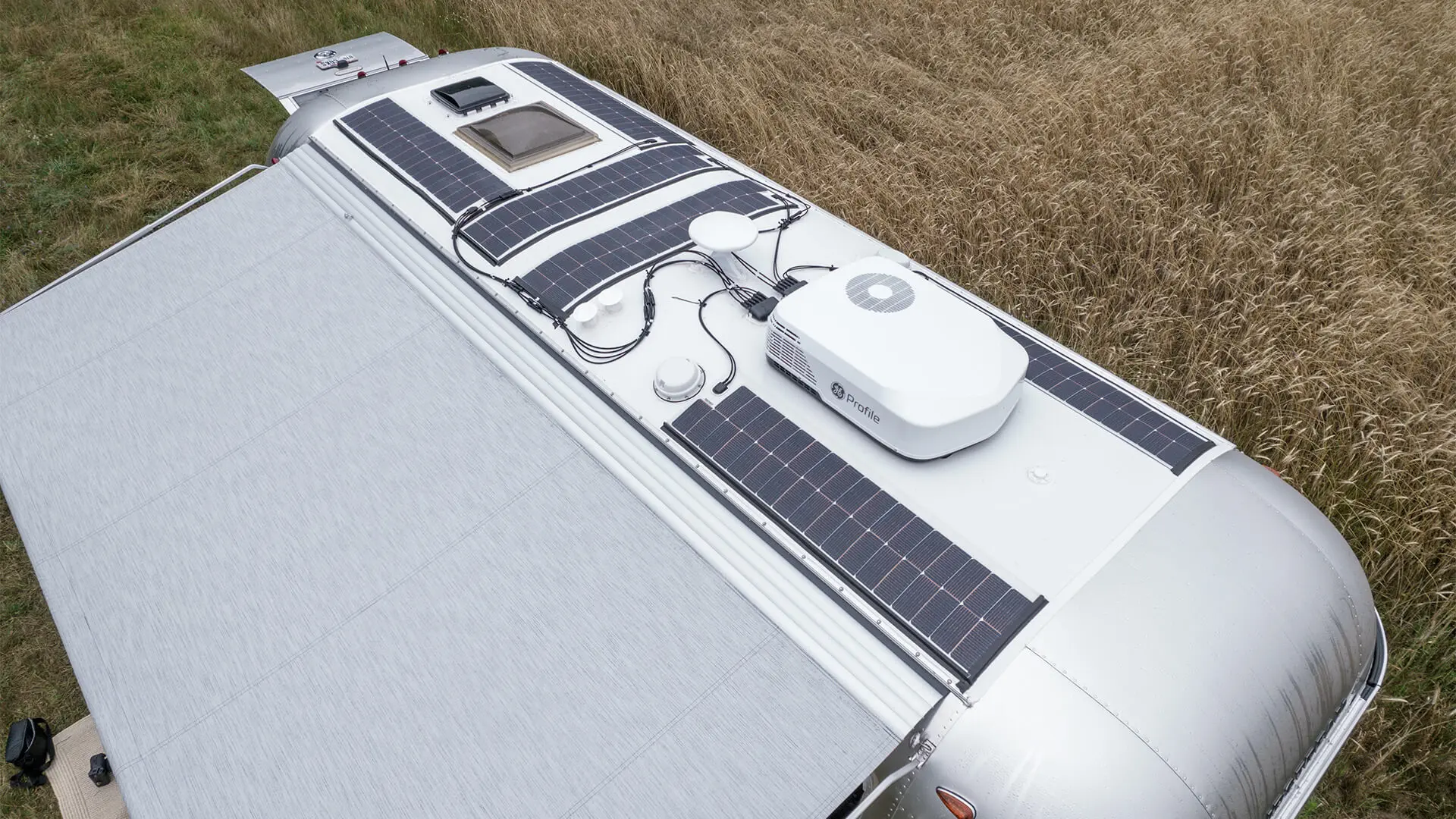
Which panel for which vehicle? Class B curved-roof vans → ETFE flexible (only viable option). Class A flat-roof motorhomes → rigid or high-efficiency flexible depending on payload margin. Class C semi-integrated → hybrid: rigid on flat cab-over section, flexible on curved body areas. Retrofit/aftermarket → flexible-first for installation simplicity and zero roof penetration risk. See Sungold's full RV Solar Kit range for application-matched configurations.
FAQ: What B2B Buyers Most Often Ask About UL-Certified RV Solar Panels
Q: What is the difference between UL 1703 and UL 61730 for RV solar panels?
UL 1703 was the legacy North American standard for flat-plate PV modules. UL 61730, aligned with IEC 61730, replaced it as the primary safety qualification standard — UL stopped issuing new UL 1703 certifications in 2022. For any RV solar panel procurement in 2026, UL 61730 is the correct standard to require. A supplier offering only UL 1703 on a new product should raise an immediate flag.
Q: How do I verify that a solar panel supplier's UL certification is genuine?
Search UL's Product iQ database (productiq.ul.com) by manufacturer name or certificate number. A genuine UL 61730 certificate shows the exact model numbers covered, issue and expiry dates, and the certifying UL entity. If the panel model you're ordering isn't listed in the certificate scope — even if the manufacturer name matches — the certification doesn't cover your product. Cross-reference the PDF against the database before any order.
Q: Can I get UL-certified solar panels with custom dimensions and low MOQ?
Yes. Custom sizing doesn't require a new UL certification if the cell configuration and encapsulant materials stay within the certified product family. Sungold Solar offers UL 61730-certified flexible and rigid panels with custom dimensions from 50 units MOQ. Always confirm in writing whether your custom size falls within the existing certification scope or requires a new test report — this affects both lead time and cost. More details at Sungold 200W Solar Panels.
Grace Hu — Marketing Director & PV Engineer, Sungold Solar
14 years of experience in photovoltaic engineering and global B2B solar procurement. Specialized in custom off-grid solar systems for RV, Marine, and portable applications. Sungold Solar: 18-year B2B manufacturer with facilities in Shenzhen, China and Batam, Indonesia. TÜV / UL / CE / IEC certified product range.
References:
[1] UL 61730 — Safety Qualification for Photovoltaic (PV) Modules, UL Standards & Engagement
[2] IEC 61215 — Terrestrial PV Modules: Design Qualification and Type Approval, IEC
[3] UL Product iQ Database — productiq.ul.com
[4] US AD/CVD Solar Panel Tariff Orders — US International Trade Commission (USITC)
[5] Sungold Solar RV Solar Kits
[6] Sungold Solar Support Center — Installation Guides