
Marine Solar Power Solutions
for Boats, Yachts & Commercial Vessels
If you’re heading out to sea to escape the roar of diesel engines, reduce the hassle of frequently finding shore power sockets, or avoid constantly worrying about battery levels, a well-designed Sungold marine solar system can change all that.
Marine Power Challenges: Why Boats Need Solar Energy
On a yacht, electricity is not just about comfort, but also about safety and confidence. With high-efficiency marine solar panels, you can harness clean, renewable energy even in remote waters. These panels are built to withstand harsh marine conditions, ensuring reliable power for navigation, lighting, and onboard appliances. Enjoy the freedom of longer voyages and peace of mind knowing your energy needs are met sustainably with Sungold’s advanced marine solar panels.
Extend Cruising Time
No reliance on shore power or generators, allowing you to explore the ocean more freely.
Continuous Power for Critical Equipment
Provides stable power for navigation, refrigeration, communication, lighting and other critical equipment.
Support Off-Grid Living
Reduce fuel noise and pollution, enjoy a purer sailing experience.
Flexible & Thin Design
Perfect for small or curved installation spaces like hardtops, awnings and deck areas.
Marine Solar vs Standard Solar Panels
The marine environment is harsh, and ordinary solar panels struggle to adapt. Sungold panels are specifically designed for marine use, balancing performance, reliability, and aesthetics to ensure clean installation and long-lasting durability.
Engineered with corrosion-resistant materials and advanced waterproofing, they continue to deliver consistent power even in the toughest conditions. With Sungold marine solar panels, you can enjoy uninterrupted energy and a worry-free boating experience.
Marine Solar Features
- Salt Mist Resistance - Withstands long-term sea breeze corrosion
- UV Resistance - Adapts to prolonged sun exposure
- Bending & Vibration Resistance - Continuous hull movement in waves won't damage components
- Custom Geometry - Matches irregular spaces of cabin tops, masts, hatches, and decks
Why Adaptation Matters
Most yachts have many irregular or non-rectangular spaces. Sungold’s customized panels can flexibly match:
- Triangular areas (near mast bases)
- Narrow spaces (lifeline stanchions, cabin top sides)
- Curved decks or hardtops
Through customized design, improve wattage utilization while maintaining deck cleanliness and integrated appearance with the hull.
Three Reliable Installation Methods
To ensure safety and long-term durability, Sungold recommends three installation methods. Each method is carefully designed to maximize panel stability and energy efficiency under marine conditions. Whether mounted on flat surfaces, curved decks, or flexible Panel structures, the installation options provide secure and reliable performance. Proper installation not only protects your panels from harsh weather but also ensures optimal power generation throughout your voyage.

Grommet & Screw Installation
Aluminum backplate + stainless steel fasteners, suitable for high sea conditions.
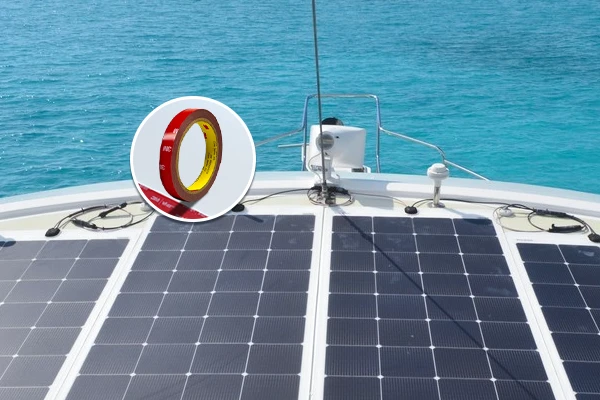
3M Industrial Double-Sided Tape
Suitable for fiberglass or composite surfaces, clean and mark-free, no drilling required.

Neutral Silicone Adhesive
Waterproof, UV resistant, suitable for hole-free installation.
Through customized design, improve wattage utilization while maintaining deck cleanliness and integrated appearance with the hull.
Sungold PA219 Series Typical Applications on Yachts
The Sungold TF flexible solar panel is ideal for yachts, providing lightweight, high-efficiency power in compact spaces. Perfect for deck or cabin installation, it ensures reliable energy for navigation, lighting, and onboard electronics.
Awnings & Canvas Hardtops
Flexible design avoids damaging fabric structure
Cabin Tops & Foredecks
Custom shaped panels avoid hatches and maintain walking space
Arches & Davits
Slender span fits neatly with hidden wiring for aesthetic appeal
How to Determine System Size?
Different sailing needs correspond to different systems. We recommend a deck measurement + power usage audit to design the optimal layout considering shading conditions.
|
Yacht Type
|
Recommended Power
|
Application Scenarios
|
|---|---|---|
|
Weekend Yacht (30-38 ft) |
200-400W |
Supports refrigerator, lights, short-term off-grid living |
|
Coastal Cruiser (38-45 ft) |
400-800W |
Can simultaneously support refrigeration, navigation, fans, and device charging |
|
Long-term Liveaboard (45 ft+) |
1kW+ |
Equipped with marine MPPT, significantly reduces generator use |
Product Specifications
| Model | SGSP 120W | SG-TF-S-120W | SG-TF-M2-140W | SG-PA621-140W | PA219-200W |
|---|---|---|---|---|---|
| Max Power Voltage | 23.3V | 19.8V | 23.2V | 23.2V | 28.7V |
| Max Power Current | 6.07A | 6.07A | 6.03A | 6.03A | 6.20A |
| Open Circuit Voltage | 19.8v | 23.3V | 27.1V | 27.1V | 25.4V |
| Short Circuit Current | 6.42A | 6.42A | 6.33A | 6.33A | 5.91A |
| Cell type | SunPower | Monocrystalline | Monocrystalline | Monocrystalline | Monocrystalline |
| Cell Efficiency | >24.4% | >24.4% | >22.70% | >22.70% | ≥25.0% |
| The maximum system voltage | 1000V DC | 200V DC | 600V DC | 1000V DC | 1500V DC |
| Color | White | ||||
| Product Size | 1060*540*35mm | 1070*540*3mm | 1020*765*3mm | 1133*807*12mm | 890*595*3mm |
| Weight | 6.51KG | 2.51KG | 2.70KG | 4.75KG | 2.6kg |
Reliability & User Experience
Marine-Grade Structure
Salt mist resistant, UV resistant, adapts to harsh marine environments
Waterproof Design
Waterproof glands and sealed wiring prevent water ingress
Efficient Energy Harvesting
High-efficiency MPPT controller optimizes energy collection in shaded conditions
Quiet Operation
Significantly reduces generator usage, making vessel operation quieter
How We Work With You
01
Needs Communication
Share deck photos/CAD sketches + 24h power usage budget
02
Surface Mapping
Analyze curves, flat surfaces, shading, and wiring paths
03
Module Customization
Custom shapes and sizes to improve wattage utilization
04
Installation Planning
Select appropriate fixing methods based on hull type
05
Power System Design
Select marine MPPT, multiple inputs to improve shading adaptability
06
Commissioning & Delivery
On-site voltage and current testing to ensure efficient system operation
Marine Solar Power Solution FAQ
It depends on your daily power consumption and vessel size. As a general guide, weekend yachts in the 30–38 ft range often need 200–400W to run a refrigerator, lights, and basic electronics. Coastal cruisers around 38–45 ft usually benefit from 400–800W to support navigation equipment, fans, and device charging at the same time. Liveaboard vessels over 45 ft often need 1 kW or more to reduce generator use in a meaningful way.
A practical starting point is to list every onboard device, note its wattage, and estimate how many hours it runs each day. That total gives you the baseline for sizing your marine solar panel system.
Choose based on where the panels will be mounted. Flexible solar panels such as the PA219 or TF series are lightweight, can adapt to curved hardtops and biminis, and are ideal when weight, deck shape, or low-profile installation matters. Rigid solar panels such as the SGSP series generally deliver stronger long-term output stability and are better suited to flat mounting locations like arches or davit frames.
If your yacht has both curved and flat mounting areas, combining flexible and rigid panels is often the most practical solution.
In most cases, marine solar panels reduce generator use rather than replacing it completely. A properly sized system can cover daily loads such as refrigeration, lighting, navigation instruments, and phone charging, which means the generator runs less often, especially during daylight hours.
For boats with moderate daily demand, solar panels paired with a lithium battery bank may cover normal use on fair-weather days. However, larger loads such as air conditioning or watermakers still typically require a generator or shore power.
Marine solar panels are designed for salt air, vibration, limited deck space, and wash-down exposure, while regular residential panels are built mainly for static rooftop use. Key differences usually include corrosion resistance, lighter weight, better adaptability to curved surfaces, stronger waterproof sealing, and surface materials that are better suited to onboard movement and occasional foot traffic.
Marine panels can also be made in custom shapes, including narrow, triangular, or irregular designs, so they fit around hatches, masts, and deck hardware more effectively than standard solar panels.
Yes. Sailboats often have small or irregular mounting areas, but that is exactly where custom marine solar panels can be useful. Common installation positions include bimini tops, dodger frames, stern arches, and davit structures. Custom-shaped panels can also fit around mast bases, hatches, and lifeline stanchions without blocking access routes.
Even a compact setup using two or three smaller panels can still make a meaningful contribution to battery charging on a 30–35 ft sailboat.
Yes, but output is reduced when sunlight is limited. Under heavy overcast, marine solar panels may produce only a small portion of their rated power, while light cloud cover usually allows a higher working range. This is why an MPPT charge controller is important on boats. It continuously adjusts voltage and current to capture as much available energy as possible under changing light conditions.
This matters even more in marine use because shading from rigging, sails, booms, and masts is common. In systems with multiple panel inputs, a suitable MPPT setup can help reduce the impact of partial shading on overall charging performance.
Sungold - Your Trusted Marine Solar Partner
Whether for new vessel construction or retrofit upgrades, Sungold's flexible and customized solutions help you efficiently utilize deck space, maintain yacht aesthetics and integrity, and enhance sailing safety and comfort.