
1. Home
  2. »
  3. Blogs
  4. »
  5. Why do you need a flexible solar panel on your boat?

The Difference Between Volts vs. Watts

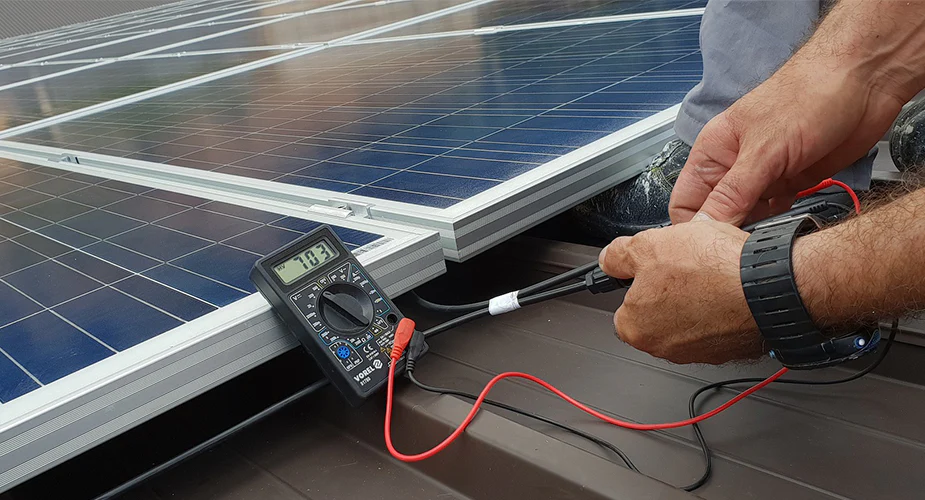
Volts represent electrical pressure, while watts measure the total power rate produced by multiplying volts by amps. In a solar energy system, understanding this relationship is essential for calculating how much energy your appliances consume and ensuring your Sungold Solar panels provide enough wattage to meet your daily power demands safely and efficiently.

When purchasing a solar generator or portable power station, you will first encounter two important terms for electrical ratings – watts and volts. Calculating the wattage of a particular household appliance will help you choose a solar generator that can produce the proper power output to keep your equipment running for an extended period of time.

How many times have you seen a lightbulb printed with “100W/120V” and wondered how the two units of electricity relate? Are watts and volts basically the same thing? Can the two be used interchangeably?

The difference between a watt and a volt.

The fundamental difference is that volts measure electrical potential (pressure), whereas watts measure the actual rate of power transfer. Think of electricity like water flowing through a pipe: volts are the water pressure, and watts are the total amount of water delivered per second. In electrical terms, one watt is defined as the power produced by one ampere of current flowing through an electrical potential of one volt (

$$W = V \times A$$

). For solar users, the voltage determines the system configuration (12V, 24V, or 48V), while the wattage determines how much work your portable solar panels can perform.

Why Are Common Appliance Wattage Ratings Important?

Appliance wattage ratings are critical because they dictate the size of the battery bank and inverter needed for your solar setup. If you underestimate the total watts required, your system may shut down under heavy loads. High-wattage appliances, like space heaters, draw more current and deplete batteries faster than low-wattage electronics like LED lights.

Appliance NameTypical Wattage RangeRecommended System Voltage
Refrigerator100 – 250 W12V / 24V DC or 110V AC
Laptop Computer50 – 100 W19V DC / 110V AC
Microwave Oven600 – 1,700 W110V / 220V AC
Flexible Solar Panel100 – 400 W18V – 40V DC
Electric Tea Kettle1,200 – 3,000 W220V AC

What are Volts?

The BIPM defines a volt as “the difference in potential between two points of a wire carrying a constant current of 1 ampere when the power dissipated between the two points is equal to 1 watt”. Using the analogy of water, voltage, like the pressure of water flowing through a pipe, is the speed of electrons along a circuit through a point. Volt is denoted by a capital “V”.

What Are Amps?

Amperes or amps are denoted by the capital letter “A”. Amperage measures the current or volume of electrons in a circuit. Amperage is the strength of current expressed in amperes. For example, a 1,000-watt microwave oven in your home draws about 8.3 amps. A bolt of lightning during a storm can draw nearly 20,000 amps. Your home’s electrical wiring is usually rated at 15 or 20 amps.

What are Watts?

A watt is a measure of the flow of power through a system. This measurement is the product of the current flowing through a one volt difference. The formula for converting voltage to watts is volts x amps = watts, which are expressed as “W”. The speed of water flowing through a fire hose or a car is actually similar to a watt.

What Are Ohms?

SI defines an ohm as a measurement of the resistance of any object, device or material that may cause a reduction in current flow. Again using water as an example, a small hose has a greater resistance to the flow of water than a large diameter hose, therefore, if measured accordingly, a small hose will have a higher ohmic value. Ohms are represented by the Greek symbol Omega.

Wattage Ratings of Common Appliances

  • Air purifier: 25 to 30 watts
  • Aquarium pump: 20 to 50 watts
  • Ceiling fan: 60 to 70 watts
  • Clock radio: 1 to 2 watts
  • Clothes dryer: 1,000 to 4,000 watts
  • Coffee maker: 500 to 1,000 watts
  • Computer monitor: 25 to 30 watts
  • Corded drill: 600 to 800 watts
  • Curling iron: 25 to 35 watts
  • Dehumidifier: 240 to 300 watts
  • Electric blanket: 200 to 300 watts
  • Electric tea kettle: 1,200 to 3,000 watts
  • Electric stove: 2,000 to 3,000 watts
  • Electric vehicle charger: 2,000 to 7,000 watts
  • Freezer: 30 to 50 watts
  • Fridge: 100 to 250 watts
  • Lawnmower, electric: 1,000 to 1,400 watts
  • Microwave: 600 to 1,700 watts
  • Oven: 2,000 to 2,500 watts
  • Toaster: 800 to 1,800 watts
  • Vacuum cleaner: 400 to 900 watts
  • Washing machine: 500 to 800 watts

How To Convert Volts To Watts?

Now that you know what watts and volts are, it’s time to learn how to convert them.
In short, you can convert volts to watts using Watt’s Law. This law states that the current is equal to the power produced divided by the voltage.
The simple formula to convert volts to watts include:
P (Watts) = A (Ampere) × V (Volts)
P = Power
A = Current in amps
V = Voltage

Volts To Watts Conversion Formula

Below we have mentioned some simple formulas that can help you convert volts to watts
Formula 1: To Convert DC Volts to Watts
In the case of a DC circuit, the power of an electrical device is equal to the voltage multiplied by the current.
P (in Watts) = V (in Volts) × I (in Ampere)
Formula 2: To Convert AC Single Phase Volts to Watts
Power equals PF (Power Factor) times RMS voltage times phase current in amps.
P (in Watts) = PF × I (in Amps) × V (in Volts)
Formula 3: To Convert Volts to Watts using Resistance
Sometimes, you know the resistance of a circuit but not the amperage. In this case, you can convert volts to watts using the formula mentioned below.
P (in Watts) = (V)² ÷ R (in Ohm)

Volts To Watts Conversion Chart

Based on the formula, here are the volts to watts conversion chart.

Volts To Watts FAQs

Here are some frequently asked questions about volt to watt conversion.

What is stronger watts or volts?

Watts are a measurement of electrical power. Volts signify electrical potential. Thus watts are measuring the energy being used and are stronger than volts.

How many watts are 120 volts?

To calculate watts, you must apply the formula P = V × I. Since the current (I) flowing through the circuit is not defined, you cannot use this formula directly.
It is also worth noting that watts will depend on the flow of charge. You need to consider the power factor PF to convert 120 volts in an AC circuit to watts.
However, in the case of a DC current, the value can be substituted directly into the given equation.

Why convert volts to watts?

Converting volts to watts is crucial because it gives you an idea of the power consumption of a particular electrical device. Additionally, it can help you choose the right size solar generator for your power needs.

How many watts does a solar generator produce?

Solar panels provide you with renewable energy whenever and wherever you need it. However, different solar generators have different capacities and wattages.

Does higher watts mean more power?

Simply put, yes. Higher wattage appliances, for example, can deliver more power and heat than ones having half the wattage. Higher wattage devices however will also use more energy than lesser watt models.

Frequently Asked Questions

Q1: Does higher voltage mean more power?

Not necessarily. While increasing voltage can increase power, watts (power) are the product of both volts and amps. A high-voltage system with almost no current will produce very few watts. Power depends on the combination of electrical pressure and the volume of electron flow.

Q2: Can I connect a 12V solar panel to a 120V appliance?

No, you cannot connect them directly. A 12V solar panel produces DC electricity, while a 120V appliance requires AC electricity. You must use a power inverter to convert the low-voltage DC from your Sungold Solar panels into high-voltage AC for the appliance to function.

Q3: Why does Sungold Solar list both Voc and Vmp for panels?

Voc (Open Circuit Voltage) is the maximum voltage without a load, while Vmp (Maximum Power Voltage) is the voltage when the panel is operating at peak efficiency. Knowing both helps you choose a compatible controller and avoid damaging your system with excessive voltage.

Picture of Grace Hu
Grace Hu

Marketing Director at Sungold | PV Engineer with 14 Years of Experience. Specialized in designing custom off-grid solar systems and helping global B2B clients turn concepts into market-ready energy solutions. Expert in RV, Marine, and Portable PV applications.

Share:

More Posts

Send Us A Message

Subscribe to our Newsletter

SunGold
With advanced technology and professional R&D, Sungold Solar has designed a large number of robust and reliable solar products to power your load.

Signup for Newsletters

Would you like to receive exclusive emails with special offers and information about new products? Then subscribe to our newsletter!

    Scroll to Top