




What Does "Lifespan" Mean for a Flexible Solar Panel — Useful Life, Warranty Life, or Economic Life?
How long flexible solar panels last depends entirely on which definition of "last" you are using. Most articles collapse three distinct concepts into one number and then argue about it. Let's separate them.
- Definition: Three lifespan categories for flexible solar modules
- Useful service life — the period the panel continues to generate electricity above a minimum functional threshold for your specific load, regardless of warranty. Warranty life — the contractual period during which the supplier accepts claims for defects or power shortfalls, split into product warranty (workmanship) and performance warranty (output). Economic life — the point at which replacement delivers a better return on investment than continued operation, accounting for degraded power output, maintenance cost, and your system's minimum generation requirement.
For a homeowner with a casual off-grid setup, useful service life is what matters. For a fleet operator running 200 van builds per year, economic life drives the replacement schedule. For a B2B buyer writing procurement contracts, warranty life is the number that must appear in the RFQ. They are rarely the same figure.
Why your panel can still "work" at year 12 and still be the wrong product for your project
A 100 W panel degrading at 1% per year produces approximately 88 W after year 12. That may still power a phone, a fan, and basic lighting. But if it is part of a system designed around 90 W minimum to satisfy a charge controller's MPPT input window, year 11 might be the real end of practical life — not year 20. The silicon is not dead. The system requirement is no longer met. This is the economic life cutoff, and it is specific to every installation. No supplier blog can tell you that number. You can calculate it once you know your load and your degradation rate.
How Long Do Flexible Solar Panels Typically Last in Real Installations?
The honest answer is: shorter than the headline range in most mobile installs, longer than the pessimists claim in well-engineered ones. The range is wide because installation boundary conditions vary far more than cell technology does.
Published lifespan ranges from manufacturers tend to run 10–25 years for premium monocrystalline-over-ETFE designs, with budget PET-frontsheet constructions often showing measurable performance loss within 3–5 years in UV-intensive environments. The key variables are encapsulation material and operating temperature.
Why mounting method changes the real-world answer
A flush-bonded panel on a dark metal van roof in a hot climate runs significantly hotter than its Standard Test Conditions rating. At elevated operating temperatures — 70–80°C cell temperature is not unusual on a sun-facing metal surface in summer — encapsulant materials creep, edge seals soften, and the temperature coefficient of Pmax (typically around −0.30% to −0.45% per °C for monocrystalline silicon) continuously drags output below rated power. The panel degrades faster, not because of silicon wear, but because of thermal and mechanical stress on everything else in the laminate stack.
I've found that installations with even a small ventilation gap under the panel — 10–15 mm of airflow — show measurably lower module temperature and proportionally slower apparent degradation compared to fully flush-bonded configurations on identical substrates. The datasheet degradation number assumes something closer to the ventilated condition. Flush mounting is the buyer's choice, but it is not the condition the warranty degradation curve was modeled on.
Monocrystalline ETFE laminate vs CIGS vs PET-frontsheet budget builds
ETFE frontsheet panels hold UV resistance significantly longer than PET-based designs. ETFE transmittance degrades slowly over years of UV exposure; PET may yellow visibly within 18–36 months in high-UV environments, directly reducing light transmission and output. CIGS thin-film laminates have different degradation modes — primarily related to sodium migration and moisture ingress at the active layer — but can show more stable output curves when properly encapsulated. Budget monocrystalline panels with PET fronts and inadequate edge sealing should be treated as short-service-life products regardless of any printed year count on the box.
Two product lines illustrate the spectrum well. The Sungold TF Series uses ETFE frontsheet construction with a reinforced composite structure — step-on rated, IP68 waterproof, and 672-hour salt mist tested — giving it a durability profile suited to marine decks and RV roofs where mechanical stress is highest. The Sungold PA219 Series takes a different approach: polymer composite materials instead of a traditional ETFE laminate stack, achieving TÜV/CSA certification, a Class C fire rating, and 3.3 kg/m² weight — relevant when fire compliance or low-load commercial roofing drives the specification. Both designs are engineered around specific failure modes; understanding which failure mode matters most for your application is the first step in selecting the right product for a target service life.
How Do Flexible Solar Panels Degrade Over Time — and What Fails First?
Degradation is not one process. It is several competing failure modes racing each other, and which one wins depends on your installation environment.
The main failure mode competition
In mobile RV and marine installs, the sequence I observe most often runs like this: first, edge seal integrity is compromised — by UV, by thermal cycling that stresses the laminate perimeter, or by an installation that left the edge under mechanical tension. Once moisture has a path in, EVA encapsulant hydrolysis produces acetic acid, accelerating delamination from the backsheet. By the time power loss is noticeable, the laminate cross-section has been wet for months.
Parallel to this, solder joints in the cell interconnects fatigue from thermal cycling — the expansion mismatch between copper ribbons and silicon generates cyclic strain. This does not require vibration; it happens on every parked panel that heats and cools daily. Visible symptoms are power loss under partial shade that is disproportionate to the shaded area, because a cracked cell junction in a bypass-diode zone takes the whole diode section with it.
Annual degradation rate: what the 0.5–1%/year figure actually assumes
Published degradation rates are measured at Standard Test Conditions — 1000 W/m² irradiance, 25°C cell temperature, AM 1.5 spectrum. Real operating temperatures in mobile installs are higher. The temperature coefficient of Pmax for monocrystalline silicon runs approximately −0.30% to −0.45% per degree Celsius above 25°C. A cell running at 65°C in summer is already down 12–18% from its STC rating before any aging occurs. That is not degradation in the usual sense, but it compounds with true aging.
Additionally, Light-Induced Degradation (LID) causes an initial power drop in the first hours to days of illumination — typically 1–3% for standard p-type monocrystalline silicon. This first-year drop is real and separate from the annual 0.5–1% figure, which starts from the post-LID baseline. Some product literature is ambiguous about whether the year-one and long-term numbers are using the same baseline. Ask the supplier.
| Failure mode | Root cause | Accelerated by | First observable symptom |
|---|---|---|---|
| Edge seal moisture ingress | UV degradation or mechanical stress opens perimeter seal | High UV, thermal cycling, improper bonding, over-bending | Visible discoloration at panel edges; rising series resistance |
| EVA / encapsulant delamination | Hydrolysis once moisture enters; acetic acid production accelerates separation | Elevated temperature + moisture ingress together | Bubbles or haze visible through frontsheet; non-uniform Isc under uniform light |
| Cell micro-cracking | Thermal cycling strain + vibration fatigue at cell fracture points | Road vibration, installation over-bend, point loads | Isc drop, disproportionate shade response, EL imaging shows dark areas |
| Interconnect / solder joint fatigue | Expansion mismatch between Cu ribbon and silicon under thermal cycling | High temperature swings; flush mounting amplifies range | Rising series resistance; power loss at high irradiance disproportionate to shade |
| Frontsheet UV yellowing (PET only) | UV photodegradation of polyester film; loss of optical transmittance | High UV irradiance; low-quality PET without UV stabilizer | Visible yellowing or cloudiness of panel surface within 18–36 months |
| Connector corrosion | Moisture intrusion at MC4 or proprietary connectors; galvanic reaction | Marine salt-fog; inadequate IP-rated connectors; loose coupling | Intermittent output; heat at connection point; voltage drop under load |
What Is the Difference Between a Product Warranty and a Performance Warranty on Flexible Panels?
Warranty structure is where B2B buyers and retail consumers make the most expensive reading errors. There are two separate documents, and they protect against two different things.
Product warranty: materials and workmanship
The product warranty (sometimes called a materials warranty or workmanship warranty) covers defects that exist at the time of manufacture or that develop from manufacturing faults — delamination on a new panel, a bypass diode that fails within months of installation, a junction box that was improperly sealed from the factory. This warranty is typically shorter: 1–5 years is common in the flexible/lightweight panel category, compared to 10–12 years in rigid glass module tiers.
Critically, the product warranty almost always contains a list of voidance conditions that map directly to the most common installation errors: bending beyond the specified minimum radius, mounting with incompatible adhesives that chemically attack the backsheet, drilling through the laminate for cable routing, and point-loading from boots or tools. My experience is that these conditions are responsible for the majority of in-warranty claim rejections — not material defects.
Performance warranty: output guarantee over time
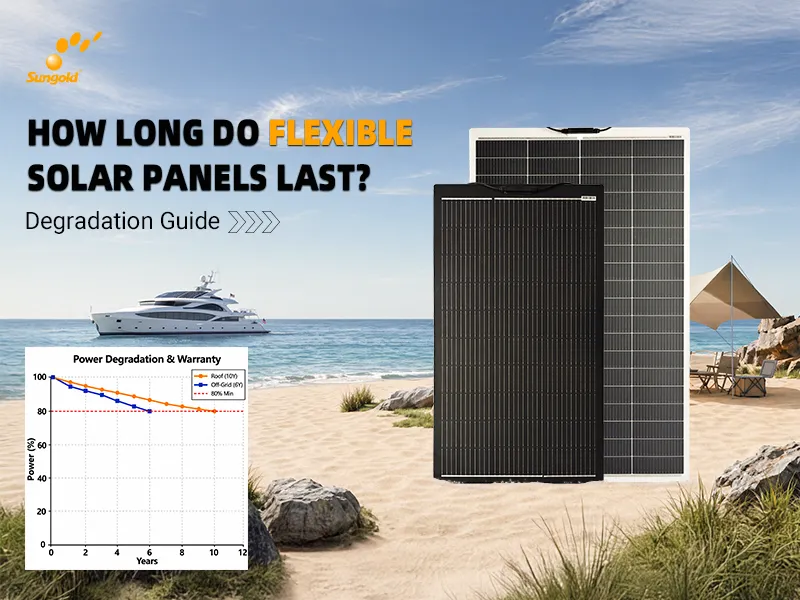
The performance warranty guarantees that the panel will maintain a minimum percentage of its rated output at defined intervals — for example, 90% in year 1, declining to 80% by year 10 or year 25, measured at STC. This is a power floor guarantee, not a reliability guarantee. A panel can be structurally intact, connector fully functional, and still breach its performance warranty if cell degradation is faster than the contracted curve.
Why a Long Performance Warranty Line Does Not Predict Your Field Lifetime
This is the point most lifespan articles skip because it is uncomfortable to say in a product context. But it is the most useful thing I can tell you if you are making a real purchasing decision.
Product warranty vs performance warranty — what each actually pays for
A supplier offering a 25-year performance warranty on a flexible laminate is making a statistical contract, not an engineering promise about your specific roof. The warranty curve is derived from accelerated aging test sequences — thermal cycling, damp heat, UV pre-conditioning — defined in standards like IEC 61215 for crystalline silicon modules and related test frameworks for flexible/consumer PV products.[1] Passing those tests qualifies the product design. It does not certify your specific installation, your specific mounting adhesive, your specific roof temperature, or your specific cable routing.
The mismatch shows up in field data. The flexible panel category has disproportionate representation in early-failure datasets because the product is inherently more sensitive to installation-driven failure modes than a rigid glass module in an aluminum frame. A rigid panel in a roof-mount racking system is mechanically isolated, thermally decoupled from the substrate, and inspectable. A flush-bonded flexible laminate is none of those things.
The three failure modes warranties rarely cover — but installers trigger every week
First: point loading. Walking on a flexible panel during installation — even briefly — creates localized stress concentrations that can cause micro-cracks the naked eye cannot see. EL imaging reveals them; a warranty claim inspection rarely includes EL imaging unless the buyer specifically requests it.
Second: adhesive incompatibility. The most common installation scenario uses VHB tape or a structural adhesive chosen for substrate adhesion, not chemical compatibility with the panel's backsheet polymer. Some adhesives attack PET and certain EVA formulations over time, softening the backsheet and creating a moisture ingress pathway at the bond line. The failure looks like edge delamination. The cause is chemistry, not manufacturing defect.
Third: cable strain at the exit point. When a cable run is under tension — because the installer pulled it tight to a clip 30 cm from the junction box — the strain is transferred directly to the junction box seal or the cable entry point. Thermal cycling then works a micro-movement at that point every day. Over 18 months, a very small gap opens. Water finds it. This is not covered by any standard warranty language.
How IEC qualification tests relate to lifespan — and the gap to your mounting stack
IEC 61215's damp heat test (DH) runs 1,000 hours at 85°C and 85% relative humidity — a severe accelerated stress. Thermal cycling (TC) runs 200 or 400 cycles between −40°C and +85°C. These sequences establish that a design can survive defined abuse without catastrophic failure. They are not a year-to-year calendar proxy. The standard itself does not state that passing TC200 equals 20 years of operation. That extrapolation is a modeling exercise with assumptions, not a direct measurement.[2]
For a flexible panel bonded to a steel van roof with a temperature swing of 60°C per day in a hot climate, the effective number of thermal cycles per year is roughly 365. IEC TC200 covers approximately six months of that. TC400 covers roughly a year. The standard was not designed to simulate a vehicle thermal environment; it was designed as a comparative qualification pass/fail. Buyers who understand this ask for TC400+ test reports, not TC200, when evaluating flexible laminate durability for mobile applications.
How Do Flexible Solar Panels Compare to Rigid Glass Panels on Lifespan and Warranty?
The comparison is real, and the trade-offs are honest. Neither product type wins unconditionally — the right answer depends on what your installation actually requires.
| Factor | Flexible laminate (mono ETFE, typical mid-tier) | Rigid glass-framed module (standard commercial tier) |
|---|---|---|
| Typical useful service life | 8–15 years in mobile/marine installs; longer in low-stress fixed mounts with airflow | 20–30+ years in rack-mounted rooftop installs |
| Typical product warranty | 1–5 years (workmanship / defects) | 10–12 years (workmanship / defects) |
| Typical performance warranty | 10–25 years (varies widely by brand tier) | 25–30 years (industry standard for Tier 1) |
| Primary degradation driver | Encapsulant/edge seal failure, interconnect fatigue, UV frontsheet yellowing (PET only) | Cell LID/LeTID, glass soiling, EVA browning, junction box sealant aging |
| Impact of installation error on warranty | High — over-bending, adhesive incompatibility, and point loads are common void triggers | Lower — framed module is mechanically robust to most site errors |
| Thermal operating disadvantage | Significant when flush-mounted; NOCT may run 15–25°C higher than racked equivalent | Lower when rack-mounted with rear airflow gap |
| Why choose flexible despite shorter life | Weight, profile, curved surface conformity; applications where rigid cannot be mounted | N/A — rigid not suitable for curved surfaces, low-profile builds, weight-limited platforms |
The table above is a starting point, not a verdict. A well-installed ETFE flexible panel on a ventilated aluminum substrate in a temperate climate can outlast a rigid panel installed on a hot corrugated steel roof with no rear airflow. Conditions matter more than the product category label.
What Should B2B Buyers and OEMs Specify for Lifespan in an RFQ or Supplier Audit?
If "how long do flexible solar panels last" is a question in your procurement process, the answer has to be more than a blog post range. Here is what goes into a defensible supplier evaluation.
- Product warranty duration and coverage scope — in writing, as a separate document, not embedded in marketing material
- Performance warranty — minimum output % at year 1, year 5, and year 10 at STC; who bears re-test cost; dispute resolution procedure
- IEC qualification test evidence — specifically: TC200 or TC400, DH1000, UV preconditioning, and for flexible types, any bending sequence test certificates
- EL test protocol at goods receipt — define sampling frequency (e.g., 5% of each lot) and pass/fail criteria for micro-crack area versus panel area
- Post-TC Pmax degradation limit — maximum allowable drop in Pmax after the qualifying TC sequence, stated as a percentage; typically <5% for TC200
- Encapsulant and frontsheet material declaration — ETFE vs PET; specify minimum UV transmittance retention after UV conditioning
- Batch traceability — cell origin, encapsulant lot, lamination date; required for warranty claim forensics
- Reject: warranty language that covers "normal degradation" without defining the degradation curve numerically
- Reject: performance warranty that refers only to "manufacturer's discretion" for remediation
My experience is that a supplier who can provide TC400 results, a lot-level EL sampling plan, and a clear two-document warranty structure (product + performance) is almost always worth the procurement investment — not because the certificates guarantee your outcome, but because producing them requires the organizational discipline that correlates with consistent manufacturing quality. The ones who cannot provide the documents in two business days are telling you something equally useful.
How Can Installers Maximize Flexible Panel Lifespan on RVs and Boats?
Most lifespan articles end with "buy quality panels" and call it done. That is the least useful advice possible once you already have panels in hand. Here is what actually changes the outcome after purchase.
Ventilation is the single highest-leverage intervention
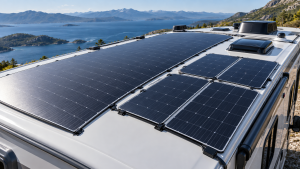
A 10–15 mm standoff gap under the panel drops module operating temperature meaningfully, directly slowing thermally-driven degradation modes and reducing the thermal cycling amplitude the interconnects experience every day. On curved surfaces where standoff is impractical, use the thickest compatible adhesive tape that still achieves a reliable bond — every millimeter of separation between laminate and substrate reduces peak temperature.
Edge seal protection for marine and humid environments
If the installation environment includes salt spray, condensation, or frequent rain, the perimeter edge of the laminate is the primary vulnerability. A bead of compatible UV-stable sealant around the panel perimeter, applied over the adhesive bond and continuous around all four edges, significantly delays moisture ingress. Use a sealant compatible with both the backsheet polymer and the mounting substrate — test adhesion on a small area first if using a new adhesive system.
Connector maintenance: the overlooked check
Marine and high-humidity installs should include annual connector inspection. MC4 connectors rated IP67 maintain that rating only when properly mated and locked. A partially inserted connector degrades to IP54 or lower. Inspect for corrosion, check that locking clips are seated, and replace any connector showing discoloration or physical deformation. This inspection takes five minutes and can prevent the most common field failure mode in the category.
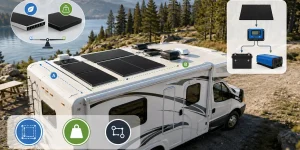
For a complete guide to RV solar system design and kit selection, including matching flexible panels to appropriate charge controllers and battery banks, the Sungold RV kits page covers current configurations and sizing guidance.
What Is the Bottom Line on How Long Flexible Solar Panels Last?
How long do flexible solar panels last is a question with a conditional answer. Under good conditions — ETFE frontsheet, ventilated mounting, correct bend radius, compatible adhesive, marine-rated connectors — a quality flexible laminate can deliver 12–18 years of service in mobile applications. Under bad conditions, three years to visible degradation is not unusual.
The headline warranty number is not a prediction. It is a contract offer with conditions. Read both warranty documents — product and performance — before assuming the year count applies to your installation as executed.
For B2B buyers, the useful question is not "how long do they last?" but "how do I qualify a supplier's product for my specific application lifetime?" That answer lives in IEC test reports, EL sampling data, and a clearly written dual-warranty structure — not in any article's year range, including this one.
If you want to review specifications and warranty documentation directly, the full range is on our flexible solar panel product page. For step-on rated, marine-grade applications, see the TF Series flexible panels. For commercial roofing and low-load structures requiring fire certification, the PA219 Series (TÜV/CSA certified, Class C fire rated) is the relevant starting point.
View flexible panel specs & warranty docs Explore RV solar kits
Frequently Asked Questions About Flexible Solar Panel Lifespan
How Long Do Flexible Solar Panels Last?
There Is No Universal Year Count: Lifespan Is Set By Module Quality, Encapsulation, And How The Panel Is Mounted And Cooled. Many Flexible Installs Fail Mechanically Or At The Edge Seal Before Silicon Wears Out On Paper. Treat Manufacturer Ranges As Conditional On Correct Bend Radius, Airflow, And Connector Protection — Then Validate With Datasheet Warranty Terms, Not Blog Summaries Alone.
Do Flexible Solar Panels Degrade Faster Than Rigid Panels?
They Can Show Faster Apparent Power Loss In Harsh Mobile Conditions Because The Laminate Runs Hotter When Flush-Mounted And Lacks Glass-Front Mechanical Protection. Rigid Glass Modules Also Carry Longer Industry-Standard Performance Warranties In Many Product Tiers. Compare Annual Degradation Coefficients And NOCT-Class Operating Assumptions On Datasheets Rather Than Relying On Generic Percentages From Third-Party Articles.
What Warranty Do Flexible Solar Panels Have?
Most Products Publish Two Layers: A Shorter Product Warranty For Defects In Materials And Workmanship, And A Longer Performance Warranty That Guarantees Minimum Power At Specific Years Under Stated Test Conditions. Installation Errors, Over-Bending, Drilling, And Incompatible Adhesives Commonly Void The Product Warranty. Read Exclusions Before Purchase And Align Procurement Contracts With The Supplier's Written Warranty PDF.