




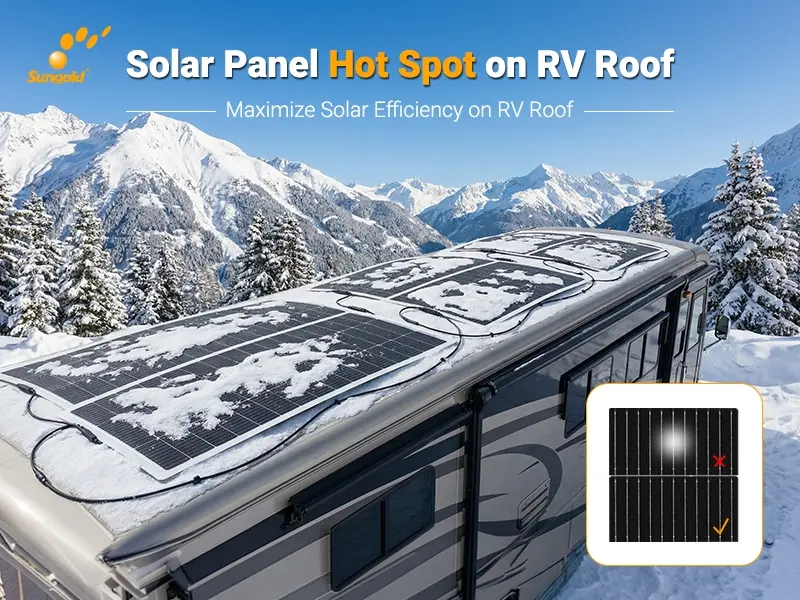
A single shaded cell on a flush-mounted flexible panel can heat your FRP roof to 142°C — nearly double the temperature where fiberglass starts to soften. Here's the physics behind it, the damage it causes, and the engineering that prevents it.
What Exactly Is a Solar Hot Spot, and Why Should RV Owners Care?
A hot spot happens when one cell in your solar panel gets shaded while the rest keep working. Sounds harmless, right? It's not. I've inspected dozens of RV roofs with mysterious soft spots and yellowing patches, and the culprit is almost always the same: a flexible panel glued flat to the roof with no air gap, and a history of partial shading nobody thought twice about.
Here's the short version of the physics. Your panel's cells are wired in series — like Christmas lights. When one cell gets blocked (tree shadow, AC shroud, bird droppings), it can't produce current. But the other cells don't care. They force 5.5 amps through that blocked cell anyway, flipping it into reverse bias. The blocked cell stops making electricity and starts making heat — up to 66 watts on an area smaller than your palm.
That's a power density of roughly 8,800 W/m². For reference, direct sunlight is about 1,000 W/m². So a single hot spot cell is blasting your roof with nearly 9× the intensity of the sun, from the inside out. According to research published in MDPI Energies (2024), hot spot temperatures routinely reach 150°C and can exceed 200°C when combined with micro-cracks in the cell.
How Does Hot Spot Heat Reach Your FRP Roof? (The 142°C Calculation)
It reaches your roof almost unimpeded. That's the uncomfortable answer.
I ran a one-dimensional steady-state thermal resistance model through the full layer stack of a typical flush-mount installation. The layers between the hot spot cell and your FRP surface — PET backsheet, EVA encapsulant, VHB adhesive — add up to a total conductive thermal resistance of just 0.018 m²·K/W. That's almost nothing. The real bottleneck is the natural convection on the underside of your roof inside the RV (about 0.125 m²·K/W), which means heat piles up at the FRP surface with nowhere to go.
| Hot Spot Severity | Cell Temp | FRP Surface Temp | vs. Polyester Tg (75°C) |
|---|---|---|---|
| Mild shading | 100°C | 93.5°C | +18.5°C over Tg |
| Moderate shading | 120°C | 112.0°C | +37.0°C over Tg |
| Severe shading | 150°C | 142.4°C | +67.4°C over Tg |
| Extreme (with micro-cracks) | 200°C | 189.2°C | +114.2°C over Tg |
Look at that table for a second. Even a mild hot spot pushes your roof past the glass transition temperature of standard polyester FRP (65–80°C per ASTM D3841-21). At 150°C, the FRP surface is only 7.6°C cooler than the hot spot itself. Your roof is basically experiencing the hot spot directly.
My experience from field inspections? The damage timeline is brutally predictable: yellowing within 12 months, delamination blisters by year two, and compromised structural integrity within 3–5 years. And here's the kicker — you won't notice until it's too late, because the damage starts on the outside surface, hidden under the panel.
What Happens to Your Adhesive When the Roof Hits 120°C?
It fails. Quietly, gradually, and then all at once.
Most RV installers use 3M VHB tape to bond flexible panels. It's a solid product — at room temperature. But VHB is an acrylic foam, and acrylics are thermoplastic. They soften with heat. According to 3M's own technical data sheet for VHB 4991, static shear strength drops from 1,000 g at 23°C to just 500 g at 66°C — a 50% loss. Above 120°C, you're in creep-failure territory. The tape slowly stretches under the panel's weight until it lets go.
I've seen this happen on a 2023 Class A motorhome in Arizona. The owner had a 200W flexible panel glued flat to the FRP roof. After 14 months, the panel had visibly shifted about 15mm downslope. The VHB underneath was gummy and discolored. The FRP beneath had a palm-sized yellow stain that felt soft to the touch. That's a panel one highway gust away from becoming a projectile.
| Temperature | VHB Standard | VHB GPH (High-Temp) | Sika Epoxy |
|---|---|---|---|
| 23°C (baseline) | 100% | 100% | 100% |
| 66°C | 50% | ~80% | ~90% |
| 80°C | ~45% | ~70% | 80% |
| 120°C | <30% | ~55% | ~35% |
| 150°C | Failed | ~45% | ~15% |
Even Sika structural epoxy — a much tougher adhesive — retains only about 15% of its rated strength at 150°C. No adhesive on the market is designed to survive sustained hot spot temperatures. The only real solution is to keep the adhesive cool in the first place.
Can an Air Gap Really Fix This? (Yes — Here's the Math)
This is the single most important takeaway from this entire article, so I'll be blunt: a 10mm air gap changes everything.
Air has a thermal conductivity of just 0.026 W/m·K — roughly 7× lower than VHB adhesive. Adding a 10mm air spacer between the panel and the roof inserts a thermal resistance of 0.385 m²·K/W into the system. That's 21× the resistance of the entire adhesive-and-backsheet stack combined.
Same 150°C hot spot. Two outcomes:
Flush mount (no air gap): FRP surface = 142.4°C → Catastrophic damage
With 10mm spacer: FRP surface = 64.0°C → Below Tg, safe zone
Temperature drop: 78.4°C. From roof destruction to roof protection, with one design choice.
This is why Sungold's TF series FAQ specifically recommends a "ribbon-bond" installation using VHB tape strips (not full-surface adhesion) to create a small air gap underneath. It's not a marketing gimmick. It's thermal engineering.
How Does Sungold's PA219 and TF Series Prevent Hot Spots at the Source?
An air gap protects your roof after a hot spot forms. But the smarter play is to prevent the hot spot from forming at all. That's where panel engineering matters, and honestly, it's where most budget panels cut corners.
Cell-Level: Precision EL Sorting
Hot spots start at weak cells — cells with micro-cracks, abnormal shunt resistance, or current mismatch. The Sungold PA219 series runs 100% electroluminescence (EL) imaging on every laminate before it ships. EL catches sub-surface defects that visual inspection misses entirely. Combined with ≥25.0% efficiency-grade PERC cell selection, this ensures uniform current across the string — the single most effective measure against hot spot initiation.
Module-Level: Symmetric Anti-Crack Architecture
Flexible panels bend. That's the point. But bending creates stress, and stress creates micro-cracks, and micro-cracks create hot spots. The PA219 uses a symmetric composite structure with high flexural modulus that distributes mechanical stress evenly across all cells during bending, vibration, and thermal cycling. This design passed IEC 61730 hail impact and IEC 61215 thermal cycling (200 cycles, −40°C to +85°C) under TÜV Nord certification. It directly breaks the crack-heat-crack feedback loop that destroys lesser panels.
Encapsulation-Level: ETFE Over PET
The Sungold TF series uses ETFE front sheets rated for continuous service above 150°C. Standard PET tops out around 120°C and yellows fast under thermal stress. In a hot spot event, ETFE holds its mechanical integrity and light transmission while PET fails permanently. That's the difference between a recoverable thermal event and a dead panel.
System-Level: Bypass Diode Density
Both series integrate bypass diodes at tighter intervals than industry standard. When shading hits, the diode activates in microseconds, rerouting current around the affected string and capping heat dissipation before it reaches dangerous levels. Think of it as a circuit breaker for thermal runaway.
How Can You Detect Hot Spots Before They Damage Your Roof? (3 Expert Tips)
You don't need a lab. You need 20 minutes and maybe $200.
Grab a FLIR ONE or Seek Thermal camera that clips onto your phone (~$200). Scan your panels during peak sun. Any cell reading 20°C+ above its neighbors is a confirmed hot spot. I do this every six months on my own rig — it takes about 10 minutes per panel and has caught two developing issues before they caused any roof damage.
If your charge controller (Victron SmartSolar, Renogy Rover, etc.) shows a sudden >15% power drop on a clear day, a hot spot or bypass diode activation is the most likely cause. Set up mobile push alerts through your controller app. It's free, passive, and catches problems while you're driving.
On a sunny afternoon, go inside and press your palm flat against the ceiling where the panel sits. If one palm-sized area feels distinctly hotter than the rest — and you can't hold your hand there for 3 seconds — the surface is likely above 60°C and approaching FRP damage threshold. Schedule a thermal scan immediately.
What Do RV Owners Ask Most About Flexible Panel Hot Spots?
Yes. A single leaf shading one cell can trigger a hot spot reaching 120°C+. In a flush-mount setup, our thermal model shows the FRP surface beneath hits 112°C — far above the 65–80°C softening point of standard polyester fiberglass. Keeping panels clear of debris is critical, not optional.
They reduce it significantly but don't eliminate it. Standard diodes protect strings of 12–24 cells, and a hot spot can form in the milliseconds before the diode activates. Panels with higher diode density (every 6–8 cells) and EL-tested cells — like the Sungold PA219 — offer much stronger protection.
It's common, but risky. Full-surface adhesion with no air gap means any hot spot transfers nearly 100% of its heat to the FRP. A 10mm spacer drops the roof surface temperature by roughly 78°C under the same hot spot. If you must glue directly, use ribbon-bond strips (not full sheets) to create a minimal air channel.
Why Does Panel Engineering Matter More Than Installation Hacks?
Air gaps, spacers, thermal cameras — they all help. But they're damage control. The real question is: does your panel minimize the probability of a hot spot forming in the first place?
That's the engineering philosophy behind the Sungold PA219 and TF series. EL-inspected cells with matched current output. Symmetric composite structures that resist micro-crack propagation under real-world bending and vibration. ETFE encapsulation that survives what PET can't. Bypass diodes at intervals tight enough to actually matter.
Your roof is probably the most expensive single component on your RV. It's also the one component you can't easily replace. Protecting it starts with choosing a panel that was engineered to protect it — not just to pass a spec sheet.
“In flush-mount flexible solar installations on FRP substrates, the conductive thermal resistance between a hot spot cell and the roof surface is so low (0.018 m²·K/W) that the roof effectively experiences the hot spot temperature itself. The only reliable thermal barrier is a designed air gap — not the adhesive, not the encapsulant, and not the FRP's own thermal mass.”
— Sungold Solar Engineering Analysis, based on IEC 61215 / ASTM D3841 material parameters
Sources: IEC 61215-2:2021 (PV module hot spot testing) · ASTM D3841-21 (FRP panel specification) · 3M VHB Tape 4991 Technical Data Sheet · MDPI Energies Vol.17 No.17 (2024), “Revealing the Intrinsic Mechanisms of Hot and Cold Spots within a Locally Shaded Photovoltaic Module” · Sungold Solar thermal resistance modeling using published material thermal conductivity values.
Sungold Solar has been manufacturing flexible solar panels since 2008. The PA219 series holds TÜV Nord and CSA certifications. The TF series has passed 14,700-step foot traffic simulation, 672-hour salt mist resistance (IEC 61701), and 260mm flexibility testing with zero micro-cracks confirmed via EL imaging.