





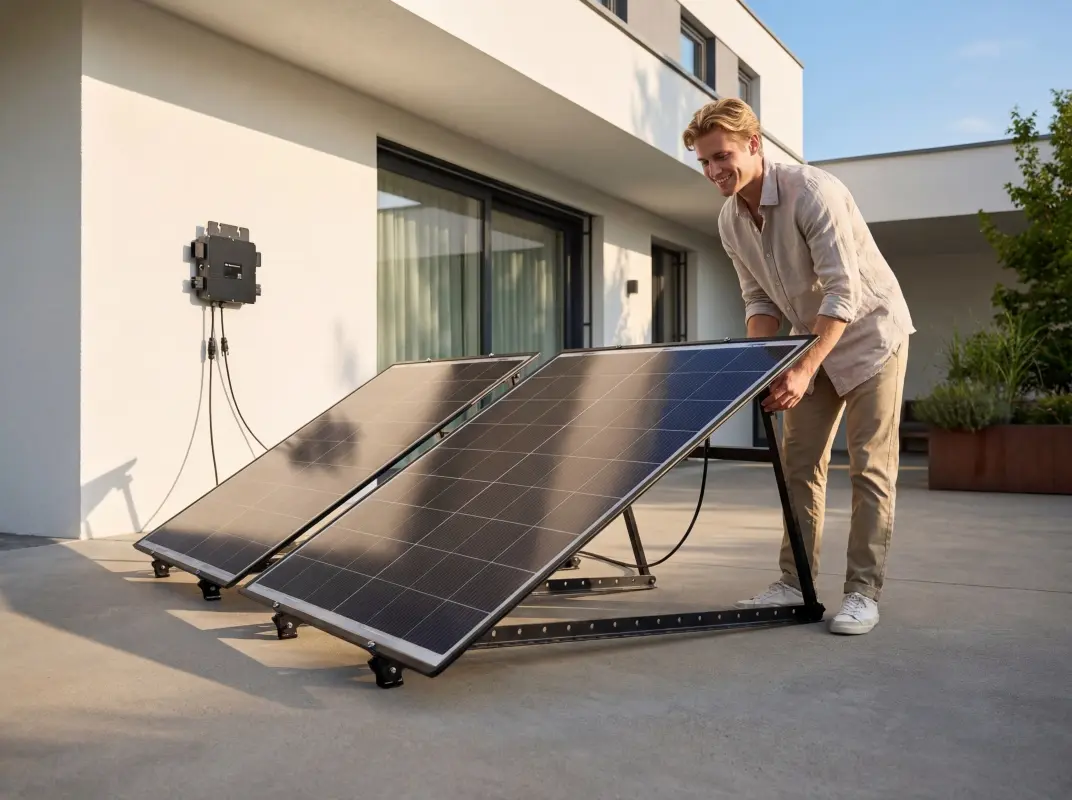
Balcony solar is designed for renters, apartment dwellers, small budgets, and fast setup where local rules allow — typically €400–€900 for an 800W system. Rooftop solar is for property owners who want higher output, long-term savings, and a professionally installed system — typically €7,000–€20,000 for 5–15 kWp. For renters: balcony solar is usually the only viable option. For homeowners with 10+ year plans: rooftop solar delivers larger absolute lifetime savings, though balcony solar can show a higher percentage ROI due to its lower base cost.
15-Factor Comparison: Balcony Solar vs Rooftop Solar
| Factor | Balcony / Plug-In Solar | Rooftop Solar |
|---|---|---|
| System cost (EU) | €400–€900 (800W) | €7,000–€20,000 (5–15 kWp) |
| System cost (USA) | $400–$1,200 (800W–1,200W) | $15,000–$35,000 (8–15 kWp) |
| Annual electricity generated | 600–900 kWh/year (800W, south) | 4,500–12,000 kWh/year (5–15 kWp) |
| Annual savings (EU, €0.32/kWh) | €100–€200/year | €600–€1,800/year |
| Payback period (after subsidies) | 2–5 years | 6–12 years |
| Installation time | Often same-day setup where local rules allow | Professional install; commonly 1–2 days after permit approvals |
| Permit / registration | Often simplified, but rules vary by country, utility, and building | Usually requires permits, utility interconnection, and installer documentation |
| Available to renters | Often possible with landlord/building approval and compliant mounting | Usually not practical without property-owner approval and consent |
| Structural requirements | Non-roof mounting; balcony, wall, stand, or railing — load conditions still matter | Roof structure assessment usually required |
| Grid connection complexity | Outlet-based connection where certified equipment and local rules allow | Utility interconnection application and inspection commonly required |
| Relocation possible | Yes — fully portable | No — permanently fixed to building |
| Property value impact | Usually limited; system is portable | May improve property value depending on market, quality, and documentation |
| Battery storage option | Small battery add-on (1–5 kWh) | Large battery systems (10–20 kWh) |
| Maintenance | Light: cleaning, cable checks, mounting inspection | Professional inspection and system monitoring commonly recommended |
| Designed for | Renters, apartment dwellers, starter solar | Homeowners with large electricity consumption |
Who Should Choose Which?
The right system depends on ownership status, available surface, budget, local rules, electricity use, and how much commitment you can make.
Choose Balcony Solar If:
- You rent and cannot structurally modify the building
- You live in an apartment with a balcony or south-facing window
- You want a lower-commitment solar option that may be installed quickly where local rules allow
- Your budget is closer to a small appliance than a full home energy project
- You may move in the next 3–5 years and want to take your system with you
- You want to test solar before committing to a larger investment
Choose Rooftop Solar If:
- You own your property and plan to stay for 10+ years
- Your household consumes 4,000+ kWh per year
- You have a suitable south-facing roof with minimal shading
- You want to maximize property value potential
- You can access government grants or favorable financing
- You want to cover a much larger share of your household electricity demand
Consider Both If:
- You own a home with rooftop solar but want to add balcony coverage for east/west surfaces the roof installation doesn't capture
- You're planning rooftop solar but want to generate electricity now while permits are being processed (3–8 weeks in Germany)
- Your rooftop system doesn't cover all your consumption and a balcony addition improves self-sufficiency
ROI Comparison: Example Numbers
These are planning examples with specific assumptions, not universal guarantees. Your actual ROI depends on electricity tariff, self-consumption rate, orientation, shading, local subsidies, and annual price changes.
| Factor | Balcony Solar (800W, Berlin example) | Rooftop Solar (8 kWp, Germany example) |
|---|---|---|
| System cost | €600 | €14,000 |
| Subsidy / grant | −€200 (Berlin city grant) | −€2,000 (KfW 270) |
| Net cost after subsidy | €400 | €12,000 |
| Annual generation | ~820 kWh (south-facing) | ~7,200 kWh (south roof) |
| Self-consumed (70% / 60%) | ~574 kWh | ~4,320 kWh |
| Annual saving (€0.32/kWh) | ~€184/yr | ~€1,380/yr |
| Payback period | ~2.2 years | ~8.7 years |
| 25-year lifetime saving | approx. €3,500–€4,500 | approx. €35,000–€45,000 |
| 25-year ROI (net) | approx. 700%–1,000% | approx. 250%–300% |
The key insight: balcony solar can show a higher percentage ROI because the base investment is so low. Rooftop solar delivers far larger absolute savings. Both are solid investments — the choice depends on your access and situation, not which looks better on a percentage chart.
Timeline: From Decision to Generating Electricity
Balcony Solar Timeline
- Day 1 — Research and order (1 hour): Choose 800W system, order online. Ships from EU warehouse in 3–5 days.
- Day 5 — Install and plug in (1–2 hours): Mount panels using rail clamps, connect to Schuko outlet. System starts generating immediately where local rules allow.
- Day 6 — Register (10 min): MaStR registration in Germany — done online at marktstammdatenregister.de.
- Day 6 onward — Generating electricity.
Rooftop Solar Timeline
- Week 1 — Site assessment and quotes (2–5 days): 3 installers visit for roof assessment, structural checks, solar irradiance analysis.
- Week 3–6 — Permits and approval (3–8 weeks): Building permit, utility interconnection application. Processing times vary by municipality.
- Week 8–10 — Professional installation (1–2 days): Installers mount panels, run cables, install inverter and smart meter.
- Week 10–12 — Utility inspection and go-live: Final inspection, meter upgrade, grid connection confirmed. System activated.
Can You Use Both? Balcony + Rooftop Combined
Yes — many German homeowners do both. A rooftop solar system typically covers the south-facing roof pitch. A balcony plug-in system can add coverage from east or west-facing balconies that the roof installation doesn't capture. The two systems operate independently — the balcony system connects to its own outlet circuit, and the rooftop system goes through the main inverter and grid connection.
In Germany, a common strategy is to install balcony solar while waiting for rooftop solar permits (which can take 3–8 weeks). The balcony system generates electricity immediately and continues operating alongside the rooftop system after it is installed. When moving, the balcony system travels with you — the rooftop system stays with the property. Always check metering, grid rules, and installer guidance when combining systems.
Frequently Asked Questions
Yes — for the right situation. Balcony solar delivers a higher percentage ROI (typically 700–1,000% over 25 years vs 200–300% for rooftop) because the base investment is so low. But rooftop solar delivers far larger absolute savings (approx. €40,000+ lifetime vs approx. €4,000 for balcony). Balcony solar is the right choice for renters, apartment dwellers, or anyone wanting a fast start with low risk. Rooftop solar is right for homeowners with high electricity consumption who will stay long-term.
In most cases, no. Rooftop solar requires structural modifications, building permits, utility interconnection agreements, and property owner consent — which renters typically cannot obtain. Balcony plug-in solar is designed specifically as the renter-accessible solar solution. Germany's Solarpaket I 2024 specifically recognizes balcony solar as a "privileged installation" that landlords generally cannot unreasonably deny.
A typical 8 kWp rooftop system generates approximately 7,000–9,000 kWh per year in Germany. An 800W balcony system generates approximately 600–900 kWh per year — roughly 10x less. A typical German household (3–4 people) consumes about 4,000 kWh/year, so rooftop can cover 150–200% of consumption while balcony solar covers 15–20%. For renters, 15–20% coverage is still meaningful and represents the maximum achievable without rooftop access.
Insurance treatment varies by country, insurer, building type, mounting method, and whether certified equipment is used. Renters should check lease terms, landlord requirements, and renter insurance policies. Homeowners should notify their insurer before installing rooftop solar or permanently mounted balcony equipment. Do not assume coverage without written confirmation.
Related guides: Balkonkraftwerk Germany Guide · Apartment Solar Guide · Germany Buyer's Guide · Is Plug-In Solar Legal?