




Plug-in solar panel output depends on rated power, equivalent sunlight hours, shading, panel angle, temperature, inverter limits, and how much electricity is used on site. A panel rated at 200W does not produce 200W continuously throughout the day.
To estimate daily energy, start with the panel rating and local sunlight conditions, then allow for system losses and installation conditions. Use measured or location-specific inputs instead of promising one fixed output for every home or balcony.
For broader photovoltaic system design context, see the U.S. Department of Energy solar PV guide.
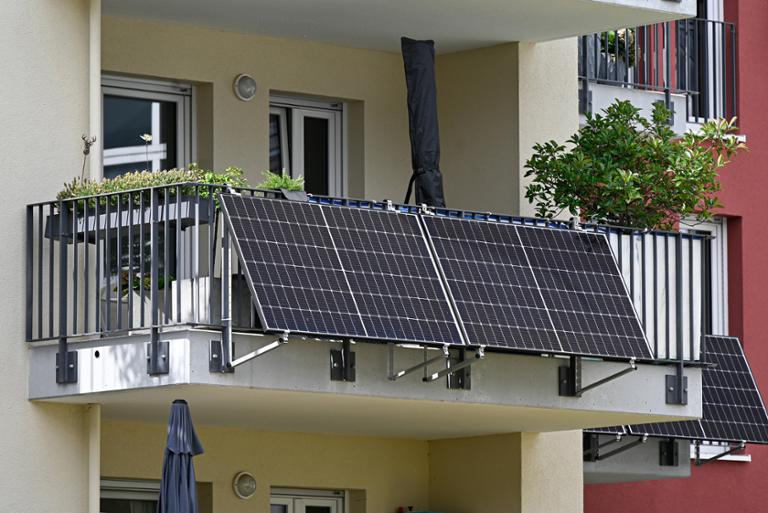
What Does the Wattage on a Plug-In Solar Panel Mean?
The wattage printed on a solar panel is its rated power under specified test conditions. It helps buyers compare module capacity, but it is not the same as daily energy production.
| Term | Meaning | Why it matters |
|---|---|---|
| Rated power (W) | Maximum nominal output under defined test conditions. | Helps size the array and compare panels. |
| Energy (Wh or kWh) | Power delivered over a period of time. | Used to estimate electricity offset and savings. |
| Vmp and Imp | Operating voltage and current at maximum power. | Must match the inverter, controller, or power station input. |
| Voc and Isc | Open-circuit voltage and short-circuit current. | Important for input limits, protection, and cold-weather checks. |
How Much Energy Can a Plug-In Solar Panel Generate?
A practical first estimate uses the panel rating, equivalent sunlight hours, and a system efficiency factor. The result is an estimate, not a guaranteed output.
For example, a project with a 200W panel, a location-specific sunlight estimate, and a defined loss factor can produce a range for planning. The calculation must be adjusted for season, panel direction, shading, temperature, wiring, inverter conversion, and downtime.
Do not treat peak sunlight hours as the number of hours the panel produces its rated wattage. Solar irradiance changes during the day, and the panel rarely operates at its nameplate rating for the full daylight period.
What Affects Plug-In Solar Panel Power Output?
| Output factor | Effect on production | What to check |
|---|---|---|
| Sunlight and season | Clouds, winter conditions, and local climate change available energy. | Location-specific solar resource and seasonal use. |
| Panel direction and angle | Vertical balcony mounting may receive less useful sunlight than an optimally angled roof installation. | Orientation, tilt, railing position, and nearby obstructions. |
| Partial shading | Railings, trees, walls, and buildings can reduce output and create uneven operating conditions. | Shade timing, shade position, cell layout, and inverter behavior. |
| Temperature | High module temperatures can reduce operating voltage and affect real output. | Roof surface, airflow, backing material, and installation gap. |
| Electrical limits | The microinverter or power station may limit usable output even when the panel array is larger. | Input voltage, current, MPPT range, output rating, and connector polarity. |
How Many Plug-In Solar Panels Do You Need?
Start with the electricity use you want to offset, not the maximum number of panels that can fit on a balcony or roof. A small plug-in system usually offsets part of daytime consumption rather than supplying a whole home.
Then check whether the proposed array fits the microinverter input range, output limit, mounting space, cable route, and local product rules. A larger array can improve production in some conditions, but only if the complete system is designed for it.
Plug-In Solar Output With or Without a Battery
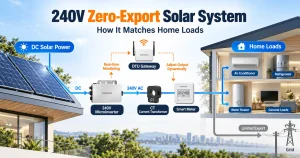
A grid-connected plug-in system can send usable AC power to the approved household connection while the system is producing. The value depends on how much electricity the home uses at that time.
A battery can store some solar energy for later use, but it changes the system architecture, cost, equipment, and compliance review. Do not assume that a battery-connected plug-in system follows the same rules as a simple panel and microinverter package.
| Configuration | Output question | Main design check |
|---|---|---|
| Panel and microinverter | How much AC power can be delivered during production? | Panel electrical values, microinverter input and output limits. |
| Panel and portable power station | How much DC energy can the station accept and store? | Voc, Vmp, current, connector, polarity, and MPPT range. |
| Panel, microinverter, and battery | How much energy can be shifted to later use? | Battery architecture, control system, grid connection, and local rules. |
Plug-In Solar Panels vs. Portable Power Stations
These systems can use similar solar panels but serve different electrical purposes. A grid-connected plug-in system is designed around an approved AC connection and microinverter. A portable power station normally receives DC input and manages charging inside its own battery system.
Before connecting a panel to a power station, compare Voc, Vmp, Isc, Imp, connector type, polarity, and the station’s maximum solar input. A panel that physically fits the connector may still be electrically incompatible.
How Do Shade and Balcony Installation Change Output?
Balcony systems often have less favorable angles and more obstructions than open rooftop systems. Railings, plants, walls, neighboring buildings, and seasonal sun paths can reduce the energy available to the panel.
When partial shade is a recurring problem, compare the module layout, bypass behavior, microinverter architecture, and expected shade pattern. Do not use an anti-shading claim as a substitute for mapping where and when shadows occur.
How to Estimate Payback From Plug-In Solar Output
Use the energy that is actually consumed on site, not only the energy the panel could theoretically generate.
For the related purchase decision, read Are Plug-In Solar Panels Worth It?. That article covers fit, cost, safety, local rules, and buyer decision factors rather than repeating the output calculation here.
For Retailers and Plug-In Solar Kit Brands
Retailers and system brands should publish output as a range with clear assumptions. A market-ready kit needs a panel datasheet, microinverter input and output limits, mounting guidance, cable and connector details, user instructions, warning labels, and market-specific documentation.
- State whether the figure is rated power, peak AC output, daily energy, or annual energy.
- Show the sunlight, shading, angle, and efficiency assumptions behind estimates.
- Explain what the kit does not power and whether a battery is included.
- Check the panel and microinverter as one system before setting a retail power claim.
FAQ: Plug-In Solar Panel Power Output
How much power does a 200W plug-in solar panel produce?
A 200W panel is rated for 200W under defined test conditions. Daily energy depends on sunlight, angle, shading, temperature, wiring, inverter limits, and system losses.
Can plug-in solar panels power a whole house?
Usually no. Most plug-in systems are designed to offset part of daytime electricity use. Whole-home supply normally requires a larger PV system and a project-specific electrical design.
Does a higher-wattage panel always produce more electricity?
Not always. Higher rated power helps only when sunlight, usable space, inverter limits, mounting, and local requirements allow the additional capacity to be used.
Can I connect any solar panel to a portable power station?
No. Check Voc, Vmp, current, connector type, polarity, and the power station’s maximum solar input before connecting a panel.
Why is my plug-in solar panel producing less than its rated wattage?
Rated wattage is measured under defined test conditions. Shade, heat, angle, clouds, soiling, wiring, inverter limits, and battery or grid restrictions can reduce real output.
Final Thoughts
Plug-in solar panel power output should be estimated from the whole installation, not from the wattage printed on the panel alone. Start with the rated power, then account for sunlight, angle, shading, temperature, electrical limits, and on-site use.
For buyers, distributors, and kit brands, a clear output range with stated assumptions is more useful than a fixed promise. It also makes the product easier to compare, explain, and support in different markets.