 EN
EN
 Deutsch
 Italiano
 Español
 Français
 日本語
日本語

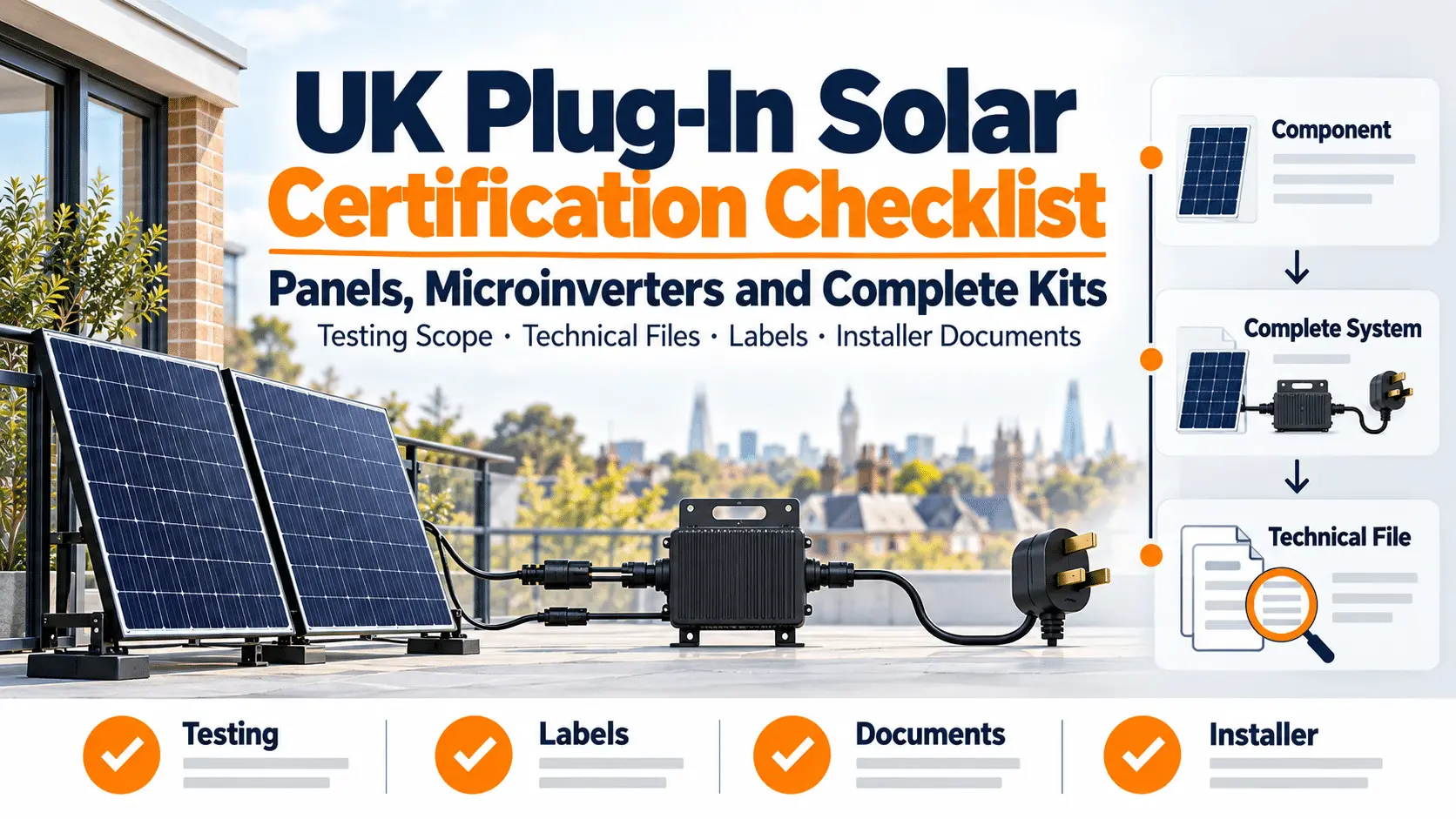
Quick answer: This UK plug-in solar certification checklist separates the evidence needed for the PV module, microinverter, complete solar kit, testing scope, technical file and product labels. A panel test report does not automatically certify the inverter or the finished kit. A microinverter type-test record does not automatically approve every panel, cable, plug or mounting method. Buyers should verify the exact product configuration, target market, applicable conformity route and installer documents before distribution or installation.
What should a UK plug-in solar certification checklist cover?
Start by defining what is being placed on the market. The compliance file will be different for a PV module sold as a component, a grid-connected microinverter sold as electrical equipment, and a packaged plug-in solar system supplied with cables, a plug, mounting hardware and instructions.
| Product boundary | Evidence to review | What it does not prove by itself |
|---|---|---|
| PV module | Module safety, performance, materials, construction and traceability documents | Grid connection approval or complete kit compliance |
| Microinverter | Electrical safety, EMC, grid-interface and applicable type-test documents | Approval of every PV module or installation |
| Complete plug-in solar kit | System configuration, wiring, protection, instructions, labels and conformity documents | That an altered or rebranded kit remains covered |
| Installation | DNO route, site checks, commissioning and customer records | That a product certificate replaces competent installation |
1. PV module checklist
The panel is one part of the generating system. For procurement, record the exact model, revision and intended use rather than relying on a general statement such as “tested to IEC standards.”
- Exact module model and product revision
- Rated electrical characteristics and permitted operating conditions
- Construction details, materials and bill of materials
- Safety and performance test reports relevant to the target market
- Connector, cable and junction-box specifications
- Mechanical, fire and mounting limitations where applicable
- Serial-number or batch traceability
- Installation, handling, cleaning and maintenance instructions
If the panel is supplied with a fixed cable, connector or mounting component, identify whether that item is part of the tested module or is being added later. A change in cable length, connector type, adhesive, frame or mounting method may require a configuration review.
2. Microinverter and grid-interface checklist
The microinverter is normally the component that interfaces with the AC circuit and public network. Its evidence must be checked separately from the PV module.
- Manufacturer, exact model and hardware revision
- AC rated output, phase and operating voltage
- DC input range and permitted PV module configuration
- Anti-islanding and protective-function information
- Applicable electrical safety and EMC evidence
- Grid-code or network type-test reference
- Firmware version and change-control record
- Installation, isolation, monitoring and fault instructions
For Great Britain, the relevant G98 or G99 route depends on the generating equipment and connection circumstances. The exact inverter reference should be checked against the current ENA process and the local DNO requirements. Read the separate G98 for UK plug-in solar guide for the notification and installer workflow.
Important boundary: A G98 type-test record relates to the applicable generating equipment and grid connection requirements. It is not a blanket certification for the panel, mounting system, household circuit or complete product package.
3. Complete plug-in solar system checklist
When panels, a microinverter, cables, plug and mounting components are sold together, assess the product as a defined configuration. The finished kit should be documented as the product the buyer will actually receive.
- System diagram showing DC and AC paths
- Exact panel-to-inverter compatibility
- Connector polarity and cable routing
- Plug, socket and isolation requirements
- Protection, earthing and overcurrent limitations
- Maximum number of modules and permitted arrangement
- Mounting, ballast, wind and structural limitations
- Indoor, outdoor, balcony, roof or vehicle installation boundaries
- Commissioning and shutdown procedure
- Warnings for shading, water ingress, heat, damage and unauthorised modification
Do not treat a kit as covered merely because each separate component has a certificate. The supplier should show how the components were selected, connected and documented as one product configuration.
4. What does the testing scope actually cover?
Every test report should be read for its scope, sample, model reference, test conditions, standard edition and result. The title of a report is not enough.
| Question | Why it matters |
|---|---|
| Which model and revision were tested? | Confirms that the report matches the supplied product. |
| Was the test for a component or a complete system? | Prevents a component report being presented as kit certification. |
| Which standards and editions were used? | Shows the technical basis and whether a newer edition affects the assessment. |
| What operating conditions applied? | Defines voltage, current, temperature, humidity, load and configuration limits. |
| Were accessories included? | Identifies whether cables, plugs, connectors or mounting parts are within scope. |
| Were deviations or limitations recorded? | Shows where additional review or installation controls are needed. |
For a buyer or distributor, request the report summary and declaration documents, then ask for clarification when the exact model or configuration is not obvious. Do not infer coverage from a similar model number.
5. Technical file and conformity documents
A technical file should allow the manufacturer, importer or market-surveillance authority to understand what the product is, how it was designed, which requirements apply and how conformity was assessed.
- General product description and intended use
- Design drawings, circuit diagrams and component lists
- Risk assessment and identified safety controls
- List of standards or technical specifications applied
- Test reports and certificates with model references
- Declaration of Conformity or applicable declaration
- Production controls and serial-number traceability
- Instructions and safety information in the required language
- Change-control records for hardware, firmware and BOM changes
- Importer, manufacturer or authorised-representative details where required
For Great Britain, electrical equipment placed on the market may use the conformity route and marking permitted by the current product regulations. For Northern Ireland and the EEA, the applicable CE or CE-plus-UKNI rules can differ. Confirm the destination before finalising labels and declarations.
6. Product labels and packaging
Labels should identify the product and communicate the information needed for safe use and traceability. Marking requirements depend on the product category and destination market, so use a market-specific label review.
- Manufacturer name or registered trade name
- Product model and serial or batch reference
- Electrical ratings and polarity where applicable
- Conformity marking required for the destination market
- Relevant importer or responsible economic operator details
- Warnings, symbols and installation limitations
- Traceable production or date information where required
- Link or reference to instructions and declaration documents
Markings should be visible, legible and durable. If the equipment cannot reasonably carry the marking, the applicable rules may allow it on the packaging or accompanying documents. This must be confirmed against the current regulation for the specific product.
7. Installer and customer documentation
Certification evidence is only one part of a deployable product. The installer needs clear instructions for the actual site, and the customer needs a record that identifies the equipment and the connection route.
- Installation and commissioning instructions
- Wiring and connection diagrams
- Protection, isolation and shutdown instructions
- Mounting and structural limitations
- DNO notification or application information where applicable
- Exact inverter model and type-test reference
- Product manual, warranty terms and maintenance instructions
- Emergency contact and fault-handling information
The UK connection route should be checked against the current DNO and ENA instructions. A product document should not tell an installer to rely on an old register, generic approval or a different country’s grid code.
Common certification mistakes
- Component substitution: Replacing the tested inverter, connector, cable or plug without reviewing the system file.
- Certificate overreach: Using a PV module report as proof that the complete kit is certified.
- Model ambiguity: Quoting a product family when the test covers only one exact model or revision.
- Market mixing: Using GB, Northern Ireland, EEA or North American documents interchangeably.
- Missing change control: Updating firmware or BOM items without checking whether the evidence remains valid.
- Label gaps: Omitting ratings, traceability, responsible-operator details or required markings.
- Installation assumption: Treating a product certificate as a substitute for site-specific electrical and structural checks.
Buyer checklist before placing an order
- What exactly is being certified: panel, inverter, kit or installation?
- Does every report list the exact model and revision?
- Are the supplied accessories included in the test scope?
- Is the intended UK market GB, Northern Ireland or both?
- Which conformity marking and declaration apply?
- Is the inverter reference verified through the current ENA process where relevant?
- Are the technical file, instructions and labels available for review?
- Who owns change control after the first shipment?
- Which documents will the distributor, installer and end customer receive?
Frequently asked questions
Does a certified solar panel make the whole plug-in solar kit certified?
No. The PV module is only one component. The microinverter, cables, plug, mounting method, system wiring, labels and instructions must be assessed against the product configuration and destination market.
Is a G98-listed microinverter the same as complete product certification?
No. G98 relates to eligible grid-connected generating equipment and the connection process. It does not replace product safety, EMC, mounting, packaging or complete-kit documentation.
What should a buyer ask for before approving a UK plug-in solar product?
Ask for the exact model references, test reports, conformity declaration, technical file summary, ENA or DNO evidence where relevant, system diagram, labels, installation instructions and change-control information.
Can the same certification documents be used in Great Britain and Northern Ireland?
Not automatically. The applicable product-marking and grid-connection requirements can differ by destination. Confirm the current rules for GB, Northern Ireland and any EEA market separately.
Does a new connector or firmware version require a new review?
It may. Any change that affects electrical safety, EMC, grid behaviour, mechanical installation or the tested configuration should be assessed through documented change control before sale.
Final takeaway
A useful UK plug-in solar certification checklist follows the product from component to complete system. Verify the panel evidence, microinverter and grid-interface documents, complete-kit configuration, test scope, technical file, labels and installer package as separate but connected layers.
For B2B buyers and OEM brands, the goal is not to collect the largest number of certificates. It is to prove that the exact product being quoted and shipped is the product covered by the documentation for the intended UK market.