




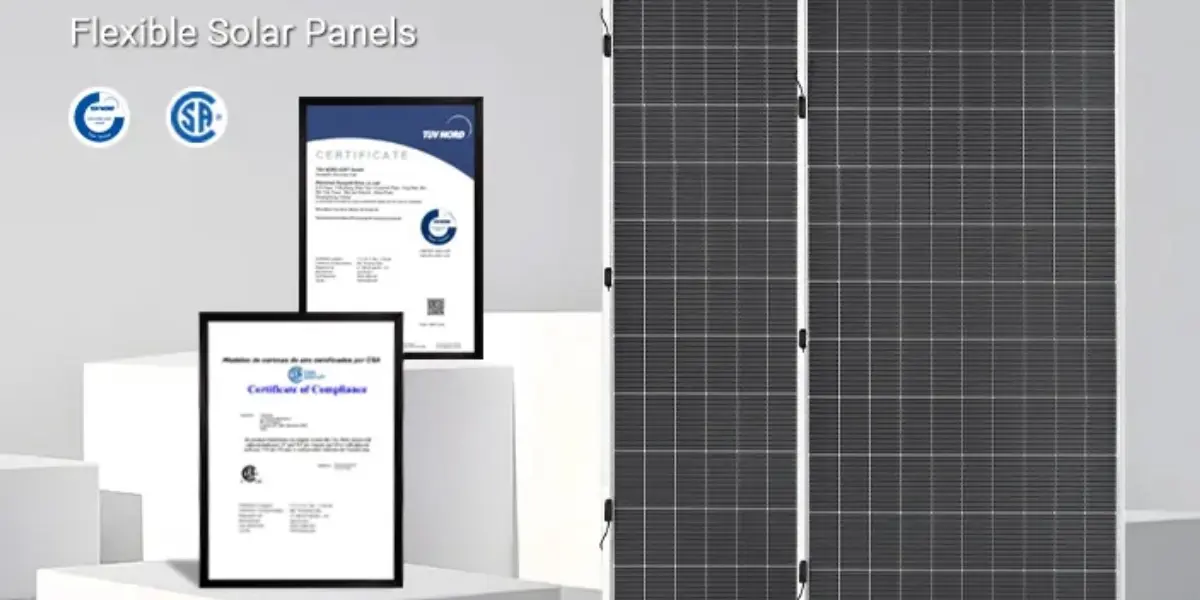
Flexible solar panel certification should be reviewed by model number, application, target market, and test scope. ETFE can support a durable flexible module surface, but ETFE alone does not mean a panel is fire-rated, IEC-certified, TÜV-certified, or suitable for every marine, balcony, RV, vehicle-roof, or custom project.
Before quotation or bulk ordering, buyers should review the datasheet, IEC / TÜV / CE documents, fire classification, salt mist or ammonia test data when relevant, warranty terms, installation guidance, and whether the test report covers the exact model being purchased.
A flexible solar panel sample may look good at first glance. For importers, distributors, and project buyers, the real review usually starts after that first impression: does the documentation match the model, the target market, and the installation environment?
This is where many sourcing mistakes happen. A buyer may ask for ETFE, fire rating, IEC, TÜV, or CE in one sentence. But these are different questions. A surface material is not the same as a module certificate. A test sample is not the same as every customized model. A certificate is only useful when it matches the exact product being quoted.
Why Certification Matters More Than Material Names
Many flexible solar panel enquiries start with one simple question: “Is it ETFE?” That is a useful starting point, but it is not enough for a project decision.
ETFE tells you something about the surface material. It does not confirm the full module structure, electrical safety class, fire classification, certified model range, installation method, or target-market suitability.
For project buyers, the more useful question is whether the supplier can provide model-specific documents that match the application and market. That usually means reviewing the exact model number, power range, test standard, fire classification, installation method, target region, warranty terms, and application limits.
A flexible panel for a marine roof, a balcony kit, an RV roof, and a private-label OEM product may all use ETFE. The document package can still be different.
ETFE Does Not Automatically Mean Fire-Rated
ETFE is commonly used as a surface film or protective laminate material in flexible solar panels. It can support weather resistance, outdoor durability, and surface protection. But it should not be treated as a certification claim by itself.
ETFE does not automatically mean Class A fire-rated, fireproof, IEC-certified, TÜV-certified, suitable for every roof, suitable for every balcony installation, or covered by one certificate across all models.
For example, available PA219 reference documentation reviewed for this article shows Fire Safety Class C in the relevant TÜV / IEC evaluation information. That is useful evidence, but it should not be rewritten as Class A unless a separate Class A document exists for the exact model and scope.
What Documents Should Buyers Review?
A good document package helps the buyer understand what has actually been tested, which model is covered, and where further project confirmation is still needed.
| Document | What It Confirms | Why It Matters |
|---|---|---|
| Datasheet | Power, voltage, current, size, weight, cell layout, cable, and connector | Basic model selection |
| IEC / TÜV / CE documents | Tested standards, model scope, and certificate coverage | Market access, distributor review, and project approval |
| Fire classification | Fire safety class and test scope | Roof, balcony, vehicle, or building-related use |
| Salt mist test report | Corrosion-related reference for coastal or marine exposure | Marine, yacht, and coastal projects |
| Ammonia test report | Corrosion-related reference for ammonia exposure | Agricultural or livestock-related environments |
| Mechanical load report | Load condition, mounting method, and tested model | Roof, vehicle, and structural application review |
| Warranty terms | Coverage, exclusions, and application limits | Channel and after-sales risk control |
| Installation guide | Mounting, bending, adhesive, and cable routing | Reduces misuse and warranty disputes |
How to Read a Flexible Solar Panel Datasheet
A datasheet should not be treated as a brochure. It is the first technical filter before samples, certification review, or quotation.
Buyers should review rated power, Voc, Vmp, Isc, Imp, maximum system voltage, module size, thickness, weight, cell type, surface material, rear cover or backsheet, junction box, cable length, connector type, bending limit, operating temperature, warranty notes, and applicable model range.
This is especially important for custom flexible solar panels. A small change in size, voltage, cable position, back-exit design, or surface material can affect sampling, certification scope, MOQ, and lead time.
For electrical matching, see Sungold’s guide on solar panel amps to watts. For custom structure decisions, review Custom Flexible Solar Panels: Size, Voltage, Cable Position and Back-Exit Design.
A Simple Document Decision Path
Different questions require different evidence. This path helps buyers avoid asking for every document at once without knowing which file actually answers the project risk.
| If the Project Question Is About… | Start With… | Then Confirm… |
|---|---|---|
| Fire rating | Fire classification document | Model scope, target market, and installation condition |
| Marine or coastal use | Salt mist test report | Cable waterproofing, mounting method, and corrosion exposure |
| Agricultural use | Ammonia test report | Encapsulation, rear cover, and actual exposure environment |
| Roof or vehicle load | Mechanical load report | Mounting method and whether the tested model matches the project |
| Bulk import | Datasheet and certificate scope | Label, packaging, manual, warranty, and shipment terms |
| OEM / private label | Drawing and sample approval | Brand label, packaging, manual, connector, and warranty wording |
PA219 Reference Test Data: What the Reports Show
For PA219 reference samples, available test reports include IEC / TÜV evaluation, salt mist testing, ammonia corrosion testing, and static mechanical load testing. These figures are useful for project review, but they should be treated as report-specific reference data, not universal guarantees for every model, installation method, or project environment.
| Test Area | Reported PA219 Reference Data | What Buyers Should Understand |
|---|---|---|
| IEC / TÜV evaluation | IEC 61215-1:2021, IEC 61215-2:2021, IEC 61730-1:2023, and IEC 61730-2:2023 related evaluation | Certification should be matched to exact model number and scope. |
| Electrical class | Electrical Protection Class II | Relevant to safety qualification review. |
| System voltage | DC 1500V / 1000V / 600V listed in the evaluation report | Confirm which voltage applies to the selected model and market. |
| Fire safety | Fire Safety Class C shown in the reviewed evaluation information | Do not describe it as Class A without separate evidence. |
| Salt mist | IEC 61701:2020, severity level 3, 5% salt solution, 7-day cycle, reported 0.79% power degradation after test | Useful for coastal or marine review, not a blanket “salt-proof” claim. |
| Ammonia | IEC 62716:2013, 20 cycles / 480h, NH3 6667 ppm, reported 0.80% power degradation after test | Useful for ammonia or corrosive-environment review. |
| Mechanical load | SG-T-PA219-114-425W, 1845 x 1177 x 3mm, 5400 Pa front / 2400 Pa back applied load, reported 2.11% power degradation | Must be interpreted with the tested model and mounting method. |
Fire Rating Checks for Flexible Solar Panels
Fire rating questions should be handled carefully. A material property, a component test, and a full module fire classification are not the same thing.
Before using fire-related wording in a distributor catalog, product page, or tender document, confirm which market or project requires fire classification, whether the requirement applies to the material, module, or installed system, whether the certificate covers the exact model, whether the fire class can be used in public sales material, and whether local engineers, authorities, or certification bodies need to review the installation.
Avoid broad phrases such as “fireproof flexible solar panel” unless the exact claim is supported by proper test documentation.
IEC, TÜV and CE: What Buyers Should Confirm
IEC, TÜV, and CE are often mentioned together, but they do not mean the same thing.
| Item | What to Confirm |
|---|---|
| IEC 61215 | Whether the module passed relevant design qualification and type approval tests. |
| IEC 61730 | Whether module safety qualification applies to the selected model. |
| TÜV | Certificate number, model scope, tested standards, report owner, and validity. |
| CE | Whether the CE declaration is available and suitable for the target market. |
| Fire safety class | Exact fire classification and whether it applies to the model being quoted. |
Do not assume that one certificate covers every wattage, cell type, cable layout, or customized structure.
Application-Specific Document Checks
Different projects need different evidence. A buyer sourcing flexible PV modules for a boat does not have the same documentation risk as a distributor preparing a balcony solar kit or a brand developing an OEM panel.
| Application | Extra Checks |
|---|---|
| Marine / yacht | Salt mist report, cable waterproofing, mounting method, and corrosion exposure. |
| Balcony solar | Fire wording, mounting instructions, plug-in system boundary, and user manual. |
| RV / vehicle roof | Vibration, heat, bending, adhesive, or mechanical mounting guidance. |
| Commercial roof | Fire classification, mechanical load, installation method, and project documentation. |
| OEM / private label | Drawing, label, packaging, user manual, warranty wording, and sample approval. |
| Agricultural environment | Ammonia test data, encapsulation, and rear-cover review. |
For projects where ETFE performance and durability are the main concern, buyers can also review Sungold’s existing article: ETFE Flexible Solar Panels: Engineering Guide and Lab Data.
Common Certification Mistakes Buyers Should Avoid
Several mistakes appear often in flexible solar panel sourcing:
- assuming ETFE means fire-rated;
- using one certificate for every model;
- comparing price before reviewing datasheets;
- ignoring installation method;
- treating sample data as a universal guarantee;
- requesting IEC / TÜV / CE without specifying the exact model;
- using unsupported claims on distributor product pages;
- forgetting warranty exclusions for flexible panel installation.
These mistakes can create problems later in customs clearance, project approval, channel sales, or after-sales support.
How Sungold Can Support Certification Review
For buyers reviewing flexible solar panel certification, the next step is to match the target application, surface material, wattage, voltage, installation method, cable design, market requirement, and document scope.
Sungold can support this review through PA219 flexible solar panels and custom solar panel development for project-specific requirements.
FAQ
No. ETFE is a surface material. Fire rating must be confirmed through model-specific fire classification or certification documents.
It depends on the target market and application. Buyers commonly request datasheets, IEC / TÜV / CE documents, fire classification, warranty terms, and application-specific test reports.
Not always. Buyers should check whether the certificate covers the exact model, cell type, power range, construction, and test scope.
Salt mist testing, installation guidance, cable waterproofing, and material structure are important checks for marine or coastal projects.
They should review certification scope, datasheet accuracy, packaging, user manual, warranty terms, sample approval, and batch supply details.
Final Thoughts
ETFE is an important material choice for flexible solar panels, but it is not a certification conclusion. Fire rating, IEC, TÜV, CE, salt mist, ammonia, and mechanical load claims must be checked against the actual report, model number, and application.
For importers, distributors, and project buyers, the stronger sourcing approach is simple: confirm the documents first, then compare price, sample timing, and bulk supply terms.
Source notes: This article references Sungold internal PA219 report-specific data reviewed for content preparation, including PA219 TÜV / IEC evaluation information, PA219 salt mist and ammonia test reporting, and PA219 static mechanical load test reporting. IEC 61215, IEC 61730, IEC 61701, and IEC 62716 are referenced as testing frameworks. Internal report data should be confirmed by Sungold before quotation, certification claims, or public document release.