




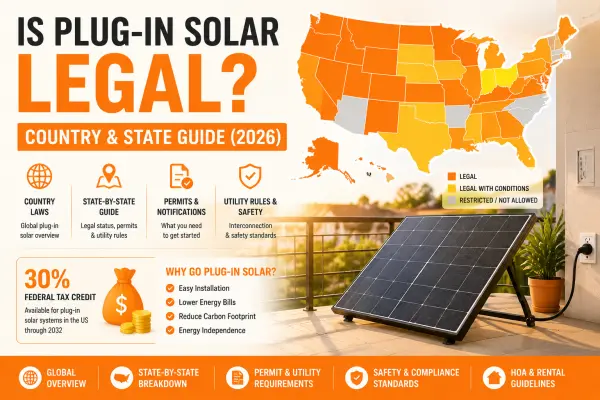
Quick answer: Is plug-in solar legal where you live? It depends on the jurisdiction, utility service, equipment and installation. Some U.S. states have specific exemptions for qualifying portable PV systems; others require an installation-specific review. A signed law may have a future effective date. Check the U.S. table below before treating a product as ready to connect. European rules are separate and should not be applied to a U.S. installation.
European Countries: Rules at a Glance
To evaluate if is plug-in solar legal across Europe, standard EU grid directives allow individual countries to set simplified rules for mini-generation systems. Below is how major European markets handle these setups:
| Country | Legal Status | Max Inverter Output | Electrician Required | Registration | Renter Rights |
|---|---|---|---|---|---|
| Germany | Legal | 800W | No | MaStR (required) | Explicitly allowed by law (2024) |
| Austria | Legal | 800W | No | E-Control portal (required) | Generally permitted; check lease |
| Netherlands | Legal | 800W | No | Not currently required | Generally permitted |
| Switzerland | Legal | 600W (cantonal variation) | No (for Schuko plug-in) | Notify local grid operator | Check lease; no-drill recommended |
| Belgium | Varies by region | Up to 10 kVA (Wallonia); 2 kVA (Flanders) | Depends on region | VREG (Flanders) or CWaPE (Wallonia) | No unified law; check local rules |
| France | Legal | 3 kVA (autoconsommation) | No for plug-in systems | Notify Enedis | No specific law; check lease |
Germany — The Most Comprehensive Framework
Germany's landmark legislation solidifies balcony solar legal protections under the Solarpaket I framework. Key regulations include:
- Wattage limit raised from 600W to 800W AC inverter output.
- Mandatory Wieland plug requirement removed — standard Schuko plugs are fully accepted.
- Licensed electrician requirement eliminated for systems up to the 800W limit.
- Tenants explicitly granted the right to install no-drill solar systems — landlords cannot refuse without a valid, exceptional reason.
- MaStR registration is the primary required step, while Netzbetreiber notification has been heavily simplified.
Austria — Closely Aligned with Germany
Austria aligns closely with Germany's framework. Systems up to 800W can be installed without an electrician using a standard Schuko plug. Registration via the E-Control portal and notification to the grid operator (Netzbetreiber) are both required. Balcony-mount systems are well-established in Austrian apartment buildings. Cantonal subsidies (Einmalvergütung) are available in many areas.
Netherlands — Simplified Approach
The Netherlands permits plug-in solar without formal registration. The saldering (net metering) scheme allowed surplus electricity to offset future bills, though this policy is being phased out through 2027 — self-consumption is increasingly the primary financial case. Notification to the grid operator is recommended but not legally mandatory.
Is Plug-In Solar Legal in the USA?
There is no single nationwide answer. The applicable rule depends on your state, utility service, exact equipment and installation. A small solar panel charging an isolated power station is not the same as an inverter feeding a household circuit. For the electrical distinction, see how plug-in solar panels work.
U.S. legal review: October 15, 2026. The table below covers selected states with documented portable-solar legislation. It is not a complete 50-state approval list or permission to connect a particular kit. Enacted laws with future start dates are separated from rules already in effect.
| State | Status at review date | What the buyer needs to check |
|---|---|---|
| Utah | Portable-device provisions effective May 7, 2025. | The statutory definition includes a maximum 1,200W output, a standard 120V AC connection, code compliance and recognized-laboratory certification. Qualifying devices receive interconnection exemptions, but outage protection remains required. Do not read a utility exemption as blanket approval for roof, railing or wiring changes. Sources: device definition and Section 54-15-601. |
| Vermont | Act 149 effective July 1, 2026. | Check the 1,200W combined inverter limit per meter, smart meter, qualifying certification and secure placement. This route cannot be combined with an existing net-metering system, and exports are not compensated. Tenants must provide at least 10 days' notice; electrical work has separate landlord and licensing conditions. Source: Act 149 as enacted. |
| California | SB 868 enacted September 30, 2026; scheduled to take effect January 1, 2027. | Check the 1,200W aggregate AC limit per dwelling, complete-system certification, code compliance and certified outage isolation. Qualifying devices receive an interconnection exemption until January 1, 2030; utilities may require simple online registration. This is not blanket approval for any panel-and-inverter combination. Sources: SB 868 official record, chaptered-text mirror and California effective-date rules. |
| Virginia | Section 56-596.8 takes effect January 1, 2027. | Check the 1,200W limit per customer or residential unit, recognized-laboratory certification and outage protection. The statute requires utility notification before installation and provides a 15-day form-review process. It is not a notification-free route. Rental units using ratio utility billing are excluded. Source: Virginia Code 56-596.8. |
| New Jersey | Signed September 1, 2026; the legislation provides a six-month commencement period. | Do not treat signing as immediate permission. Review the 1,200W aggregate limit, qualifying product listing and outage protection. The text includes 14-day tenant notice and placement conditions. Exempting device placement from a municipal permit does not exempt building alterations or electrical work. Sources: signing announcement and legislative text, including commencement. |
What if my state is not listed?
For Colorado, Texas, New York, Florida, Hawaii and other states not assessed in this table, do not infer either permission or a ban. Ask the state regulator and your actual electricity utility which current rule covers a receptacle-connected, grid-parallel PV system. A rooftop net-metering program or a small-generator application does not, by itself, establish an exemption for a plug-in kit.
A useful enquiry is: "I am considering a [model] system with [rated AC output] at [service address]. It connects through [connection method]. Does a current portable-PV exemption apply? What notification, interconnection and local inspection steps remain?" Include the system manual and certification record. Ask for the rule or tariff reference in the reply so you can distinguish a documented requirement from a general sales statement.
California After SB 868: What Should You Check Before Buying?
First, distinguish the law's 2027 start from the purchase date. Then match the exact kit to the statutory device definition. The aggregate limit concerns AC output, not the sum of panel DC ratings. An inverter certificate alone does not establish that a complete plug-in system qualifies. Check the utility's registration instructions and retain the model-specific documentation.
A buyer comparing two visually similar kits should request the full wiring diagram, certification scope and installation instructions before choosing. Check whether adding a battery or changing the inverter, cable or connection method takes the configuration outside that documentation. Ask about returns if the supplied configuration cannot be used at the property. This is more useful than a package label saying only "California ready."
Buyer Checks That Apply Across State Lines
- Identify the electrical path. Does the equipment charge an isolated battery, feed a household circuit, or support a separately isolated backup outlet? Those are different uses.
- Read the current rule and its start date. A bill introduced, passed or signed is not necessarily an operative exemption today. Save the version you relied on.
- Verify the exact model and system configuration. Match the label, laboratory listing, manual, inverter and protection equipment. A panel certificate does not approve an entire grid-connected kit.
- Separate utility rules from installation rules. Check the outlet and circuit with a qualified electrician when suitability is uncertain. Confirm any local requirements for wiring, mounting or building alterations. An interconnection exemption does not make unsafe wiring acceptable.
- Check the property arrangement. Establish who pays for the meter, whether the balcony is leased or shared space, and which landlord, association or building requirements apply. Keep exits clear and assess secure attachment.
- Confirm what happens during an outage and with surplus power. Anti-islanding protection is not a promise of backup electricity. Likewise, permission to operate does not establish payment for exports or eligibility for net metering.
Do not improvise a backfeed cable or use an adapter to bypass the listed connection method. If the manual, certificate and intended installation disagree, resolve the mismatch before energizing the system. For mounting and equipment risks, read our balcony solar safety guide.
Manufacturer boundary: Sungold can help review panel dimensions, electrical specifications and application requirements. That review does not replace system-level certification, utility procedures or a qualified local installation assessment. This article provides general information, not site-specific legal advice.
Frequently Asked Questions
Does a plug-in solar law mean I can use any solar kit?
No. An exemption applies only when the equipment and installation meet its conditions. Check the complete system's model documentation, connection method and applicable output limit. A compatible plug or a certified individual component is not sufficient evidence on its own.
Do I need a permit for plug-in solar in the USA?
It depends on the operative state rule and the work involved. Utility interconnection, utility notification, local electrical permits and property permission are separate questions. A qualifying-device exemption may remove one requirement without removing the others. Check before modifying a circuit or mounting structure.
Can renters install plug-in solar?
Check the jurisdiction, lease, electricity billing arrangement and placement. Some state laws provide specific tenant rights with notice and equipment conditions. Do not assume that rules for a portable appliance also cover attaching a solar system to a railing or feeding a building circuit.
Does the 30% federal residential solar credit apply to a new 2026 installation?
Do not budget for it. The IRS Residential Clean Energy Credit guidance states that the credit is unavailable for property placed in service after December 31, 2025. Carrying forward an eligible earlier credit is a different matter. Check current federal, state and local eligibility with a qualified tax adviser before relying on an incentive.
Related guides: Balkonkraftwerk Germany Guide · USA State-by-State Guide · Safety Guide · Apartment Solar Guide