




Key Takeaways
- RV solar system cost depends on energy use, battery storage, inverter size, panel layout, and installation method.
- A panel-only package is not the same as a complete off-grid system.
- A 400W system may support basic loads, but it does not automatically run an RV air conditioner.
- Flexible panels can solve roof-weight and layout problems, while rigid panels may offer easier airflow and service access.
- A useful quote must show panels, battery, controller, inverter, wiring, protection, mounting, and labor separately.
When people ask how much RV solar costs, they are usually not asking for the price of one panel. They want to know whether the complete setup will support their way of traveling, whether the quote includes everything, and whether installing it themselves is realistic.
That is why two quotes can look very different even when both mention 400W of solar. One may include only panels and a controller. Another may include a battery bank, inverter, protection devices, roof hardware, cable work, commissioning, and installation labor.
This guide explains the cost logic behind an RV solar system in 2026. The useful question is not “What is the cheapest kit?” It is “What will this system actually power, and what work is included in the quote?”
For a useful RV solar system cost comparison, separate the equipment price from the installation scope before comparing two quotes.
How Much Does an RV Solar System Cost?
There is no single RV solar system cost because the system is built around an energy requirement, not only a panel rating. A weekend camper charging phones and lights needs a different system from a full-time traveler who wants to run a refrigerator, water pump, laptop, induction cooker, or air conditioner.
The final RV solar system cost is usually shaped by four linked decisions: how much energy the RV uses, how much battery storage is required, how much roof area is available, and how much installation work the vehicle needs.
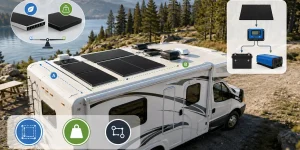
Some systems do not need every item. A panel connected to a compatible portable power station may not need a separate battery or solar charge controller. A DC-only RV setup may not need a large inverter. A roof-mounted system may need brackets, cable entry hardware, sealing, and service planning.
Before comparing prices, ask what the quote includes. “400W solar kit” can describe a panel package, while “400W RV solar system” usually implies a broader electrical system. Those are not interchangeable descriptions.
What Is Included in an RV Solar System?
Solar panels
The panel portion depends on format, size, construction, cable layout, and application. RV buyers commonly compare rigid, flexible, lightweight, foldable, and portable panels.
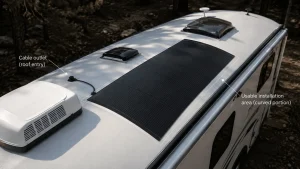
A rigid panel may need a rack or brackets. A flexible panel may reduce height and weight, but the roof surface, fixing method, heat path, drainage, and replacement plan still need review. A portable panel may avoid roof work but requires storage and a safe cable route when deployed.
Battery storage
The battery determines how much solar energy can be used after sunlight is weak or unavailable. Ask whether the quoted capacity is nominal or usable. Also check voltage, maximum charge current, low-temperature behavior, monitoring, installation location, and replacement planning.
Charge controller and inverter
The controller must accept the panel voltage and current and support the battery charging profile. The inverter must be sized for continuous and starting loads. Do not confuse inverter output with battery capacity: a high-output inverter can run a load only as long as the battery and charging system can support it.
Wiring and protection
Wiring, fuses, disconnects, connectors, grounding, cable glands, labels, and waterproofing are often hidden under “accessories.” Long cable runs need a voltage-drop review. A connector that fits physically does not prove that polarity, current rating, or cable size is correct.
How Much Solar Power Does Your RV Need?
Start with daily energy use. List each load, its power, and the hours it runs. Separate normal daily loads from short high-power loads.
| RV use case | Planning question | Budget driver |
|---|---|---|
| Weekend travel | Will the system charge phones, lights, a router, and small electronics? | A smaller array and battery may be sufficient when shore power or vehicle charging is available. |
| Regular off-grid travel | Will it support a refrigerator, water pump, laptops, and overnight use? | Battery capacity, solar harvest, controller size, and cable design matter more. |
| Full-time RV living | Will it support repeated daily use over several days? | More storage, more solar area, monitoring, and a larger inverter may be needed. |
| High-demand loads | Does the user expect to run air conditioning or an induction cooker? | Starting power, inverter output, battery discharge limits, and roof space can dominate the cost. |
A simple planning example
Consider a small RV that uses a refrigerator at an estimated 60W for 8 hours of equivalent daily runtime, lights at 40W for 4 hours, and a laptop at 60W for 3 hours. The simple load estimate is 480Wh + 160Wh + 180Wh = 820Wh before conversion, charging, cable, temperature, and battery losses.
This does not tell the owner to buy a fixed panel size. It shows why two people asking for “an RV solar system” can receive different recommendations. The first owner may only need daytime support. The second may need enough battery storage to carry the same loads through the evening or through a cloudy day.
This is a starting estimate, not a guaranteed daily output. Weather, season, shade, panel temperature, mounting angle, roof equipment, controller behavior, and battery state all affect real production.
400W, 600W, or 800W: Which RV Solar Size Makes Sense?
Panel wattage helps compare capacity, but it does not define the complete RV solar system cost. Battery, controller, inverter, roof area, and installation work can change the budget more than panel count alone.
| Solar target | More suitable for | Checks before ordering |
|---|---|---|
| 400W | Basic daily loads and smaller RV layouts | Roof area, battery size, shade, and controller current limit. |
| 600W | Regular off-grid use and larger daily loads | Panel arrangement, cable length, controller capacity, and battery charging rate. |
| 800W or more | Larger RVs or higher energy demand | Roof space, weight, heat, array voltage, storage, and inverter requirements. |
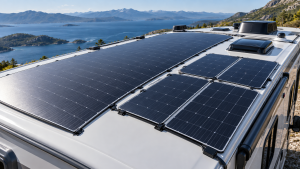
A 400W target can use one large panel or several smaller panels. One large panel may work on a clear roof. Several smaller panels may use more of a roof divided by an air conditioner, skylights, vents, rails, or curves.
Why two 400W quotes can be very different
Imagine two RVs with the same 400W target. The first has a clear roof, an existing battery, a short cable route, and a controller that can accept the array. The second has an air conditioner and two vents, needs a new battery and inverter, and requires a longer protected cable run. The panel wattage is the same, but the second project has more equipment, more installation work, and more decisions around layout and heat.
For high-power layouts, see 400W Flexible Solar Panels: Size, Weight and System Matching.
For a general explanation of how PV modules form part of a complete electrical system, see the U.S. Department of Energy’s Solar Photovoltaic Technology Basics.
Flexible vs Rigid RV Solar Panels: Which Costs More?
It is not accurate to say that flexible panels are always cheaper or more expensive. The installed cost also includes roof preparation, brackets, height, heat management, cable routing, and replacement access.
Flexible panels may make sense when:
- The roof has weight or height limits.
- A low-profile installation is important.
- The surface has a simple curve or irregular usable area.
- Standard rigid dimensions leave too much unused space.
- The project needs a specific cable exit or custom layout.
Rigid panels may make sense when:
- The RV has a clear roof and a suitable rack.
- Backside airflow and inspection are priorities.
- The owner expects to replace panels over time.
- The installer prefers a repeatable framed mounting method.
Flexible panels still require review of roof material, fixing, heat, drainage, wind exposure, cable protection, and replacement access. A lower-profile panel does not remove those engineering questions.
DIY vs Professional RV Solar Installation Cost
DIY can reduce labor cost, but it does not remove design and safety responsibilities. The installer still needs to size cables, install overcurrent protection, make secure connections, waterproof roof entries, and test the system.
| Approach | Possible advantage | Cost or risk to check |
|---|---|---|
| DIY | Lower labor cost and direct layout control | Design mistakes, rework, missing protection, water ingress, and support questions. |
| Professional | Installation experience, commissioning, and a clearer service path | Labor, travel, local requirements, and installer scope. |
| Hybrid | Owner prepares the layout while a qualified installer completes electrical or roof work | Responsibilities must be agreed before work starts. |
Hidden Costs That Change the Final RV Solar Quote
- Roof brackets, rails, or mounting adhesive
- Cable glands and waterproof roof entries
- Fuses, disconnects, breakers, and grounding parts
- Extra cable length and larger wire for voltage-drop control
- Battery monitoring and temperature protection
- Removal of an old panel or controller
- Custom dimensions, cable exits, connectors, or private-label packaging
- Access work around roof vents, air conditioners, antennas, or storage equipment
- Testing, commissioning, documentation, and replacement access
A quote that omits these items may look cheaper because the work has been moved outside the headline price. Ask whether each item is included, optional, or the owner’s responsibility. On a moving vehicle, waterproofing, cable protection, and service access are part of the installation, not decorative extras.
How to Compare Two RV Solar Quotes
Compare quotes using the same technical checklist rather than comparing total price or panel wattage alone.
| Quote item | What to verify |
|---|---|
| Panel | Exact model, rated power, Voc, Vmp, current, dimensions, weight, and construction. |
| Battery | Nominal and usable capacity, voltage, chemistry, charge limits, and monitoring. |
| Controller | Maximum PV voltage, current, input power, and battery charging profile. |
| Inverter | Continuous output, surge output, efficiency, ventilation, and cable requirements. |
| Wiring and protection | Wire size, cable length, connectors, fuses, disconnects, grounding, and labels. |
| Installation | Roof preparation, mounting, waterproofing, commissioning, and service scope. |
| Documentation | Datasheet, wiring diagram, user instructions, and model-specific limitations. |
What to Send Before Asking for an RV Solar Quote
- RV model or roof photos and a marked-up roof drawing
- Clear roof dimensions after vents, air conditioners, rails, and service gaps
- Daily appliances and estimated operating hours
- Battery voltage, capacity, and existing charging equipment
- Inverter or portable power station model
- Target solar wattage and acceptable panel weight
- Preferred panel format and any custom-size requirement
- Cable length, connector, cable exit, and polarity requirements
- Climate, vibration, moisture, salt exposure, and parking conditions
This turns a vague request for “the cheapest 400W RV solar kit” into a reviewable technical project.
FAQ About RV Solar System Cost
How much does a 400W RV solar system cost?
It depends on whether 400W refers to panels only or a complete system. Battery, controller, inverter, wiring, mounting, protection, and labor can change the total substantially.
Is it cheaper to install RV solar panels yourself?
DIY can reduce labor cost, but it does not remove the need for correct cable sizing, protection, waterproofing, commissioning, and testing. Rework can cost more than the original labor saving.
Can a 400W RV solar system run an air conditioner?
Not automatically. Starting power, continuous inverter output, battery discharge capability, available solar energy, operating time, and weather must all be reviewed.
Are flexible solar panels more expensive than rigid panels?
The panel price is only one part of the installed cost. Roof preparation, brackets, weight, height, heat management, cable routing, and replacement access also matter.
What is the biggest hidden cost in an RV solar installation?
Commonly overlooked items include wiring and protection, roof cable entry, waterproofing, mounting hardware, battery monitoring, old-system removal, and labor around roof obstacles.
Can I add more solar panels to an existing RV system?
Sometimes, but the controller input range, current limit, existing panel voltage, cable size, battery charging limits, and available roof area must be checked first.
Final Thoughts
The right RV solar budget starts with the loads you need to power, not the cheapest panel kit you can find. A 400W system may be sensible for a small RV with modest daytime loads and undersized for a full-time setup. A flexible panel may solve a roof-layout problem, while a rigid panel may provide easier airflow and maintenance.
Before ordering, separate panel cost from complete system cost. Confirm the battery, controller, inverter, cable, protection, mounting, installation scope, and documentation. Then compare quotes using the same technical checklist.
For panel selection, review the RV solar panel selection guide. For power station matching, review the solar panel compatibility guide.