




Key Takeaways
- A solar panel is compatible with a power station only when voltage, current, connector type, polarity, and solar input wattage all fit the exact model.
- Check Voc first. If the panel or panel string exceeds the power station’s maximum PV input voltage, the setup may damage the charging input.
- A matching cable is not enough. MC4, XT60, Anderson, DC8020, DC5521, and other connectors still require the right electrical match.
- Series wiring increases voltage. Parallel wiring increases current. Both must be checked before connecting two or more panels.
- For B2B projects, Sungold’s standard initial factory connector is MC4. Anderson connectors and one-to-two or one-to-three cable designs can be customized after the target power station input requirements are confirmed.
Quick Answer
A solar panel works with a portable power station only when the panel’s open-circuit voltage, working voltage, current, connector, and polarity match the power station’s solar input limits. Do not choose by wattage alone. Start with the power station manual, then compare the panel datasheet.
For buyers comparing power stations from brands such as EcoFlow, Jackery, Bluetti, Anker, Goal Zero, or other manufacturers, the answer is always model-specific. One model may accept a wide high-voltage PV input, while another may require a lower-voltage portable panel. The label and manual matter more than the brand name.
Why Solar Panel Compatibility Matters
A solar panel can have the right wattage and still be wrong for a portable power station. A power station is not a generic battery terminal. It has a built-in solar charging input, usually managed by an MPPT charge controller, and that input has voltage, current, and wattage limits.
Most buyers start with the number printed on the panel: 100W, 200W, 400W, or higher. That number is useful, but it is not the first compatibility check. A 400W panel may be too high in voltage for one power station. A 200W panel may have the right voltage but the wrong connector. Two smaller panels may be safe alone but unsafe when connected in series.
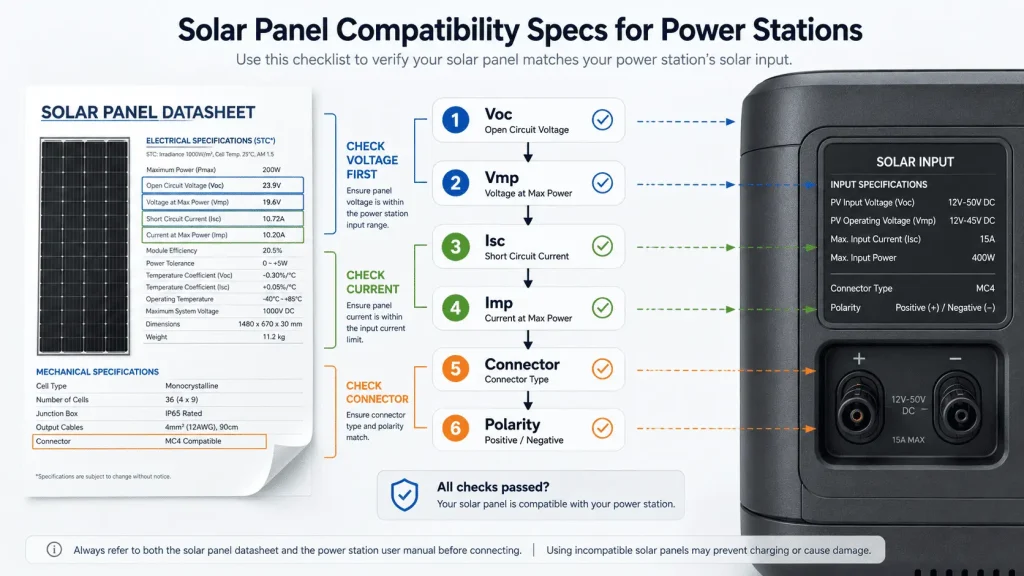
The practical order is simple: voltage first, current second, connector and polarity third, wattage last.
The 6 Specs You Must Check Before Connecting a Solar Panel
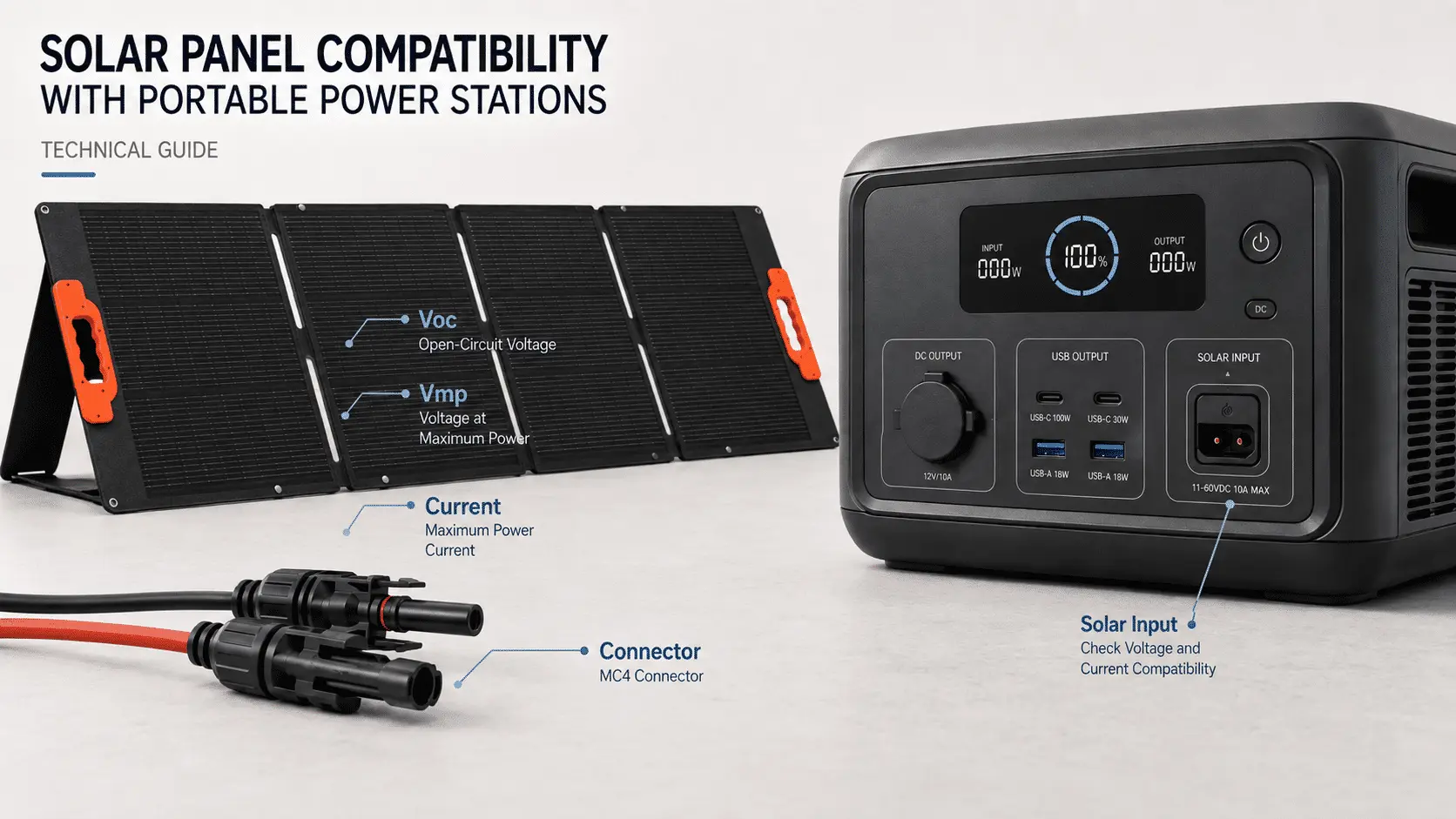
Before connecting a solar panel to a power station, compare the solar panel datasheet with the power station’s solar input specification. The key terms are Voc, Vmp, Isc, Imp, connector type, and polarity.
| Spec | What it means | Why it matters |
|---|---|---|
Voc |
Open-circuit voltage when the panel is not under load | This must stay below the power station’s maximum solar input voltage. Cold weather can raise Voc, so leave margin. |
Vmp |
Voltage at maximum power under operating conditions | This should sit inside the power station’s MPPT operating voltage range. |
Isc |
Short-circuit current | This helps check current limits and protection requirements. |
Imp |
Current at maximum power | This shows the normal working current and whether the input may clip extra current. |
| Connector | MC4, XT60, XT60i, Anderson, DC5521, DC7909, 8mm, or another connector | A matching connector helps physically connect the cable, but it does not prove electrical compatibility. |
| Polarity | Positive and negative direction | Wrong polarity may prevent charging or damage equipment, especially when using adapter cables. |
Voc is usually the first safety check. If the panel or panel string exceeds the power station’s maximum input voltage, the connection may damage the charging circuit. This risk is higher when users connect panels in series because series wiring adds voltage.
Do Not Match by Wattage Alone
Wattage tells you how much power a solar panel may produce under standard test conditions. It does not prove that the panel is safe or suitable for a specific power station.
For example, a 400W panel may look attractive because it suggests faster charging. But if the power station only accepts 200W of solar input, the extra capacity may not be used. If the panel’s voltage is above the input limit, the problem is more serious: the panel may be electrically unsuitable even if the wattage looks reasonable.
A better question is not “Can I use a 400W panel?” The better question is: Does this panel’s Voc, Vmp, current, connector, and polarity match the exact solar input specification of my power station?
How to Read a Power Station Solar Input Label
The power station manual or product label should include a solar input section. This is different from AC input and car charging input. The solar/DC input is the section that matters for solar panel compatibility.
| Power station input item | What to record | Why it matters |
|---|---|---|
| Exact model | Model name and regional version | Different models from the same brand may have different inputs. |
| Solar input voltage range | Example format: 11-60V, 30-150V, or 135-450V | The panel’s working voltage must fit this range. |
| Maximum input voltage | The highest voltage allowed | The panel or series string Voc must stay below this value. |
| Maximum input current | Example format: 10A, 15A, 20A | Extra current may be clipped or unsupported. |
| Maximum solar input wattage | Example format: 200W, 600W, 1000W, 1600W | This limits useful charging power. |
| Connector type | XT60, XT60i, Anderson, DC8020, DC5521, DC7909, 8mm, or other | Cable and adapter selection depends on this. |
| Input port count | Single input, dual input, high-PV, low-PV, or other design | Multi-port systems may have separate rules. |
EcoFlow, Jackery, Bluetti, and other power station brands publish model-specific solar input limits. These limits can vary widely. Some larger units support high-voltage PV input. Smaller or mid-size portable units may use lower-voltage inputs. Do not assume that one cable or one panel design fits the whole brand.
If the manual lists both a high-voltage PV input and a low-voltage PV input, check which port you are using. A panel string that belongs on a high-voltage input may be wrong for a low-voltage input, and a low-voltage portable panel may not make sense for a high-voltage PV input.
STREAM Compatibility Case: Check the PV System, Not Just the Brand
EcoFlow STREAM is a useful compatibility case because it should not be treated as an ordinary portable power station. STREAM is a solar storage and plug-in system with its own PV terminals, power-conversion equipment and model-specific input rules. A panel that works with a portable EcoFlow unit is not automatically suitable for every STREAM model.
For example, the official STREAM 5000 EU specifications list multiple MPPT inputs, a maximum PV input voltage of 60V, and a total PV input power rating of up to 5000W. Those figures belong to that specific product and market page. They should not be copied to another STREAM version without checking its current manual and regional specifications.
| STREAM review point | What a panel buyer should confirm | Practical reason |
|---|---|---|
| Exact STREAM model | Model name, generation and market version | PV ports and limits can differ between models and regions. |
| PV terminal | Which positive and negative terminals form one input pair | The panel leads must be connected to the correct pair; a connector that fits the housing is not enough. |
| Voltage limit | Maximum PV voltage for the selected input | Do not build a series string that exceeds the listed limit. The official STREAM manual warns against series connections that can push input voltage above 60V. |
| Current and wattage | Maximum current and usable input power per port or for the system | A large panel or multi-panel array may be clipped even when its voltage is acceptable. |
| Panel layout | One panel per input, parallel design, cable length and connector path | Layout affects shade behavior, cable loss, installation safety and troubleshooting. |
A practical STREAM review therefore starts with the manual, then checks the panel datasheet. Record Voc, Vmp, Isc, Imp, connector, polarity and cable length. If the project uses flexible panels on a balcony, wall, RV or custom surface, also review heat, drainage, fixing and access. The panel structure solves the installation problem; it does not override the STREAM PV input limits.
For a supplier or distributor, the safest quotation wording is model-specific: “compatible with the confirmed STREAM model and PV input configuration,” rather than “compatible with STREAM” as a blanket claim. Keep the model manual, panel datasheet, wiring diagram and sample test record together.
How to Check a Solar Panel Data Label
The solar panel datasheet or rear label should list the electrical values needed for compatibility. Do not stop at rated power.
| Solar panel item | Value to record | Pass / fail question |
|---|---|---|
| Rated power | ___ W | Is this within the useful charging range of the power station? |
Voc |
___ V | Is it below the maximum input voltage after cold-weather margin? |
Vmp |
___ V | Is it inside the MPPT input voltage range? |
Isc |
___ A | Is the short-circuit current acceptable for the input design? |
Imp |
___ A | Will the current be used or clipped by the input limit? |
| Connector | ___ | Does the connector match the required cable path? |
| Polarity | ___ | Has polarity been verified before connection? |
| Temperature coefficient | ___ | Does cold-weather Voc need extra margin? |
A panel described as a “12V solar panel” does not normally output exactly 12V. Many nominal 12V panels have a higher open-circuit voltage and a working voltage above 12V. That is normal for solar modules, but it is exactly why the datasheet must be checked.
Series vs Parallel: What Changes?
Series wiring increases voltage. Parallel wiring increases current. Both methods can be useful, but both must be checked against the power station’s input limits.
| Wiring method | What increases | What usually stays similar | Main compatibility risk |
|---|---|---|---|
| Single panel | Nothing added | Panel voltage and current stay as listed | Lower power, but easiest to verify. |
| Series | Voltage | Current | Combined Voc may exceed the power station’s maximum input voltage. |
| Parallel | Current | Voltage | Combined current may exceed or be clipped by the input current limit. |
| Series-parallel | Voltage and current | Depends on the design | More complex and should be reviewed before use. |
For many portable power stations, the biggest mistake is connecting two or more panels in series without calculating total Voc. If each panel has a Voc of 40V, two panels in series can reach 80V before cold-weather adjustment. That may be fine for one power station and too high for another.
Parallel wiring has a different issue. It keeps voltage similar but adds current. If the power station accepts only a certain current, the extra current may not increase charging speed. This does not always mean the setup is dangerous, but it may mean the buyer paid for panel capacity the power station cannot use.
Common Compatibility Mistakes Buyers Make
Most compatibility issues come from treating solar panels, cables, and power stations as if they were universal accessories. They are not. The electrical match still matters.
- Choosing a solar panel only by wattage.
- Assuming a “12V solar panel” outputs only 12V.
- Using an adapter cable without checking polarity.
- Connecting panels in series before calculating total
Voc. - Mixing different wattage panels without checking voltage and current behavior.
- Confusing AC input specifications with solar/DC input specifications.
- Expecting full rated panel wattage in hot, cloudy, shaded, or flat-mounted conditions.
- Assuming a panel that works with one EcoFlow, Jackery, or Bluetti model will work with another model from the same brand.
When a Compatible Solar Panel Still Charges Slowly
Compatibility means the connection is allowed. It does not guarantee full rated output.
| Cause | What happens |
|---|---|
| Low sun angle | The panel receives less irradiance than the test condition used for its rating. |
| High temperature | Solar cells usually produce less power as cell temperature rises. |
| Partial shade | Even small shade on cells can reduce output. |
| Flat mounting | Roof-mounted panels may not face the sun directly. |
| Dirty surface | Dust, pollen, salt, or road grime can reduce light reaching the cells. |
| Cable loss | Long or thin cables can waste power before it reaches the station. |
| Battery state | Some power stations reduce charge rate when the battery is near full or too hot/cold. |
| Input limit | The station may cap voltage, current, or watts even when the panel can produce more. |
This is why a 400W panel rarely means 400W on the screen all day. Real charging depends on sunlight, temperature, mounting angle, cable design, controller behavior, and the power station’s battery condition.
Which Panel Type Fits a Power Station Use Case?
The best solar panel format depends on how the power station will be used. A weekend camper, an RV roof installer, and a power station brand building a retail bundle may need different panel structures.
| Use case | Better panel format | Why |
|---|---|---|
| Camping and temporary charging | Foldable portable solar panel | Easier to angle toward the sun, move away from shade, store after use, and pair with a power station. |
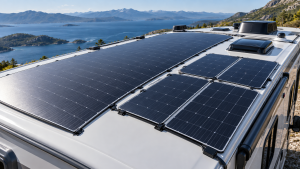
| RV or van roof with height or weight limits | Flexible or lightweight panel | Lower profile and lighter structure, but heat, cable routing, and serviceability must be planned. |
| Long-term fixed installation | Rigid panel or engineered lightweight module | A mounted structure can provide airflow and service access. |
| Marine or humid environments | Application-specific panel and cable design | Sealing, corrosion resistance, cable routing, and service access matter more. |
| Power station brand bundle | Custom portable, foldable, flexible, or lightweight panel | Voltage, connector, cable length, labeling, manual, and packaging can be matched to the target power station. |
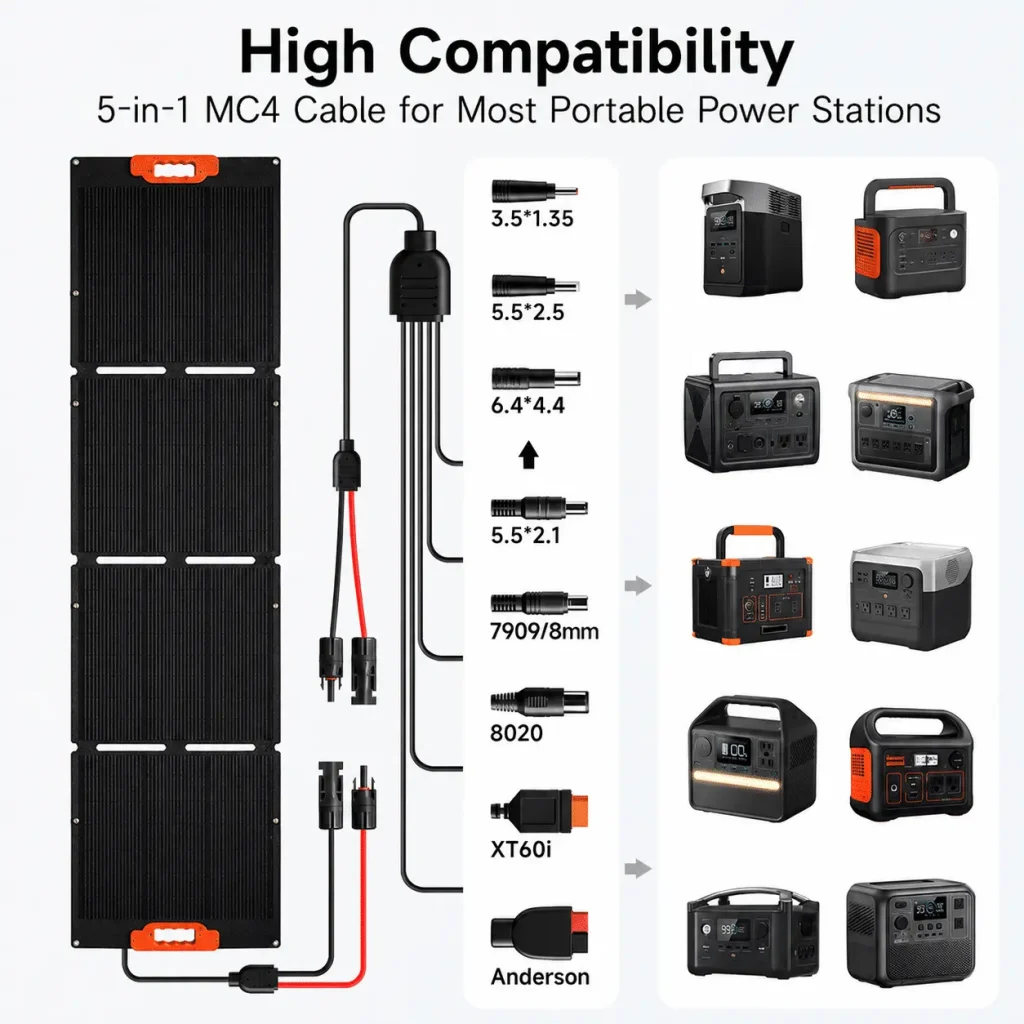
For Sungold projects, the standard initial factory connector is MC4. If the project requires it, Anderson connectors can be customized. Cable sets can also be designed around the target power station brand and model, including one-to-two or one-to-three splitter or adapter designs.
Connector customization should still begin with the electrical specification. A cable can solve the physical connection, but it cannot make an over-voltage panel safe or make a low-input power station accept more watts than it is designed to receive.
B2B RFQ Checklist for Power Station Brands, Distributors, and Kit Sellers
For B2B buyers, compatibility is not only a technical issue. It is a support, return-rate, and brand-trust issue. A solar panel bundle that looks simple on the shelf can create problems if the voltage, current, connector, cable length, label, and manual do not match the power station.
| RFQ item | What to provide |
|---|---|
| Power station model | Exact model and regional version. |
| Example brand category | EcoFlow, Jackery, Bluetti, or another brand, if relevant to the project. |
| Solar input range | Voltage range, maximum voltage, maximum current, and maximum watts. |
| Input port type | XT60, XT60i, Anderson, DC8020, DC5521, DC7909, 8mm, or another connector. |
| Port quantity | Single input, dual input, high-PV input, low-PV input, or other design. |
| Target panel wattage | 100W, 200W, 400W, or custom wattage. |
| Panel structure | Portable, foldable, flexible, lightweight, rigid, or custom laminate. |
| Cable requirement | MC4 standard, Anderson customization, one-to-two cable, one-to-three cable, or brand-specific adapter set. |
| Use environment | Camping, RV roof, marine, balcony, backup power, outdoor event, or off-grid kit. |
| Labeling | Polarity label, voltage/current label, warning label, and private-label artwork. |
| Documentation | Datasheet, user manual, inspection checklist, packaging text, and compliance document requirements. |
This information lets the supplier review the panel as part of a system, not as an isolated module. It also helps prevent a common B2B problem: the sample works in one test, but the final bundled kit creates support issues because the cable, label, or manual did not match the customer’s actual use case.
What Sungold Can Review for a Power Station Solar Panel Project
Sungold can support portable, foldable, flexible, lightweight, and custom solar panel projects where the solar panel needs to match a power station, RV solar kit, off-grid package, or private-label bundle.
For a compatibility review, buyers should provide:
- The exact power station model and regional version
- The solar input voltage range
- The maximum input voltage
- The maximum input current
- The maximum solar input wattage
- The connector or input port type
- Whether one panel, two panels, or three panels will be used
- Whether the cable design should be one-to-one, one-to-two, or one-to-three
- The target panel wattage and panel structure
- The expected use environment
- Private-label, packaging, and manual requirements
Sungold’s standard initial factory connector is MC4. For project needs, Anderson connectors and brand/model-specific cable sets can be customized after the target power station input requirements are confirmed.
The important boundary is this: customization should not be treated as a universal compatibility claim. A connector change must still follow the voltage, current, polarity, and input-wattage limits of the power station.
Final Thoughts
The safest way to match a solar panel with a power station is to start with the power station, then choose the panel. Confirm voltage first, current second, connector and polarity third, and wattage last.
If you are a consumer, take a photo of the power station’s solar input label and compare it with the solar panel datasheet before connecting anything. If you are a distributor, kit seller, or power station brand, send the input specification to the panel supplier before sample production.
For B2B projects, Sungold can review the panel-side voltage, current, connector, cable, and structure requirements when you provide the target power station’s solar input specifications. For related system planning, see Sungold’s solar backup sizing guide.
FAQ
Can I use any solar panel with EcoFlow STREAM?
No. STREAM should be checked by exact model and PV input configuration. Confirm the selected input pair, maximum PV voltage, current, usable wattage, connector and polarity against the panel datasheet. The official STREAM documentation also needs to be checked for series or parallel wiring limits before connecting more than one panel.
Can I use any solar panel with a portable power station?
No. The panel must match the power station’s solar input voltage range, maximum voltage, current limit, connector type, and polarity. A similar wattage or matching connector does not prove compatibility.
Is a 400W solar panel always better than a 200W panel for a power station?
Not always. If the power station only accepts 200W or has a low current limit, the extra panel capacity may not be fully used. A larger panel also needs to stay within the station’s voltage and current limits.
Can I connect two solar panels in series to a power station?
Only if the combined open-circuit voltage stays below the power station’s maximum solar input voltage, including cold-weather margin. Series wiring increases voltage, so it is often the easiest way to exceed an input limit.
Can I connect two solar panels in parallel to a power station?
Sometimes. Parallel wiring increases current while keeping voltage similar. The combined current should be checked against the power station’s input current limit. Extra current may be clipped or unsupported depending on the model.
Is MC4 to XT60 enough to make a panel compatible?
No. An MC4-to-XT60 cable may solve the physical connection, but the panel still needs the right voltage, current, polarity, and wattage range for the power station input.
Do flexible solar panels work with EcoFlow, Jackery, or Bluetti power stations?
They can work when the electrical specifications and connector path match the exact power station model. Flexible describes the panel structure; it does not automatically prove compatibility with EcoFlow, Jackery, Bluetti, or any other brand.
What should I send to a solar panel supplier for a compatibility check?
Send the power station model, solar input voltage range, maximum voltage, maximum current, maximum solar watts, connector type, target panel wattage, panel structure, cable length, use environment, and any one-to-two or one-to-three cable requirements.
Need a solar panel matched to a power station project?
Send Sungold the target power station model, solar input limits, connector requirement, cable layout, and use environment. Our team can review the panel-side specification before sample production.
Contact Sungold