




Quick Answer
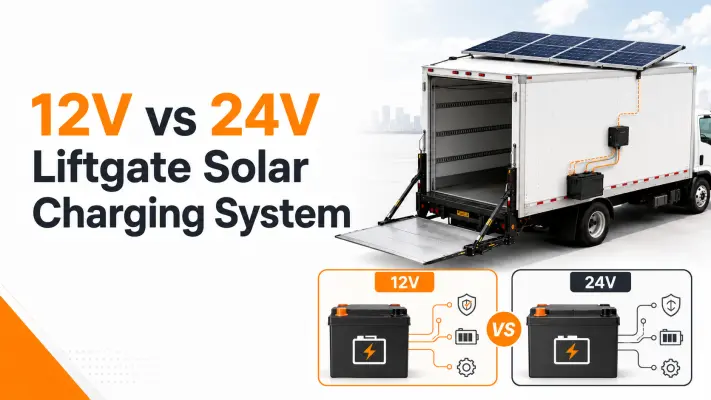
A 12V or 24V liftgate solar charging system should match the actual liftgate battery voltage. Neither voltage is automatically better. A 12V system is common on many delivery trucks, box trucks, and trailers. A 24V system may appear on some heavier vehicles, specialized auxiliary equipment, or fleet platforms where the battery architecture is already designed around 24V.
The real decision is not only the voltage label. Fleet buyers need to confirm the battery bank voltage, charge controller compatibility, solar panel voltage range, cable length, fuse protection, roof space, liftgate duty cycle, and battery condition.
Match the solar charging system to the vehicle’s existing battery architecture first, then choose the panel size and controller.
Why This Topic Matters for Fleet Buyers
If liftgate batteries keep failing after short delivery routes, the problem is often not just battery capacity. It may involve charging time, voltage drop, controller matching, and the actual 12V or 24V battery architecture.
Liftgate battery problems are rarely caused by one factor. A truck may run a liftgate many times per day, drive short routes between stops, power lights or telematics, and then sit at a depot overnight. The alternator may not have enough run time to fully recover the liftgate battery before the next route.
That is why solar charging has become a practical option in commercial vehicle applications. The goal is not to replace the truck’s electrical system. The goal is to add a supplemental charging source that helps maintain battery state of charge while the vehicle is parked, staged, or operating in daylight.
Industry examples already show this use case. WALTCO’s solar liftgate charging kit is positioned around roof-mounted solar panels, an MPPT controller, 12V/24V system charge voltage, and charging while the vehicle is stationary. Automotive Fleet’s coverage of eNow and Hercules also points to delivery-fleet use cases where liftgate batteries, frequent stops, and auxiliary loads create charging demand.
For OEM/ODM buyers and distributors, the business risk is clear. If the system voltage is wrong, the controller is undersized, or the roof panel does not match the duty cycle, the after-sales issue will look like a solar panel problem even when the real problem is system design.
How a Liftgate Solar Charging System Works
A liftgate solar charging system usually has four core parts:
| System Part | Role in the System | Buyer Check |
|---|---|---|
| Solar panel | Generates charging power from daylight | Wattage, dimensions, weight, voltage, roof fit, mounting method |
| Charge controller | Regulates charging to the battery bank | 12V/24V compatibility, input voltage, output current, battery type settings |
| Cabling and protection | Transfers power from the roof to the controller and battery area | Cable length, voltage drop, fuse or breaker, abrasion protection, water entry |
| Liftgate battery bank | Supplies high current to the liftgate motor | Actual voltage, battery chemistry, age, capacity, condition |
The liftgate motor still draws high current from the battery when lifting and lowering freight. Solar charging replenishes energy over time. This makes solar useful as a battery maintainer and supplemental charging source, especially for trucks with daylight parking, depot staging, or repeated short routes.
Purkeys describes its Solar Bolt as a liftgate charging system that works with the vehicle electrical system and helps keep liftgate and auxiliary batteries charged whether the vehicle is on or off. That is a useful way to frame the role of solar: support the battery system, not replace it.
If the battery is damaged, the hydraulic system is failing, cables are corroded, or the ground connection is weak, solar charging may not solve the real problem.
How to Identify Whether Your Liftgate Battery System Is 12V or 24V
Do not assume the voltage only from the vehicle type. A box truck, trailer, or delivery vehicle may be modified by the body builder, liftgate installer, fleet maintenance team, or previous owner.
Before specifying the solar panel and controller, check:
| Check Method | What to Look For | Why It Matters |
|---|---|---|
| Battery label | The voltage printed on each battery | Confirms the individual battery voltage |
| Battery wiring | Series or parallel connection | Two 12V batteries in series create a 24V bank; two 12V batteries in parallel remain 12V |
| Liftgate manual | Required battery voltage and current guidance | Prevents mismatch with liftgate manufacturer requirements |
| Existing controller or charger | 12V, 24V, or multi-voltage support | Shows how the current charging system is configured |
| Upfitter documentation | Vehicle body and liftgate electrical notes | Useful when the fleet has multiple vehicle builds |
| Maintenance test | Voltage measured by a qualified technician | Confirms the actual system before ordering components |
For fleet buyers, this step is practical. It reduces the risk of buying a 12V solar charging setup for a 24V battery bank, or specifying a higher-voltage system when the liftgate battery architecture is actually 12V.
12V vs 24V: What Actually Changes?
Before choosing a solar panel or controller, confirm the battery bank voltage on the actual vehicle. Do not assume a delivery truck is 12V or a heavy vehicle is 24V without checking the liftgate battery system.
| Design Item | 12V Liftgate Solar Charging | 24V Liftgate Solar Charging |
|---|---|---|
| Common fit | Many delivery trucks, box trucks, trailers, and aftermarket systems | Some heavier vehicles, specialized fleets, and auxiliary equipment already designed around 24V |
| Main advantage | Simpler matching for many common vehicle platforms | Lower current for the same power level, which can help with longer cable runs when correctly designed |
| Main risk | Undersized controller, voltage drop, poor battery matching | Wrong controller voltage, panel voltage too low, or undercharging due to poor configuration |
| Panel planning | Often starts with 12V nominal panel planning or suitable controller input | May require higher-voltage panel configuration or series wiring with an MPPT controller |
| Controller planning | PWM or MPPT may be considered depending on the system | MPPT is often preferred where array voltage and battery voltage need better matching |
| Buyer priority | Confirm battery condition, current rating, and route duty cycle | Confirm controller input/output range, array voltage, and battery charging profile |
For the same power level, a 24V system carries about half the current of a 12V system. Lower current can reduce voltage drop and cable heating when the system is properly designed. But that does not make 24V automatically better. A 24V battery bank still needs the right solar array voltage and charge controller.
Why Voltage Matching Matters More Than Panel Wattage
Many buyers start by asking, “Do I need a 100W, 200W, or 400W solar panel?” That question matters, but it is not the first question.
The first question should be: what battery voltage and charging profile does the liftgate system actually require?
If the controller and battery voltage do not match, a larger panel will not solve the problem. Common mismatch risks include:
- the controller does not support the battery voltage;
- the solar panel voltage is not high enough for proper charging;
- the controller current rating is too low for the array;
- cable runs create too much voltage drop;
- the battery chemistry does not match the controller setting;
- the system is connected to an old or damaged battery bank;
- the installation lacks proper fuse or breaker protection.
WALTCO’s published solar charger specification is a useful industry reference because it separates system charge voltage, rated charge current, system input power, and maximum system input voltage. That is the right way to think about the design. The panel wattage is only one part of the system.
Can a 12V Solar Panel Charge a 24V Liftgate Battery?
Not by itself in a simple direct setup. A 24V battery bank normally needs a charging voltage above the battery voltage. A typical 12V nominal panel may not provide the right voltage window for charging a 24V battery bank.
There are several ways a system can be designed, but they must be engineered properly:
| Option | When It May Apply | Buyer Risk |
|---|---|---|
| Higher-voltage solar panel | When the panel voltage is suitable for the controller and 24V battery | Must verify voltage range, current, and controller limits |
| Panels wired in series | When roof layout allows multiple panels and the controller supports the input voltage | Series wiring increases voltage; design must respect controller maximum input |
| MPPT controller | When array voltage and battery voltage need conversion and optimization | Controller must support the battery voltage and charging profile |
| Separate charging path | When liftgate and auxiliary equipment need independent charging | More components, more documentation, more installation control |
This is why a 24V liftgate solar charging project should not be treated as “just use a bigger panel.” It needs a matched panel, controller, wiring, and battery plan.
When a 12V System Is Usually the Better Starting Point
A 12V liftgate solar charging system is often easier to specify when the vehicle already uses a 12V liftgate battery architecture and the duty cycle is moderate.
| Situation | Why 12V May Fit |
|---|---|
| Common delivery truck or box truck platform | Many aftermarket and fleet electrical systems are already organized around 12V batteries |
| Smaller roof area | A lower-power panel may be enough for maintenance charging |
| Battery maintenance focus | The main goal is to reduce low-state-of-charge events, not power heavy auxiliary loads |
| Simpler aftermarket program | Easier for distributors and installers to explain and repeat |
| Shorter cable route | Voltage drop is easier to control when the roof-to-battery distance is reasonable |
The main caution is current. As panel wattage rises, a 12V system needs more current. That makes controller sizing, wire gauge, fuse selection, and cable routing more important.
When a 24V System May Make More Sense
A 24V system may make more sense when the existing liftgate battery bank is already 24V, when the vehicle platform is built around 24V electrical architecture, or when the solar charging system must support higher power with lower current.
| Situation | Why 24V May Fit |
|---|---|
| Existing 24V liftgate battery bank | The solar system should match the battery architecture already on the vehicle |
| Heavier vehicle platform | Some platforms and auxiliary equipment may be planned around 24V |
| Longer cable runs | Lower current can help reduce voltage drop if the system is designed correctly |
| Higher input power | Larger solar arrays may be easier to manage at higher voltage |
| Auxiliary equipment charging | Some applications may include 24V pallet jack or auxiliary battery charging |
The main caution is compatibility. A 24V system needs a controller that supports 24V charging, an array voltage high enough for charging, and clear documentation for installers.
Controller, Wiring, and Battery Checks Before Ordering
A liftgate solar charging project can fail even when the panel is well made. The most common weak points are controller matching, cable routing, battery condition, and installation quality. This is also why installation documents matter: Purkeys lists Solar Bolt install guides and technical documents alongside the product, which is a useful reminder that commercial liftgate solar charging needs controlled installation, not only product selection.
| Checkpoint | What to Confirm | Why It Matters |
|---|---|---|
| Battery voltage | 12V, 24V, or another architecture | Determines controller and panel configuration |
| Battery type | Lead-acid, AGM, gel, lithium, or other | Charging profile must match the battery |
| Controller voltage range | Input and output voltage limits | Prevents undercharging or controller damage |
| Controller current rating | Maximum charge current | Prevents overheating and system limitation |
| Cable length | Roof to controller and controller to battery | Affects voltage drop and wire sizing |
| Protection | Fuse, breaker, abrasion protection, waterproof entry | Reduces installation and service risk |
| Battery condition | Age, capacity, load-test result, terminals | Solar should not be used to hide a failed battery |
| Service access | Location of controller, fuses, and cable routes | Helps technicians maintain the system |
For fleet projects, these items should be part of the RFQ. If the supplier only asks for “12V or 24V” and panel wattage, the input is not detailed enough.
How to Estimate the Solar Panel Range
Panel sizing should start from the route, not from a generic wattage. A truck that uses the liftgate twice a day does not need the same plan as a high-density urban delivery route with repeated lift cycles.
For early B2B planning, many liftgate solar charging discussions fall around 100W to 400W. Treat this as a planning range, not a guaranteed performance claim.
| Planning Range | Better Fit | What to Check |
|---|---|---|
| Around 100W | Battery maintenance, lighter liftgate routes, limited roof area | Battery size, parking exposure, daily recovery target |
| Around 200W | Medium-use routes and repeated lift cycles | Controller current, available roof area, cable run |
| 300W-400W | Higher-use routes, larger battery banks, demanding duty cycles | Mounting layout, controller design, installation method |
| Above 400W | Specialized fleets or multi-load auxiliary systems | Engineering review, controller input, roof structure, compliance |
Do not promise a fixed result from a fixed wattage. Solar output depends on sunlight, season, shading, panel orientation, roof dirt, controller efficiency, and parking habits.
Roof Layout: Why Panel Format Still Matters
Commercial vehicle roofs are not clean solar rooftops. A box truck or trailer roof may include seams, marker lights, vents, refrigeration equipment, cable paths, or curved areas. A panel that works electrically may still fail the project if it does not fit the roof.
For fleets where roof height, panel weight, and repeated installation across vehicle models matter, flexible or lightweight customized solar panels may be reviewed before final controller selection.
For liftgate solar charging, buyers should check:
- available flat roof area;
- roof material and mounting method;
- vehicle height limitations;
- panel weight and thickness;
- cable route to the battery box;
- vibration and abrasion risk;
- cleaning and service access;
- repeatability across multiple vehicle models.
Flexible and lightweight solar panels are often considered when low profile, lower roof load, and better fit are important. Rigid panels may work in some cases, but they usually require brackets, roof clearance, and more mechanical review.
For commercial vehicle projects, buyers can start by reviewing Sungold’s PA219 flexible solar panel series and PA621 lightweight solar panel series as roof-fit directions. Final selection should be confirmed against panel dimensions, voltage platform, mounting method, certification requirements, and project volume.
RFQ Checklist for Fleet Buyers and Upfitters
Before asking for a quote, prepare the information that affects the system design:
| RFQ Input | Why It Matters |
|---|---|
| Vehicle type | Box truck, trailer, delivery van, refrigerated vehicle, or work truck |
| Roof layout | Determines panel size, mounting method, and cable route |
| Liftgate battery voltage | Decides 12V or 24V charging plan |
| Battery chemistry and capacity | Affects controller settings and recovery target |
| Average lift cycles per day | Helps estimate charging demand |
| Route pattern | Short urban stops, regional delivery, depot parking, weekend storage |
| Available roof area | Limits panel wattage and format |
| Cable distance | Affects voltage drop and protection |
| Target market | Determines certification and documentation needs |
| Volume plan | Supports OEM, ODM, distributor, or aftermarket planning |
A good RFQ describes the vehicle and route. A weak RFQ only asks, “How much for a 200W solar panel?”
How Sungold Can Support 12V and 24V Liftgate Solar Projects
Sungold Solar can support B2B projects where the solar panel must fit a commercial vehicle roof, repeat across a vehicle program, and match the project documentation needs.
For liftgate battery solar charging, Sungold’s role should be positioned clearly:
- flexible and lightweight panel review for truck and trailer roofs;
- custom panel dimensions for OEM/ODM or upfitter projects;
- panel-level planning for 12V and 24V charging discussions;
- support for distributor and aftermarket product development;
- documentation support for quotation and project evaluation.
Sungold should not be described as replacing the battery, controller, alternator, liftgate motor, or full vehicle electrical system unless a complete system scope is separately confirmed. Exact charging output, controller selection, certification scope, warranty terms, MOQ, lead time, and performance claims should be confirmed before quotation or public use.
For buyers comparing 12V and 24V liftgate solar charging, the next useful step is to share the vehicle type, roof dimensions, battery voltage, liftgate duty cycle, target wattage range, and market requirements. Sungold can then review whether a PA219 flexible panel, PA621 lightweight panel, or custom solar panel format is the better starting point.
FAQ
Is 12V or 24V better for a liftgate solar charging system?
Neither is automatically better. The correct choice is the one that matches the vehicle’s liftgate battery system. Confirm the actual battery bank voltage before choosing the solar panel and charge controller.
Can a 12V solar panel charge a 24V liftgate battery?
Not in a simple direct setup. A 24V battery bank normally needs a higher charging voltage and a compatible controller. The system may require a higher-voltage panel, panels in series, or an MPPT controller designed for the battery voltage.
Why does controller selection matter so much?
The controller regulates charging to the battery bank. If it does not support the battery voltage, current, battery chemistry, or panel input range, the system may undercharge, stop charging, or create service problems.
What size solar panel is needed for liftgate batteries?
Many fleet projects evaluate 100W to 400W planning ranges, but the right size depends on lift cycles, battery capacity, route pattern, parking exposure, sunlight, roof space, and controller design.
Can solar charging replace the alternator?
Usually no. Solar charging is best treated as supplemental battery support. The alternator, battery bank, controller, and solar panel should work together as part of the vehicle charging strategy.
What should an upfitter provide before requesting a quote?
Provide vehicle type, roof dimensions, battery voltage, battery chemistry, daily lift cycles, cable route, target market, certification needs, and project volume. This helps the supplier recommend a realistic panel format and voltage plan.
Are flexible panels suitable for liftgate battery charging?
Flexible or lightweight panels can be suitable when low profile, reduced weight, and roof fit matter. Buyers should still confirm mounting method, cable routing, vibration risk, heat exposure, and service access.
Send Your Liftgate Solar Charging Requirements
If your fleet, upfitter program, or liftgate product line needs 12V or 24V solar charging support, Sungold Solar can review roof space, voltage platform, target wattage, panel format, and OEM requirements before recommending a panel direction.
Technical References
- WALTCO Solar Liftgate Charging Kit by Hiab for liftgate solar charging system, 12V/24V charge voltage, MPPT controller, and system input context.
- Purkeys Solar Bolt for liftgate charging system, auxiliary battery charging, and product documentation context.
- Automotive Fleet coverage of eNow and Hercules for delivery-fleet liftgate and auxiliary-load application context.