 EN
EN
 Deutsch
 Italiano
 Español
 Français
 日本語
日本語
Quick Answer
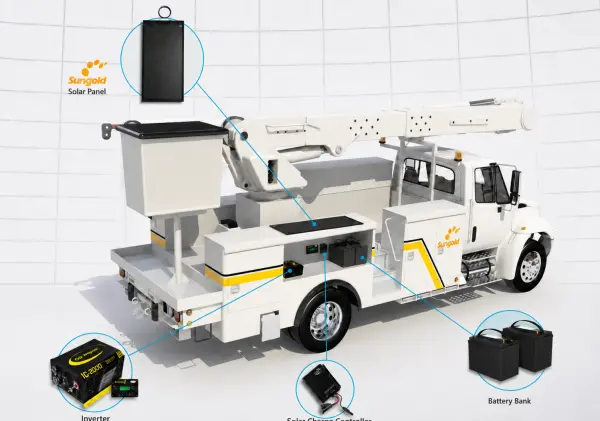
A solar charger for a delivery truck liftgate battery helps keep the liftgate battery charged during short routes, frequent stops, and parking periods. It does not replace the battery or liftgate motor. It adds supplemental charging through a roof-mounted solar panel, charge controller, and properly matched 12V or 24V battery connection.
Why Delivery Truck Liftgate Batteries Lose Charge
Delivery truck liftgate batteries lose charge because the route often works against the battery. A liftgate may be used repeatedly at stops that are only a few minutes apart. The motor draws high current, but the alternator may not run long enough between stops to fully recover the battery.
This is common in last-mile delivery, grocery distribution, beverage delivery, parcel fleets, appliance delivery, and urban box truck routes. The liftgate may work well at the start of the day, slow down after multiple delivery cycles, and eventually fail to raise the platform when the battery voltage drops too low.
Typical causes include:
- High lift cycles during dense delivery routes
- Short drive time between stops
- Battery age, sulfation, or poor maintenance
- Voltage drop from long cable runs or weak grounds
- Parasitic loads from lights, locks, telematics, or cameras
- Cold weather reducing available battery capacity
When a Solar Charger Makes Sense for Delivery Fleets
A solar charger makes the most sense when the liftgate battery problem is partly caused by insufficient charging time, not only by a failed battery or damaged liftgate component. Solar adds a steady daytime charging source that can help maintain battery state of charge while the vehicle is parked or moving in daylight.
For fleet buyers, the strongest use case is not a single truck with one dead battery. It is a repeated pattern across vehicles: liftgates slow down late in the route, drivers need jump support, batteries are replaced too often, or service calls interrupt deliveries.
| Fleet Symptom | How Solar Can Help | What to Check First |
|---|---|---|
| Liftgate slows near the end of a delivery route | Adds daytime charging between stops | Battery health, lift cycles, route length |
| Battery loses charge while parked | Maintains battery during daylight parking | Parking exposure, shading, parasitic loads |
| Drivers need jump starts or service calls | Reduces avoidable low-voltage events | Cable condition, grounds, controller setup |
| Fleet has mixed box trucks and trailers | Can be specified by vehicle group | Roof layout, voltage, battery location |
What a Solar Charger Can and Cannot Fix
A solar charger can support the liftgate battery, but it is not a repair for every liftgate issue. If the battery is damaged, the hydraulic pump is weak, the cables are corroded, or the ground connection is poor, solar charging may not solve the real failure.
The most reliable approach is to treat solar as part of a battery maintenance strategy. Fleets should first confirm that the liftgate, battery, cable, fuse, solenoid, and hydraulic system are in working condition. Solar then helps reduce the charging gap during normal use.
| Solar Can Help With | Solar Cannot Fix By Itself |
|---|---|
| Battery maintenance during daylight parking | A failed or undersized liftgate battery |
| Supplemental charging between short routes | Corroded cables, weak grounds, or poor wiring |
| Offsetting small parasitic loads | Hydraulic pump, cylinder, or mechanical binding issues |
| Reducing avoidable low-voltage events | An incorrectly specified charging controller |
100W, 200W, or 400W: Which Planning Range Fits?
The right solar charger size depends on the delivery route, lift cycles, battery capacity, sunlight, roof space, and voltage platform. A light-duty route and a high-density urban delivery route should not be specified the same way.
For early planning, fleets often evaluate liftgate battery solar charging in the 100W to 400W range. Treat this as a planning range, not a guaranteed performance claim.
| Planning Range | Typical Delivery Truck Fit | Buyer Notes |
|---|---|---|
| Around 100W | Light-duty liftgate use, limited roof space, battery maintenance focus | Best for lower lift cycles or maintenance charging |
| Around 200W | Medium-duty delivery routes and repeated daily liftgate use | Often a practical B2B starting point for route-based review |
| 300W-400W | Higher-use delivery routes, larger battery banks, more demanding duty cycles | Requires more roof space and careful controller selection |
Box Truck Roof Fit: Flexible vs Lightweight Panels
Delivery truck and box truck roofs are often crowded. They may include roof seams, marker lights, refrigeration equipment, vents, cable paths, or limited flat areas. A solar charger for a delivery truck liftgate battery must fit the vehicle roof before it can support the battery.
Flexible and lightweight panels are useful when roof load, low profile, or custom dimensions matter. Rigid panels can also work in some projects, but they may need brackets, roof clearance, and vibration review.
| Vehicle Type | Solar Panel Concern | Design Implication |
|---|---|---|
| Box truck | Large roof, but possible seams and cargo body differences | Check panel dimensions and cable route to the battery box |
| Delivery van body | Smaller roof area and more roof accessories | Low-profile or custom-size panel may fit better |
| Trailer with liftgate | Battery may be far from the panel location | Plan cable distance, voltage drop, and protection carefully |
For commercial vehicle roof applications, buyers can start by reviewing Sungold’s PA219 flexible solar panel series and PA621 lightweight solar panel series. Final selection should still be confirmed against roof size, voltage platform, mounting method, certification requirements, and project volume.
12V or 24V: What Fleet Buyers Must Confirm
A delivery truck liftgate battery solar charger must match the electrical system. Many North American delivery trucks use 12V liftgate battery systems, while some commercial vehicles and heavier platforms may require 24V planning. Buyers should confirm actual battery voltage before selecting the panel and controller.
The controller is especially important. The wrong controller can lead to undercharging, poor charging behavior, or compatibility issues. Battery chemistry also matters, because lead-acid, AGM, gel, and lithium systems may require different charging profiles.
Buyer Checklist Before Requesting a Quote
A good RFQ should describe the vehicle and route, not just ask for a wattage. Fleet buyers, upfitters, and liftgate manufacturers should provide enough information to support a realistic panel recommendation.
- Vehicle type: box truck, delivery van body, trailer, or refrigerated delivery vehicle.
- Liftgate battery voltage: 12V or 24V.
- Battery chemistry and capacity.
- Average liftgate cycles per day.
- Route pattern: dense urban stops, regional delivery, depot parking, or weekend storage.
- Available roof area and obstructions.
- Preferred panel format: flexible, lightweight, rigid, or custom-size.
- Cable route from roof to controller and battery box.
- Target market and certification requirements.
- Estimated project volume and OEM or aftermarket channel.
How Sungold Solar Supports Delivery Truck Liftgate Projects
Sungold Solar supports B2B solar panel projects where vehicle roof fit, panel weight, repeatable installation, and customization matter. For delivery truck liftgate battery projects, the most useful starting point is a project-specific configuration review.
Sungold can support:
- Flexible and lightweight solar panel options for delivery truck roofs
- Custom panel dimensions for box truck or trailer roof layouts
- OEM and ODM panel planning for liftgate manufacturers and upfitters
- 12V and 24V project discussions at the solar panel level
- B2B documentation support for RFQ and supplier evaluation
Exact charging output, certification scope, warranty terms, MOQ, lead time, and fleet ROI should be confirmed before quotation or public use.
FAQ
Can a solar charger keep a delivery truck liftgate battery charged?
It can help maintain the battery by adding supplemental charging during daylight operation and parking. It should not be treated as a guarantee against every dead battery issue.
What size solar charger do I need for a delivery truck liftgate battery?
Many fleets evaluate 100W to 400W planning ranges, but the correct size depends on lift cycles, battery capacity, route profile, roof space, sunlight, and controller design.
Does solar charging replace the alternator?
Usually no. Solar charging is supplemental. The alternator, battery bank, charge controller, and solar panel should work together as part of the vehicle electrical system.
Is a flexible solar panel suitable for a box truck roof?
Flexible or lightweight panels can be suitable when low profile, reduced weight, and roof fit matter. Mounting, cable routing, vibration, heat, and roof surface condition still need review.
Should a liftgate solar charger be 12V or 24V?
It should match the liftgate battery system. Confirm the actual battery voltage and controller requirements before choosing the solar panel configuration.
What information should fleets provide before ordering?
Provide vehicle type, roof dimensions, battery voltage, battery capacity, daily lift cycles, target wattage range, cable route, controller requirements, certification needs, and order volume.
Send Your Delivery Truck Liftgate Battery Requirements
If your delivery truck fleet, liftgate program, or upfitter project needs solar charging support, Sungold Solar can review roof space, voltage platform, target wattage, panel format, and OEM requirements before recommending a panel configuration.
Source Notes
- Internal market research report: Commercial Vehicle & Truck Off-Grid Solar Market Intelligence Report.
- Public reference: Fleet Maintenance discussion of liftgate performance, low voltage, and charging options.
- Public reference: Work Truck Online coverage of solar chargers for liftgate batteries.
- Public reference: WALTCO Solar Charger page by Hiab.
- Public reference: Box truck repair content discussing liftgate electrical and battery failure symptoms.