 EN
EN
 Deutsch
 Italiano
 Español
 Français
 日本語
日本語
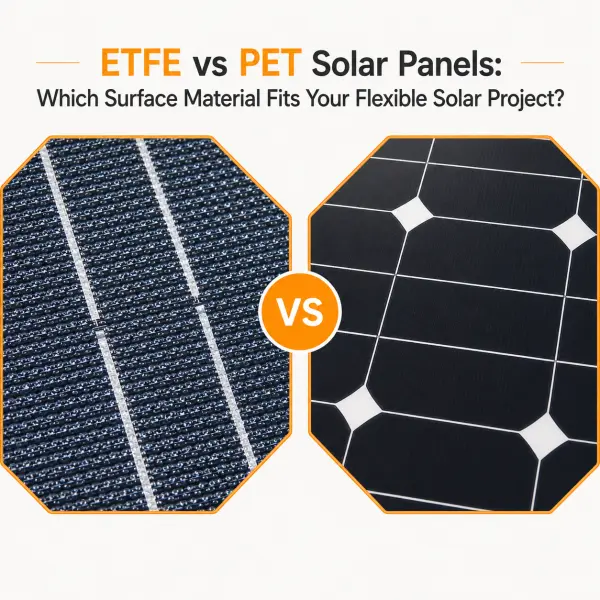
Quick Answer
For flexible solar panels used in long-term outdoor projects, ETFE is usually the stronger surface-film choice because fluoropolymer materials are known for weathering, UV, chemical, heat, and moisture resistance. PET can still be a practical option for cost-sensitive, lighter-duty, or controlled-use projects, but buyers should treat it as a material that needs closer checking under UV, heat, moisture, and abrasion exposure.
The right choice is not simply “ETFE is good and PET is bad.” It depends on the project environment, expected service life, installation surface, module structure, lamination quality, certification scope, and total cost target.
The safer B2B question is: which surface material fits the application risk, and what evidence does the supplier provide for that exact module construction?
Why This Comparison Matters for Flexible PV Buyers
Flexible solar panels are often chosen because glass modules are too heavy, too rigid, or too difficult to install on curved or low-load surfaces. That makes the surface material more important than many buyers expect.
In a rigid glass module, the front glass provides a strong, stable weather barrier. In a flexible module, the top surface is usually a polymer film or protective laminate. That layer has to deal with sunlight, cleaning, foot traffic risk, salt air, heat, bending stress, and long outdoor exposure.
For an OEM buyer, the surface film affects product positioning. For a distributor, it affects customer complaints and warranty risk. For a project buyer, it affects whether the panel is suitable for a roof, vehicle, marine, balcony, or off-grid installation.
This is not a cosmetic material choice. It is a procurement decision.
First, Clarify the Layer Terminology
A common mistake is to compare ETFE, PET, EVA, and POE as if they are the same type of material. They are not.
ETFE/PET are surface films or protective laminate materials, while EVA/POE are the internal encapsulant layers.
In a simplified flexible module stack, you may see:
| Layer | Typical Role | Buyer Question |
|---|---|---|
| Front surface film or laminate | Protects the module from external exposure | Is it ETFE, PET, PVF, or another film? |
| Encapsulant | Bonds and protects the cells inside the laminate | Is it EVA, POE, EPE, or another encapsulant? |
| Solar cells and conductors | Generate and collect current | What cell type, interconnection, and layout are used? |
| Rear film or backsheet | Protects the back side and supports insulation | What rear material and insulation structure are used? |
| Junction box, cables, connectors | Electrical output and field connection | Are they suitable for the installation environment? |
This article focuses on the front surface material comparison between ETFE and PET. It does not claim that the surface film alone determines the lifetime of a solar panel. PV module reliability depends on the full bill of materials, production process, lamination quality, installation method, and test evidence.
ETFE vs PET: Practical Buyer Comparison
| Buyer Concern | ETFE Surface Film | PET Surface Film |
|---|---|---|
| Outdoor weathering | Generally stronger choice for demanding outdoor exposure | Can work in lighter-duty applications, but needs careful UV/weathering verification |
| UV resistance | ETFE is a fluoropolymer; Chemours’ ETFE material information highlights UV and weathering resistance | PET can be UV-stabilized, but buyers should verify the actual film grade and UV-aging evidence |
| Moisture and hydrolysis risk | Low moisture absorption is commonly listed for ETFE materials | PET is a polyester material; heat and moisture exposure should be checked through supplier data and module-level testing |
| Abrasion and cleaning | Often selected where the surface needs better durability | Can be acceptable, but surface wear and scratching risk should be checked |
| Cost | Usually higher | Usually lower |
| Project positioning | Better fit for premium flexible PV, vehicle roofs, marine, outdoor OEM products, and longer-service projects | Better fit for controlled-use, budget-sensitive, short-cycle, or low-exposure products |
| Procurement risk | Lower material-risk profile, but still needs module-level test proof | Higher need for supplier evidence and application boundary control |
The practical rule: if the panel will live outside, move, flex, face salt air, sit on a hot roof, or be sold into a premium B2B channel, ETFE is usually easier to defend. If the project is price-driven and the exposure is controlled, PET may still be worth evaluating.
Where ETFE Usually Makes More Sense
ETFE is often chosen for flexible solar panels because it fits the way many flexible modules are actually used: outdoors, close to hot surfaces, sometimes on curved roofs, and often in places where replacement is inconvenient.
Chemours describes Tefzel ETFE resins as melt-processable fluoropolymers with resistance to radiation, chemicals, UV, extreme temperatures, and low moisture absorption. That does not automatically prove the performance of any finished PV module, but it does explain why ETFE is commonly discussed as a higher-end surface material for outdoor flexible PV.
| Project Condition | Why ETFE Is Usually Preferred |
|---|---|
| Vehicle roof, RV roof, or delivery vehicle roof | Heat, vibration, cleaning, and curved-surface installation increase surface stress |
| Marine or coastal use | Salt air, moisture, and cleaning exposure raise material risk |
| Distributor product line for outdoor users | Fewer material questions at the sales and after-sales stage |
| OEM/ODM product with brand reputation risk | Surface aging complaints are expensive to handle after shipment |
| Long-term outdoor installation | UV and weathering resistance matter more than initial material cost |
| Custom flexible module project | Material choice must match the application, not only the target wattage |
The key point for buyers is not only whether a supplier says “ETFE.” Ask for the exact structure, surface film thickness if available, rear material, encapsulant type, bending limits, installation guidance, and model-specific test or certification scope.
Where PET Can Still Be a Reasonable Choice
PET is not automatically unsuitable. It is a widely used polyester material and is used in different PV-related films and backsheets. PET-based constructions may be reasonable where the project has a shorter lifecycle, lower exposure, tighter price target, or controlled installation conditions.
The important point is evidence. If a supplier recommends PET for an outdoor flexible module, ask for the exact film grade, UV-stabilization information, damp-heat or weathering evidence, and the module construction used in testing. A generic “PET surface” description is not enough for a distributor or OEM buyer.
| Project Condition | Why PET May Be Considered |
|---|---|
| Price-sensitive distribution product | Lower material cost may support entry-level positioning |
| Indoor, temporary, or low-exposure charging product | Weathering pressure is lower than permanent outdoor use |
| Short-cycle promotional or accessory product | Long outdoor service life may not be the main requirement |
| Protected installation surface | Less direct abrasion, less water retention, and less UV exposure |
| Buyer has verified supplier testing | PET can be evaluated if UV stabilization and module-level test evidence are available |
PET should not be selected only because it is cheaper. For outdoor flexible modules, buyers should ask how the PET film is stabilized, whether the surface has proven UV resistance, how the full laminate behaves under damp heat and thermal cycling, and what application boundary the supplier is willing to put in writing.
If the project is exposed to high UV, heat, moisture, frequent handling, or marine air, the cost saving from PET can disappear quickly if it creates complaints, replacements, or channel reputation issues.
The Real Procurement Question: What Will the Panel Experience?
Many material comparisons fail because they start with the material name, not the application. A better procurement brief starts with the stress profile.
| Application | Main Stress Factors | Typical Material Direction |
|---|---|---|
| RV and camper roofs | Heat, vibration, cleaning, curvature, long outdoor exposure | ETFE is usually the safer starting point |
| Marine and yacht surfaces | Salt air, moisture, reflection, cleaning, cable sealing risk | ETFE plus model-specific salt/marine evidence where available |
| Delivery truck or vehicle auxiliary power | Heat, motion, cleaning, roof shape, route exposure | ETFE for longer-service fleet products |
| Lightweight commercial roof | Roof load, wind, heat, installation method, compliance | Choose by system design and certification scope |
| Balcony or building-attached use | Safety, local compliance, mounting, fire classification | Material choice must follow project approval needs |
| Portable charging product | Folding, handling, abrasion, storage, cost target | ETFE for premium outdoor; PET only if exposure is controlled |
| Promotional or short-term product | Cost, appearance, simple use | PET may be acceptable if expectations are clear |
This is where OEM/ODM buyers should push suppliers beyond a simple quotation. The supplier should understand the use case before recommending a film structure.
What OEM/ODM Buyers Should Confirm Before Choosing ETFE or PET
1. Confirm the full material stack
Ask the supplier to identify the front film, encapsulant, cell type, rear film, junction box, cables, connectors, and adhesive or lamination structure where relevant. If a quotation only says “ETFE solar panel” or “PET solar panel,” it is not enough for a serious B2B decision.
2. Confirm the application boundary
The supplier should tell you where the panel is meant to be used and where it should not be used. For example:
- Can it be used on a curved roof?
- What bending radius is allowed?
- Can it be bonded directly to a surface?
- Does it need ventilation?
- Is walking or stepping on the panel allowed?
- Is it suitable for coastal or marine-adjacent use?
- What cleaning method is acceptable?
If these answers are vague, the project risk is not solved.
3. Confirm test and certification scope
For B2B projects, ask whether the exact model is covered by relevant test or certification documents. Do not assume one sample test covers every size, wattage, cell type, or customized layout.
This matters because PV module studies have shown that polymer components, backsheets, encapsulants, and other bill-of-materials choices can be linked to performance and reliability outcomes. IEC 61215-1 also makes an important distinction for buyers: design qualification and type approval are not the same as a quantitative lifetime prediction. That is why the evidence should be model-specific and tied to the actual construction being purchased.
For flexible PV projects, the buyer should normally ask about UV exposure, damp heat, thermal cycling, mechanical bending, salt mist or ammonia exposure where relevant, and electrical safety documentation. If the target market needs UL/CSA recognition, ask for the exact certificate and covered model list rather than relying on a generic claim.
4. Confirm how the product will be sold
Distributors should think about claim control. A product sold as a low-cost PET flexible panel should not be marketed like a premium long-service ETFE panel. A product sold into RV, marine, or professional OEM channels needs stronger evidence, clearer installation instructions, and more conservative warranty language.
The channel message should match the material choice.
Procurement Recommendation Before Choosing ETFE or PET
For buyers who are unsure whether ETFE or PET fits their project, the next step is not to choose a material immediately. The better step is to review the application stress profile, expected service life, installation surface, and required documentation.
Start with five questions:
- What surface will the module be installed on: flat, curved, vehicle-mounted, marine, low-load roof, or portable?
- What exposure will it face: UV, heat, moisture, salt air, vibration, handling, or cleaning?
- What is the procurement target: distributor product line, OEM/ODM model, project supply, or customized module?
- What documentation is required: model-level certification scope, regional market approval, or internal quality file?
- What is the commercial position: premium durability, balanced cost, or entry-level price?
Sungold can support this review through PA219 flexible solar panel options, TF-series options, or customized flexible module structures, depending on the confirmed application and current product documentation.
For projects that need a lightweight flexible solar panel, Sungold’s PA219 flexible solar panel series is a relevant product direction to review. PA219 is positioned for lightweight roofs, RVs, marine applications, off-grid scenarios, distributors, and custom B2B module projects. For certification or test-related claims, buyers should confirm the exact covered model scope before publication or procurement approval.
For projects that involve special flexible-module construction or surface-material selection, buyers can ask Sungold to compare TF-series and PA219-series options against the required installation environment. Because material stacks and available configurations can vary by project and model, the final recommendation should be based on current product documentation, application conditions, and confirmed bill of materials.
In short: do not choose ETFE or PET in isolation. Bring the use case, expected market, installation surface, and documentation requirements into the discussion early.
Buyer Checklist: ETFE vs PET Flexible Solar Panel
Use this checklist before approving a sample or placing a bulk order.
| Checkpoint | What to Ask |
|---|---|
| Surface film | Is the front film ETFE, PET, PVF, or another laminate? |
| Encapsulant | Is the internal encapsulant EVA, POE, EPE, or another structure? |
| Rear material | What is the rear film or backsheet? |
| Application | Is the module designed for RV, marine, roof, balcony, portable, or custom use? |
| Bending | What bending radius or installation limit applies? |
| Ventilation | Can it be bonded directly, or does it require air gap/heat management? |
| Electrical safety | Which model-specific certification or test documents are available? |
| Weathering | What UV, damp heat, thermal cycling, salt mist, or other evidence exists? |
| Claims | Are marketing claims limited to the tested/certified model scope? |
| After-sales risk | Are installation instructions clear enough for the target buyer? |
If the answer to most of these questions is “we can confirm later,” the project is not ready for a final material decision.
FAQ
Is ETFE always better than PET for solar panels?
No. ETFE is usually the stronger choice for demanding outdoor flexible solar panels, but PET may be acceptable for lower-cost, lower-exposure, or shorter-cycle products. The final decision should depend on the application environment, full module structure, and test evidence.
Does ETFE mean the flexible solar panel will last longer?
Not by itself. ETFE has material properties that make it attractive for outdoor flexible PV, but module lifetime depends on the complete bill of materials, lamination quality, installation method, electrical design, and actual exposure conditions.
Is PET bad for flexible solar panels?
No. PET is a useful polymer film material and appears in different PV-related constructions. The risk is using PET in the wrong environment or selling it with claims that require stronger weathering evidence than the product provides.
Are ETFE and EVA the same thing?
No. ETFE is typically discussed as a surface film or protective laminate material. EVA is an internal encapsulant used to bond and protect cells inside the module. POE is another internal encapsulant option often discussed for moisture and durability considerations.
What should distributors ask before buying ETFE flexible solar panels?
Distributors should ask for the exact model, front and rear material structure, encapsulant type, certification scope, installation guidance, bending limits, and warranty language. The word “ETFE” alone is not enough to control after-sales risk.
Which Sungold flexible panel should I review for an OEM/ODM project?
PA219 is a relevant Sungold flexible solar panel series for lightweight roofs, RVs, marine applications, off-grid scenarios, distributors, and custom B2B module projects. For projects focused on special flexible construction or surface-material selection, buyers can also ask Sungold to compare TF-series and PA219-series options based on confirmed product documentation and application conditions.
Review Your Flexible PV Material Requirements
If your flexible PV project is comparing ETFE and PET, send Sungold your target application, installation surface, expected exposure, wattage range, certification market, and volume plan. Sungold can help review whether PA219, TF-series options, or a customized flexible module structure is the better starting point for your project.
Technical References
- Chemours Tefzel ETFE resin information for general ETFE material-property context.
- IEC 61215-1:2021 for PV module design qualification and type approval context.
- PV Modules and Their Backsheets for backsheet and bill-of-materials reliability context.
- Solar module thermomechanical durability and BOM study for material-system durability context.