





Lightweight flexible solar panels can be a strong product line for distributors when the panels match the target application, documentation needs, packaging plan, and after-sales expectations.
For bulk orders, the right choice is not simply the thinnest panel, the lowest price per watt, or the highest wattage on a datasheet. Distributors should check weight, size, surface material, mounting method, cable design, certification scope, packaging, sample quality, and market-specific requirements before placing larger orders.
A product that looks attractive in a catalog may still create problems if it is hard to install, difficult to explain, weak in documentation, or unsuitable for the end user’s application.
Why Distributors Are Looking for Lightweight Flexible Solar Panels
Many distributors are expanding beyond standard glass solar panels because not every customer has a strong roof, fixed mounting structure, or enough space for traditional modules.
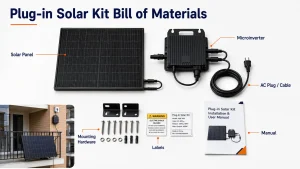
Lightweight flexible panels are often considered for RV and camper roofs, marine and yacht surfaces, balcony solar kits, weak roofs, mobile solar kits, and custom OEM products. For distributors, this creates a useful product category. It allows them to offer something more specific than standard glass panels and avoid competing only on commodity pricing.
But lightweight flexible panels also need more careful selection. The product has to match how it will actually be installed. A panel used on a flat RV roof is not the same as a panel used on a balcony railing, a curved marine surface, or a lightweight commercial roof.
That is why bulk orders should come after product review, sample testing, and clear market positioning.
What Makes a Lightweight Flexible Panel Suitable for Bulk Supply?
A distributor-ready lightweight flexible panel should be evaluated as a product package, not just as a module.
| What to Check | Why It Matters |
|---|---|
| Weight | Helps determine whether the panel fits weak roofs, vehicles, balconies, and shipping plans. |
| Thickness | Affects appearance, handling, installation method, and product positioning. |
| Surface material | ETFE, PET, or other surface structures may affect durability, cleaning, UV exposure, and outdoor suitability. |
| Cell technology | Affects output, appearance, efficiency, and available product formats. |
| Cable and connector design | Important for kit assembly, installation speed, and after-sales service. |
| Backing structure | Affects mounting, bonding, ventilation, and long-term stability. |
| Certification documents | Buyers need to know which model and market the documents actually support. |
| Packaging | Poor packaging can create breakage, warehouse, labeling, and return problems. |
For distributors, the strongest product is usually not the one with the most impressive single specification. It is the one that can be explained, shipped, installed, and supported with fewer surprises.
Flexible vs Lightweight vs Rigid Panels
Distributors often need to decide whether to carry flexible panels, lightweight panels, rigid glass panels, or a mix of all three.
| Product Type | Best Fit | Main Limitation |
|---|---|---|
| Rigid glass panels | Rooftop, ground-mounted, and fixed systems | Heavier and less suitable for curved or lightweight surfaces |
| Flexible solar panels | RV, marine, curved surfaces, custom structures | Requires careful review of heat, mounting, bending, and surface conditions |
| Lightweight solar panels | Weak roofs, balconies, vehicle roofs, and portable kits | Must confirm load, fixing method, installation surface, and market expectations |
This comparison is important because many buyers use “flexible” and “lightweight” as if they mean the same thing. They do not always mean the same product.
Some panels are flexible enough for curved surfaces. Some are lightweight but designed for flatter mounting. Some are suitable for visible balcony or vehicle applications where appearance matters. The distributor should define the sales scenario first, then choose the panel type.
Distributor Buying Checklist Before Bulk Orders
Before moving from sample order to bulk order, distributors should check five areas.
Product Fit
The first question is whether the panel fits the actual use case.
Distributors should confirm the target application, wattage range, panel size, weight limit, thickness, surface material, color, appearance, bending boundary, mounting boundary, junction box position, cable length, and connector type.
For example, a marine dealer may care more about salt exposure, cable routing, and surface cleaning. A balcony solar distributor may care more about appearance, weight, mounting brackets, and user instructions.
Documentation
A distributor needs documents that support sales, technical review, and after-sales service.
This usually includes a datasheet, certification documents, test report references, warranty wording, installation guidance, cleaning and maintenance notes, packaging label information, and after-sales FAQ.
Certification should always be checked by model and market. Do not assume that one certificate covers every product size, wattage, or structure.
Commercial Terms
Commercial terms should be confirmed case by case. They should not be guessed from a general article.
Before bulk orders, distributors should confirm MOQ, sample availability, sample lead time, bulk lead time, FOB or CIF terms, payment terms, private label options, packaging requirements, and spare parts or replacement policy.
If the product will be sold under a distributor’s own brand, the packaging, documentation, and label requirements should be discussed before production.
Packaging and Logistics
Packaging is often underestimated. It matters more when products are lightweight, thin, or sold through multiple warehouses.
Distributors should review carton strength, pallet layout, container loading plan, edge protection, model labeling, barcode or SKU requirements, manual placement, accessory packaging, and warehouse handling.
A good panel can still create customer complaints if the packaging is not ready for the distribution channel.
After-Sales Readiness
Distributors should also think about what customers will ask after purchase.
Common questions include how the panel should be mounted, whether it can be walked on, whether it can be bent, how much heat it can tolerate, how to clean the surface, what shading does to output, whether the cable or connector can be changed, what installation mistakes may affect warranty terms, and what photos or information are needed for after-sales review.
Good after-sales preparation reduces pressure on both the distributor and the manufacturer.
Common Mistakes Before Bulk Orders
The most common mistake is comparing only price per watt.
That number matters, but it does not tell the whole story. A cheaper panel can become more expensive if it creates shipping damage, unclear installation, frequent customer questions, or weak product positioning.
Other common mistakes include ordering bulk before testing samples, assuming all flexible panels use the same structure, ignoring heat and ventilation conditions, using one product for too many applications, not checking certification scope by model, selling without clear installation limits, not preparing user manuals and after-sales FAQ, or overpromising durability, output, warranty, or compliance.
For B2B buyers, the safer approach is simple: test samples first, confirm the application, review documents, then plan bulk orders.
Certification and Test Report Review
For distributors, certification documents are not just paperwork. They affect market access, buyer confidence, and product claims.
Before bulk purchase, check which exact model the certificate covers, whether the wattage range is included, whether the module structure matches the product being ordered, whether the target market needs CE, IEC, TUV, UL, fire rating, salt mist, or other documents, whether test reports are current and relevant, and whether the supplier’s claims match the document scope.
A distributor should not turn one test result into a universal claim. A test report for one model does not automatically prove that every size, structure, or custom version has the same result.
For certification-specific questions, buyers can review Sungold’s guide on flexible solar panel certification, fire rating, and test reports before confirming bulk purchase requirements.
When to Choose PA621, PA219 or Custom Solar Panels
Different distributor projects need different product paths.
| Buyer Need | Suggested Product Path |
|---|---|
| Weight-sensitive roof or vehicle project | PA621 lightweight solar panels |
| Flexible, lightweight, or visual-fit project | PA219 flexible solar panels |
| Special size, voltage, cable, connector, or packaging | Custom solar panel solutions |
| Distributor package development | Custom solar panel review plus PA219 or PA621 selection |
For weight-sensitive roofs, vehicle roofs, and lightweight mounting projects, buyers can start with the PA621 lightweight solar panels. For flexible, lightweight, or visual-fit projects, the PA219 flexible solar panels may be a better review path.
If the project requires special size, voltage, cable position, connector type, label, or packaging requirements, buyers should review Sungold’s custom solar panel solutions and the related guide on custom flexible solar panel size, voltage, and cable design.
The right selection depends on the distributor’s target customer. A marine dealer, RV brand, balcony kit seller, and lightweight roof project buyer may all need different panel structures.
How Sungold Can Support Distributor Projects
Sungold can support distributors by reviewing the panel side of the product plan.
This can include product selection review, lightweight or flexible module recommendation, OEM/ODM customization discussion, cable and connector review, packaging and label discussion, sample-to-bulk order planning, datasheet and document preparation, and application-specific panel matching.
Commercial details such as MOQ, pricing, sample time, lead time, warranty terms, certification coverage, and private label requirements should be confirmed for each project.
For distributors, the best starting point is to describe the target application clearly. The more specific the project brief is, the easier it is to recommend the right panel structure.
FAQ
Are lightweight flexible solar panels suitable for distributors?
Yes, when the product matches the target application, documentation needs, packaging plan, and after-sales support requirements. Distributors should review samples and documents before bulk orders.
What should distributors check before bulk orders?
They should check panel structure, weight, size, surface material, cable design, certification scope, sample quality, packaging, MOQ, lead time, and target market requirements.
Can lightweight flexible solar panels be private labeled?
Private label or OEM packaging may be possible, but logo use, packaging design, label requirements, MOQ, documentation, and target market needs should be confirmed case by case.
Should distributors order samples before bulk purchase?
Yes. Samples help verify product fit, appearance, installation method, cable design, packaging quality, and documentation before larger orders.
Final Thoughts
Lightweight flexible solar panels can give distributors a stronger product line, especially for RV, marine, balcony, lightweight roof, mobile power, and custom solar applications.
But bulk purchasing should not start with price alone. The better question is whether the panel fits the target application, whether the documents support the sales claim, whether the packaging can survive the channel, and whether the supplier can support the product from sample review to bulk delivery.
For distributors, the right lightweight flexible solar panel is not just a module. It is a product system that must be easy to explain, easy to ship, easy to install, and realistic to support after sale.