

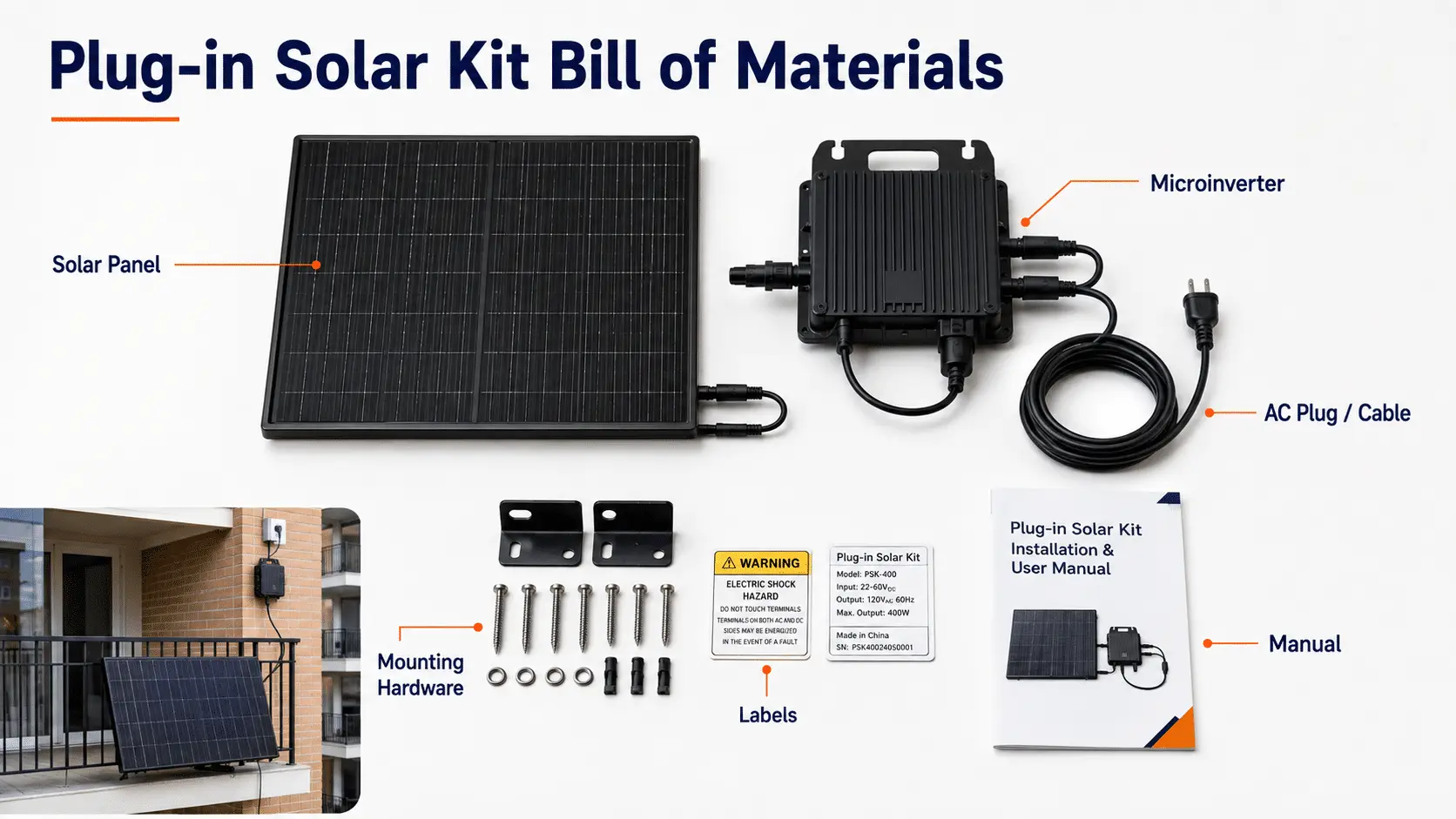
A 1200W plug-in solar kit can mean different things on different product listings. The figure may describe the panels’ combined DC nameplate power, the inverter’s AC output, or a system limit set by local rules. Those are not interchangeable.
Before comparing a 1200W plug-in solar kit, find out what the rating measures, whether the panels match the inverter, and exactly what any certification covers. TOPCon may be worth considering when panel area is tight, but the cell technology alone does not confirm system compatibility or local approval.
Quick answer: For a 1200W plug-in solar kit, ask for the exact panel and inverter model numbers, their datasheets, the system configuration, and the product-specific certification record. Then check the connection method and local rules. A “1200W” label by itself does not tell you the kit’s AC output, the appliances it can support, or whether the complete configuration qualifies for use at your property.
What does “1200W” mean on a plug-in solar kit?
Ask the seller to identify the rating in writing. Does 1200W describe the panels’ combined rated DC power, the inverter’s AC output, or a limit that applies to the system in a particular location?
As a simple arithmetic example, not a specification for a particular kit, six 200W panels add up to 1,200W DC of panel nameplate capacity. That arithmetic does not mean the system will continuously deliver 1,200W AC. Actual output changes with sunlight, panel temperature, shading, orientation, wiring and inverter limits.
| Rating or detail | What it describes | What to verify |
|---|---|---|
| Total PV wattage | Combined rated output of the panels, usually DC | Panel model, quantity and individual rating |
| Inverter AC output | Power the inverter is rated to deliver as AC | Continuous output, connection method and applicable limits |
| Operating voltage and current | Electrical values at the panel or inverter input | Compatibility across the permitted operating range |
| System configuration | The equipment combination supplied or evaluated | Exact models, cables, connectors and stated conditions |
If a listing only says “1200W system,” request the component list and a system diagram. Without them, two kits with the same headline rating may not be comparable.
How do you match the panels to the inverter?
The panel array and inverter must work together electrically. Comparing only their wattage totals can hide a mismatch.
Check the panel and inverter documentation for Voc, Vmp, Isc and Imp. These values describe voltage and current under specified conditions. The inverter’s permitted input range and current limits must accommodate the proposed panel arrangement. The number of panels wired in series or parallel changes those values, so have the exact layout checked against the inverter manual.
Two panels with the same wattage are not automatically interchangeable. Voltage, current, dimensions, connectors and temperature behavior can differ. Ask the supplier to confirm the proposed arrangement for the exact inverter model.
Physical fit matters too. Measure the usable mounting area and allow for roof edges, vents, skylights, cable routes and maintenance access. Panel dimensions and weight matter as much as total wattage when space or roof loading is limited.
Does a 1200W kit provide backup power?
Not by wattage alone. A panel rating does not tell you which appliances a 1200W plug-in solar kit can run at a particular moment. Check the inverter’s AC output limit, each appliance’s running and startup power, and how much solar is available at the time.
A grid-connected plug-in kit should not be treated as outage backup unless the system is specifically designed and documented for that function. Conventional grid-following inverters disconnect when a grid disturbance exceeds their ride-through limits; backup requires equipment designed to operate with the grid isolated. Ask whether the configuration includes storage or another documented backup arrangement, and follow the instructions for the exact models. Do not assume that plugging a solar kit into a receptacle will keep household circuits energized during an outage. The U.S. Department of Energy explains inverter behavior during grid disturbances.
Is TOPCon a reason to choose one kit?
TOPCon is a cell technology, not a system compatibility or certification mark. It may be worth considering when you need to use limited panel area efficiently, but the technology name alone cannot tell you whether a particular kit is a good fit.
Compare the exact module datasheet, including rated power, dimensions, weight, Voc, Vmp, Isc, Imp, temperature coefficient, connectors and stated installation limits. Then compare those details with the inverter documentation and the available mounting area. A higher nameplate rating per unit of area may help with a tight layout, but it does not remove shading, temperature, mounting or inverter limits.
For model-specific information, see Sungold’s TOPCon solar panel page. Confirm the individual model and its current datasheet before making a system-level decision.
What does UL 3700 certification cover?
The phrase “UL certified plug-in solar” is not specific enough to establish what was evaluated. Ask which exact equipment and model numbers are covered, who issued the certification, where the listing can be verified, which standard edition applies, and whether the certification has conditions.
Distinguish among a module certification, an inverter certification, a component or subsystem evaluation, and an evaluation of a complete plug-in PV configuration. A certificate for one component does not, by itself, show that the complete kit was evaluated. Nor should a certificate for one configuration be assumed to cover a similar-looking kit with different model numbers.
UL’s standards catalog identifies UL 3700 Edition 2 as the Outline of Investigation for Interactive Plug-In PV (PIPV) Equipment and Systems, published October 1, 2026. That is a standard catalog page, not proof that a particular kit is certified. UL Solutions describes its testing and certification program in this program announcement. For a product claim, request the actual certificate or listing record and confirm that it covers the exact models and configuration being sold.
Certification also does not automatically settle local permission, installation rules, utility conditions or the suitability of a home’s wiring. For a fuller explanation, see Sungold’s guide to UL 1741 vs. UL 3700 for plug-in solar kits.
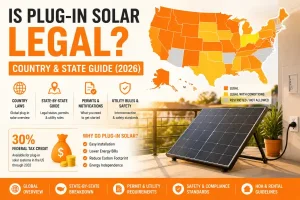
Is a 1200W plug-in solar kit allowed where you live?
Do not treat one wattage or certification claim as blanket approval for every U.S. home. Rules can depend on the state, local requirements, equipment and connection method.
Vermont is one example. Effective July 1, 2026, state law allows qualifying plug-in photovoltaic devices up to a combined 1,200W inverter capacity per electric meter. That is an inverter limit, not the panels’ combined DC nameplate rating.
For a device to qualify, the statutory definition requires an outage-protection feature, UL 3700 certification by UL Solutions or an equivalent certification from an equivalent NRTL, and operation under IEEE 1547-2018 or its successor. The device must connect to a smart-meter system and be temporarily but securely attached. Qualifying devices are exempt from Vermont’s Section 248 process and a utility interconnection agreement.
The law also says a customer with net metering may not install a plug-in device, the device is not eligible for net metering, and exported electricity is not compensated. Tenants must give the landlord at least 10 days’ notice. The landlord has 10 days to respond with reasonable restrictions; if there is no response, the tenant may proceed. Electrical work still requires the landlord’s permission, and the landlord is not required to pay for it. Read Vermont’s statute; these rules are not nationwide.
For your location, verify whether state or local rules address plug-in PV, what metering or utility notice conditions apply, which equipment standards are required, and whether landlord or property-owner requirements affect the installation. When a rule is unclear, confirm it with the relevant authority before buying or connecting the system.
What should you request before buying?
Before buying a 1200W plug-in solar kit, a short document check can reveal gaps that a product headline hides. Ask the seller for:
- The complete equipment list, including manufacturer and model number for each item
- Panel and inverter datasheets
- A wiring or system configuration diagram
- The exact certification record or listing details, if certification is claimed
- The conditions and component models covered by that record
- Installation instructions and the permitted connection method
- Written guidance on the rules you must confirm for your location and property type
Keep the replies with the product documents. If a seller says “the whole kit is UL certified” but provides only a module or inverter certificate, ask them to identify the complete configuration covered by the certification.
Is a 1200W plug-in solar kit right for your setup?
A 1200W-class kit may be worth investigating when the mounting area, intended use and electrical setup suit that configuration. It may not be the right fit if the panels cannot be mounted with suitable clearance, the inverter does not match the array, the site is frequently shaded, or local rules do not allow the proposed connection.
The number on the listing is only a starting point. Decide from the actual modules, inverter, layout, connection method and local requirements—not the headline wattage alone.
FAQs
Does a 1200W plug-in solar kit produce 1200W of AC power?
Not necessarily. The figure may describe the panels’ combined DC nameplate capacity rather than the inverter’s AC output. Check both ratings in the product documentation.
Does a TOPCon solar panel make a plug-in kit UL 3700 certified?
No. TOPCon describes a solar-cell technology. Certification applies to specified equipment or configurations; the cell technology alone does not establish system certification.
Does a UL 1741 inverter listing mean the whole kit is UL 3700 certified?
Not by itself. Check the documentation for the exact models and configuration evaluated. A component certification is not proof of complete-kit certification unless the applicable record says so.
Is a 1200W plug-in solar kit legal throughout the United States?
Do not assume so. Requirements vary by location and equipment. Verify the rules that apply where the system will be installed.
What information should I request from the seller?
Request the exact panel and inverter model numbers, their datasheets, the complete system configuration, installation instructions and the certification record that supports any “UL certified” claim.
Final Thoughts
When comparing a 1200W plug-in solar kit, separate panel wattage from inverter output. Check that the exact panels and inverter are compatible, find out whether the system is designed for backup, and confirm what any UL 3700 or other certification actually covers. Then verify the requirements for your location before buying or connecting the system.