




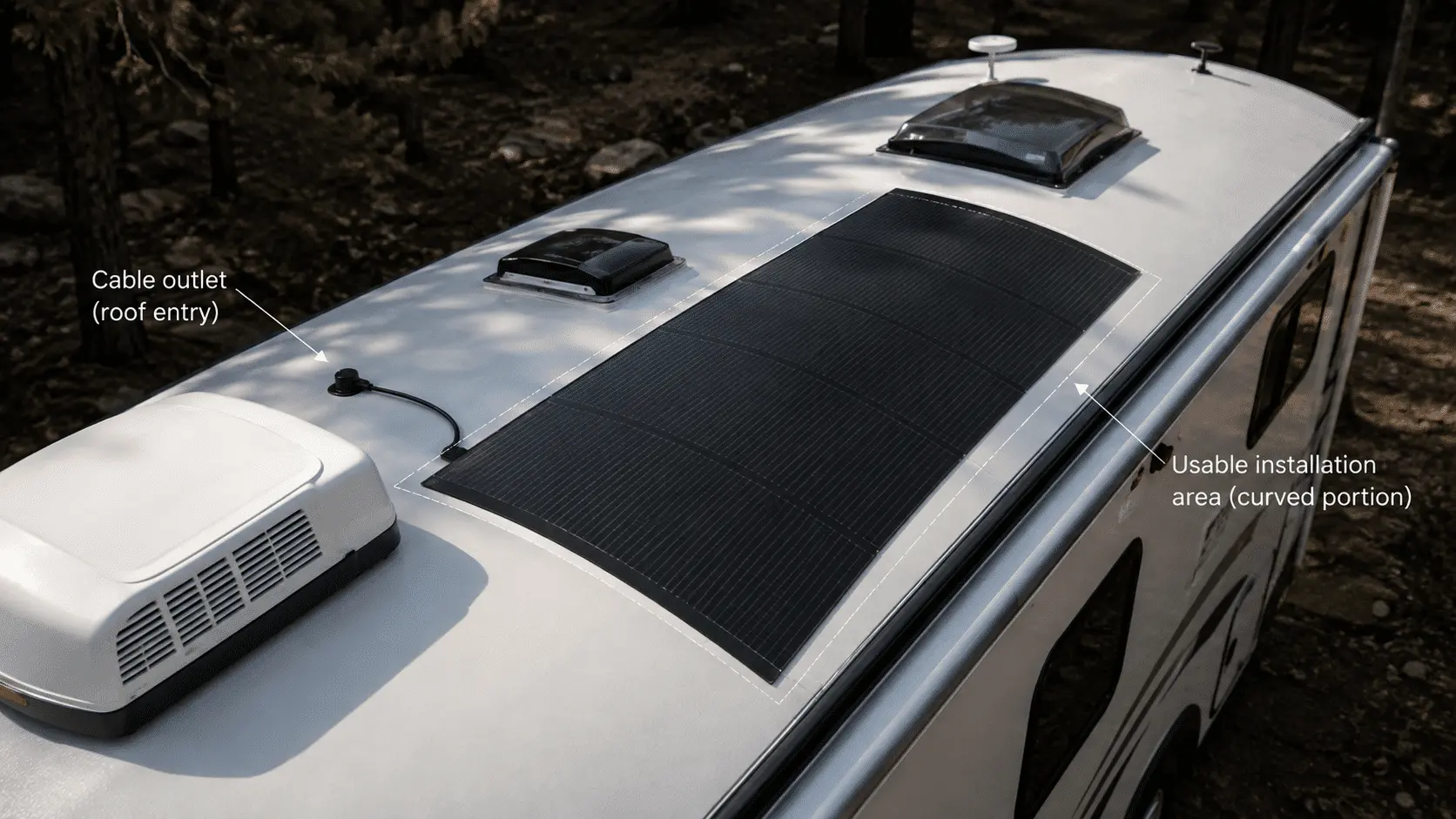
Custom-shaped solar panels can make better use of curved or irregular surfaces, but the outline is only one part of the design. The usable area, curvature, cable route, mounting method and maintenance space all need to work together.
Standard rectangular panels are not always practical on boat decks, camper roofs, vehicle tops, curved covers or narrow installation areas. A panel may fit the overall length and still interfere with a hatch, roof rail or cable route. The right design starts with the real installation space, not just the shape the user wants to draw.\n
When Do You Need Custom-Shaped Solar Panels?
Most users do not need a custom panel because they want an unusual shape. They need one because a standard panel leaves too much unused space or cannot sit properly on the surface.
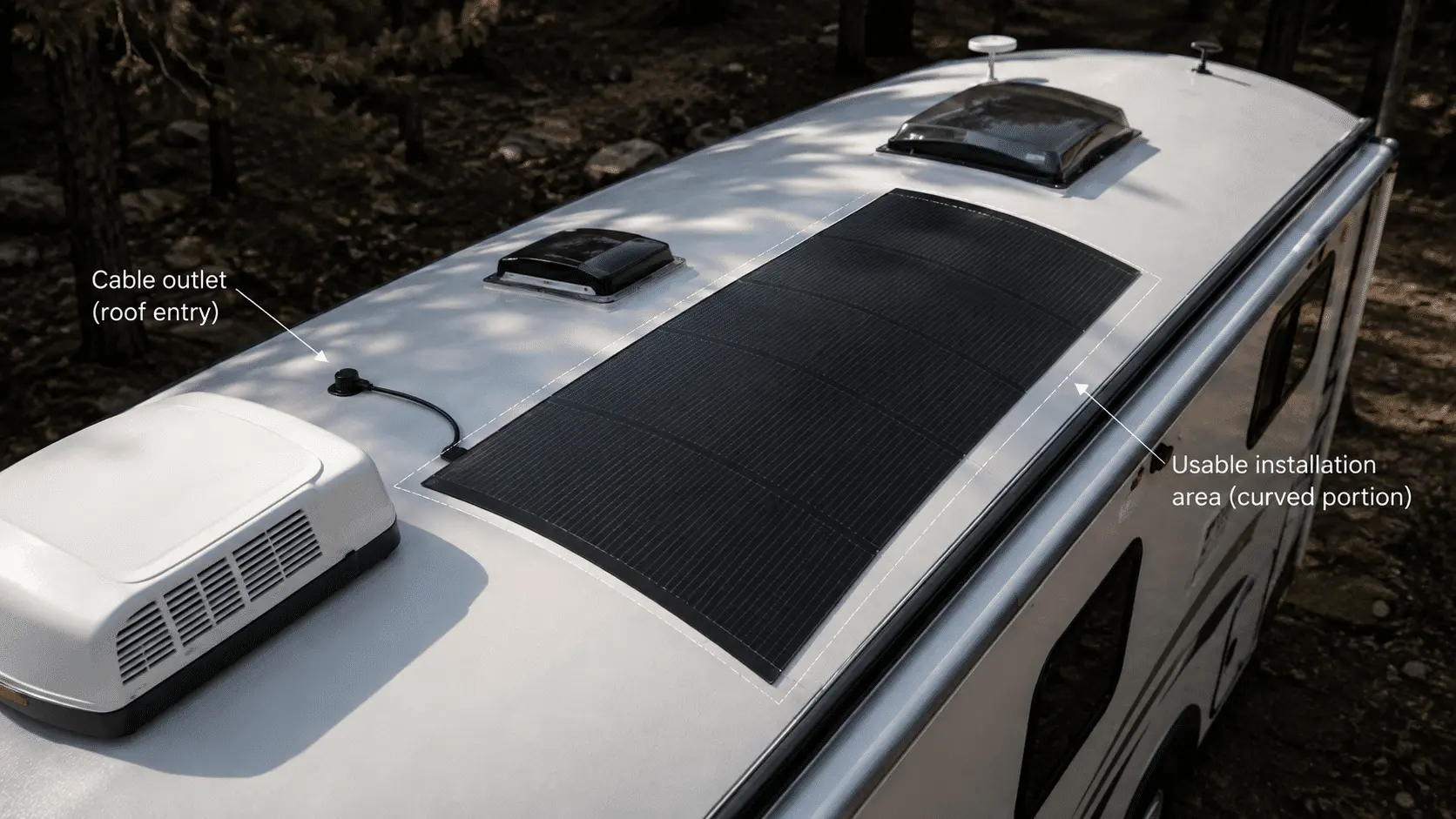
A boat roof may have a curved front section. A camper roof may include vents and roof rails. A vehicle cover may offer only a narrow strip of usable area. In each case, the practical question is whether the panel can be installed, connected and maintained without forcing the material into an unsuitable position.
How to Measure a Curved or Irregular Surface
A useful drawing does not need to be professionally designed. A clear sketch with measurements and photos is often enough for an initial review.
- Usable length and width
- Curvature direction and approximate radius
- Edge shape and corner details
- Openings, vents, rails or handles
- Areas that cannot be covered
- Junction box and cable exit location
- Available space for installation and maintenance
Measure the area where the panel will actually sit. Do not measure only the full outside surface. A surface may be 1,000 mm wide, while the usable panel width is smaller because of a raised edge, drainage channel or cable path.
Photos are also important. A top view shows the layout, while a side view helps explain the curve. Adding a ruler or another known-size object to the photo makes the dimensions easier to review.
One Custom-Shaped Solar Panel or Several Smaller Panels?
One large custom panel can give a clean appearance and use a continuous surface efficiently. Several smaller panels may be easier to carry, position and replace when the area is divided by vents, rails or separate curved sections.
| Option | More suitable when | Main consideration |
|---|---|---|
| One custom panel | The surface is continuous and the outline is simple | Handling and replacement may be more difficult |
| Several smaller panels | The area has obstacles or separate sections | More wiring and installation coordination |
| Standard panels | The surface is mostly flat and rectangular | More unused space may remain |
What to Provide for a Divided Surface
If vents, rails, hatches or separate curved sections divide the available area, send more than the outside dimensions. Mark each usable section, the gap between sections, the height of nearby obstacles and the route between the panel and the controller or battery.
- Length and width of each usable section
- Distance between sections and fixed obstacles
- Curve direction for each section
- Shaded or restricted areas that must remain uncovered
- Preferred cable exit for each panel
- Whether the panels will be wired together or used as separate circuits
This information helps determine whether one custom-shaped panel is practical or whether several smaller panels will be easier to install and service. For the electrical details, including voltage, connector and cable position, see our guide to custom flexible solar panel size, voltage and cable design.
The best option depends on the surface layout, expected power output, shading and how often the equipment will be accessed or moved. A more complex shape is not automatically a better solution.
Junction Box and Cable Exit Placement
A panel can match the surface and still be difficult to install if the cable exits from the wrong location.
Before confirming the design, consider where the controller, battery or power station will be placed, which direction the cable needs to travel and whether the cable will pass over an edge or through a protected channel.
For a boat or vehicle, the shortest cable route is not always the safest route. The cable may need to avoid a moving cover, walking area or exposed edge. The junction box and connector position should support the real route instead of creating a sharp bend or an exposed connection.
This is why we review the installation layout together with the panel drawing. Panel dimensions and cable design should be confirmed as one system.
Leave Space for Heat, Water and Maintenance
A panel may fit the surface outline and still be unsuitable if there is no room for drainage, cable movement or future inspection.
- Keep practical clearance around edges and openings.
- Check for low points where water may collect.
- Avoid sharp edges that can rub against the panel or cable.
- Leave access around the junction box.
- Consider how the panel will be cleaned, checked or replaced.
On curved surfaces, forcing a panel to follow a curve that is too tight can create unnecessary stress. The installation method matters as much as the panel material. A panel designed for a gentle single-direction curve should not automatically be treated as suitable for a sharp or changing curve. For a broader comparison of panel construction and application fit, see flexible solar panels vs. rigid solar panels.
Which Shapes Are Practical for Custom Solar Panels?
Many outlines can be evaluated, but some are easier to manufacture and install than others.
Rounded rectangles, trapezoids, long narrow panels and simple single-direction curves are usually easier to review. More attention is needed for designs with multiple sharp corners, very narrow strips, rapidly changing curves or no usable space for the junction box.
A design may be possible to manufacture but still impractical to install. For example, a narrow panel may match the available space but leave no room for a safe cable exit or reliable fixing method.
As a manufacturer, we look beyond whether the outline can be produced. We also consider how the finished panel will be handled, connected and installed in the real application.
From Drawing and Photos to a Usable Sample
The sample stage is important when the panel will be installed on a curved or irregular surface. A typical review includes:
- Reviewing the installation photos and available dimensions.
- Marking the usable area and restricted zones.
- Confirming the curve direction and installation method.
- Positioning the junction box and cable exit.
- Checking the required voltage and power.
- Making a sample for physical fitting.
- Adjusting the design before production.
Test the sample in the actual installation position whenever possible. A panel that looks correct on paper may need adjustment once it is placed on the surface. Check the corners, cable reach, edge pressure and access around the connections before confirming the final design.
Common Mistakes Before Ordering Custom-Shaped Solar Panels
The first mistake is measuring the visible surface instead of the usable mounting area. The second is forgetting to show the cable route. The third is designing the panel to follow a curve that is too tight for the intended installation method.
Another common issue is leaving no room around openings or edges. The panel may technically fit, but the installer has no practical space to position it or remove it later.
A simple drawing with accurate measurements, photos and a marked cable location is usually more useful than a complicated drawing that does not explain the installation conditions.
FAQ About Custom-Shaped Solar Panels
Can flexible solar panels be made in custom shapes?
In many cases, flexible solar panels can be designed in different outlines and sizes. The final design depends on the shape, curvature, electrical requirements, connection position and installation method.
How much curvature can a flexible solar panel follow?
It depends on the panel construction and the direction and degree of the curve. A gentle single-direction curve is usually easier to evaluate than a sharp or changing curve. The actual installation surface should be reviewed before the design is confirmed.
Is one custom panel better than several standard panels?
Not always. One custom panel may use the surface more efficiently, while several smaller panels may be easier to install and maintain. The better option depends on the surface layout, shading, wiring and access requirements.
Final Thoughts
A custom-shaped solar panel is not simply a standard panel cut to match an outline. It needs to fit the usable space, follow the surface without excessive stress and leave enough room for wiring, drainage and maintenance.
When the measurements, photos, curve direction and cable route are clear, the design can be reviewed more realistically and adjusted before production. This reduces the risk of receiving a panel that looks right on paper but is difficult to install in the real space.\nFor broader photovoltaic planning context, Department of Energy photovoltaic system design basics provide useful reference material. Custom-shaped solar panels still require an application-specific fit review because the installation surface is different from a standard array.