

If you live in an apartment, you may not have access to a private roof or permission to install a full rooftop solar system. That does not necessarily mean you cannot use solar power. Apartment balcony solar panels can help offset some daytime electricity use, but the right setup depends on building rules, sunlight, mounting security, and the way the system connects to your electrical equipment.
Most apartment residents are not only asking whether a panel can fit on the balcony. They also want to know whether the building will allow it, whether the wiring is safe, and whether the system will produce enough useful power to justify the cost.
Apartment Balcony Solar Panels: What Type of System Do You Need?
People often use “balcony solar” to describe several different systems. They do not all work the same way.
| System type | How it works | Best suited for |
|---|---|---|
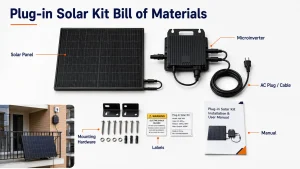
| Plug-in grid-tied system | Solar panels connect to a microinverter and supply power to the building’s electrical circuit. | Owners or tenants with approval and a suitable electrical setup. |
| Solar panels plus portable power station | Panels charge a power station or battery without connecting to the apartment’s fixed wiring. | Renters, patio users, or people who do not want to modify the electrical system. |
| Balcony system with battery storage | Solar energy is generated during the day and stored for later use. | Users who want higher self-consumption or backup power. |
| Foldable portable panels | Panels are deployed when needed and stored during severe weather or transport. | Temporary use, frequent movers, and portable applications. |
A panel connected to a portable power station is not the same as a plug-in grid-tied system. A plug-in system requires additional checks for the microinverter, outlet, circuit, and local requirements. For a separate explanation of plug-in operation, see How Plug-In Solar Panels Work.
Four Checks Before Installing Solar Panels on an Apartment Balcony
1. Is the installation allowed by the landlord or building?
An apartment balcony may be reserved for your private use, while the railing, exterior wall, or structural elements may still be considered part of the shared building.
Before buying equipment, confirm whether railing-mounted equipment is allowed, whether panels can be visible from outside, whether drilling is permitted, whether cables may pass through doors or windows, and whether the building requires an installation drawing or product information.
Renters should obtain written approval from the landlord or property manager. A system being removable does not automatically mean that approval is unnecessary.
2. Does the balcony receive enough sunlight?
Apartment balconies are often affected by nearby buildings, trees, overhangs, upper floors, and railing shadows. Do not judge the site only by its direction.
Observe shading in the morning, around noon, and in the afternoon. Also check whether the railing blocks the lower part of the panel, whether the panel must be installed vertically, and whether air conditioners, awnings, or walls create regular shade.
If the balcony receives only a short period of direct sunlight each day, installing a higher-wattage panel may not solve the real problem.
3. Can the balcony handle the total weight and wind exposure?
The calculation should include the solar panels, mounting brackets, clamps, bases, microinverters, batteries, cables, and protective accessories. Rain, snow, and other added loads may also matter.
High-rise balconies need particular attention to wind. A larger panel presents more surface area to the wind. Railing clamps should be reviewed by location, load direction, center of gravity, and anti-loosening method—not only by whether they fit.
A lightweight panel can reduce part of the load, but it does not replace structural or wind-load review.
4. Is the electrical connection suitable?
For a plug-in system, check the microinverter connection method, loss-of-grid protection, outlet circuit capacity, shared loads, cable use, and any local inspection or utility requirements. Local rules should be checked separately from general product information; our plug-in solar legality guide explains the limits of a general buyer guide.
If the system only charges a portable power station, it follows a different electrical path. For fixed wiring, a dedicated circuit, a distribution panel, or a grid connection, consult a qualified professional who understands local requirements.
Can You Plug Balcony Solar Into a Regular Outlet?
There is no universal yes-or-no answer. The fact that a plug fits into an outlet does not prove that the complete system is suitable or compliant.
The outlet circuit may already supply other appliances. The microinverter may have specific installation requirements. Local rules may also apply to the equipment, circuit, building, and utility connection.
A portable power station is a different case from a grid-tied plug-in system. Do not treat the two as interchangeable when comparing products.
Which Mounting Method Works Best on an Apartment Balcony?
Removable supports
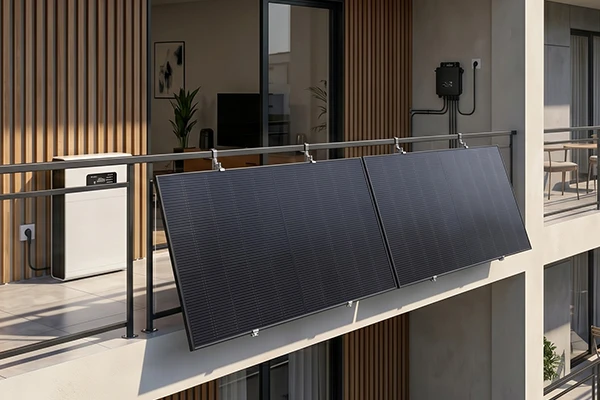
Removable supports may suit renters or users who do not want to make permanent changes to the building. Check whether the support can remain stable in strong wind, whether it places stress on the railing, and whether the panel could fall or damage the railing surface.
Railing-mounted systems
Railing mounts can make use of vertical space, but the railing material, dimensions, and load capacity must be checked. Also consider whether the panel’s center of gravity extends outward, whether the railing can handle the load direction, and whether the installation affects normal railing use.
Floor-mounted or balcony-interior supports
This approach may be easier to remove and may not require attachment to the building structure. It uses valuable balcony space, however, and needs protection from people, furniture, pets, and accidental impact.
Wall-mounted or permanent installations
Permanent mounting may provide a more stable fixing point, but it can involve exterior walls, building appearance, waterproofing, and structural approval. Do not drill into a wall or permanently fix a panel without clear permission from the property owner or building management.
Are Flexible Solar Panels Suitable for Apartment Balconies?
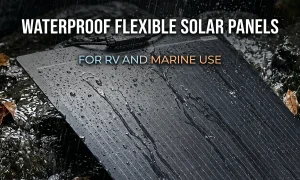
Flexible solar panels may suit some low-profile, space-limited, or non-standard surfaces. They should not be assumed to fit every balcony.
Potential advantages include a lower profile, easier fit on certain curved surfaces, and more layout flexibility in restricted spaces. You still need to review the balcony surface, bonding or mechanical fixing method, airflow, drainage, cable exit, wind exposure, and future replacement access.
A flexible panel is not automatically a “stick it down and use it” product. For railings, walls, balcony floors, and custom supports, the exact panel model and mounting surface should be reviewed together.
How Much Can Balcony Solar Reduce Your Electricity Bill?
When comparing apartment balcony solar panels, do not estimate the value of a system from rated wattage alone. Actual results depend on daily sunlight, balcony orientation and tilt, shading, panel temperature, inverter and battery efficiency, self-consumption, and local electricity prices.
Even if a system produces energy on a sunny day, some of that energy may not be used immediately if nobody is home. Without battery storage or an approved export arrangement, the financial value may be lower than the panel’s rated capacity suggests.
A system is more likely to make sense when the balcony receives consistent sunlight, the generated electricity can be used effectively, and the equipment and installation costs are reasonable.
Three Common Apartment Balcony Scenarios
Scenario 1: A renter who cannot drill into the building
A renter may not be looking for the largest possible system. They may simply want to keep a router, laptop, or small refrigerator running during the day without damaging the building or losing the system when they move.
A removable support, portable solar panel, or panel connected to a portable power station may be more practical than a permanent installation.
Scenario 2: A high-rise balcony with strong wind exposure
This installation should prioritize bracket stability, panel center of gravity, railing load capacity, cable protection, and a removal or storage plan for severe weather.
A panel being lightweight does not automatically make it safe for a high-rise balcony.
Scenario 3: A sunny balcony where the user wants backup power
A standard plug-in grid-tied system may not continue supplying power during an outage. Users who want backup power should separately evaluate battery capacity, portable power station options, critical loads, inverter output, and safe isolation from the grid.
Apartment Balcony Solar Buying Checklist
- Photos of the balcony;
- Balcony length, width, and railing dimensions;
- Proposed panel location;
- Daily sunlight and shading conditions;
- Rules from the landlord, property manager, or HOA;
- Maximum acceptable total weight;
- Whether the system must be removable;
- Whether the system will connect to the apartment’s electrical circuit;
- Microinverter, battery, or portable power station specifications;
- Cable entry route;
- Whether local rules require professional installation, a permit, or inspection.
If these details are still unknown, do not order a system based only on panel wattage.
Frequently Asked Questions
Are solar panels on an apartment balcony legal?
Not always. The answer may involve the landlord, property manager, HOA, building regulations, electrical requirements, and utility rules. Check each requirement for the specific system and location.
Can renters install solar panels on an apartment balcony?
Possibly, but renters should usually obtain approval from the landlord or property manager first. Removable systems may be easier to approve, but they are not automatically exempt from building rules.
Do balcony solar panels need a battery?
Not necessarily. A grid-tied system may operate without a battery. Battery storage may be useful if you want to use solar energy at night or charge a portable power station.
Will balcony solar work during a power outage?
A standard plug-in grid-tied system usually cannot serve as backup power during an outage. Backup use requires a properly configured battery and isolation system.
Can flexible solar panels be bonded directly to an apartment balcony?
That cannot be decided in general terms. The surface, bonding materials, heat, drainage, wind exposure, cable routing, and future maintenance plan all need to be reviewed.
Final Thoughts
Apartment balcony solar is not intended to turn a small balcony into a full rooftop power plant. Its value is more practical: it can help offset some daytime electricity use or provide solar charging for a portable power station.
Whether apartment balcony solar panels are worth installing depends on more than panel price and rated wattage. First confirm that the balcony receives enough sunlight, the landlord or building allows the installation, the mounting system is secure, the electrical configuration is suitable, and the generated energy can actually be used.
For flexible or non-standard balcony applications, share the balcony photos, usable dimensions, mounting surface, cable route, and inverter or power-station limits with Sungold before ordering. The panel format should be reviewed together with the installation method and the actual project conditions.