 EN
EN
 Deutsch
 Italiano
 Español
 Français
 日本語
日本語
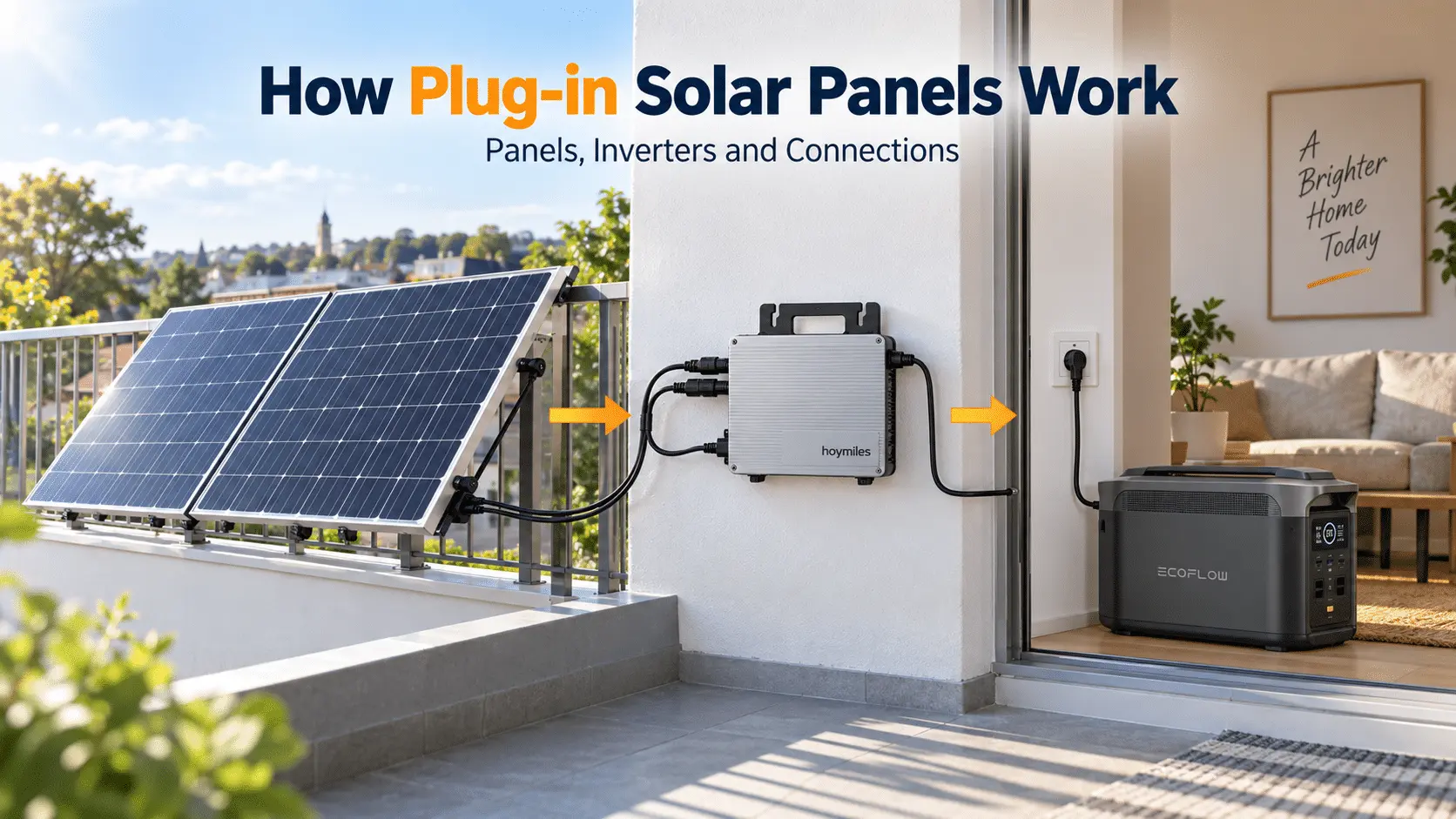
How do plug-in solar panels work? They use a solar panel, a specified inverter, and a defined connection method to convert and deliver solar energy to a household circuit, battery, or portable power station.
The practical answer depends on the complete system. Some products are designed for daytime household use through a grid-connected inverter. Others charge a battery or portable power station. These two paths should not be treated as the same product.
Key Takeaways
- A solar panel produces DC electricity. A plug-in system normally needs a suitable inverter to produce AC power for its specified connection.
- A standard solar panel cannot simply be connected directly to a household wall outlet.
- Panel voltage, current, inverter input range, connectors, mounting, and local requirements must be reviewed together.
- A portable power station and a household plug-in system use different electricity paths.
- For distributors, the complete system package matters more than panel wattage alone.
How Do Plug-in Solar Panels Work?
The basic process is: solar panel → inverter or charge controller → specified household connection or battery system.
The solar panel captures sunlight and produces direct current. If the system is designed to supply AC power, an inverter converts the panel’s DC output into AC electricity for the intended connection.
The inverter also controls how the system interacts with the connection. This is why a plug-in solar system is not simply a solar panel with a longer cable. The inverter, protection functions, connector, and connection method must be designed as one system.
A panel can look similar to one used in a plug-in kit while having different electrical specifications. The receiving equipment determines whether the panel is suitable.
What Components Are in a Plug-in Solar System?
A complete plug-in solar system may include:
- One or more solar panels
- A specified microinverter or other inverter
- DC cables and connectors
- An AC cable and plug
- Mounting brackets or support parts
- Monitoring equipment
- Optional battery storage
- Product labels and installation instructions
The exact contents vary by market and product design. Some systems are intended for daytime household use. Others are built around a battery or portable power station. Before purchasing, check whether the product is sold as a panel, a kit, or a complete system.
What Does the Inverter Do?
The inverter is the main control point between the solar panel and the AC side of the system. It may convert DC electricity into AC electricity, track available panel power, control output according to the system design, disconnect under specified fault or grid conditions, and communicate with monitoring equipment.
A panel’s rated wattage does not tell you whether its output can be used with a particular inverter. Panel voltage, current, maximum input range, connector, and operating conditions must all be checked.
For grid-connected systems, the applicable certification or approval depends on the market, system architecture, and actual inverter model. These requirements should be confirmed for the intended market rather than assumed from the panel specification alone.
Can You Plug a Solar Panel Directly Into a Wall Outlet?
No. A standard solar panel produces DC electricity and does not provide the controlled AC output expected by a household wall outlet.
A grid-connected plug-in solar system may supply AC power through its specified inverter and connection method, subject to local requirements. A physical plug adapter does not make an incompatible system safe or suitable. Voltage, frequency, current, protection, grounding, and connection requirements must be considered together.
A portable power station should not be confused with a household plug-in solar system. A power station may accept DC input from a solar panel and provide AC output through its own built-in inverter. Its AC outlet is not automatically a household grid connection.
Plug-in Solar Panels and Portable Power Stations
Some users use the phrase plug-in solar panels when they actually mean a panel that connects to a portable power station. The energy path is different: solar panel → portable power station PV input → battery → AC or DC outputs.
Before connecting a panel, check the maximum PV input voltage, operating voltage range, maximum input current, maximum charging power, connector type, polarity, and cable length. An MC4 connector alone does not prove compatibility.
For a detailed matching process, see Solar Panel Compatibility with Power Stations.
What Should Apartment Buyers Check?
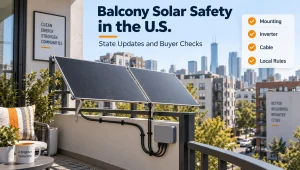
Apartment users should check the installation location before focusing on panel output. Confirm whether balcony or exterior mounting is permitted, whether the panel can remain outdoors, whether the cable route is safe, and whether the system is fixed, removable, or portable.
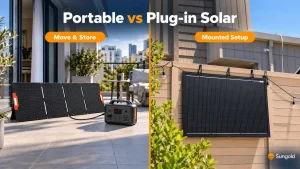
A portable panel with a power station may be more practical for a renter who cannot make permanent changes. A fixed plug-in arrangement may suit a property with an approved mounting location and a documented connection method.
The Apartment Solar Installation Guide provides a useful checklist for these property-level questions.
What Should Retailers and Distributors Verify?
For B2B buyers, the main risk is comparing incomplete quotations. Before ordering, request the exact panel model, inverter model and input range, supported connector and cable configuration, system wiring diagram, mounting instructions, user manual, documents covering the exact model and intended market, packaging details, and a clear process for controlling changes from sample approval to bulk production.
A quote for the panel alone cannot be compared directly with a quote that includes the inverter, custom cables, packaging, labels, and documentation. For OEM projects, also confirm whether the manufacturer can support custom dimensions, rear cable exits, connector changes, private-label packaging, and repeat production.
FAQ About Plug-in Solar Panels
Do plug-in solar panels work without an inverter?
A standard solar panel cannot supply normal AC household power without an appropriate inverter. It may connect to a charge controller, battery, or power station instead, depending on the system design.
Can any solar panel be used with a plug-in solar kit?
No. The panel must match the inverter’s voltage, current, power, connector, and operating limits. The mounting method and cable configuration must also be suitable.
Do plug-in solar panels provide backup power during an outage?
Not automatically. Many standard grid-connected systems are designed to stop operating when the grid is unavailable. Backup operation requires a separately documented battery and inverter architecture designed for that function.
Final Thoughts
Plug-in solar panels work as part of a complete electrical system. The panel produces DC power, while the inverter, battery, connector, mounting, and connection method determine how that power can be used.
For consumers, identify whether the goal is daytime household use, battery charging, or portable backup power. For distributors, verify the complete product package and the documents that support the exact configuration.