 EN
EN
 Deutsch
 Italiano
 Español
 Français
 日本語
日本語
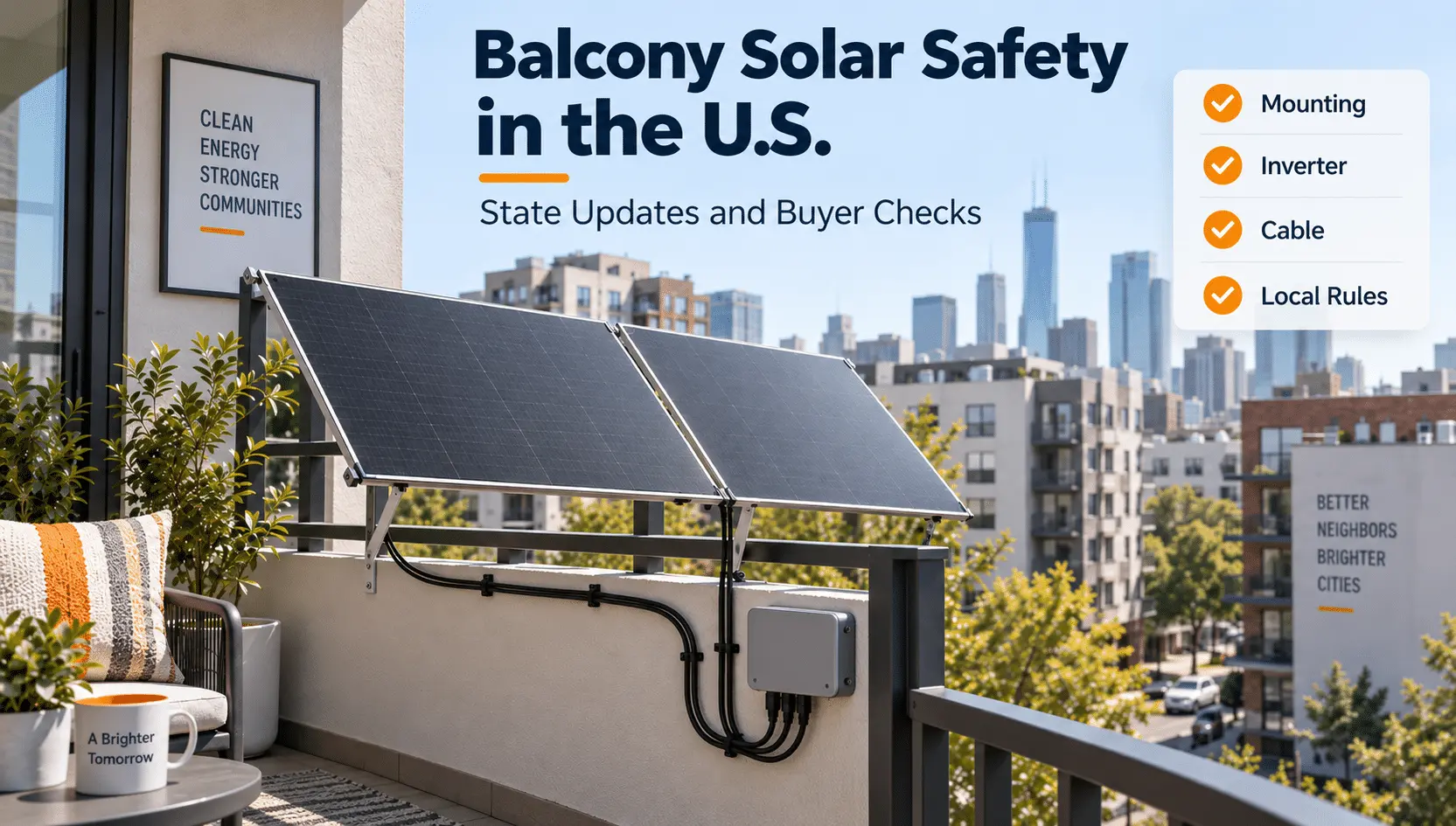
Balcony solar is attracting attention in the United States because it gives renters, apartment residents, and homeowners with limited roof access another way to use solar power. But the useful question is not only whether balcony solar is safe. Buyers also need to ask whether the complete system, mounting method, connection route, and product documents fit the intended site and market.
Balcony solar can be operated safely when the panel, inverter, cables, mounting, and connection method are designed and reviewed as one system. A solar panel alone is not a complete plug-in solar system.
State information in this article was reviewed in September 2026. Legislative status, utility requirements, and local implementation rules may change. Verify the latest official guidance before installation or sale.
Key Takeaways
- Balcony solar safety depends on the complete system and installation conditions, not only the solar panel.
- A standard solar panel should not be connected directly to a household outlet.
- Anti-islanding, grounding, overcurrent, and other protection functions depend on the actual inverter and system design.
- U.S. requirements are changing at the state and local level.
- Retailers should verify the exact model, system configuration, applicable documents, and installation instructions before selling a kit.
What Is Balcony Solar?
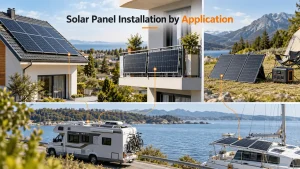
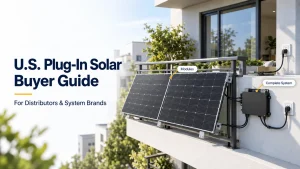
Balcony solar generally refers to a small, portable, or semi-portable photovoltaic system installed on a balcony, patio, exterior wall, terrace, or similar residential space.
A typical system may include solar panels, a specified inverter, DC and AC cables, mounting equipment, a connection plug, optional battery storage, monitoring equipment, product labels, and installation instructions. The exact package varies by design and market.
The phrase “plug and play” does not mean that any panel can be connected to any household outlet. Buyers should first confirm whether they are purchasing a panel, a kit, or a complete system.
How Safe Is Balcony Solar?
Balcony solar is not automatically safe or unsafe as a product category. Its safety depends on the actual equipment, the connection method, the mounting conditions, and the requirements that apply at the installation site.
For a grid-connected system, the inverter normally controls the conversion from DC to AC and monitors operating conditions. For a battery or power-station system, the receiving equipment controls the PV input, storage, and output. These are different system paths and should not be combined in one safety assumption.
What Protection Functions Should Buyers Check?
Depending on the inverter model and system design, relevant protection functions may include anti-islanding, ground-fault detection, overcurrent protection, surge protection, and automatic shutdown under specified conditions.
These functions are not automatically included in every balcony solar kit. Ask for the model-specific documentation and confirm which component provides each function. A panel certificate should not be presented as proof that the complete kit is approved for every market.
What Are the Main Balcony Solar Safety Risks?
Unverified or incomplete equipment
A low quotation may exclude the inverter, mounting hardware, custom cable, labels, installation instructions, or market-specific documents. For channel buyers, compare the complete bill of materials rather than panel price alone.
Poor mounting
A balcony panel may be exposed to wind, vibration, rain, and repeated temperature changes. The buyer should request the permitted mounting method, attachment points, weight information, and inspection instructions.
Damaged or poorly routed cables
Cables can be damaged by compression, sharp edges, repeated movement, water, UV exposure, or loose connectors. The cable path should not block doors, stairs, walkways, drainage, or emergency access.
Incorrect electrical connection
A physical plug adapter does not prove compatibility. Voltage, frequency, current, grounding, protection, and connection requirements must be reviewed together.
How Do Balcony Solar Panels Connect?
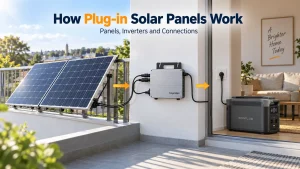
A grid-connected arrangement generally follows this path:
Solar panel → specified inverter → approved AC connection → household circuit
A battery or portable power-station arrangement may follow this path:
Solar panel → charge controller or power station → battery → AC or DC loads
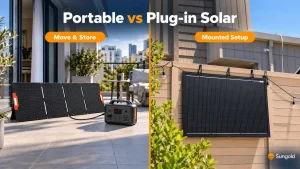
A portable power station may provide AC power through its own inverter, but that outlet is not automatically a household grid connection. Buyers comparing these systems can also review Solar Panel Compatibility with Power Stations.
Selected U.S. State Updates
There is no single nationwide rule that answers whether every balcony solar system can be installed in every U.S. home. Requirements may depend on state legislation, local electrical code, utility requirements, building permits, landlord or property-manager approval, HOA rules, and product listing.
| State | September 2026 update | What buyers still need to verify |
|---|---|---|
| New Jersey | The Garden State Balcony Solar Act was signed in September 2026 and describes qualifying portable plug-in devices of up to 1,200 watts. | Qualifying equipment, product conditions, property rules, and the applicable local implementation. |
| Maryland | The Public Service Commission provides state-specific balcony solar guidance and discusses portable solar systems and connection risks. | Product configuration, installation conditions, and current state or utility guidance. |
| New York | The SUNNY Act passed the New York State Legislature in 2026, bringing plug-in solar closer to a state-level framework. | Final executive action, implementation rules, utility treatment, and local requirements. |
These updates should be treated as dated references, not permanent installation approval. For example, the New Jersey Governor’s official announcement, Maryland Public Service Commission guidance, and New York State Senate announcement should be checked again before a product launch.
What Should Renters and Property Managers Verify?
Before installation, confirm whether the balcony or exterior space may be used, whether permanent mounting is allowed, whether drilling or railing attachment is restricted, whether the system may remain outdoors, and whether emergency exits remain clear.
A portable system may involve fewer permanent changes, but it is not automatically exempt from all requirements. The Apartment Solar Installation Guide provides a useful property-level checklist.
What Should Retailers Verify Before Selling a Kit?
For distributors and retailers, request the exact panel model, inverter model and input range, supported connector and cable configuration, system wiring diagram, mounting instructions, user manual, documents covering the exact model and target market, packaging details, and a clear process for controlling changes from sample approval to bulk production.
A panel certificate does not automatically prove that the complete balcony solar kit is approved for every market. For a broader explanation of system boundaries, see what buyers should check before choosing plug-in solar panels.
FAQ About Balcony Solar Safety
Is balcony solar safe in the United States?
It can be operated safely when the complete system is suitable for the market and site, the mounting is secure, the electrical connection is correct, and the applicable property and local requirements are followed.
Can I install balcony solar myself?
Some products are designed for simplified or user-assisted installation. The permitted method depends on local electrical rules, property requirements, product design, and connection type. A qualified local professional should confirm the installation when required.
Does a state law mean I can install any plug-in solar panel?
No. State legislation may define qualifying equipment or remove certain approval steps, but product specifications, inverter requirements, mounting, property rules, local codes, and utility conditions may still apply.
Final Thoughts
Balcony solar is not one standardized product. It may refer to a grid-connected plug-in system, a portable panel paired with a power station, or a small kit with a battery and inverter.
The safest purchasing decision begins with the complete system: where it will be installed, what it will power, how it will connect, which protection functions are included, and which documents cover the exact model. For distributors, these questions should be answered before the product is packaged and sold.