 EN
EN
 Deutsch
 Italiano
 Español
 Français
 日本語
日本語
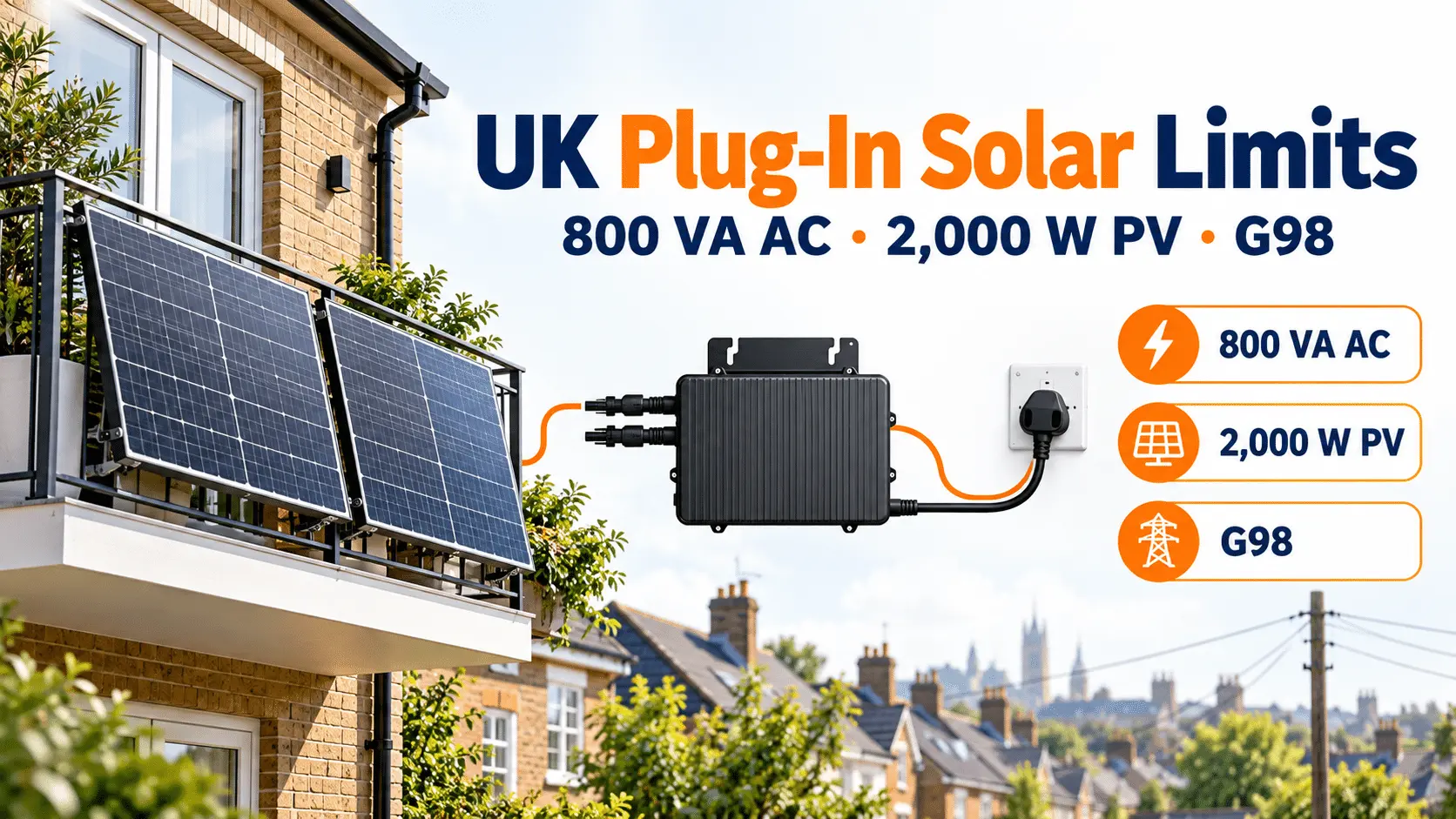
UK plug-in solar power limits: the short answer
The main UK plug-in solar power limits are not defined by one wattage number. The final 2026 interim specification separates the system into three limits:
- Maximum AC apparent power: 800 VA
- Maximum AC current: 3.5 A
- Maximum combined PV module DC power: 2,000 W
The specification also says that consumers using more than 960 W of total PV module capacity should consider a professional assessment of the existing electrical installation before installation.
These numbers describe different parts of the system. The 800 VA limit relates to power supplied to the household electrical installation. The 2,000 W limit relates to the nameplate DC capacity of the connected PV modules. They are not interchangeable. A 2,000 W PV array does not mean that the system may export 2,000 W AC through a household socket.
The final product specification also limits the configuration to one plug-in solar device per household final ring circuit. Current Great Britain network requirements under G98 restrict this to one device per household unless the network requirements are amended.
This article explains the limits for buyers, installers, distributors and brands developing plug-in solar products for Great Britain. It is technical guidance, not a substitute for checking current rules or obtaining professional electrical advice.
Key limits at a glance
| Requirement | Current limit or condition | What it means |
|---|---|---|
| AC apparent power | 800 VA maximum | Limits power supplied to the household circuit |
| AC current | 3.5 A maximum | Limits current exported through the connection |
| PV module DC capacity | 2,000 W maximum | Total nameplate capacity of connected modules |
| Professional assessment threshold | Above 960 W PV | Electrical installation assessment should be considered |
| PV module quantity | Up to 4 modules | Still subject to inverter and wiring limits |
| Series modules | Up to 2 per string | Total Voc must remain within the specified limit |
| Inverter input voltage | 120 V DC maximum Voc | Helps reduce DC shock and arcing risk |
What these figures do and do not confirm
Confirmed by the GB Interim Product Specification
- The 800 VA AC apparent-power limit.
- The 3.5 A maximum current.
- The 2,000 W combined PV module limit.
- The above-960 W recommendation for professional assessment.
- The four-module and two-module-per-series-string limits.
Still requires project verification
- Exact inverter model and current G98 status.
- Existing household circuit and socket suitability.
- Balcony, wall or ground mounting structure.
- Cable route and outdoor protection.
- Local installation conditions.
- Northern Ireland connection requirements.
This does not mean
- A 2,000 W AC plug-in output.
- Every 2,000 W panel combination is approved.
- Any panel can be paired with any microinverter.
- Two devices can automatically be installed in one home.
- A component certificate alone proves complete system compliance.
800 VA vs 800 W: what is the difference?
The UK specification uses 800 VA, or volt-amperes, for the maximum apparent power supplied to the mains installation. In a simple resistive load, VA and W may be close. In a real AC system, power factor and reactive power can make the two values different.
For product selection, an 800 VA plug-in solar device is not automatically an 800 W device in every operating condition. The inverter, declared output, power factor, protection functions and test documentation must be reviewed together.
The 800 VA limit applies to the AC side. It does not tell you how many watts of PV modules may be connected on the DC side. A product can therefore have more than 800 W of PV module nameplate capacity while its AC output remains limited to 800 VA, provided the complete device meets the applicable requirements.
Can a UK plug-in solar system use 2,000 W of panels?
The final interim specification permits a maximum combined PV module DC power of 2,000 W for a plug-in solar device. This is the total declared maximum power of the modules under the relevant standard test conditions.
That does not mean every 2,000 W configuration is automatically suitable. The inverter must keep AC apparent power at or below 800 VA; its input voltage and current must match the selected modules; the panel arrangement must remain within the permitted module count and series-voltage limits; and the manufacturer must provide the specified cables, connectors, mounting system and instructions.
A higher DC-to-AC ratio may help the inverter receive useful power during weaker sunlight, but it increases the importance of electrical compatibility, thermal design, documentation and installation review. Do not market this as “2,000 W plug-in output.” The accurate description is a plug-in solar device with up to 2,000 W of PV module capacity and an AC output limited to the declared inverter rating.
Why does the 960 W threshold matter?
The 960 W figure is a precautionary threshold. When total PV module maximum power is above 960 W, the manufacturer must advise consumers to consider a professional assessment of the existing electrical installation before installation.
This is not a second AC output limit, and it does not mean systems below 960 W are suitable for every property. The condition of the electrical installation, circuit arrangement, age of the building, socket location and product configuration still matter.
Avoid wording such as “960 W is the legal maximum.” That is inaccurate because the specification allows up to 2,000 W of combined PV module DC power, subject to the other requirements.
How many solar panels can be connected?
The interim specification allows up to four PV modules to be connected to the inverter. No more than two modules may be connected in series within a series string.
The actual number of panels depends on module wattage and inverter architecture. Four 200 W modules produce 800 W of nominal PV capacity. Four 450 W modules total 1,800 W and remain below the 2,000 W PV limit, but the configuration would still need to meet the inverter input, voltage, current, wiring, mounting and documentation requirements.
A technical review should include Voc, Vmp, Isc, Imp, maximum inverter input voltage and current, MPPT range, connector configuration and whether panels are connected in series or parallel. A general statement that a panel is “microinverter compatible” is not enough for a UK plug-in solar product.
Can two solar panels be connected in series?
Yes. The specification allows modules to be connected in series or parallel when the manufacturer supplies suitable interconnecting cables and the configuration follows the instructions. No more than two PV modules may be connected in series within one series string.
The combined open-circuit voltage at the inverter input must not exceed 120 V DC. Series connection should be treated as a designed configuration, not user improvisation. Documentation should show the approved wiring diagram, maximum modules per string, maximum Voc, connector and cable type, inverter input limits and array isolation procedure.
Parallel connection has different current implications. The selected inverter and connectors must be rated for the combined current, and the manufacturer should specify whether parallel operation is permitted.
How UK plug-in solar power limits fit with G98
For a compliant product, the UK plug-in solar power limits must be checked alongside the G98 connection route. The power limits describe the device configuration; G98 addresses how a tested microgenerator connects to the public low-voltage network.
G98 is the UK engineering recommendation for connecting fully type-tested microgenerators in parallel with public low-voltage distribution networks. It is part of the grid-connection framework; it is not a replacement for product safety testing.
Review the system through four separate checks:
- Product specification: does the complete device meet the UK interim product specification?
- AC output: is the device within the 800 VA and 3.5 A limits?
- Network connection: does the inverter and installation meet current G98 requirements?
- Property and installation: are the selected circuit, socket, mounting method and building suitable?
Passing one check does not prove the other three are satisfied. A PV module certificate does not prove that the microinverter is suitable for G98, and a G98-compatible inverter does not prove that the mounting system is safe on a particular balcony.
The final specification states that current G98 requirements restrict plug-in solar to one device per household in Great Britain unless network requirements are amended. This article only explains how G98 interacts with the power limits. For the detailed notification, ENA and installer workflow, see the forthcoming UK Plug-In Solar G98 Guide. Northern Ireland should not be treated as identical to Great Britain: it has separate connection requirements under G98/NI.
What do the UK plug-in solar power limits mean for buyers?
Before choosing a kit, check the mounting surface, wind and environmental conditions, panel weight, cable route, supplied plug and connectors, matched inverter configuration, and current local and network requirements.
The specification treats a plug-in solar device as a complete assembly: PV module or modules, grid-following inverter, manufacturer-supplied connection lead and plug, associated DC connections and mounting system. It is not simply a panel with a cable. For related planning, compare this technical article with Sungold’s plug-in solar legal guide, balcony solar solution, and North American plug-in solar solution. The North American page should not be treated as proof of Great Britain compliance; certification scope must match the intended market and exact system configuration.
What do the UK plug-in solar power limits mean for suppliers and OEM brands?
A market-ready package should identify the exact PV module model, maximum DC power, inverter model, AC apparent power, input range, approved panel count, wiring configuration, cables, connectors, BS 1363 plug configuration, mounting system, user manual, labels and test documentation.
Changing the panel wattage, cable route, connector, inverter, mounting method or packaging instructions may change the documented system configuration. Sample approval should record the exact bill of materials and test scope before bulk production.
Buyer and supplier decision table
| Buyer question | What to verify |
|---|---|
| Can I use 2,000 W of panels? | Confirm inverter input range, approved module configuration and professional-assessment needs |
| Can I connect two panels in series? | Check total cold-weather Voc and the manufacturer wiring diagram |
| Can I install two systems? | Check current G98 and household or circuit restrictions |
| Is the panel certified? | Confirm whether the document covers the module only or the complete device |
| Can I sell this kit in Great Britain? | Review the exact bill of materials, testing scope, plug, mounting and user documentation |
| Can I use the same product in Northern Ireland? | Check G98/NI and local connection requirements separately |
UK plug-in solar power limits checklist
- AC apparent power is no more than 800 VA.
- Maximum AC current is no more than 3.5 A.
- Combined PV module capacity is no more than 2,000 W.
- Professional electrical assessment is considered above 960 W PV capacity.
- No more than four PV modules are connected to the inverter.
- No more than two modules are connected in series in one string.
- Open-circuit voltage at the inverter input does not exceed 120 V DC.
- The product uses the manufacturer-supplied connection method.
- Current G98 and local installation requirements are checked.
- Mounting, cables, connectors and documents match the exact configuration.
Frequently asked questions
What is the maximum plug-in solar output in the UK?
The final 2026 interim product specification sets the maximum apparent AC power at 800 VA and the maximum current at 3.5 A. The maximum combined PV module DC capacity is 2,000 W.
Is 2,000 W the maximum plug-in solar output?
No. 2,000 W is the maximum combined PV module DC power. AC power supplied to the household installation remains limited to 800 VA.
Can I install four 500 W solar panels?
Four 500 W modules total 2,000 W of PV capacity, but the configuration is not automatically approved. Inverter input limits, Voc, current, wiring, mounting and complete product documentation must support it.
Can I install two plug-in solar systems in one home?
Do not assume that you can. The final specification allows one device per household final ring circuit, while current Great Britain G98 requirements restrict this to one device per household unless amended.
Does G98 certify the solar panels?
No. G98 concerns the connection of fully type-tested microgenerators to the public low-voltage network. It does not replace PV module safety testing, inverter testing, mounting assessment or complete product documentation.
Does the Great Britain specification automatically apply in Northern Ireland?
No. Northern Ireland has separate connection requirements under G98/NI and should be checked separately.
Final takeaway
The UK plug-in solar power limits are 800 VA AC, 3.5 A and up to 2,000 W of combined PV module DC capacity. The 960 W figure is a precautionary threshold for considering professional assessment, not the maximum system output.
For consumers, buy a complete, documented device rather than combining unrelated components. For suppliers and OEM brands, validate the panel, inverter, wiring, mounting, testing scope and G98 requirements as one defined configuration.
Planning a UK plug-in solar product?
If you are developing a Great Britain balcony or plug-in solar kit, prepare the target PV capacity, inverter model, panel configuration, mounting method and intended sales market before requesting a quotation. Sungold can review the panel-side requirements and support a defined OEM configuration, but final system compliance must be verified for the complete product and target market.
For a project review, start with the Sungold balcony solar solution or contact the team with the completed technical requirements.