 EN
EN
 Deutsch
 Italiano
 Español
 Français
 日本語
日本語
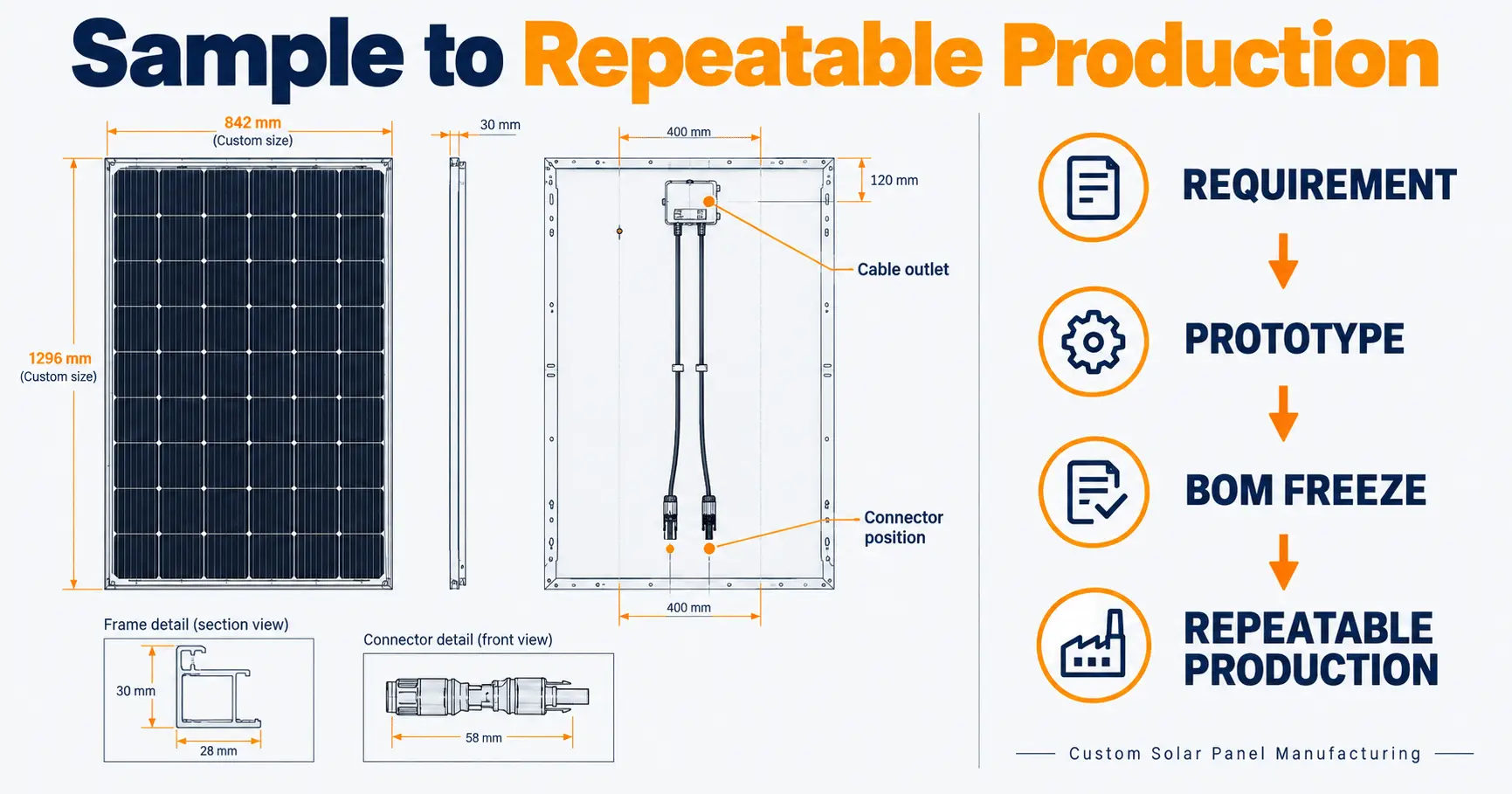
The custom solar panel manufacturing process becomes repeatable when the buyer and manufacturer convert the application idea into a controlled production specification.
The custom solar panel manufacturing process includes requirement definition, feasibility review, prototype validation, BOM approval, pilot-batch testing, and repeat-production control.
Definition: Repeatable custom solar panel production means reproducing the same approved design, materials, electrical configuration, documentation, and inspection criteria across future batches.
Custom Solar Panel Production at a Glance
| Stage | Main question | Output |
|---|---|---|
| Requirement | What must the panel do? | Controlled requirement |
| Feasibility | Can it be built? | Feasibility review |
| Prototype | Does it work? | Approved sample |
| BOM freeze | What will be produced? | Locked BOM and drawings |
| Pilot batch | Can it be repeated? | Pilot approval |
| Production | How is consistency maintained? | QC and change control |
Why a Successful Sample Does Not Guarantee Repeatable Production
A prototype confirms that one design can be built and tested. Repeatable production requires additional controls.
Consistency can be lost when dimensions are not recorded with tolerances, cable positions exist only in email, prototype materials are not fixed in the BOM, or the buyer and manufacturer use different inspection criteria.
- Labels or datasheets do not match the final construction.
- A manual sample process was never defined for production.
- Material or process changes are made without approval.
The key question is not only, “Can the manufacturer build this panel once?” It is also, “Can the same panel be produced to the same approved requirements for future orders?”
Stage output: A list of variables that must be controlled before mass production.
Step 1: Convert the Application Into a Controlled Specification
The first step is to define the application before selecting the panel design.
The buyer should provide the application, available length and width, maximum thickness and weight, target power, voltage and current, mounting method, cable exit position, connector requirement, operating environment, sample quantity, expected volume, and destination market.
| Input | Why it matters |
|---|---|
| Available area | Sets the physical limit. |
| Power and electrical targets | Defines the design direction. |
| Surface and mounting | Affects construction and installation review. |
| Volume and market | Shapes production and documentation planning. |
Stage output: One controlled requirement sheet for both buyer and manufacturer.
Step 2: Separate Feasibility Review From Quotation
A quotation is not the same as a feasibility confirmation.
The review should separate physical, electrical, installation, and production questions. A target dimension may require a different construction. A target wattage may depend on area and cell selection. A certification request may depend on the final construction and destination market.
| Review area | Main question |
|---|---|
| Physical | Can the dimensions, thickness, and weight be achieved? |
| Electrical | Can the target output and voltage be reached? |
| Installation | Can it be mounted, routed, and serviced? |
| Production | Can it be manufactured consistently? |
Stage output: A feasibility response showing what is buildable, what needs revision, and what requires confirmation.
Step 3: Use the Prototype to Validate the Production Specification
The prototype should be a validation tool, not only a demonstration unit.
Review final dimensions, thickness, weight, surface, cell layout, electrical output, cable length and position, connector, polarity, mounting interface, packaging, labels, and technical documents.
The approval record should identify the drawing revision, electrical target, approved construction, cable layout, datasheet version, and required changes.
Stage output: An approved sample record with all required changes listed before BOM approval.
Step 4: Freeze the BOM, Drawings, and Documentation
The production specification must identify exactly what the manufacturer will build.
The BOM should define the cell type and arrangement, surface and encapsulation materials, back-surface construction, junction box, connector, cable specification, cable exit location, labels, packaging, datasheet version, and inspection requirements.
Drawings should define important dimensions and tolerances. “Approximately 1200 mm” may be suitable during an early discussion, but production may require a fixed dimension, tolerance, and measurement method.
Stage output: Locked BOM, approved drawings, document versions, and inspection requirements.
Step 5: Run a Pilot Batch Before Full Production
A pilot batch helps determine whether the approved design can be reproduced under normal production conditions.
Evaluate dimensional consistency, electrical consistency, surface appearance, cable and connector placement, packaging, installation handling, label accuracy, documentation, and rework requirements.
| Pilot item | What to define |
|---|---|
| Quantity | Number of units |
| Reference design | Approved drawing and BOM version |
| Inspection | Measurement and test method |
| Acceptance | Pass and fail criteria |
| Deviations | How exceptions are recorded |
| Next step | Revision, production, or hold |
Stage output: Pilot-batch results and a decision to revise, approve, or hold the project.
Step 6: Define What Must Stay Consistent Between Batches
Repeatable production depends on identifying critical variables and controlling changes to them.
Product geometry
- Length and width
- Thickness
- Hole positions
- Bending or folding requirements
- Cable outlet location
Electrical characteristics
- Rated power
- Voltage and current
- Connector and polarity
- Electrical configuration
Materials and documentation
- Cell type, surface material, encapsulation, and junction box
- Product label and datasheet
- Installation instructions and packaging
- Serial-number system and approved warranty documentation
If a cell type, material, connector, or production process changes, the parties should determine who approves the change, whether a new sample is required, whether testing must be repeated, and whether the datasheet must be updated.
Stage output: A batch-consistency checklist and documented change-control process.
What Should a Buyer Include in the RFQ?
A complete RFQ helps a manufacturer evaluate the project more accurately and reduces repeated clarification.
Custom solar panel RFQ checklist
- Application and destination market
- Installation surface and available dimensions
- Maximum thickness and weight
- Target power, voltage, and current
- Cell or technology preference
- Surface, construction, and mounting requirements
- Cable length, exit position, connector, and polarity
- Sample quantity and expected production quantity
- Packaging, branding, and documentation needs
- Target delivery term
Useful attachments may include drawings, surface sketches, installation photos, battery or controller information, system input labels, packaging references, target datasheets, and branding files.
The supplier should then determine whether the project is best suited to an existing standard model, a modified standard product, a new custom module, or an OEM/ODM development route.
When Should You Use a Standard Panel Instead?
A standard panel may be the better choice when it already meets the main application and electrical requirements.
| Use a standard panel when | Consider customization when |
|---|---|
| Dimensions already fit | The available area is non-standard |
| Electrical output is sufficient | A specific voltage range is required |
| Mounting is already defined | The surface requires a special format |
| Expected volume is uncertain | The buyer is developing a repeatable product line |
| Sampling speed is the priority | Cable, packaging, or branding must be integrated |
Customization is justified when additional engineering work creates meaningful value through better application fit, easier installation, improved integration, reduced wasted space, or a repeatable OEM product line.
FAQ
Can a manufacturer customize solar panel size and voltage?
It depends. Feasibility depends on the available area, cell configuration, construction, target output, and system requirements. The complete project specification should be reviewed before final approval.
Does an approved prototype guarantee mass-production consistency?
No. A prototype proves that one unit can be built and tested. Repeatable production also requires an approved BOM, controlled drawings, inspection criteria, and change control.
What is the difference between OEM and ODM solar panel development?
OEM usually starts with a buyer-defined design or specification. ODM usually starts with an application and target outcome, while the manufacturer supports design development. Responsibilities should be agreed before sampling.
What documents should be approved before production?
The project should normally approve the BOM, drawings, datasheet, labels, packaging requirements, and inspection criteria. The exact document set depends on the product, application, and destination market.
Does a prototype automatically prove certification or long-term performance?
No. Certification and testing scope must be reviewed against the final construction, product model, application, and destination market.
Final Thoughts
A custom solar panel project becomes repeatable when the original idea is converted into a controlled production system.
- Define the application.
- Create a controlled requirement.
- Review physical, electrical, and production feasibility.
- Validate the prototype.
- Freeze the BOM and drawings.
- Run a pilot batch.
- Define inspection and change control.
- Approve the path to repeat production.
Request a Custom Solar Panel Review
Send the available dimensions, application details, target output, electrical requirements, mounting conditions, cable preferences, destination market, and expected volume. Sungold can then assess whether the project should begin with a standard model, a modified product, or a custom development route.