 EN
EN
 Deutsch
 Italiano
 Español
 Français
 日本語
日本語
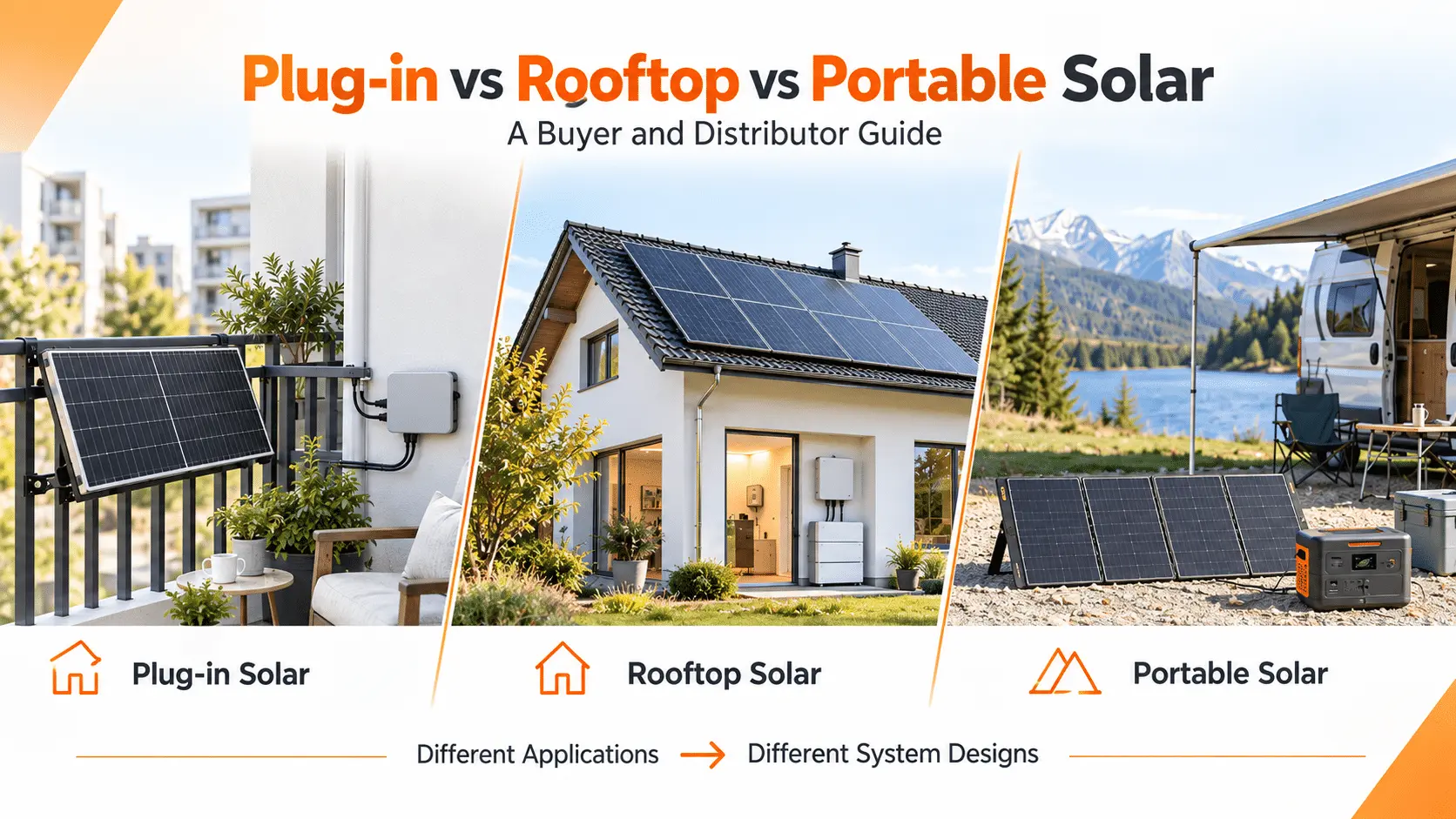
Plug-in vs rooftop vs portable solar is not only a consumer comparison. It is also a product and system decision for distributors, OEM buyers, and project developers. Each format uses a different energy path, installation approach, and support model.
Rooftop solar is designed for permanent residential generation. Plug-in solar is built around a specified inverter and connection method. Portable solar usually charges a battery or power station for mobile or backup use. For buyers, the panel should be selected after the system path is defined.
Key Takeaways
- Rooftop solar suits permanent residential projects with larger energy requirements.
- Plug-in solar may fit smaller residential or balcony applications when the connection method, mounting, property permission, and local requirements are confirmed.
- Portable solar is designed for power stations, batteries, RVs, marine use, camping, and selected backup loads.
- A similar-looking panel may not be compatible with every inverter, battery, or power station.
- Distributors should compare the complete product package rather than panel price alone.
- OEM buyers should confirm dimensions, voltage, cable exit, connector, mounting, labeling, and packaging before sample approval.
Plug-in vs Rooftop vs Portable Solar Compared
| Decision factor | Plug-in solar | Rooftop solar | Portable solar |
|---|---|---|---|
| Main application | Apartments, balconies, patios, and smaller residential use | Long-term whole-home or larger residential generation | RV, marine, camping, backup, and mobile power |
| Typical energy path | Panel to specified inverter and approved AC connection | Panel array to inverter, electrical panel, and utility connection | Panel to power station or charge controller and battery |
| Installation | Fixed or semi-portable | Permanent installation | Temporary or movable deployment |
| Main buyer concern | Connection, property permission, mounting, and local rules | Roof condition, permits, structure, and interconnection | PV input compatibility, storage, weight, and handling |
| Best channel opportunity | Balcony kits and smaller residential products | Residential projects and installer channels | Portable power, RV, marine, and emergency products |
These systems may use similar photovoltaic technology, but they are not interchangeable products.
How the Three Solar Systems Work
Plug-in solar
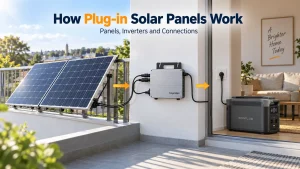
A plug-in solar system generally follows this path:
Solar panel → specified inverter → approved AC connection → household circuit
The panel produces DC electricity. The inverter converts it into AC electricity and manages the system’s interaction with the intended connection. A plug-in system is not simply a solar panel with a household plug.
Rooftop solar
A rooftop system generally follows this path:
Solar array → inverter → electrical panel → utility connection
The system is permanently mounted and may include structural mounting, disconnects, overcurrent protection, grounding equipment, monitoring, permits, inspection, and utility procedures.
Portable solar
Portable solar generally follows this path:
Solar panel → power station or charge controller → battery → selected AC or DC loads
The power station or charge controller determines the permitted PV input voltage, current, charging power, connector, and battery path. A portable power station’s AC outlet is not automatically a household grid connection.
For the basic system explanation, see How Do Plug-in Solar Panels Work?.
When Plug-in Solar Makes Sense
Plug-in solar may suit customers who live in an apartment or rental property, have limited roof access, want a smaller residential product, or want to offset selected daytime consumption.
The main limitations are installation permission, local electrical requirements, mounting conditions, limited panel area, and the output capacity of the selected system. For a distributor, the product should be sold with clear boundaries explaining whether it is intended for a specific grid connection, a battery system, or another use case.
When Rooftop Solar Makes Sense
Rooftop solar may suit customers who own the property, plan to remain for the long term, have suitable roof space, want higher generation capacity, and are prepared for permits, inspection, and professional installation.
Rooftop solar is a project rather than a simple product purchase. Roof structure, orientation, shading, waterproofing, wiring, inverter selection, utility approval, and installation labor all influence the final result.
When Portable Solar Makes Sense
Portable solar may suit RV and camper owners, boat and marine users, outdoor customers, emergency-preparedness buyers, temporary sites, and users who already own a portable power station.
Before selecting a portable panel, compare maximum PV input voltage, operating voltage range, maximum input current, maximum charging power, connector type, polarity, cable length, and panel dimensions. A connector that fits physically does not prove electrical compatibility. See Solar Panel Compatibility with Power Stations.
What Buyers Should Compare Before Ordering
| Item to compare | Questions to ask |
|---|---|
| Panel output | Is the rated output based on the same test conditions? |
| Dimensions | Will the panel fit the available installation space? |
| Voltage and current | Does the receiving inverter, controller, battery, or power station accept the output? |
| Cable design | What length, exit position, polarity, connector, and outdoor rating are included? |
| Mounting | Is compatible mounting hardware included or sourced separately? |
| Documents | Do the documents cover the exact model and target market? |
| Packaging and support | Are labels, manuals, accessories, and after-sales responsibilities clear? |
Two quotations are not directly comparable when one includes custom cables, packaging, labels, manuals, and accessories while the other includes the panel only.
What Distributors Should Verify
Distributors should evaluate the product as a complete customer-ready package. Before placing an order, request the exact product model, datasheet, compatible inverter or power-station list, wiring diagram, cable and connector specification, mounting instructions, labels, target-market documents, packaging details, sample approval procedure, change-control process, and replacement process.
A distributor should compare not only the panel specification, but also the cost and responsibility of the complete customer-ready package. This helps reduce the risk that the final cable, connector, packaging, or manual differs from the approved sample.
OEM and Customization Considerations
An OEM project may require custom panel dimensions, voltage or current targets, rear cable exit, custom cable length, MC4, Anderson, or another connector, flexible or rigid construction, low-profile installation, private-label packaging, or custom labels and manuals.
These requirements should be defined before quotation and sample approval. For a manufacturer such as Sungold, the buyer conversation can cover the complete product configuration, including panel design, electrical matching, cables, connectors, packaging, and documentation. Final suitability still depends on the project specifications and target-market requirements.
Can These Solar Systems Be Combined?
Some customers may use more than one solar system. For example, a homeowner may use rooftop solar for regular household generation and a portable system for camping or selected emergency loads.
Plug-in and rooftop systems should not be combined casually. The electrical design, utility requirements, connection method, and system documentation must be reviewed before operating them together. A battery does not automatically provide backup power, and a grid-connected system may not operate during an outage unless it is designed to isolate safely from the grid.
Which System Fits Each Buyer?
| Buyer profile | More suitable starting point | Main verification |
|---|---|---|
| Renter with limited installation rights | Portable or approved plug-in solar | Property permission and energy path |
| Long-term homeowner | Rooftop solar | Roof, permits, utility, and project budget |
| RV or marine user | Portable or application-specific flexible solar | Space, environment, battery, and cable distance |
| Emergency-preparedness buyer | Portable solar with compatible power station | PV input and usable battery capacity |
| Retail distributor | Standardized kit with clear documents | BOM, packaging, support, and target market |
| OEM project buyer | Custom solar panel solution | Size, voltage, cable, connector, and production control |
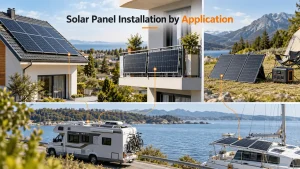
For a broader installation planning framework, see Solar Panel Installation by Application. Buyers with apartment projects can also review the Apartment Solar Installation Guide.
FAQ About Plug-in, Rooftop, and Portable Solar
Is plug-in solar the same as portable solar?
No. Plug-in solar usually refers to a system designed around a specified inverter and connection method. Portable solar is generally designed to charge a battery or power station and supply selected loads away from a permanent electrical installation.
Which solar system is best for distributors?
There is no single best format. Distributors should choose based on customer use, installation conditions, target market, support requirements, and package completeness. A product with clear documents and compatible accessories may be easier to sell than a lower-priced panel with an incomplete package.
Can plug-in solar and rooftop solar be used together?
They may be used in the same property in some cases, but the combination requires a review of the electrical design, utility requirements, connection method, and system documentation. Do not assume that two individually suitable products can be combined without further review.
Final Thoughts
Plug-in vs rooftop vs portable solar is ultimately a system architecture decision. Plug-in solar can suit smaller residential and balcony applications. Rooftop solar is designed for permanent, larger-scale household generation. Portable solar is useful for power stations, RVs, marine systems, outdoor use, and selected backup loads.
For buyers, the correct choice depends on the location, energy demand, electrical path, installation method, and local requirements. For distributors and OEM customers, the decision also depends on documentation, packaging, compatibility, customization, and batch-to-batch consistency.