 EN
EN
 Deutsch
 Italiano
 Español
 Français
 日本語
日本語
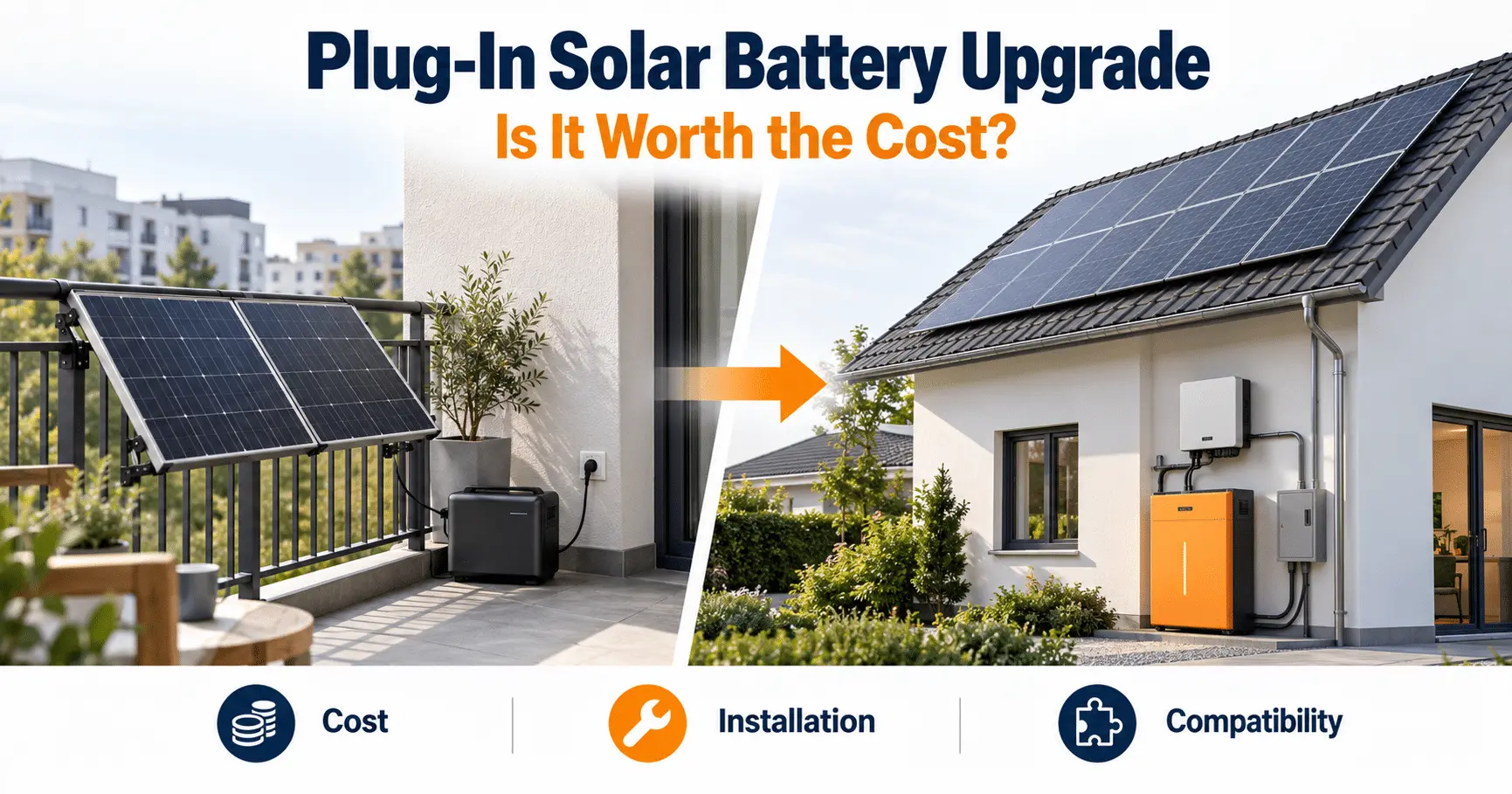
Quick answer: A plug-in solar battery upgrade can be worthwhile, but it is not automatically the cheaper or better option. The decision depends on fixed wiring, electrical work, installation permission, system compatibility, daily electricity use, and how long you plan to stay in the property.
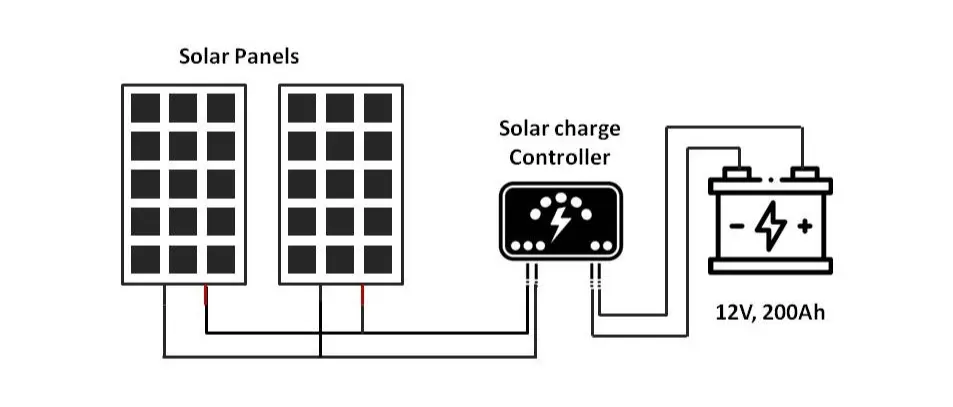
For renters and apartment residents, plug-in solar may remain the more practical choice because it can involve less permanent installation. For homeowners with long-term plans, higher electricity demand, and permission to modify the electrical system, a fixed-wired solar and battery system may offer better control over energy use.
The key question is not simply, “Is a battery better than plug-in solar?” It is: “Will the extra cost and complexity create enough additional value for this particular property and usage pattern?”
Is a Plug-In Solar Battery Upgrade Worth It?
A plug-in solar battery upgrade is worth considering when the battery can store electricity that would otherwise be unused and release it when the household needs power.
However, the upgrade only makes financial sense when the additional savings or energy flexibility justify the complete project cost. That cost may include more than the solar panel and battery.
| Cost or requirement | Why it matters |
|---|---|
| Battery storage | Adds energy capacity but also increases the purchase price. |
| Electrical installation | A qualified electrician may be required depending on the system and local requirements. |
| Fixed wiring | May increase installation time and reduce portability. |
| Inverter compatibility | The existing inverter may not support the chosen battery. |
| Property permission | Renters or apartment residents may need approval. |
| Protection equipment | Additional electrical protection may be required. |
| Future expansion | The first battery choice can affect later system upgrades. |
| Maintenance and replacement | Batteries have a different service profile from solar panels. |
This is why comparing only the price of a plug-in solar kit with the price of a battery can give a misleading result. The more useful comparison is between complete, installed systems.
What Changes When You Add a Battery to Plug-In Solar?
Adding a battery changes how the system is used. Without storage, the value of solar electricity depends heavily on when the panels generate power and when the household consumes it. With a battery, surplus electricity may be stored for later use, depending on the system design, battery capacity, inverter compatibility, and local operating requirements. For a neutral overview of how solar and storage work together, see the U.S. Department of Energy solar and storage guide.
The project becomes more integrated. You are no longer evaluating only panel output. You are evaluating solar generation, household demand, battery capacity, inverter operation, installation method, electricity prices, grid interaction, and future expansion plans.
A battery does not create additional solar energy. It changes when some of the generated energy can be used. This is the central plug-in solar battery upgrade question: can stored energy be used when the household actually needs it? A larger battery is not automatically better if the household does not regularly generate enough surplus electricity or consume enough energy later in the day.
When Does a Plug-In Solar Battery Upgrade Make Sense?
For a plug-in solar battery upgrade, the practical test is whether several conditions are true:
- You plan to remain in the property for several years.
- You have permission for the required installation work.
- Your household uses a meaningful amount of electricity outside solar generation hours.
- The battery and inverter are technically compatible.
- The complete installed cost is clear.
- You have a realistic plan for future expansion.
- The system can be operated within applicable local requirements.
This does not mean every homeowner needs a battery. It means the upgrade deserves closer analysis when the user has long-term control over the property and a predictable electricity usage pattern.
Who Should Stay with Plug-In Solar?
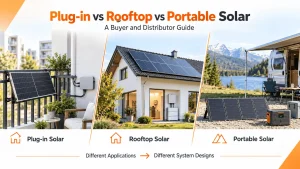
Plug-in solar can remain a sensible option for people who value simplicity, portability, and a lower initial commitment.
- Renters;
- Apartment residents;
- People without permission for permanent installation;
- People who may move soon;
- Users who want to test solar before making a larger investment;
- Buyers with limited upfront budgets;
- Small systems designed around a specific low-load application.
For these users, fixed wiring and battery storage may introduce costs and restrictions that reduce the original value of plug-in solar. Its portability and lower installation barrier may be the reason a buyer chooses it in the first place.
Who Should Consider Fixed-Wired Solar and Battery Storage?
A fixed-wired system may be worth comparing when the property owner wants a longer-term energy solution and can support the installation requirements.
- Homeowners planning to stay in the property;
- Households with higher or more consistent electricity demand;
- Users who want to improve self-consumption;
- Buyers planning to add more solar capacity later;
- Properties with suitable installation access;
- Users who can obtain the required permission and technical support.
The final decision still depends on the complete design. A fixed-wired system is not automatically the best choice simply because it includes more equipment.
The Total-Cost Comparison Most Buyers Miss
Many buyers compare a basic plug-in system with the price of a battery and assume the difference represents the cost of a plug-in solar battery upgrade. That is usually too narrow.
| Question | Plug-in solar | Fixed solar with battery |
|---|---|---|
| Initial equipment cost | Usually focused on the panel and basic control equipment. | May include panels, inverter, battery, protection, and installation. |
| Permanent installation | May be less permanent, depending on local requirements. | Usually requires more integrated installation planning. |
| Portability | Often easier to relocate. | Usually less portable. |
| Property permission | Depends on local rules and installation method. | More likely to require approval or professional review. |
| Surplus energy | Depends on the system architecture. | Battery storage may provide more control. |
| Future expansion | Depends on compatibility and product design. | Usually planned as a wider system. |
| Payback factors | Equipment cost and actual solar use. | Total installed cost, battery use, electricity value, and system life. |
The correct question is: “What is the total cost of owning and operating each option for my situation?” This comparison should be made before buying additional components.
When Does the Upgrade Stop Making Financial Sense?
A plug-in solar battery upgrade may stop making financial sense when the added costs are high but the expected additional energy use is low.
- The user may move within a short period;
- Permission for fixed installation is uncertain;
- The battery is much larger than the household’s realistic needs;
- The existing inverter cannot support the proposed battery;
- Electrical work adds a significant cost;
- The system requires several new components to work together;
- A complete alternative system offers better value at a similar budget;
- The buyer is mainly interested in portability;
- The expected savings depend on assumptions that have not been verified.
This does not mean the upgrade is technically unsuitable. It means the financial case needs to be tested more carefully. A technically impressive system can still be the wrong purchase if the user cannot use its additional capacity or recover the added cost over the expected ownership period.
Compare Complete Systems, Not Individual Components
Once a project includes fixed wiring, a battery, an inverter, protection equipment, and professional installation, it should be compared with other complete system options.
- Plug-in solar with no battery;
- Plug-in solar with compatible storage;
- Fixed-wired solar with a hybrid inverter;
- Hybrid inverter with a separate battery;
- A lightweight custom solar system;
- A complete residential solar and storage package.
| Buyer priority | Likely direction |
|---|---|
| Lowest initial commitment | Plug-in solar may be more suitable. |
| Portability | Plug-in or modular equipment may be preferable. |
| Long-term property ownership | A fixed system deserves closer comparison. |
| Higher evening electricity use | Battery storage may be more relevant. |
| Future expansion | Check system architecture before purchase. |
| Limited installation access | Confirm feasibility before choosing fixed wiring. |
| Custom roof or weight constraints | Consider lightweight or custom-format options. |
What Should Buyers Confirm Before Upgrading?
Property and installation
- Do you own the property or rent it?
- Is fixed installation permitted?
- Are there building, landlord, or property-management requirements?
- Is professional electrical work required?
Energy use
- When does the household use the most electricity?
- How much solar electricity is likely to be used immediately?
- Is there regular evening or overnight demand?
- Is backup power a requirement or only a preference?
Equipment compatibility
- Can the existing inverter work with the battery?
- Are the connectors, voltage range, and control system compatible?
- Can the system be expanded later?
- Does the supplier provide the required technical documentation?
Financial planning
- What is the complete installed cost?
- Which costs are one-time and which may recur?
- How long will the buyer use the property?
- Is the estimated payback based on documented assumptions?
- Would another complete system offer better value?
These questions are more useful than choosing a battery based only on capacity or advertised savings.
Does Adding a Battery Always Improve Payback?
No. Adding a battery does not automatically shorten the payback period.
The result depends on battery and installation cost, solar generation, electricity consumption, timing of electricity use, export arrangements, usable battery capacity, electricity price differences, and maintenance or replacement assumptions.
A plug-in solar battery upgrade may provide greater energy flexibility even when its financial return is not the fastest. Conversely, a low-cost battery may still be a poor fit if the system cannot use it effectively. Payback calculations should therefore be treated as scenario estimates rather than guaranteed outcomes.
A Simple Decision Framework
- Confirm whether fixed installation is possible. If the buyer cannot obtain permission or access for fixed wiring, the upgrade path may be limited from the beginning.
- Calculate the complete project cost. Include the battery, inverter, wiring, electrical work, protection equipment, installation, and required accessories.
- Check how much energy can actually be used. Estimate when the solar system generates electricity and when the household needs it.
- Compare alternative complete systems. Do not compare one plug-in kit with one battery. Compare complete systems with similar goals and capacities.
- Decide based on ownership period and flexibility. A long-term homeowner and a short-term renter may need completely different solutions.
Final Thoughts
A plug-in solar battery upgrade can be a useful next step, but it should not be treated as an automatic improvement.
For renters, apartment residents, and buyers who value portability, plug-in solar may remain the most practical option. For homeowners with long-term plans, suitable installation access, higher electricity demand, and a clear expansion strategy, fixed-wired solar with battery storage may deserve a full comparison.
The most reliable decision comes from comparing the complete system cost, installation conditions, energy-use pattern, compatibility, and ownership period together.
If you are evaluating a custom solar project, prepare the application, available space, target output, electrical requirements, installation conditions, and expansion plans before requesting a supplier quotation. This gives the supplier enough information to assess whether a standard, lightweight, flexible, or custom solar solution is appropriate.
FAQ
Is a plug-in solar battery upgrade suitable for renters?
It may be suitable if the equipment and installation method comply with local requirements and the property owner allows the setup. Renters should confirm permission before choosing a solution that involves permanent wiring or structural changes.
Is fixed solar always better than plug-in solar?
No. Fixed solar may offer a more integrated long-term system, but plug-in solar may be more practical for renters, apartment residents, short-term occupants, or buyers who prioritize portability and lower initial commitment.
Does a battery guarantee faster payback?
No. Payback depends on total installed cost, energy use, electricity prices, system compatibility, and how effectively the stored energy is used.
What should I ask a solar supplier before upgrading?
Ask about system compatibility, battery integration, installation requirements, documentation, expansion options, total project cost, and the specifications needed for a proper quotation.
Planning a custom solar project? Share your application, available space, target output, electrical requirements, installation conditions, and expansion plans so the supplier can assess the right system path.