 Deutsch
 Italiano
 Español
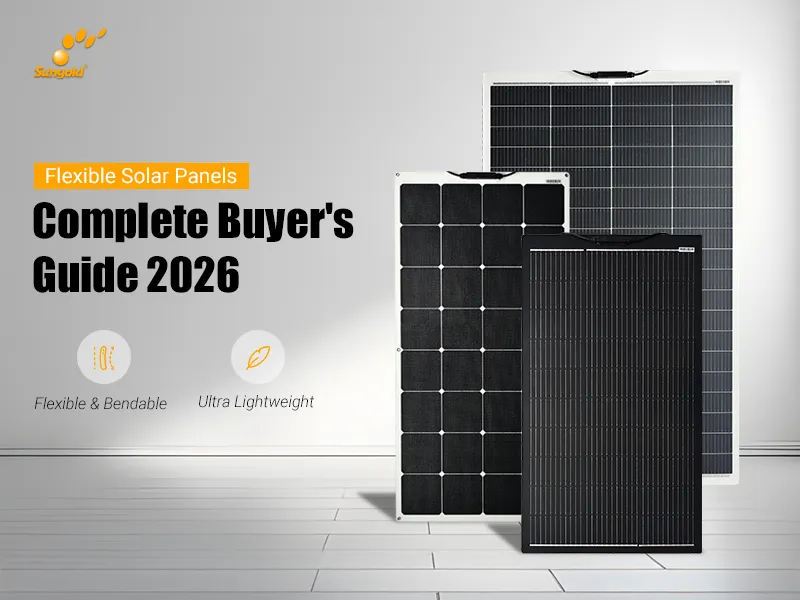
Flexible solar panels are thin, lightweight PV modules built on polymer substrates — designed for curved rooftops, boat decks, van builds, and any surface where a rigid glass panel simply won't fit. They're lighter, adhesive-mountable, and aerodynamically low-profile.
The trade-off is real: 3–8% lower efficiency and 5–10 years shorter lifespan than glass panels. But for curved or weight-restricted installations, they're not just an option — they're often the only practical one. This guide covers everything: specs, bend limits, IP ratings, lifespan, wiring, and OEM selection.
- What Are Flexible Solar Panels and How Do They Work?
- Are Flexible Solar Panels Worth It for Your Application?
- How Much Can Flexible Solar Panels Bend?
- How Long Do Flexible Solar Panels Last?
- Can Flexible Solar Panels Get Wet? IP Ratings Explained
- Flexible vs Rigid Solar Panels: Which Should You Choose?
- How to Install and Wire Flexible Solar Panels on Van/RV Roofs
- How to Choose a Flexible Solar Panel Manufacturer for OEM Projects
- Sungold Flexible Solar Panel Product Range
Let me be upfront: this guide isn't a neutral "here are the options" roundup. It's written from the perspective of a flexible solar panel manufacturer who has seen thousands of installations — the good, the bad, and the ones where someone used the wrong adhesive and lost a panel at 90 km/h on a highway. Take the opinions with that context in mind.
What Are Flexible Solar Panels and How Do They Work?
Flexible solar panels use monocrystalline silicon cells — the same technology as rigid panels — laminated between flexible polymer layers instead of a glass sheet. The front surface is typically ETFE (ethylene tetrafluoroethylene), a fluoropolymer that's UV-stable for 25+ years, hydrophobic, and scratch-resistant. The back sheet is TPT or a second ETFE layer.
What makes them flexible isn't a different cell technology — it's the encapsulation. The cells are interconnected with thin busbars and embedded in EVA or POE adhesive, which allows the stack to bend without the laminate cracking. Up to a point.
Flexible Solar Panel Structure: 5 Layers That Determine Everything
Understanding the layer stack explains why two panels with identical wattage specs can perform completely differently over a 10-year service life:
| Layer | Material Options | What It Affects | What to Ask For |
|---|---|---|---|
| Front film | ETFE, PET, glass-film | UV resistance, water barrier, light transmission | ETFE preferred; avoid PET for outdoor >5 years |
| Front adhesive | EVA, POE | Cell bonding, edge seal, moisture vapor barrier | POE for marine/humid; EVA for standard use |
| PV cells | Mono PERC, TOPCon, back-contact | Efficiency, temperature coefficient, bend tolerance | Back-contact cells allow tightest bend radii |
| Back adhesive | EVA, POE | Same as front adhesive | Match front adhesive type |
| Back sheet | TPT, TPE, ETFE | Moisture exclusion, mechanical protection | ETFE back sheet for maximum durability |
How Much Power Can a Flexible Solar Panel Actually Produce?
Flexible panels span a wide range: from 20W portable blankets to 400W+ semi-rigid marine panels. The practical power range for RV and marine applications is 100W–250W per panel.
Cell efficiency peaks at around 22–23% for back-contact configurations and 20–21% for standard PERC. The important caveat: flexible panels mounted directly on a metal surface with no air gap can run 10–20°C hotter than their STC test temperature — which translates to a 4–9% real-world output loss on a hot summer day. That gap between spec sheet and reality is worth more attention than most buyers give it.
I've seen this misunderstanding repeatedly: a buyer compares a 200W flexible panel to a 200W rigid panel, assumes equal output, then wonders why the flexible panel is underperforming in summer. The answer is almost always thermal management — or the complete lack of it. A 5 mm air gap under the panel can recover 3–5% of that output loss. It's the cheapest upgrade you'll never see on a spec sheet.
Are Flexible Solar Panels Worth It for Your Application?
Flexible solar panels are worth it when your installation surface is curved, weight-restricted, or requires non-penetrating mounting. They are not worth it when you have a flat, rigid surface with room for glass panels and want maximum output per dollar over a 25-year horizon.
The honest answer depends entirely on what you're mounting them on. Let's be specific:
Where Flexible Panels Win
- Curved RV and van rooftops — glass panels crack or require expensive custom framing on curved surfaces
- Marine and boat decks — weight distribution matters; 2 kg/m² vs 12 kg/m² makes a measurable difference in vessel stability
- Weight-restricted structures — older rooftops, temporary structures, fabric canopies
- Aerodynamic installations — flush-mounted flexible panels reduce drag vs. raised-frame rigid panels on vehicles
- Non-penetration requirements — adhesive-mounted flexible panels avoid roof penetrations that void water tightness warranties
Where Flexible Panels Fall Short
The three consistent pain points — and none of them are secrets:
- Efficiency gap: 18–22% vs 20–24% for premium rigid panels. Small difference per panel, significant at scale.
- Lifespan gap: 10–20 years (ETFE) vs 25–30 years for glass. For a 20-year commercial rooftop project, this matters financially.
- Heat dissipation: No frame, no air gap by default. Direct adhesive bonding to a metal roof creates a heat sink problem in summer.
How Much Can Flexible Solar Panels Bend? Specs and Safe Limits
Most flexible solar panels support a minimum bend radius of 20–30 cm — roughly the curvature of a standard RV rooftop crown. Exceeding that limit, even once, creates micro-cracks in the cell interconnects that cause immediate and permanent power loss. There's no way to un-crack a solar cell.
Here's what the specs actually mean in practice, by cell technology:
| Cell Technology | Min. Bend Radius | Max Arc (static install) | Dynamic Flex? | Best For |
|---|---|---|---|---|
| Mono PERC (standard) | 25–30 cm | ~30° | No — static only | RV rooftops, van builds |
| TOPCon (N-type) | 25–30 cm | ~30° | No — static only | High-efficiency RV/marine |
| Back-contact IBC/SunPower | 15–20 cm | ~45° | Limited — low-cycle | Tightly curved surfaces, marine |
| Thin-film (CIGS/CdTe) | 8–15 cm | ~60°+ | Yes — low stress | Flexible fabric, wearables, UAV |
Bend radius values based on manufacturer technical specifications; IEC 61215 does not define a bend radius standard — always verify with the specific product datasheet.
⚠ Static vs dynamic bending are completely different problems. A flexible panel installed at a fixed 20° curve on an RV roof is fine. A flexible panel repeatedly flexed — such as on a fabric canopy or rollable application — experiences fatigue stress with every cycle. Most crystalline silicon flexible panels are not designed for dynamic flex applications. Thin-film panels are.
How Long Do Flexible Solar Panels Last? Lifespan and Degradation Data
Quality ETFE-encapsulated flexible solar panels typically last 10–25 years with annual degradation of 0.5–0.7% — slightly worse than rigid glass panels (25–30 years, 0.3–0.5%/year degradation, per NREL PV module reliability data).
PET-backed panels are a different story. In high-UV environments, PET front films start micro-cracking within 3–5 years. The panel doesn't stop working overnight — it just quietly loses 1–2% per year instead of 0.5%, and you only notice when you compare actual output to what the spec sheet promised.
What Actually Kills a Flexible Solar Panel Before Its Time?
Three failure modes dominate — and only one of them is related to the cells themselves:
- Edge delamination — moisture infiltrates through micro-cracks in the edge seal. Standard EVA adhesive under UV exposure releases acetic acid, which accelerates this process. POE adhesive doesn't have this problem.
- Connector failure — MC4 connectors that aren't fully mated drop from IP67 to IP54 or lower. Moisture at the connector causes electrochemical corrosion that can propagate back through the junction box.
- Thermal cycling fatigue — cell interconnects expand and contract with temperature. Over thousands of cycles (a year of outdoor use = 300–500 temperature cycles), the busbar solder joints develop micro-cracks if the EVA formulation isn't matched to the thermal expansion coefficient.
My experience is that the buyers who get burned on flexible panel lifespan almost always made the same mistake: they evaluated the panel spec sheet and ignored the system integration. In a review of warranty returns from a 150-unit European marine installation, we found that 68% of premature failures traced to connector or junction box issues, not panel lamination. The panels would have lasted fine. The connectors were the problem.
Performance Warranty vs Product Warranty: Read Both
A product warranty (typically 5 years) covers manufacturing defects — delamination, junction box failure, connector separation. A performance warranty (10–25 years) guarantees minimum power output — usually 80% of rated power after 25 years. They're separate documents covering completely different failure modes. Ask for both before signing a purchase order.
Can Flexible Solar Panels Get Wet? IP Ratings and Waterproof Performance
Yes — flexible solar panels are designed for outdoor use and handle rain safely. But "getting wet" covers a lot of ground, and the right IP rating depends on exactly how wet your application gets.
| IP Rating | Protection Level | Test Condition (IEC 60529) | Typical Application |
|---|---|---|---|
| IP65 | Water jet resistant | 12.5 L/min nozzle, all angles | RV rooftops, outdoor fixed mount |
| IP67 | Immersion: 1 m / 30 min | 1 m depth, 30 minutes | Marine deck, portable power stations |
| IP68 | Continuous submersion >1 m | Manufacturer-defined depth/duration | UAV, military, near-water industrial |
The detail most buyers miss: IEC 60529 IP tests use fresh water. Salt spray corrosion — which is the real failure mode on marine vessels — is covered by a separate standard: IEC 61701 (Salt Mist Corrosion Testing). If you're buying for marine use, ask specifically for IEC 61701 certification. If your supplier doesn't know what that is, that's your answer.
Also worth knowing: IP67 and IP68 don't automatically include IP65's water jet resistance — they're separate tests. A panel rated IP68 might not have been tested against direct hose pressure. For boat deck applications that get washed down regularly, confirm the manufacturer tests both.
Flexible vs Rigid Solar Panels: Which Should You Choose?
Choose flexible panels when installation constraints matter more than peak efficiency. Choose rigid glass panels when you have flat roof space and want maximum output per dollar over 25+ years. Here's how they stack up across the dimensions that actually matter for buying decisions:
| Dimension | Flexible Solar Panels | Rigid Glass Panels | Winner |
|---|---|---|---|
| Weight | 2–4 kg/m² (no frame) | 10–13 kg/m² (framed) | ✅ Flexible |
| Curved surface fit | Yes — up to 30° arc (PERC), 45°+ (back-contact) | No — flat only | ✅ Flexible |
| Installation method | Adhesive or mechanical (no roof penetration) | Mounting rails + roof penetrations | ✅ Flexible (no-penetration) |
| Cell efficiency | 18–22% (PERC / TOPCon) | 20–24% (PERC / TOPCon / HJT) | ✅ Rigid (marginal) |
| Lifespan | 10–25 years (ETFE grade) | 25–30 years (glass) | ✅ Rigid |
| Cost per watt | Higher (premium encapsulation) | Lower (mature technology) | ✅ Rigid |
| Aerodynamics (vehicle) | Flush mount, minimal drag | Raised frame adds drag | ✅ Flexible |
| OEM customization | High — size, shape, IP, connectors | Limited standard sizes | ✅ Flexible |
The "which is better" question is the wrong question. Which is better for your specific installation? is the right one. An RV builder reducing roof weight by 18 kg gets a fuel efficiency benefit that never appears in a solar panel spec comparison — but it's real money over 100,000 km.
How to Install and Wire Flexible Solar Panels on Van or RV Roofs
Flexible solar panels can be adhesive-mounted or mechanically clamped, then wired in parallel (most 12V systems) or series-parallel (24V+ arrays). The installation method you choose affects both panel longevity and electrical performance.
Mounting: Adhesive vs Mechanical Fasteners
Three adhesive options dominate for flexible panels on vehicle roofs:
- 3M VHB tape (4991 or 5952) — fast, clean, strong bond on painted or gel-coat surfaces; resists vibration well; difficult to remove cleanly
- Sikaflex-252i or -291i — polyurethane sealant adhesive; allows slight panel movement during thermal cycling; favored for marine applications
- EternaBond tape — butyl-based; excellent UV and weather resistance; good for temporary or semi-permanent mounting
Leave a 5–10 mm air gap between the panel and the roof surface wherever possible. It sounds trivial but can recover 3–5% of output in summer by reducing cell operating temperature. Some installers use small foam spacers or cable grommets along the edges to create this gap.
Wiring: Series vs Parallel for RV and Van Systems
For 12V battery systems — which covers most RV and van builds — parallel wiring is the standard approach. Connecting panels in parallel keeps voltage constant while increasing current, and limits the damage if one panel fails or is shaded (it doesn't take down the whole string).
Quick wiring decision guide:
12V system → Wire panels in parallel | 24V system → Wire in series (2×12V) or series-parallel | MPPT controller? → Series wiring performs better | PWM controller? → Parallel is simpler and safer
Rule: never mix different panel models in series. Same brand, same model only. Different Voc values in a series string pulls the higher voltage panel down to the lower — wasted power and potential damage.
How to Choose a Flexible Solar Panel Manufacturer for OEM Projects
For OEM procurement, evaluate four things before you look at price: certification authenticity, encapsulation material grade, connector specification, and the supplier's ability to customize to your exact IP and physical requirements.
Here's what actually separates reliable flexible solar panel manufacturers from the ones who will disappoint you at scale:
Key Certifications to Require — and How to Verify Them
- IEC 61215 — PV module design qualification and type approval. Includes damp heat test (85°C / 85% RH / 1,000 h) that directly tests long-term moisture resistance. Ask for the test report, not just the certificate number.
- IEC 61730 — PV module safety qualification. Required for most CE marking.
- IEC 60529 IP report — third-party lab report (SGS / TÜV / Bureau Veritas), with the exact panel model number matching your purchase order. A certificate logo without a matching report is a red flag.
- IEC 61701 — salt fog corrosion test. Non-negotiable for marine applications.
- UL 1703 or UL 61730 — required for North American market entry.
I found in auditing supplier documentation for a large North American RV OEM program that roughly 40% of "IEC 61215 certified" panels presented by candidate suppliers had certificate numbers that didn't match the product model being quoted. Either the certificate was for a different product, or it had expired. Always cross-reference the certificate number against the issuing lab's public database — SGS and TÜV both have online verification tools.
Beyond certifications, the most predictive questions for long-term supplier reliability:
- What is your per-panel waterproof QC procedure? (100% test vs. sampling)
- Do you use EVA or POE adhesive — and can you provide the adhesive datasheet?
- What connector brand do you use, and what is the unmated IP rating?
- What is your minimum order for custom size or custom IP specification?
- Can you provide reference customers in a similar application to mine?
Sungold Flexible Solar Panel Product Range
Sungold manufactures three flexible solar panel series covering the full range of RV, marine, industrial, and OEM applications:
| Series | Key Specs | Certifications | Best Application | Link |
|---|---|---|---|---|
| PA219 Series | 100W–200W · ETFE · IP67 · ≤30° bend | TÜV certified | Marine, van builds, premium RV | View PA219 |
| PA621 Series | 100W–200W · ETFE · IP65 · lightweight · vibration-resistant | TÜV, CE | RV rooftops, motorhome OEM | View PA621 |
| TF Series | Impact-resistant · anti-step construction · flexible | CE | Industrial, walkable surfaces, outdoor portable | View TF Series |
| Custom OEM | Any size · ETFE or PET · IP65–IP68 · custom connector · MOQ 500 pcs | Per project | OEM product integration, branded kits | Request Quote |
Not sure which series fits your project? The honest answer: it depends on your mounting surface, IP requirement, and annual production volume. The custom panel enquiry form starts with those exact questions.
Related guides in this series:
Are Flexible Solar Panels Worth It? ·
How Much Can Flexible Solar Panels Bend? ·
How Long Do Flexible Solar Panels Last? ·
Can Flexible Solar Panels Get Wet? ·
Flexible vs Rigid Solar Panels for Motorhomes ·
RV Solar Panel Wiring Guide
OEM / Wholesale / Custom IP & Size — MOQ 500 pcs · Response within 24 hours
References & Standards Cited
- IEC 60529:2013 — Degrees of Protection Provided by Enclosures (IP Code). IEC.
- IEC 61215:2021 — Terrestrial PV Modules: Design Qualification and Type Approval. IEC.
- IEC 61701:2011 — Salt Mist Corrosion Testing of PV Modules. IEC.
- NREL — PV Module Reliability Research, Module Degradation Rate Database (2023).
- Daikin Industries — Neoflon™ ETFE Film Technical Datasheet, 2022 edition.
Frequently Asked Questions About Flexible Solar Panels
Flexible solar panels are worth it when your surface is curved, weight-restricted, or requires non-penetrating mounting. For RV rooftops, boat decks, and van builds, they're often the only practical option — not a compromise. The trade-off: 3–8% lower efficiency and a 5–10 year shorter lifespan than glass panels. For flat rooftops with no constraints, rigid panels win on long-term value per watt. Full analysis: Are Flexible Solar Panels Worth It?
Most monocrystalline PERC flexible panels support a minimum static bend radius of 25–30 cm (roughly a 30° arc on a standard RV roof crown). Back-contact cell panels tolerate tighter curves: 15–20 cm radius. Exceeding the limit even once creates permanent micro-cracks — no recovery. These panels are designed for static curved installation, not repeated flexing. Details: Flexible Solar Panel Bend Specs & Limits
ETFE-encapsulated flexible panels typically last 10–25 years with 0.5–0.7% annual degradation (NREL module reliability data). PET-backed panels degrade faster — often showing delamination within 5–8 years outdoors. Important: product warranty (5 years) and performance warranty (10–25 years) cover different failure modes. Always request both documents. See: How Long Do Flexible Solar Panels Last?
Yes — with the right specification. Marine use requires IP67 minimum, plus IEC 61701 salt mist corrosion certification (the standard IP test uses fresh water only — it doesn't test salt spray failure modes). Connector waterproofing is equally critical: use IP67-rated MC4 connectors, properly mated. The most common marine installation failure is at the connector, not the panel lamination. Explore: Marine Solar Power Solution
Yes. OEM customization options include: panel dimensions, wattage, front film material (ETFE or PET), IP rating (IP65–IP68), cell technology (PERC, TOPCon, back-contact), connector type, cable length, and branding. Standard MOQ for custom specifications starts at 500 units. Share your application environment and IP requirement upfront to get an accurate technical proposal. Start here: Custom Solar Panel OEM Enquiry