




[ Summary]
In the 2026 solar landscape, the “three-year performance cliff” of traditional flexible panels remains a major hurdle for B2B buyers. This technical deep-dive examines how Sungold’s transition to N-Type Flexible Panel technology (TOPCon and BC cells) eliminates Light-Induced Degradation (LID) and stabilizes annual power loss at just 0.4%. By contrasting 10-year and 25-year power models, we demonstrate that Sungold N-Type modules offer a 30-year operational life, transforming flexible solar from a “disposable expense” into a “long-term financial asset” with significantly higher resale and utility value.
Introduction: Confronting the “Short-Life” Stigma of Flexible Solar
For nearly a decade, the flexible solar panel market has been haunted by a persistent reputation: planned obsolescence. Professional buyers—from RV fleet managers to marine engineers—have grown accustomed to seeing traditional P-type PERC flexible panels suffer massive power drops within just 36 to 60 months.
Common symptoms like “browning,” delamination, and sudden voltage drops have led many to view flexible solar as a temporary solution rather than a permanent power source. However, as we move into 2026, a technological revolution is occurring. At Sungold, we are shifting the narrative from “temporary power” to “30-year asset value” by leveraging N-type silicon technology.
This article explores the specific degradation physics of N-type cells and why they are the only viable choice for buyers who demand a decades-long Return on Investment (ROI).

The Physics of Failure: Why P-Type Fades
To understand why N-type is superior, we must look at why the previous generation (P-type PERC) fails. P-type silicon is doped with Boron. When these cells are first exposed to sunlight, a chemical reaction occurs between the Boron and the Oxygen in the silicon, creating what is known as the Boron-Oxygen Complex.
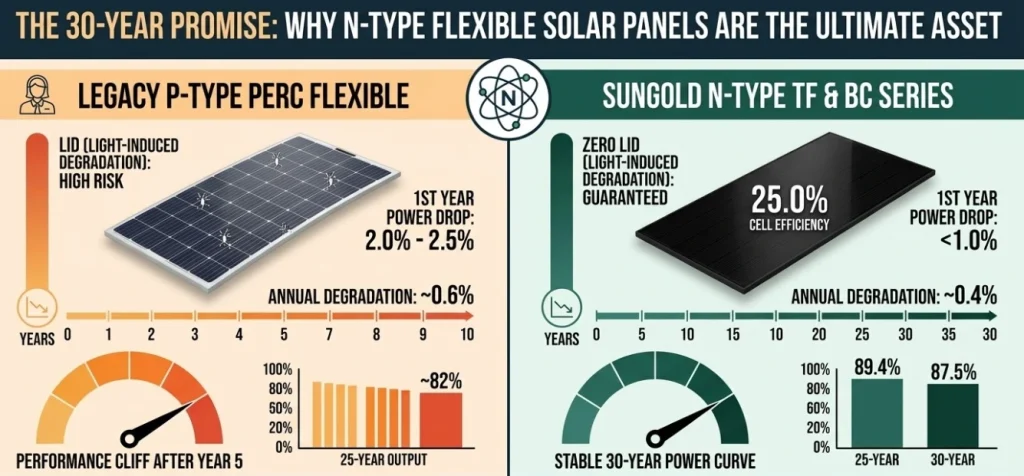
This leads to Light-Induced Degradation (LID). Within the first weeks of installation, a P-type panel can lose up to 3% of its rated power before it even settles. Furthermore, P-type cells are more susceptible to LeTID (Light and elevated Temperature Induced Degradation), a critical flaw in high-heat environments like California or Australia.
For a long-term buyer, this initial drop is just the beginning. Over 5 years, cumulative micro-cracks and thermal stress in standard PERC modules can lead to a “performance cliff” where output drops below 80%—well before the system has paid for itself.
The N-Type Advantage: Zero LID and Stability
Sungold’s 2026 N-type modules (including the TF Series and BC Series) use silicon doped with Phosphorus instead of Boron.
Zero LID (Light-Induced Degradation)
Because there is no Boron in our N-type cells, the Boron-Oxygen complex cannot form. Sungold N-type panels experience Zero LID. Your panels produce 100% of their rated power from Day 1 and stay there through the critical first year.
Superior Temperature Coefficient
Degradation is often accelerated by heat. As shown in our field reports, Sungold’s N-type cells maintain a temperature coefficient of -0.29%/°C(for TOPCon) and -0.28%/°C(for BC cells). By running cooler and more efficiently, the internal chemical “wear and tear” on the cell is drastically reduced, leading to a much slower annual degradation rate.
Modeling the 30-Year Power Curve: P-Type vs. Sungold N-Type
When evaluating ROI, we must look beyond the purchase price and calculate the Total Energy Harvest over 25 to 30 years.
| Year | Standard P-Type PERC (Output %) | Sungold N-Type TF/BC (Output %) | The ROI Difference |
| Year 0 | 100% | 100% | Initial parity |
| Year 1 | 97.5% (LID impact) | 99.0% | Sungold leads by 1.5% |
| Year 10 | 91.0% | 95.4% | +4.4% Energy Gain |
| Year 25 | 82.0% | 89.4% | +7.4% Asset Value |
| Year 30 | Fails/Not Rated | 87.5% | Operational Life Extension |
The “Asset Value” Breakdown
By Year 25, a Sungold N-type system has produced approximately 15-18% more total kilowatt-hours than a PERC system of the same initial wattage. In commercial terms, this is equivalent to getting 4 years of electricity for free.
For RV and Marine OEMs, this translates to a higher resale value for the vehicle. A 5-year-old RV equipped with Sungold N-type solar still performs like a new system, whereas a PERC-equipped vehicle may require a costly solar retrofit, hurting its market value.
Materials Matter: Patented ETFE and BC Technology
A cell is only as good as its protection. High degradation rates in flexible panels are often caused by the “yellowing” of the top layer, which blocks light.
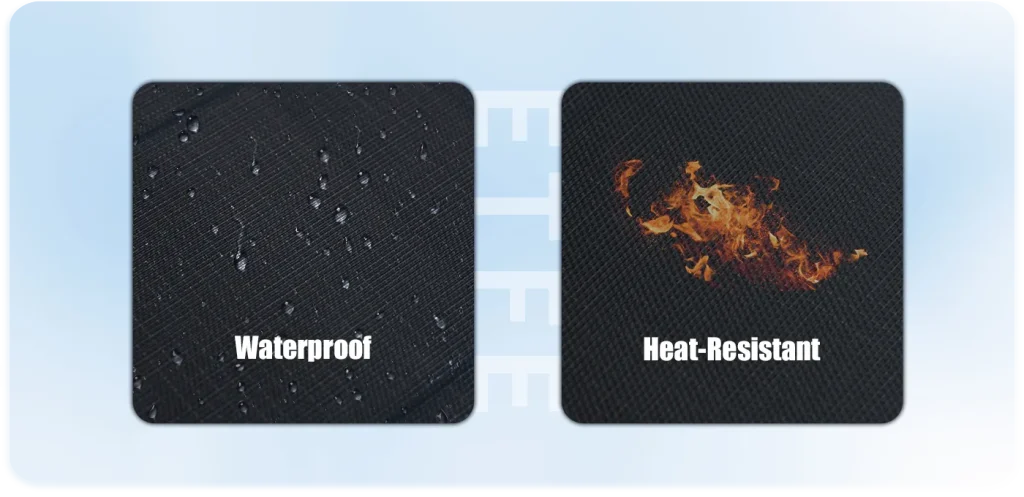
Sungold utilizes a patented ETFE (Ethylene Tetrafluoroethylene) encapsulation process. Unlike cheap PET or TPT plastics, ETFE is:
-
Chemically Inert: It does not react with UV rays, preventing the “cloudy” look that kills efficiency after Year 3.
-
Self-Cleaning: Its low-friction surface allows rain to wash away dust, maintaining optimal light absorption without manual scrubbing.
-
High Thermal Stability: It handles the expansion and contraction of the roof without delaminating.
Combined with our BC (Back Contact) cells, which remove all front-side metal grids, the internal stress on the cell is minimized. This structural integrity is why we can confidently offer a power curve that extends to 30 years—a feat previously thought impossible for flexible modules.
FAQ: Addressing Long-Term Buyer Concerns
Q: If N-type is so much better, why do some companies still sell PERC? A: Cost. PERC is cheaper to manufacture in the short term. It is often used by “budget” brands focusing on the one-time DIY consumer. Sungold focuses on the B2B and “Prosumer” market where the Cost per kWh over time is more important than the initial price tag.
Q: Can I really expect 30 years from a flexible panel? A: While the “physical” warranty covers 10-12 years of workmanship, the Linear Power Warranty proves the cell’s capability to produce power for 30 years. With proper mounting (avoiding extreme mechanical folding), the N-type TF series is designed to outlast the vehicle or vessel it is mounted on.
Q: Is N-type more resistant to “Salt Mist” in marine environments? A: Yes. N-type silicon is naturally more resistant to PID (Potential Induced Degradation). In salty, high-humidity marine environments, P-type cells can suffer from accelerated ion migration that kills voltage. N-type’s chemical structure is significantly more stable under these electrolytic conditions.
Conclusion: Securing Your Energy Future
In 2026, the era of “disposable” solar is over. For the long-term buyer, the N-type flexible panel degradation rate is the single most important metric for calculating ROI.
By choosing the Sungold TF or BC Series, you are investing in a 30-year power curve, Zero LID technology, and a traceable supply chain that guarantees performance long after the competition has faded. Don’t let your investment degrade—choose N-type stability.