 EN
EN
 Deutsch
 Italiano
 Español
 Français
 日本語
日本語
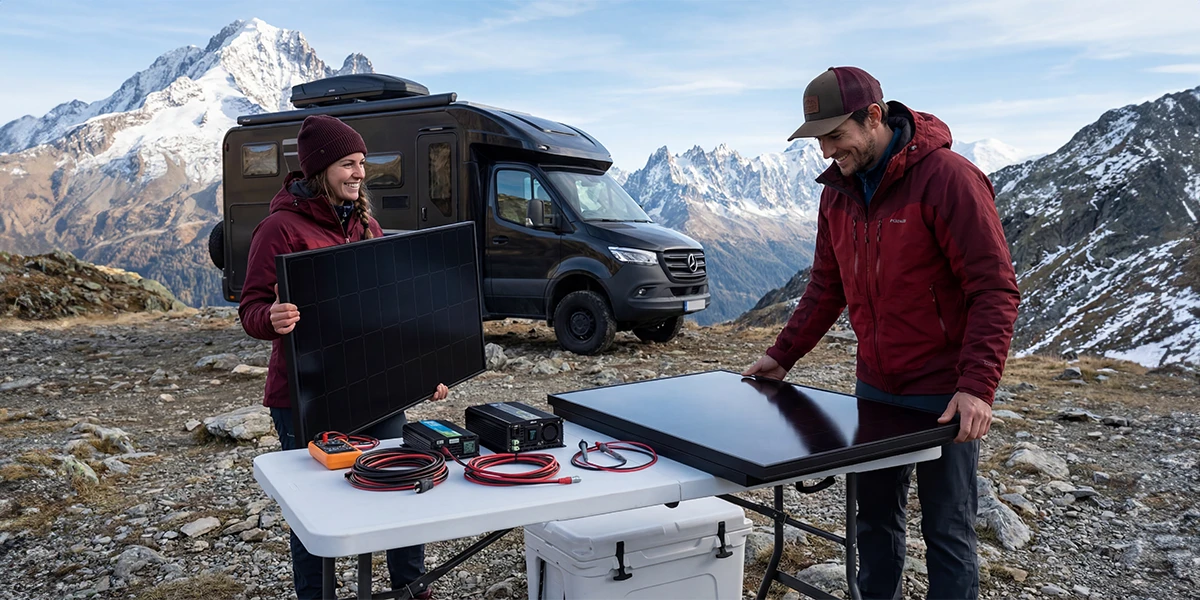
Solar panel customization refers to modifying standard photovoltaic module parameters — including size, voltage, wattage, shape, color, backsheet, connector, cell type, lamination, and branding — to meet specific project or OEM requirements. Customization is typically available from specialized manufacturers with MOQs starting at 100–500 pieces.
| Customizable Dimension | What You Can Specify | Sungold Capability |
|---|---|---|
| Size | Any length × width, irregular cut | Free-size cutting, min 50×50mm |
| Wattage | 5W – 700W+ | Full range, matched to cell layout |
| Voltage | 5V / 12V / 18V / 24V / 36V / 48V | Custom string design |
| Cell Type | Mono PERC, HJT, TOPCon, BC | BC cells, 22.7%+ efficiency |
| Shape | Rectangle, round, triangle, L-shape | CNC cutting + laser scribing |
| Color | All-black, dark blue, transparent, custom | Custom EVA/backsheet color matching |
| Backsheet | PET, TPT, Glass, ETFE, PCB | ETFE standard on flexible series |
| Connector | MC4, Anderson, JST, USB, DC, custom | In-house harness assembly |
| Lamination | Glass-glass, glass-backsheet, flexible | All three processes in-house |
| Branding | Logo, silkscreen, label, retail box | Full OEM/ODM packaging service |
Why Do Solar Panel Customization Options Matter for B2B Buyers?
Lorem ipsum dolor sit amet, consectetur adipiscing elit. Ut elit tellus, luctus nec ullamcorper mattis, pulvinar dapibus leo.
Let me put it bluntly: standard panels fit about 60–70% of real-world installations. The other 30–40%? That’s where things get expensive if you don’t customize upfront.
I had a client last year — a European company building solar-powered environmental monitoring stations for remote mountain locations. They initially bought standard 100W rigid panels. Seemed reasonable. But the mounting frames needed custom brackets ($18 each), the MC4 connectors had to be swapped to weatherproof Anderson plugs (labor + parts), and the 18V output was feeding a 24V battery system through a buck-boost converter that ate 8% of the power. Total “adaptation cost” per unit: about $45 on a $65 panel.
When we switched them to a custom panel — right size, 36V output, Anderson connector, ETFE backsheet for the harsh UV at altitude — the per-unit cost went up by $22, but the total system cost dropped by $23 per station. Multiply that by 2,000 stations and you’re looking at $46,000 saved. Not a bad trade.
The math is simple: if your adaptation cost exceeds 15–20% of the panel price, you should be customizing.
Who Actually Needs Custom Solar Panels?
Not everyone does. If you’re installing a standard residential rooftop system with off-the-shelf inverters, buy standard panels. Seriously. Don’t overcomplicate it.
But if your project hits any of these scenarios, customization starts making financial sense:
| Application | Why Standard Panels Fail | Typical Custom Requirements |
|---|---|---|
| RV / Campervan | Roof dimensions are non-standard | Custom size, 12V/24V, lightweight, flexible |
| Marine / Boat | Salt spray, curved surfaces | ETFE encapsulation, curved shape, sealed connectors |
| IoT / Sensors | Need tiny panels (5W–20W) | Ultra-small, USB/JST connector, PCB backsheet |
| Street Lighting | Must match specific battery controller | Exact wattage + voltage pairing |
| BIPV / Architecture | Aesthetic requirements from architects | Custom color, transparency, shape |
| Portable / Camping | Weight and packability matter | Foldable, lightweight, USB output, branded packaging |
| Electric Fence / Agri | Harsh outdoor, low power | Weatherproof, low wattage, Anderson connector |
| Commercial Rooftop | Maximize watts per m² | Optimized dimensions for specific roof layout |
Quick gut check: does your project involve a non-rectangular surface, a specific voltage requirement, an unusual environment, or end-user branding? If yes to any of these, keep reading.
What Size and Shape Options Can You Customize?
Size is the number-one customization request. And honestly, it’s the easiest one for manufacturers to accommodate — so if size is all you need to change, your cost premium will be minimal (often under 10%).
Standard vs. Custom Dimensions — How to Decide
Here’s my rule of thumb: if a standard panel wastes more than 15% of your available mounting surface, go custom.
I worked with a marine electronics company that was mounting panels on the hardtop of center-console fishing boats. The available space was 580mm × 420mm — an awkward size that no standard panel fits. They’d been using a 540×400mm panel and losing 12% of potential surface area. Doesn’t sound like much, until you realize that on a boat where every watt counts for running fish finders and radios, that 12% is the difference between “battery holds all day” and “battery dies at 3pm.”
The process for getting custom dimensions is straightforward:
1. Measure your available surface — account for mounting clearances (typically 10–15mm per edge), obstructions, and any curvature.
2.Calculate your target wattage per unit area — with higher-efficiency cells (>22%), you can get more watts from a smaller panel. Ask your manufacturer what cell technology they’ll use.
3.Request a layout drawing — any serious manufacturer will provide a CAD layout showing cell arrangement within your specified dimensions. Sungold provides this within 48 hours, free of charge.
Irregular Shapes — Round, Triangular, L-Shaped Panels
This is where it gets fun (and a bit more expensive). Custom shapes require laser scribing and CNC cell cutting, which typically adds 10–15% to unit cost.
When does it make sense? Think circular garden light panels, triangular BIPV facades, or L-shaped panels that wrap around a rooftop obstacle. If the shape serves a functional or aesthetic purpose that drives sales or solves an engineering problem, the premium pays for itself.
When does it not make sense? When someone just thinks a round panel would “look cool” on a product that would work perfectly fine with a rectangle. I’ve talked people out of this more than once. Your call, but my experience is that irregular shapes should solve a problem, not create a conversation piece.
How to Choose the Right Voltage and Wattage for Custom Panels?
Voltage selection trips up more buyers than any other parameter. Get it wrong, and your panel either won’t charge the battery at all or will force the charge controller to work overtime (reducing its lifespan and wasting energy as heat).
The core principle: your panel’s Vmp (voltage at maximum power) must exceed your battery’s charging voltage by 15–20% to compensate for heat-related voltage drop.
A 12V lead-acid battery needs about 14.4V to charge. On a hot day, a panel rated at 18V Vmp might drop to 15V — barely enough. That’s why most 12V systems use panels with 18V Vmp, and 24V systems use 36V Vmp panels.
Voltage Matching Quick Reference
| System Type | Recommended Panel Vmp | Why |
|---|---|---|
| 12V battery (lead-acid/LiFePO4) | 18V | Compensates for heat loss, ensures charging |
| 24V battery system | 36V | Equivalent to 2-series string |
| 48V battery system | 54–60V | Matches MPPT controller input range |
| Grid-tie micro-inverter | Check MPPT range | Must fall within specified window |
| USB device charging (5V) | 5V regulated | Requires integrated voltage regulator |
| Direct DC load | Match load ±5% | Avoids conversion losses |
A mistake I see constantly: buyers ordering “12V panels” for a 24V system, planning to wire two in series. This works electrically, but now you need twice as many panels, twice as many connectors, and twice as many potential failure points. Just order a 24V panel.
Wattage — It's a Function, Not a Choice
Here’s something that confuses people: you don’t independently “choose” wattage. Wattage = cell efficiency × active cell area. So wattage is a result of your size and cell type choices.
With BC cells at 22.7%+ efficiency, you get roughly 227W per square meter of active cell area. With standard PERC at 20.5%, you get about 205W. That 10% efficiency gap means a BC-based custom panel can be 10% smaller for the same wattage — or deliver 10% more power in the same footprint.
Ask your manufacturer which cell technology they’re using. It directly impacts what’s possible within your size constraints.
What Backsheet and Encapsulation Materials Are Available?
This is the customization dimension that separates informed buyers from everyone else. Most people obsess over wattage and size — which are important — but completely ignore the backsheet. And then they’re surprised when panels fail in the field after 3 years.
The backsheet is the rear protective layer of the panel. It determines weight, flexibility, weather resistance, and — more than most people realize — long-term reliability.
Material Comparison
| Material | Weight | Flexibility | UV Resistance | Salt Spray | Lifespan | Best For |
|---|---|---|---|---|---|---|
| Tempered Glass | Heavy | Rigid | Excellent | Good | 25+ yrs | Rooftop, ground mount |
| PET | Light | Semi-flex | Good | Moderate | 5–10 yrs | Cost-sensitive portable |
| ETFE | Light | Fully flex | Excellent | Excellent | 15–20 yrs | Marine, RV, curved |
| TPT (Tedlar) | Medium | Rigid | Good | Good | 20+ yrs | Standard residential |
| PCB (FR4) | Light | Rigid | Moderate | Good |
The ETFE vs. PET Debate — Settled by Data, Not Marketing
I get asked about this constantly, so let me be direct.
PET is cheaper. ETFE is better. The question is whether “better” is worth the 20–30% cost premium for your application.
Under IEC 61215 accelerated aging (damp heat testing at 85°C/85% RH for 1,000 hours), ETFE-encapsulated modules retain >95% of initial power output. PET modules typically degrade to ~90%. That 5% gap doesn’t sound dramatic until you project it over a 10-year product life in a humid environment — you’re looking at potentially 15–20% cumulative degradation with PET vs. 5–8% with ETFE.
My recommendation: If your panel will live outdoors for more than 5 years, or if it will see salt spray, high humidity, or extreme UV (marine, tropical, high-altitude), ETFE is worth every penny. For indoor applications, trade show displays, or products with a 2–3 year lifecycle, PET is perfectly fine. Don’t overspend.
Which Connector and Interface Options Can Be Customized?
Connectors are the least glamorous customization option and also the one most likely to cause field failures if you get it wrong. A mismatched or low-quality connector is the #1 cause of warranty claims on custom panels, based on what I’ve seen across hundreds of projects.
Here’s your menu:
- MC4 — The industry standard for panels >100W. IP67 rated, tool-free locking. If you’re connecting to any standard solar equipment, this is the default.
- Anderson Powerpole — Popular in RV and marine. Color-coded, genderless, tool-free. Great for non-technical users.
- JST connectors — Compact, lightweight. The go-to for small IoT panels under 20W. Not waterproof unless you specify a sealed variant.
- USB (Type-A or Type-C) — For direct device charging. Requires an integrated voltage regulator, adding $1.50–$3.00 to unit cost.
- DC barrel jack — Legacy compatibility. Still common in security cameras, LED lighting, and older electronics.
- Custom wire harness — Specific cable length, wire gauge (AWG), terminal type, and labeling per your spec. This is what most serious OEM buyers request.
Pro tip: Always specify cable length in your customization request. Default lengths from manufacturers are often 300mm or 900mm — which may be too short or too long. Getting the right length from the factory costs almost nothing; adding extension cables in the field costs time and creates failure points.
How Do OEM Branding and Packaging Customization Work?
If you’re reselling panels under your own brand, this section matters. If you’re using them internally for a project, skip ahead.
OEM vs. ODM vs. White-Label — Pick Your Model
| Model | You Provide | Manufacturer Provides | Best For | MOQ |
|---|---|---|---|---|
| OEM | Brand + detailed specs | Manufacturing to your design | Established brands | 500–1,000 pcs |
| ODM | General requirements | Design + manufacturing | No in-house engineering | 300–500 pcs |
| White-label | Purchase order only | Finished product + your logo | Resellers, Amazon sellers | 100–300 |
I find that most first-time buyers overestimate their need for full OEM. Unless you have a specific technical requirement that existing designs can’t meet, ODM or white-label gets you to market 2–3 months faster and saves $5,000–$15,000 in design and certification costs.
What Can Be Branded?
- Panel surface: silkscreen printing (logo, model number, safety markings)
- Junction box label: your brand, electrical specs, certification marks
- Packaging: custom retail color box or industrial carton with your design
- Documentation: user manual, warranty card, spec sheet — all with your branding
- Certification label: your company name on the compliance sticker
Sungold handles all of this in-house, which means one point of contact instead of coordinating between a panel factory, a packaging printer, and a labeling company.
The Factor Nobody Talks About: Why "Made Where" Is Now a Customization Decision
Counter-Intuitive Insight
Here’s where I’m going to say something that most solar panel customization guides completely ignore — because it’s uncomfortable, complicated, and doesn’t fit neatly into a spec sheet.
Where your custom panel is manufactured has become as important as what it’s made of.
If you’re selling into the US market, you already know (or should know) about AD/CVD duties — anti-dumping and countervailing duties on solar cells and modules from China. These aren’t small numbers. We’re talking 30–250% added to your landed cost depending on the specific manufacturer and ruling (AD case A-570-979, CVD case C-570-980).
“Fine,” you think, “I’ll just source from Southeast Asia.” Except the US Commerce Department has been investigating transshipment — Chinese cells assembled into modules in Vietnam, Thailand, Malaysia, and Cambodia. Preliminary rulings in 2024 applied retroactive duties to several major manufacturers in those countries.
Here’s the data point that should get your attention: Indonesia remains one of the few Southeast Asian manufacturing origins not currently under AD/CVD investigation as of early 2026.
What This Means for Your Customization Decision
When you’re specifying a custom panel, add “manufacturing origin” to your requirements list. It’s not on any spec sheet template, but it can change your total landed cost by 40%+.
Sungold operates dual factories — Shenzhen, China (headquarters and primary R&D) and Batam, Indonesia (Panbil Industrial Estate). For US-market buyers, Indonesia-origin production with full Country of Origin documentation is available on request. This isn’t a workaround or a gray area — it’s legitimate manufacturing diversification.
Why don’t other customization guides mention this? Probably because it’s messy, it changes, and it requires actual trade compliance knowledge rather than just listing panel specs. But if you’re a B2B buyer importing into the US, ignoring origin compliance is like ignoring the price tag — technically possible, but financially reckless.
What Certifications Should Your Custom Solar Panel Have?
Certifications aren’t optional — they’re market access tickets. A panel without the right certifications is a panel you can’t legally sell or install in your target market.
Per IEC 61215:2021, PV modules must pass design qualification testing including thermal cycling (200 cycles, -40°C to +85°C), damp heat (1,000 hours at 85°C/85% RH), and mechanical load (5,400 Pa front, 2,400 Pa rear).
Certification Requirements by Market
| Target Market | Required | Recommended | Est. Cost & Time |
|---|---|---|---|
| Global | IEC 61215, IEC 61730 | ISO 9001, ISO 14001 | $8K–$12K, 6–10 wks |
| United States | UL 61730 | FEMA compliance | $10K–$15K, 8–12 wks |
| European Union | CE marking + IEC | TÜV Rheinland, MCS | $8K–$12K, 6–10 wks |
| Australia | CEC approved + IEC | CEC listing | $10K–$14K, 8–12 wks |
| Japan | JET certification | JIS C 8990 | $12K–$18K, 10–14 wks |
Can Custom Panels Actually Get Certified?
Yes — but here’s the catch: every unique model needs its own certification. If you customize the size, voltage, and backsheet, that’s a new model, and it needs new testing.
The smart approach (and what Sungold does) is platform certification. You certify a base design with a defined range of acceptable modifications — for example, a platform certified for 50W to 150W, sizes from 500×300mm to 800×600mm, using either PET or ETFE. Any customization within that envelope is covered. Customizations outside require additional testing, but usually only for the changed parameter — not a full re-test.
This can save you $5,000–$15,000 and 4–8 weeks per model. Ask your manufacturer whether they have platform certifications that cover your requirements before assuming you need a new cert.
.
How Much Do Custom Solar Panels Actually Cost?
Let’s talk money. I know this is what most of you scrolled down for.
The honest answer: custom panels cost 10–40% more than equivalent standard panels, depending on what you’re customizing and how many you’re ordering. But as I showed earlier with the monitoring station example, the total system cost with custom panels is often lower.
Cost Breakdown by Customization Type
| What You’re Customizing | Cost Impact | One-Time Fees | How to Minimize |
|---|---|---|---|
| Size only | +5–10% | None | Use standard cell sizes in custom layout |
| Voltage / string config | +0–5% | None | Straightforward rewiring |
| Custom shape (irregular) | +10–15% | $1K–$3K tooling | Avoid unnecessary complexity |
| Backsheet upgrade (PET→ETFE) | +20–30% | None | Only where environment demands |
| Custom connector / harness | +$1–$5/unit | None | Specify exact requirements upfront |
| New cell tech (HJT, BC) | +15–25% | None | Justify with efficiency calculation |
| Full OEM branding + packaging | +$2–$5/unit | $500–$2K setup | Min 1,000 pcs for efficiency |
| New model certification | — | $5K–$15K/model | Use platform certific |
MOQ Reality Check
| Customization Level | Typical MOQ | Why |
|---|---|---|
| White-label (existing design + logo) | 100 pcs | No engineering changes |
| Standard customization (size, voltage, connector) | 100–300 pcs | Minor line adjustments |
| Advanced (new shape, materials) | 300–500 pcs | Tooling amortization |
| Full new design (ODM) | 500–1,000 pcs | Engineering + prototyping + cert |
My advice for first-time buyers: Start with a standard customization order of 100–300 pieces. Test the market. Validate product-market fit. Then invest in full custom tooling and certification for your second order. I’ve seen too many companies spend $20,000 on a fully custom certified panel only to discover their end customers actually wanted a different voltage.
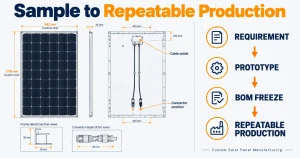
How to Order Custom Solar Panels — The Actual Process
I’ll walk you through this step by step, because the process is less mysterious than most manufacturers make it seem.
- Define your requirements. Fill out a specification sheet covering: dimensions, voltage, wattage target, backsheet material, connector type, quantity, target market, and branding needs. Don’t have a template? Ask Sungold for one — they’ll send it within hours.
- Request a quotation. Send your spec sheet to the manufacturer. Sungold typically responds within 24 hours with pricing, feasibility notes, and recommended modifications. (Sometimes a small design tweak can save 15% on cost — a good manufacturer will tell you this.)
- Review the design layout. You’ll receive a CAD drawing showing cell arrangement, dimensions, junction box placement, and connector routing. Plus an electrical schematic. Review carefully — changes after this stage cost time and money.
- Approve and produce samples. Sample production takes 7–15 days. You’ll receive 1–5 prototype units for testing. Test them thoroughly — electrical performance, mechanical fit, environmental exposure if possible.
- Confirm mass production. Standard timelines: 15–30 days for existing tooling, 45–60 days for new tooling projects.
- Quality control and shipping. Expect 100% EL testing, IV curve testing, and visual inspection. Sungold provides test reports with each shipment.
One thing I always tell new buyers: don’t rush the sample approval stage. An extra week of testing here can save you months of dealing with field failures later. The sample is your insurance policy — use it.
Frequently Asked Questions
Solar panels can be customized across ten dimensions: size, wattage, voltage, cell type, shape, color, backsheet material, connector type, encapsulation/lamination method, and OEM branding. The specific range for each parameter depends on the manufacturer's capabilities and your order quantity. Sungold Solar supports all ten dimensions with MOQ from 100 pieces for standard customizations.
It depends on complexity. Standard customizations — changing voltage, dimensions, or connector type on an existing platform design — start at 100 pieces at Sungold. Full custom designs requiring new tooling or molds typically start at 500 pieces. Some manufacturers require 1,000+ pieces minimum, so always confirm MOQ before investing time in design discussions.
Typical timelines: Samples/prototypes: 7–15 days. Standard custom orders: 15–30 days. New tooling projects: 45–60 days. Add 4–8 weeks if you need certification for a new model. Sungold guarantees a 30-day turnaround for repeat orders on existing specifications. First-time orders with new designs should plan for 60–90 days total from initial inquiry to shipment.