 EN
EN
 Deutsch
 Italiano
 Español
 Français
 日本語
日本語
What Are "Lightweight Solar Panels" Compared to Traditional Glass Panels?
Before comparing anything, the category boundaries need to be clear — because "lightweight" gets applied to three genuinely different things in the market right now. The phrase lightweight solar panels vs traditional glass panels covers a wide spectrum, and confusing the categories leads to real procurement mistakes.
- Definition: three technology paths, not one
- Polymer-composite / frameless laminates — replace tempered glass and aluminum frame with ETFE or polymer-composite frontsheets and flexible backsheets. Mass per square meter typically 2.5–5 kg/m². Examples include adhesive-mounted flexible panels for RV roofs, van builds, and low-load commercial surfaces. Thin-glass lightweight framed modules — use 1.6–2 mm reinforced glass instead of 3.2 mm tempered glass, retain aluminum frame, reduce module weight to roughly 6–9 kg/m² while keeping the racking compatibility of standard modules. Increasingly common in commercial BIPV and low-load industrial roofing. Traditional glass-framed modules (baseline) — 3.2 mm tempered glass front, aluminum frame, typically 10–14 kg/m² for single-glass, 16–20 kg/m² for double-glass.
The reason this distinction matters for B2B buyers: the three categories have different racking systems, different fire classification pathways, different warranty structures, and different end-of-life handling requirements. Treating them as one "lightweight" bucket leads to misspecification.
Lightweight solar panels vs traditional glass panels: three technology paths, one decision framework
The comparison is not "flexible vs rigid" or "new vs old." It is a structured choice across three product categories with different weight profiles, mounting systems, fire ratings, and warranty structures. Getting the category right first makes the rest of the comparison tractable.
Module weight vs installed system weight: why B2B quotes must use the second number
Module-only weight appears on every product page. Installed-system weight — the number a structural engineer signs off on — includes racking rails, clamps, grounding hardware, and for non-penetrating flat-roof systems, ballast blocks. A lightweight module on a ballasted flat-roof installation may carry less system weight advantage than the datasheet headline implies, because the ballast required to resist wind uplift partially offsets the module's mass reduction. We will come back to this in the exclusive insight section. For now: always ask suppliers for installed system kg/m² alongside module kg/m².
How Much Lighter Are Lightweight Solar Panels Than Traditional Glass Panels?
The difference is real and significant — but context-dependent. Here are published and publicly available reference ranges, not marketing assertions.
| Technology category | Typical module-only weight (kg/m²) | Frontsheet material | Frame | Primary application fit |
|---|---|---|---|---|
| Polymer-composite / ETFE laminate | 2.5–5 kg/m² | ETFE or polymer composite | None (adhesive or bonded mount) | RV roofs, van/boat builds, low-load curved commercial surfaces |
| Thin-glass lightweight framed | 6–9 kg/m² | 1.6–2 mm reinforced glass | Aluminum (lighter section) | Low-load flat commercial roofs, BIPV, retrofit where racking is preferred |
| Standard single-glass framed | 10–14 kg/m² | 3.2 mm tempered glass | Aluminum | Residential rooftop, ground-mount, commercial standard projects |
| Double-glass (bifacial, frameless) | 16–22 kg/m² | 3.2 mm tempered glass front and back | None or aluminum | Utility-scale, BIPV with bifacial gain, agrivoltaics |
For a flat commercial roof project targeting 200 kWp, the difference between 3 kg/m² polymer-composite and 12 kg/m² standard glass translates to roughly 160–170 tonnes less static load before any racking is added — enough to avoid structural reinforcement on many post-2000 light-industrial buildings. That is real money, not a marketing claim.
I've found that when buyers compare using module-only figures without accounting for the racking or adhesive system, the apparent weight advantage narrows considerably in practice — sometimes by 30–40% on ballasted flat-roof configurations. Always get the system-level figure in writing from your installer or EPC contractor before finalizing product selection.
How Do Lightweight and Glass Panels Compare on Efficiency and Power Density?
Efficiency is where the conversation gets more nuanced than most comparison articles acknowledge. The gap has narrowed significantly in recent years, but it has not closed uniformly.
Premium polymer-composite lightweight modules using high-efficiency monocrystalline cells — including designs like the Sungold PA219 series with cell efficiency above 25% — operate in the same efficiency tier as many standard glass-framed monocrystalline products. The module efficiency (watts per square meter of panel area) will differ from cell efficiency, but the gap between lightweight and glass modules in this tier is now measured in single-digit percentage points, not the 5–8 point gap that was typical a decade ago.
Budget polymer or thin-film lightweight products are a different matter. Amorphous silicon thin-film still runs 6–10% module efficiency. Early CIGS flexible designs are in the 12–14% range. If you are comparing these against a 21–23% monocrystalline glass module, the lightweight panel requires roughly 2–2.5× the roof area for the same kWp output. That has system implications for string count, inverter sizing, and cable runs that show up in BOS cost, not just the module price per watt.
The same kWp installed: what changes between lightweight and glass
For a fixed generation target, higher-efficiency glass modules require fewer panels, shorter string runs, and typically one fewer MPPT input on the inverter. Lower-efficiency lightweight panels may require a second inverter or a more complex DC wiring layout. These are not showstoppers, but they add to the installed cost and must be modeled before comparing $/W module prices in isolation. My experience is that the module price comparison is almost always the number buyers start with — and the system BOS comparison is the number that decides actual project economics.
How Do Installation Cost, Labor, and BOS Differ Between Lightweight and Glass Panels?
Installation economics are where lightweight panels often make their strongest legitimate case — but only under the right mounting conditions.
Adhesive-mounted polymer laminates: where the labor case is strongest
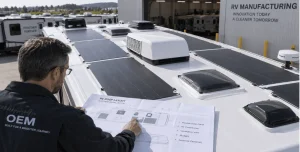
For RV roofs, van conversions, and boat decks, adhesive-bonded lightweight panels eliminate drilling, sealant patches, and racking hardware entirely. The labor time per panel drops significantly. For a professional mobile-build installer doing 50+ vehicles per year, that time saving compounds into meaningful margin improvement. This is the use case the technology was genuinely designed for, and the labor-cost argument holds.
For flat commercial roofs, the picture is more mixed. Adhesive mounting on a TPO or EPDM membrane requires surface compatibility testing, controlled application temperature, and in many jurisdictions, warranty sign-off from the membrane manufacturer. A membrane warranty void triggered by incompatible adhesive is a real project risk that rarely appears in lightweight panel marketing materials. Racking with ballast avoids this risk but, as discussed below, reintroduces weight.
Logistics and transit: underrated cost factor
Lightweight modules ship at higher panel count per pallet and lower breakage risk versus glass-framed modules. For distributors and fleet operators, this reduces per-panel freight cost and eliminates glass-breakage write-offs that are a consistent line item in the P&L for standard module distribution. A 200-panel order of 3 kg/m² composite panels ships in roughly half the pallet space of an equivalent glass-framed order. That is a procurement and logistics advantage that rarely appears in efficiency comparisons but appears clearly in quarterly freight invoices.
How Do Durability, Warranty, and End-of-Life Compare?
Durability and warranty are where traditional glass-framed modules hold their clearest structural advantage — for now.
Standard glass-framed modules carry decades of field data, standardized IEC 61215 qualification test history, and performance warranties that in Tier 1 products commonly run 25–30 years.[1] The tempered glass frontsheet provides physical protection against hail, tools, debris, and UV at a level that polymer frontsheets generally do not match without specific reinforcement engineering.
For lightweight polymer-composite panels, the product warranty (workmanship) is typically shorter — 5–10 years in current market tiers. Performance warranties vary more widely. The failure modes also differ: glass modules fail primarily through cell degradation, junction box aging, and frame corrosion over decades; lightweight laminates are more vulnerable to edge seal integrity, encapsulant delamination, and adhesive bond-line stress, often within the first five years if installed incorrectly.
The detailed failure mode analysis for flexible and lightweight panels is in the third article in this cluster on lifespan, degradation, and warranty — the short version: installation boundary conditions drive lightweight panel lifespan more than cell technology does.
End-of-life: an honest comparison
Aluminum and glass from conventional framed modules fit into established recycling streams. Aluminum has high recovery value; tempered glass is recyclable though the mixed-glass composition makes high-value reuse harder than it sounds. Polymer-composite laminates currently have fewer established recycling pathways. Most end-of-life lightweight laminates go to landfill or are returned to specific manufacturer programs. For B2B buyers with sustainability reporting obligations, this is a real question to ask suppliers before purchase, not during decommissioning.
Why Lightweight Panels Sometimes Add System Mass on Flat Roofs
This is the section most lightweight-panel comparison guides skip — because it complicates the headline message. But if you are specifying a non-penetrating flat-roof system, you need to understand it.
Installed-system weight: what belongs in the denominator
On a pitched residential roof, racking is anchored to the structure. The panel weight is the dominant variable, and lighter panels genuinely reduce roof load. On a flat commercial roof with a waterproof membrane, penetrating the roof for anchors is often contractually prohibited or technically undesirable. The alternative is a ballasted racking system: the panels sit in tilt frames held down by concrete or paver blocks that provide the dead weight resisting wind uplift.
Wind uplift force is governed by panel area, wind zone, roof exposure category, and edge-zone multipliers — not by panel weight. A 2 kg/m² lightweight panel and a 12 kg/m² glass module produce approximately the same uplift force from the wind acting on the same surface area in the same wind zone. The ballast required to counteract that uplift is the same. The lightweight panel's weight saving is real; the wind does not care about the panel's weight at all.
When adhesives beat ballast — and when they do not
Adhesive mounting avoids the ballast requirement entirely, which is why it is the correct solution for many lightweight laminate applications. But adhesive mounting on a flat commercial roof has its own constraints: membrane compatibility, application temperature window, long-term creep under thermal cycling, and in some jurisdictions, code authority (AHJ) acceptance. Where adhesives are approved and membrane-compatible, they are the most weight-efficient solution. Where they are not — or where the membrane manufacturer voids its warranty for adhesive-bonded solar — ballast re-enters the equation and the lightweight advantage narrows.
The procurement question that separates marketing from engineering
Ask this specific question to any supplier or EPC contractor pitching lightweight panels for a flat-roof project: "What is the total installed system weight per square meter, including racking or adhesive system and any required ballast, for your proposed design in our specific wind zone?" If the answer starts with the module-only kg/m² from the brochure, the engineering work has not been done yet. If it comes back with a site-specific uplift calculation, you are talking to someone who understands the project.
I've seen two projects where the shift from glass to lightweight modules was made on the basis of module-only weight — and in both cases, the wind zone triggered enough ballast to bring the installed system weight back within 15% of the glass-module baseline. The lightweight panels still made sense on logistics and installation speed, but the structural load argument that initially sold the decision was largely neutralized. The right decision was still made for the wrong reason. That is an uncomfortable place for a B2B project to land.
How Do Fire Safety and Building Code Pathways Differ?
Fire classification for solar modules is determined by a combination of module construction and the mounting system it is installed on — not the module alone. This distinction matters significantly for commercial and multi-occupancy building applications.
IEC 61730-2 defines fire testing for PV modules, including fire class (Class A, B, C in the context of the fire test — not the US building code A/B/C which has different criteria).[2] In practice, most project specifications and building code applications require the combined system — module plus mounting — to achieve a specific fire rating. A module with a Class C fire certification alone does not automatically qualify the entire roof assembly; the system must be tested or evaluated together in many jurisdictions.
Polymer-composite lightweight modules have made meaningful progress on fire classification — the PA219 Series, for example, achieves a Class C fire rating under IEC 61730-2 with its polymer composite construction. For applications where Class A fire-rated roof assemblies are required (common in US commercial buildings under the IBC code pathway), verify the complete mounting system certification, not just the module certification, with the authority having jurisdiction (AHJ) before specifying.
Traditional glass-framed modules have a longer history of fire classification approvals in certified racking systems. If fire code compliance is a critical project constraint, confirm the complete system certification pathway before selecting technology — not after the equipment is on site.
Which Applications Favor Lightweight Panels vs Glass Panels?
The comparison is not one versus the other in the abstract — it is about matching technology to application. Here is the honest split.
| Application | Lightweight laminate fit | Glass-framed module fit | Deciding factor |
|---|---|---|---|
| RV and camper van roofs | Strong — weight, profile, curved surface, adhesive mounting | Poor — too heavy, rigid, drilling required | Structural load and surface geometry |
| Sailboat and motor yacht decks | Strong — IP-rated, salt-fog tested, lightweight, curved mount | Poor — weight, fragility at sea, no curved mounting | Marine environment and hull load |
| Low-load flat commercial roof (<15 kg/m² available) | Good — reduces structural concern; adhesive or ballasted | Marginal to poor — may require structural upgrade | Available roof load capacity |
| Residential pitched roof (new build or strong structure) | Competitive if aesthetics/profile matters; otherwise over-specified | Strong — bankability, standard racking, longest warranties | Finance/bankability requirements and warranty length |
| Ground-mount utility scale | Poor — no structural advantage; glass wins on W/$ and warranty | Strong — lowest LCOE, longest bankable history | Cost per kWh over project life |
| High wind zone flat roof (non-penetrating) | Conditional — ballast paradox applies; validate system kg/m² | Neutral — same ballast requirement applies | Installed system weight after ballast calculation |
| Commercial fire-code-sensitive installation | Conditional — confirm system fire rating and AHJ pathway | Better established — longer approval history in most jurisdictions | Jurisdiction-specific fire code and AHJ requirements |
For portable and off-grid deployments — temporary structures, emergency response, agricultural monitoring — lightweight laminates have a clear advantage in deployability and transport. For bankable long-term power purchase agreements, traditional glass-framed modules with 25-year performance warranties from established manufacturers remain the safer procurement choice. Choosing the right column in this table is the job; the technology itself is not the decision.
What Should a B2B RFQ Include When Comparing Lightweight vs Glass Module Suppliers?
A purchasing specification that relies on module brochures will produce inconsistent results. Here is what a defensible lightweight vs glass comparison includes at the RFQ stage.
- Installed system kg/m² — module plus mounting system plus ballast at your specific wind zone (not module-only from datasheet)
- Applicable IEC test reports — for lightweight: confirm which standard applies (IEC 61215, IEC 61730, or consumer PV standard IEC 63163 for portable/consumer applications); for glass: confirm current-edition IEC 61215 qualification
- Fire classification documentation — module fire class plus confirmation that the proposed mounting system as a combined assembly meets project code requirements
- Membrane manufacturer compatibility confirmation — for adhesive-mounted flat-roof applications; required to maintain membrane warranty
- Both warranty documents in writing — product warranty (workmanship, defects) and performance warranty (output over time) as separate PDFs with explicit exclusion clauses
- End-of-life handling — supplier's stated take-back or recycling program for the specific product; ask for documentation, not verbal commitment
- Batch traceability requirements — cell origin, encapsulant lot, lamination date; necessary for warranty claim forensics and quality audit
- Reject: specifications that compare module-only weight without system-level validation
- Reject: fire classifications cited without confirming the mounting system is included in the rating
My experience is that suppliers who can produce all of these documents within a standard business proposal turnaround — typically 5–7 business days — are operating at the quality level where procurement risk is manageable. Those who cannot locate the fire classification certificate and the membrane compatibility letter together are telling you something about their documentation maturity that will matter at the first insurance or warranty claim.
What Is the Bottom Line on Lightweight Solar Panels vs Traditional Glass Panels?
Lightweight solar panels vs traditional glass panels is a genuinely useful comparison — when it is done at the system level, not the module-brochure level.
Lightweight polymer-composite and thin-glass laminates offer real advantages in weight-constrained, curved, or mobile applications: they make projects possible that glass cannot serve at all. The logistics and labor arguments are real and measurable. The efficiency gap versus premium glass modules has narrowed to the point that it is no longer a category-level objection for mid-tier to premium lightweight products.
Traditional glass-framed modules retain structural advantages in bankability, warranty length, established fire certification pathways, and total cost of ownership at scale for fixed ground and roof installations where structural capacity is not a constraint.
The ballast paradox, fire code system requirements, and membrane compatibility are the three areas where lightweight-panel projects most commonly encounter specification problems that were not visible during the initial comparison. Plan for all three before committing to a technology choice.
For specifications on our lightweight flexible laminate range — including the PA219 Series (TÜV/CSA certified, Class C fire rated, 3.3 kg/m²) and the TF Series (IP68, step-on rated, ETFE frontsheet) — datasheets and certification documentation are available on the flexible and lightweight solar panel product page.
Frequently Asked Questions: Lightweight vs Glass Solar Panels
Are lightweight solar panels as good as traditional glass panels?
They are better for weight-constrained, curved, or adhesive-mounted applications, and competitive on efficiency in premium lightweight crystalline designs. Traditional glass-framed modules still dominate where maximum bankability, longest performance warranties, and standardized racking economics matter. "Good" depends on roof load, code pathway, wind zone, and target LCOE — not a universal ranking.
How much lighter are lightweight solar panels than traditional glass panels?
Published lightweight crystalline or composite modules often land roughly 50–75% lower mass per square meter than conventional glass-framed modules, depending on whether the baseline is single-glass or double-glass construction. Always compare datasheet values for the same module area and include mounting hardware, ballast, or adhesive system mass for installed projects — not module-only figures from marketing pages.
Which lasts longer — lightweight solar panels or glass solar panels?
Glass-framed modules typically carry longer industry-standard performance warranties and a longer track record in fixed utility and rooftop fleets. Lightweight polymer or adhesive-mounted systems can match or exceed useful life when installed with correct thermal management and edge sealing, but failure modes differ. Compare product warranty, performance warranty, IEC test evidence, and the supplier's field history for your specific mounting method.