


 EN
EN
 Deutsch
 Italiano
 Español
 Français
 日本語
日本語
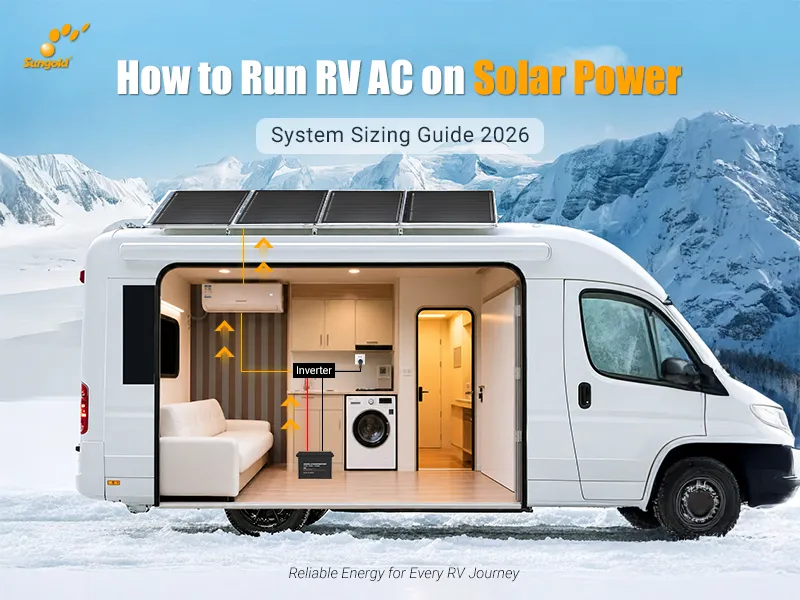
Running a 13,500 BTU RV air conditioner on solar requires: a 2,000–3,000W pure sine wave inverter, at least 200Ah LiFePO4 battery (preferably 300–400Ah for sustained use), 800W–1,200W solar panels, and — critically — a soft starter to cut the compressor's startup surge from ~3,200W down to under 1,200W. Without a soft starter, most inverters trip on AC startup even when they're technically large enough for the running load.
The single biggest mistake people make: sizing the inverter for the AC's running watts and ignoring the startup surge. That 3-second spike is what actually determines whether your system works or doesn't.
Every summer, the forums fill up with the same frustrated question: "I have 600W of solar and a 2,000W inverter — why won't my RV AC start?" The people asking usually aren't wrong about their panel wattage or their inverter rating. They've just run into the physics of an air conditioner compressor: it needs three to four times its running current for about one second every time it kicks on, and most systems aren't built to handle that.
This guide explains how to size a system that actually works — running AC during the hottest part of the day, in a typical campsite away from hookups, without a generator running in the background. It's doable. But the math has to be right from the start.
If you haven't sized your overall system yet, start with the RV solar panel size calculator — it'll give you the baseline numbers before you add AC into the equation.
What Your RV Air Conditioner Actually Draws
The number on the AC unit's label — 13,500 BTU, 15,000 BTU — tells you cooling capacity, not power draw. You need the wattage numbers, which are usually buried in the spec sheet rather than stamped on the unit itself.
| AC Unit Size | Running Watts | Startup Surge (no soft starter) | Startup Surge (with soft starter) | Typical RV Type |
|---|---|---|---|---|
| 9,000 BTU | 700–900W | 1,800–2,200W | 700–1,000W | Small Class B van, teardrop |
| 11,000 BTU | 1,000–1,200W | 2,200–2,800W | 900–1,200W | Pop-up campers, small travel trailers |
| 13,500 BTU | 1,200–1,500W | 2,800–3,500W | 900–1,400W | Most Class C, mid-size travel trailers |
| 15,000 BTU | 1,600–1,900W | 3,200–4,200W | 1,200–1,700W | Class A motorhomes, large 5th wheels |
| Dual 13,500 BTU | 2,400–3,000W | Up to 7,000W (simultaneous) | 1,800–2,800W (staggered) | Large Class A (front + rear AC) |
The surge numbers in that third column are what kills most DIY solar-AC setups. A 13,500 BTU unit drawing 3,200W on startup will trip a 2,000W inverter every single time, even though the unit only needs 1,400W once it's running. Without understanding this distinction, you'll spend money on more panels and batteries and still watch the inverter fault light blink at you.
Inverter-Driven ACs: The Solar-Friendly Option
It's worth knowing that not all RV air conditioners work the same way. Traditional fixed-speed compressor units are what create the brutal startup surge. Variable-speed compressor units — commonly called "inverter ACs" (a different use of the word "inverter" than your DC-to-AC inverter) — ramp up gradually. They're 30–50% more power-efficient when running, they have dramatically lower startup draws, and they're far better suited to solar operation.
If you're buying a new unit specifically to run on solar, look at the Dometic FreshJet 3, the Coleman Mach 15+, or the Furrion Chill variable. These units cost more upfront, but they make the battery and inverter sizing much more manageable. The Dometic FreshJet 3 at 13,500 BTU draws about 980W running and surges to only about 900W — no soft starter required for most 2,000W+ inverter setups.
The Soft Starter: The Single Most Impactful Upgrade
If you already have a traditional fixed-speed RV AC and want to run it on solar, a soft starter is not optional — it's the component that makes the whole thing possible without buying a massive inverter.
A soft starter (the two main RV-specific options are the Micro-Air EasyStart and the SoftStartRV) installs inside the AC unit's electrical compartment and replaces the capacitor assembly. Instead of slamming the compressor from 0 to full speed in one inrush, it ramps the motor up over 2–3 seconds. The result is a startup current that's 50–65% lower than stock.
| Scenario | Startup Draw | Inverter Needed | Battery Stress |
|---|---|---|---|
| 13,500 BTU — no soft starter | 3,200–3,500W peak | 4,000W+ (or runtime faults) | High — large instantaneous current spike |
| 13,500 BTU — with soft starter | 900–1,400W peak | 2,000–3,000W is sufficient | Moderate — gradual ramp-up |
| Variable-speed inverter AC | 600–1,000W peak | 2,000W sufficient | Low — no significant surge |
Installation takes about an hour for someone comfortable with basic electrical work. The unit's wiring compartment is accessed by removing a panel on the AC shroud, and the soft starter wires in between the capacitor and the compressor terminals. Both Micro-Air and SoftStartRV include detailed instructions and are a direct replacement.
Battery Sizing: The Part That Determines How Long the AC Runs
Solar panels recharge your batteries, but it's the battery bank that actually powers the AC moment-to-moment. Getting battery sizing right is where most people either overestimate (building a bank way heavier and more expensive than needed) or underestimate (running out of power mid-afternoon).
The Core Calculation
Example: 1,400W × 4 hours ÷ 0.95 ÷ 1.0 = 5,894 Wh → ~492 Ah at 12V
Or at 24V: 246 Ah — which is more practical for wiring
That example shows why full-day AC operation from batteries alone is expensive. A realistic solar-powered AC setup isn't "run the AC for 8 hours from stored power." It's "run the AC during the day while the panels are actively recharging what you're using." The math shifts dramatically when you account for simultaneous solar input.
Solar Input Offsetting Battery Draw
Example: 1,400W AC − (800W panels × 0.85) = 1,400 − 680 = 720W net drain
At 720W net drain, a 200Ah 12V battery (2.4 kWh) lasts: 2,400 Wh ÷ 720W = 3.3 hours
Compare that to running the AC without any solar: the same 200Ah battery would last only 1.5–1.6 hours. The solar isn't running the AC by itself — it's cutting the net drain rate in half, which doubles your runtime. That's the real value of the solar + battery combination.
| Battery Bank | Usable Energy | AC Runtime (No Solar) | AC Runtime (800W Solar) | Suitable For |
|---|---|---|---|---|
| 100Ah LiFePO4 @ 12V | 1.2 kWh | ~0.8 hours | ~1.7 hours | Very limited AC use / testing |
| 200Ah LiFePO4 @ 12V | 2.4 kWh | ~1.6 hours | ~3.3 hours | Occasional afternoon use |
| 300Ah LiFePO4 @ 12V | 3.6 kWh | ~2.4 hours | ~5 hours | Regular daytime AC use |
| 200Ah LiFePO4 @ 24V | 4.8 kWh | ~3.2 hours | ~6.7 hours | Extended daytime use, larger rigs |
| 200Ah LiFePO4 @ 48V | 9.6 kWh | ~6.4 hours | Full day daytime use | Full-time AC use, serious off-grid rigs |
One more thing worth understanding: lead-acid batteries are not suitable for AC-load applications. The high discharge rates from inverter loads accelerate sulfation and significantly shorten battery life. Even AGM lead-acid — which tolerates higher discharge rates than flooded — will degrade quickly under repeated AC cycling. LiFePO4 is the practical choice for any serious solar-plus-AC setup.
Solar Panel Sizing for AC Use
Here's the part that surprises people: you don't need a massive solar array just to run the AC. You need enough panels to meaningfully offset the draw while the AC runs, and enough to recharge the battery bank during peak sun hours before the AC kicks on for the afternoon.
Example: 1,400W ÷ 0.85 = ~1,650W of panels to fully offset a 13,500 BTU AC during peak sun
Practical recommendation: 800–1,200W for partial offset + battery buffering (most RV roofs can't fit 1,650W anyway)
Full offset requires a lot of panels — more than most RV roofs can fit. The practical approach is partial offset: size your panels to cover 50–70% of the AC load, let the battery bank handle the balance, and count on recharging during any gaps in AC use. This is why panel efficiency matters more for AC setups than for general RV use — you're working with a fixed roof area, and every extra watt per square foot from a higher-efficiency panel directly translates to more AC runtime.
| Roof Space Available | Recommended Configuration | AC Offset During Peak Sun | Notes |
|---|---|---|---|
| ~50 sq ft (small Class C) | 2 × 200W = 400W | ~27% offset | Minimal; heavily battery-dependent |
| ~80 sq ft (mid Class C) | 4 × 200W = 800W | ~55% offset | Good for a few hours daytime AC |
| ~100 sq ft (Class A rear) | 4 × 200W + 2 × 100W = 1,000W | ~68% offset | Solid system for regular AC use |
| ~140 sq ft (large Class A) | 6 × 200W = 1,200W | ~82% offset | Very capable; suitable for dual AC with staggering |
If your roof has a partial curve or obstacles around the AC shroud, anti-shading panels are worth serious consideration. A traditional series-wired string drops significantly when even one panel is shaded by the AC shroud shadow — Sungold Solar's anti-shading solar panels use bypass diode architecture that keeps unshaded cells at full output even when adjacent cells are partially shaded.
Inverter Selection: Why It Matters More Than Most Guides Admit
The inverter is the most failure-prone component in a solar-AC system, and it's also the one where buying cheap causes the most headaches. For AC use specifically, you need to pay attention to three specifications — not just the nameplate wattage.
The Three Numbers That Matter
- Continuous power rating: Must exceed the AC's running watts. For a 13,500 BTU unit at 1,400W, any inverter rated 2,000W+ continuous is fine here.
- Surge/peak power rating: This is what determines whether startup works. A 2,000W inverter with a 4,000W surge rating (common for quality units) can handle even an unmodified AC's startup. A 2,000W inverter with only a 3,000W surge rating may fault. Always check this spec.
- Output waveform: Must be pure sine wave. No exceptions. Modified sine wave units will cause the AC compressor motor to overheat, make the unit hum, and shorten its lifespan — and some units won't start at all.
| Inverter Size | Without Soft Starter | With Soft Starter | Recommendation |
|---|---|---|---|
| 1,500W pure sine | Won't start 13,500 BTU | May work, but very marginal | Not recommended for standard AC |
| 2,000W pure sine | Will fault on startup surge | Works well with soft starter | Minimum with soft starter installed |
| 3,000W pure sine | May start small/efficient AC | Works reliably; good headroom | Best choice for 13,500 BTU with SS |
| 4,000W+ pure sine | Handles startup surge without SS | Overkill but very reliable | Required for 15,000 BTU or dual AC |
System Voltage: 12V vs 24V vs 48V
This is a practical wiring question as much as an efficiency one. At 12V, a 2,500W inverter draws over 200A continuous — which requires 4/0 AWG cable for any run longer than a few feet. That's expensive, heavy cable that's hard to work with. At 24V, the same 2,500W load draws only about 104A, which is manageable with 2 AWG cable. At 48V, it's only 52A — even easier.
If you're designing a new system specifically around AC use, 24V is the practical minimum that most people should consider. 48V is ideal for larger rigs with dual AC or heavy overall loads. For existing 12V systems adding AC capability, it works — just be very deliberate about cable sizing and keep the inverter physically as close to the battery as possible.
Real-World System Examples
Scenario 1: Class C with 13,500 BTU, Occasional Summer Use
- AC: Stock 13,500 BTU unit + Micro-Air EasyStart soft starter installed
- Inverter: 3,000W pure sine wave (Renogy, Victron, or equivalent)
- Battery: 300Ah LiFePO4 @ 12V (3.6 kWh) — two 150Ah batteries in parallel
- Solar: 4 × 200W rigid panels = 800W (fits on most Class C roof after AC shroud clearance)
- Controller: 60A MPPT (handles 800W @ 12V with headroom)
- Net result: Can run AC ~3.5–4.5 hours using combined solar input + battery, full recharge by mid-morning next day under good sun
- Estimated cost: ~$3,500–4,500 for the full system (panels + batteries + inverter + controller + soft starter)
Scenario 2: Travel Trailer with 13,500 BTU, Full-Time Living
- AC: Upgraded to Dometic FreshJet 3 variable-speed (no soft starter needed)
- Inverter: 2,000W pure sine wave (variable-speed AC has low surge)
- Battery: 400Ah LiFePO4 @ 24V (9.6 kWh) — two 200Ah 24V batteries
- Solar: 6 × 200W = 1,200W
- Controller: 60A MPPT @ 24V
- Net result: Sustainable daytime AC use in most US climates below 105°F; requires generator backup on multi-cloudy days or peak summer heat in Phoenix/Las Vegas
- Estimated cost: ~$6,000–8,000 (variable-speed AC upgrade is the biggest cost driver)
Scenario 3: Class A Motorhome, Dual 13,500 BTU AC
- AC: Front + rear 13,500 BTU, both with soft starters; units staggered by 45 seconds on startup
- Inverter: 5,000W pure sine wave (or 2 × 3,000W in parallel configuration)
- Battery: 600Ah LiFePO4 @ 48V (~28.8 kWh) — custom build or pre-built rack
- Solar: 8 × 200W = 1,600W on large Class A roof
- Controller: 2 × 60A MPPT @ 48V
- Notes: Running both ACs simultaneously all day is impractical — use front AC for travel, rear AC for living, alternating based on where you're spending time
- Estimated cost: $10,000–15,000 — serious investment, but enables true extended boondocking in summer
Why Your RV AC Won't Start on Solar (Troubleshooting)
If you already have a system and the AC refuses to start, here's where to look first — in order of most to least common cause:
- Startup surge exceeds inverter peak capacity. Most common cause by far. Test: use a clamp meter on the AC cable during startup and compare the peak to your inverter's surge spec. Fix: add a soft starter to the AC unit, or upgrade the inverter.
- Low battery voltage during startup. Even if the battery is at 50% state of charge, the voltage sag when the inverter draws surge current can dip below the inverter's low-voltage cutoff, causing it to shut down. Fix: add battery capacity, or reduce other loads before starting the AC.
- Inverter cable undersized. A 2,000W inverter drawing 200A at 12V through undersized cable will suffer so much voltage drop that the inverter faults. Fix: use proper AWG sizing — typically 2/0 AWG at minimum for 12V 2,000W+ inverters, kept as short as possible.
- Modified sine wave inverter. AC compressors often won't start at all on modified sine wave. Fix: replace the inverter with a pure sine wave unit.
- Inverter temperature shutdown. Inverters in enclosed cabinets on hot days can thermal-fault during high-load startup. Fix: mount the inverter with ventilation clearance or add a small fan.
When Solar Alone Isn't Enough (And What To Do About It)
There are honest limits to what solar can do for air conditioning, and ignoring them leads to systems that fail in the exact conditions you most need them.
Full-time summer use in extreme heat climates — Phoenix in August, Houston in July — means the AC may need to run 10+ hours continuously. The battery drain during overnight use alone is more than most mobile systems can practically store and recharge in a single day. This isn't a solar equipment problem; it's the physics of air conditioning in extreme heat.
The practical solution most full-time boondockers use isn't "more panels" — it's a hybrid solar + generator system. The generator runs a few hours per day during peak heat or cloud cover, and solar covers the rest. A 2,000W generator running 3–4 hours uses far less fuel than running 8 hours, and the total system cost is significantly lower than the battery bank that would be needed to eliminate the generator entirely.
For the wiring and control side of a hybrid system, see the complete RV solar wiring guide — it covers transfer switching and charge priority configuration for solar + generator setups.
Tips That Make a Real Difference
- Park in shade whenever possible. Obvious, but it matters enormously. Parking under trees or next to a building can cut AC runtime needs by 40–60% — which is the equivalent of doubling your battery capacity for free.
- Use reflective roof covers. An RV roof in direct Arizona sun hits 150–170°F. A roof cover or reflective coating can reduce this by 40°F and meaningfully cut the AC's duty cycle.
- Pre-cool before going off-grid. If you're on hookups the night before a boondocking day, cool the RV down significantly before disconnecting shore power. The thermal mass of the cooled interior buys you an extra hour before the AC needs to cycle on.
- Seal roof and window leaks. An RV with poor weatherstripping lets cool air escape constantly. Fixing air leaks is often more effective than adding another panel.
- Set the thermostat strategically. The difference between 72°F and 78°F inside can cut AC runtime by 30–40% in moderate outside temperatures. On solar, that's the difference between a system that works and one that doesn't.
- Use a fan in low-demand periods. Ceiling fans on DC power draw 30–50W versus the AC's 1,400W — keeping air moving between AC cycles extends the time you can go before the AC needs to kick on again.
For a detailed comparison of which solar panels work best in space-constrained RV roof applications, see our guide on best solar panels for RV roof 2026 — it covers efficiency per square foot rankings with specific attention to high-load applications like AC use.
PA621 Series — Vibration-Resistant Lightweight RV Panel
Cell-level shade management (Shade-Smart™) and Cool-Back™ thermal backing. Designed specifically for RV rooftops with shading from AC units, antennas, or trees.
- Available 100W–220W per panel
- Ultra-lightweight; reinforced for road vibration
- OEM/ODM custom sizes available
PA219 Series — TÜV/CSA Certified Flexible Panel (100W–490W)
3mm thin, 3.3 kg/m² ultra-lightweight ETFE flexible panel. Bonds to curved RV roofs without brackets. Class C fire-rated, salt mist certified, 10-year warranty.
- Voc range 28V–47.3V (100W–490W)
- Max system voltage 1,500V DC (IEC)
- TÜV & CSA certified
SGM Series — TÜV & UL Certified Rigid Glass Panel
High-efficiency rigid monocrystalline panel for flat-roof RV installations. Best efficiency, 25+ year lifespan, ideal for trailers and large motorhomes with bracket mounting space.
- TÜV & UL dual certified
- 21–23% module efficiency
- 25-year linear power warranty
TOPCon Series — N-Type, 26.1% Cell Efficiency
N-type TOPCon technology with <1% first-year degradation and 0.25%/yr thereafter. Zero LID/LeTID. Best choice for space-constrained RV roofs where every watt per square foot counts.
- Pmax temperature coefficient −0.30%/°C
- 10-year product + 25-year power warranty
- MPPT compatible, 12V/24V/48V systems
Related Guides
Frequently Asked Questions
How many solar panels do I need to run my RV air conditioner?
To run a 13,500 BTU RV AC for 4–6 hours per day, you typically need 800W–1,200W of solar panels, a 2,000–3,000W pure sine wave inverter, and 200–300Ah of lithium battery capacity. The exact numbers depend on your AC's efficiency rating, daily sun hours at your location, and whether you've installed a soft starter. The solar doesn't power the AC alone — it offsets the battery draw, which significantly extends how long you can run the unit.
What size inverter do I need to run an RV air conditioner?
At minimum, a 2,000W pure sine wave inverter with a soft starter installed on the AC. A 3,000W inverter is the safer choice because it provides headroom for startup even if conditions aren't perfect — battery at 80%, cables slightly long, temperature-related voltage sag. Never use a modified sine wave inverter with an AC compressor motor.
Does a soft starter really make a difference for running RV AC on solar?
Yes, very significantly. A standard 13,500 BTU AC pulls a startup surge of 2,800–3,500W. A soft starter like the Micro-Air EasyStart reduces that to roughly 900–1,400W. This allows a 2,000W inverter to handle the load that would otherwise require a 4,000W unit. It also reduces voltage sag on the battery and extends the life of both the AC compressor and the inverter. For most people, it's the most cost-effective single upgrade they can make to a solar-AC system.
Can I run RV AC on a 12V system or do I need 24V or 48V?
You can run it at 12V, but the cable sizing requirements become severe — a 2,500W inverter at 12V draws 208A continuous, requiring 4/0 AWG cable for runs over 3 feet. At 24V, the same load draws only 104A, which is much more manageable. For a new system being designed around AC use, 24V is the practical minimum most people should consider. For existing 12V systems, keep the inverter physically as close to the battery bank as possible and use the largest practical cable gauge.
Why won't my RV air conditioner start on solar even though my inverter is rated high enough?
The most common reason is that the inverter's surge (peak) rating is insufficient for the AC startup draw, even if the continuous rating looks adequate. Other causes include: voltage sag from a partially-discharged battery causing the inverter to trip on low-voltage protection; undersized inverter cables causing excessive voltage drop during startup; or a modified sine wave inverter (which won't start most compressor motors reliably). Check the peak/surge spec on your inverter — not just the continuous rating — and confirm your battery is above 80% state of charge before starting the AC.
Sources & Further Reading
RV Solar Panel Size Calculator — Sungold Solar · How to Install Solar Panels on RV — Sungold Solar · Complete RV Solar Wiring Guide — Sungold Solar · Technical references: Dometic FreshJet 3 specifications, Micro-Air EasyStart installation data, Victron Energy inverter peak power documentation, NEC 690 Solar PV Systems, RVIA electrical standards.
Content reviewed for accuracy May 2026. Sungold Solar is a B2B & OEM solar panel manufacturer specializing in flexible, lightweight, anti-shading, and custom RV solar solutions.