


 EN
EN
 Deutsch
 Italiano
 Español
 Français
 日本語
日本語
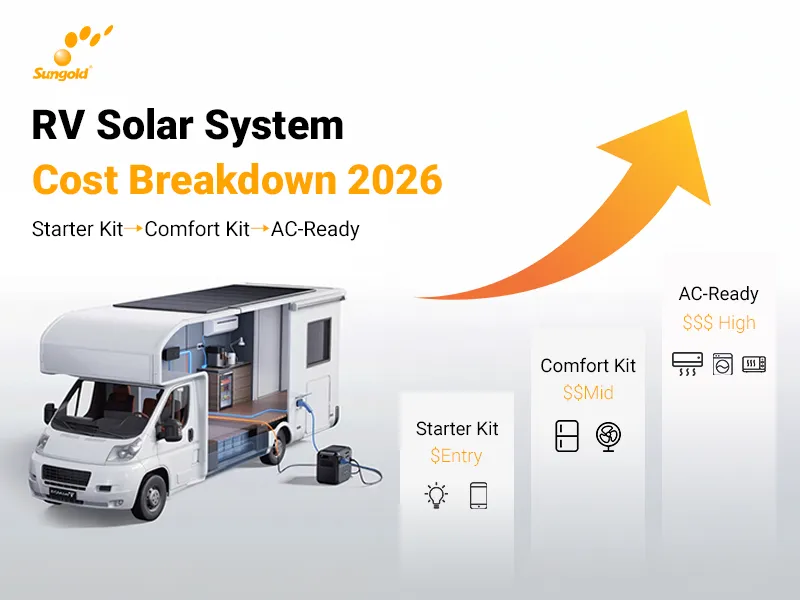
In 2026, a complete RV solar system costs: $800–$1,500 for a starter setup, $2,500–$5,000 for a mid-range full-timer system, $6,000–$12,000 for a high-capacity build, and $10,000–$18,000 for an AC-ready system. The battery bank is almost always the biggest line item—typically 40–55% of total cost. Most people forget that panels are surprisingly affordable; it's everything else that adds up.
Three things most buyers don't expect: (1) hidden wiring and hardware costs add another 15–25% to any quote, (2) cheap lead-acid batteries cost more over 10 years than quality lithium, and (3) solar panel prices hit historical lows in 2026—waiting won't save you more.
Let me be direct about something: most RV solar cost articles are either written by people trying to sell you the cheapest kit on the market or are so vague they're useless. "$500 to $30,000" is technically true and completely unhelpful. This guide breaks down what you'll actually spend at four realistic system sizes, where every dollar goes, what gets left off most quotes, and whether the investment makes financial sense for how you use your RV.
Before diving into costs, if you haven't sized your system yet, start with our RV solar panel size calculator—knowing your wattage and battery target makes every cost number below far more relevant to your situation.
2026 RV Solar Total Cost: 4 System Tiers at a Glance
These are real-world system costs, not "starting from" teaser prices. Each tier is based on 2026 market pricing for quality components—not the cheapest options available, not premium custom installs.
| Tier | Solar Panels | Battery | Inverter | Controller | Wiring / Hardware | Total Range | Best For |
|---|---|---|---|---|---|---|---|
| Starter | 200W rigid mono (1 panel) | 100Ah LiFePO4 (12V) | None (DC only) | MPPT 20–30A | $150–$250 | $800–$1,500 | Weekend trips, phone/fridge/lights only, no AC appliances |
| Mid-Range | 400W rigid (2 panels) | 200Ah LiFePO4 (12V) | 1,000W pure sine wave | MPPT 40A | $250–$450 | $2,500–$5,000 | Full-time vanlife, remote work, microwave / coffee maker briefly |
| Full-Featured | 800W rigid + lightweight (4–6 panels) | 400Ah LiFePO4 (24V) | 3,000W pure sine wave | MPPT 60–80A | $400–$700 | $6,000–$12,000 | Heavy boondocking, induction cooktop, instant water heater |
| AC-Ready | 1,200–1,600W (6–10 panels) | 600–800Ah LiFePO4 | 3,000–4,000W + soft-start | MPPT 80–100A | $600–$1,000 | $10,000–$18,000 | Full-time / hot climate / daily AC use; roof space is the real bottleneck |
Notice that wiring and hardware is listed separately—and intentionally. It's one of the most commonly omitted line items in online estimates. We'll cover it properly in the hidden costs section below.
Where Does Your Money Go? (Component Cost Breakdown)
Here's what surprises almost everyone who hasn't priced out an RV solar system before: solar panels are not the biggest expense. Not even close. The breakdown for a typical mid-range system looks like this:
• Solar panels: 20–30% of total system cost
• Battery bank: 40–55% (the biggest single line item)
• Inverter: 10–15%
• Charge controller: 5–8%
• Wiring, hardware, mounting, installation: 15–25%
That last bullet—wiring, hardware, mounting, and installation—is what most online calculators completely ignore. We address that in its own section. First, let's break down each component.
Solar Panels: The Most Affordable Major Component in 2026
Panel prices have fallen roughly 50% over the past five years, and 2026 prices are near historical lows. This is actually good news that tends to get buried: the most technically sophisticated piece of the system is now the cheapest on a per-watt basis.
| Panel Type | Typical $/W (2026) | 100W Cost Range | 200W Cost Range | Best Application |
|---|---|---|---|---|
| Rigid monocrystalline (standard) | $0.40–$0.70/W | $40–$70 | $80–$140 | Flat roof, permanent install, Class A/C RV |
| Rigid N-Type TOPCon | $0.55–$0.90/W | $55–$90 | $110–$180 | Maximum efficiency where roof space is limited |
| Flexible monocrystalline (standard) | $0.70–$1.10/W | $70–$110 | $140–$220 | Curved roofs, Airstreams, van conversions |
| Flexible (TÜV/CSA certified, premium) | $0.90–$1.40/W | $90–$140 | $180–$280 | Commercial RV, marine, low-load rooftops |
| Portable foldable panels | $1.00–$1.60/W | $100–$160 | $200–$320 | Shade backup, expandable setups, renters |
One thing worth flagging: the cheapest rigid panels (no-name imports at $0.25–$0.35/W) do exist. They tend to have poor temperature coefficients, no meaningful certifications, and degradation rates that eat into their apparent savings within 3–5 years. At current legitimate panel prices, the quality premium is small enough that it rarely makes sense to chase the absolute cheapest option.
Battery Bank: The Biggest Cost—and Where Most Mistakes Happen
This is where budgets blow up. People go online, price out some 200W panels for $120, think "this is going to be cheap"—and then discover the battery they actually need costs $800 before they've bought anything else.
The 10-year total cost comparison is where lead-acid's apparent price advantage completely falls apart:
| Battery Type | Cost per 100Ah (12V) | Cycle Life | Usable DoD | Replacements over 10 yrs | 10-Year Total Cost (100Ah) | Weight |
|---|---|---|---|---|---|---|
| Flooded Lead-Acid | $120–$200 | 300–500 cycles | 50% | ~4–5× | $600–$1,000 (+ maintenance) | ~30 kg |
| AGM Lead-Acid | $200–$350 | 400–700 cycles | 50% | ~3–4× | $800–$1,400 | ~28 kg |
| Gel Lead-Acid | $250–$400 | 500–800 cycles | 60% | ~2–3× | $750–$1,200 | ~28 kg |
| LiFePO4 (Lithium Iron Phosphate) | $600–$1,000 | 3,000–5,000+ cycles | 80–90% | 0–1× | $600–$1,000 (buy once) | ~13 kg |
The numbers are clear: LiFePO4 costs the same or less over a 10-year window as AGM or gel, while offering nearly double the usable capacity per rated Ah, one-third the weight, and zero watering or equalization maintenance. The only scenario where lead-acid makes sense is a very low-budget starter system you expect to replace within 2–3 years anyway.
Inverter: Pure Sine Wave vs. Modified Sine Wave—and Why It Matters for Your Budget
If you're only running DC loads (12V fridge, LED lights, USB charging), you don't need an inverter at all—and you can save $100–$400 at the starter tier. But the moment you want to plug in a laptop charger, a microwave, or a coffee maker, you need an inverter.
| Inverter Type | 500W | 1,000W | 2,000W | 3,000W | Use Case |
|---|---|---|---|---|---|
| Modified sine wave | $40–$80 | $70–$130 | $120–$200 | $180–$300 | Resistive loads only (basic lights, simple fans) |
| Pure sine wave | $80–$150 | $130–$250 | $250–$450 | $400–$700 | All AC appliances, electronics, motor loads |
| Pure sine wave + soft-start | N/A | N/A | $350–$600 | $550–$950 | AC units, compressor fridges, power tools |
For any practical RV setup in 2026, buy pure sine wave. The price gap over modified sine wave is narrow—$50–$150 for most sizes—and modified sine wave can damage laptop chargers, variable-speed fans, some battery chargers, and any appliance with an AC motor. It's not worth the risk or the false economy.
Charge Controller: MPPT vs. PWM—The Upgrade That Pays for Itself
A PWM (Pulse Width Modulation) controller costs $30–$80 for a 20–30A unit. An MPPT (Maximum Power Point Tracking) controller for the same current rating costs $80–$180. That $50–$100 difference buys you 15–30% more output from the same panels. On a 400W system, 20% more output means you're effectively getting an extra 80W of generation for free.
| Controller Type | 20–30A Price | 40A Price | 60–80A Price | Efficiency Advantage | Best For |
|---|---|---|---|---|---|
| PWM | $30–$80 | $60–$120 | N/A (not practical) | Baseline | Tiny systems under 100W, 12V only |
| MPPT | $80–$180 | $120–$250 | $200–$450 | +15–30% over PWM | All systems 200W and above |
The math is simple: at 400W of solar in the Southwest US (5 PSH), a 20% MPPT advantage generates roughly 400Wh extra per day. Over a 200-day camping year, that's 80kWh—enough to run a 12V fridge for an entire month. MPPT is not optional for any serious system.
Hidden Costs Checklist: 15 Items That Can Add $700–$2,500 to Your Budget
This is the section most solar cost articles skip. The list below isn't theoretical—these are real purchases that real RV solar builders make. Every item has a real price range. The total almost always lands in the 15–25% range on top of the component quote.
DIY vs. Professional Installation: Full Cost Comparison (It's Not Just the Labor)
The question isn't "should I DIY to save money?" The better question is "what does each option actually cost in total, and which one makes sense for my situation?" Here's the honest breakdown:
| Factor | DIY Installation | Professional Installation |
|---|---|---|
| Material cost | $800–$12,000+ (you buy everything) | $800–$12,000+ (installer may source components) |
| Labor cost | $0 cash, but 60–80 hours of your time | $800–$4,000 (varies by system size and region) |
| Tools required | $100–$300 first time (reusable) | Included in labor rate |
| Time from start to power-on | 1–3 weekends for most people | 4–8 hours for professional crew |
| Technical skill needed | Moderate — DC wiring, basic electrical safety, roof work | None from owner |
| Risk of errors | Higher — wiring mistakes, roof leaks, poor mounting | Lower — experienced crew, liability coverage |
| Component warranty | Full warranty — you own the components | Full warranty — may include installer's labor warranty |
| RV roof warranty risk | DIY penetrations may void roof warranty | Professional can document work for warranty purposes |
| Return-visit cost if something fails | Your time + potential component replacement | Covered under labor warranty period |
| Realistic total cost | $1,500–$12,000+ (components + tools + your time) | $3,500–$18,000+ (components + labor) |
The Real Time and Hidden Cost of DIY
60–80 hours is not an exaggeration for a first-time installer doing a 400–800W system. That includes research, parts sourcing, test-fitting, actual installation, and debugging. If your time is worth $30/hour, that's $1,800–$2,400 in time cost that doesn't show up in any comparison table but is very real.
There's also the non-zero probability of mistakes. Common first-time DIY errors include: undersized wire for the current load (fire risk), roof penetrations that leak in the first rainstorm, panel strings wired at the wrong voltage for the controller, and battery bank connections that create voltage imbalances. None of these are catastrophic if caught early, but all of them cost time and potentially money to fix.
When Professional Installation Is Worth the Premium
Consider paying for professional installation when any of these apply:
- Your RV is worth $80,000+ and you're not willing to risk roof damage
- The system is AC-ready or AC-heavy (1,200W+, 600Ah+, 3,000W inverter) — larger systems have more failure points
- Your state or province requires permitted electrical work for certain voltage levels
- You have specific manufacturer warranty requirements tied to professional installation
- You simply don't have 60+ hours available before your camping season starts
10-Year Lifecycle Cost: Who Really Wins—Quality vs. Budget Components?
Buying cheap is tempting when you're looking at a $5,000+ system. But cheap components in an RV solar setup have a way of extracting their savings back from you, with interest, over the years that follow.
| Component | Budget Option (Year 0 Cost) | 10-Year Scenario (Budget) | Quality Option (Year 0 Cost) | 10-Year Scenario (Quality) | 10-Year Winner |
|---|---|---|---|---|---|
| 100Ah Battery (12V) | Flooded lead-acid: $150 | Replace ×4: ~$600 + $200 maintenance | LiFePO4: $700 | Replace ×0–1: ~$700 | LiFePO4 by ~$100–500 |
| 200W Solar Panel | No-name import: $60 | ~25% degradation by year 5; possible failure | Certified mono: $130 | <5% degradation in 10 years; 25-yr warranty | Quality by year 5 |
| 1,000W Inverter | Modified sine wave: $80 | Replacement in 3–5 years typical: +$80 | Pure sine wave: $180 | Typically lasts 8–12 years | Quality — less total spend |
| MPPT Controller | No-name MPPT: $50 | Replacement in 3–4 years: +$50; efficiency often 10% below spec | Brand-name MPPT: $150 | 8–10 year lifespan; full spec efficiency | Quality — pays back in efficiency |
The pattern is consistent: the cheapest option has the lowest sticker price and the highest 10-year total cost. For a system you're investing $2,000–$10,000 in, saving $100 on a battery and replacing it twice is a bad trade. The lifecycle math almost always favors quality components.
Payback Period (ROI): How Long Before It Pays for Itself?
Here's the honest answer: payback period varies enormously based on how you use your RV. A full-timer running 200+ days per year gets their money back in a very different timeframe than a weekend warrior camping 30 days per year.
Campground Fee Savings: The Most Direct ROI Source
This is where the math gets compelling fastest. Full hookup campsite fees in the US average $40–$80 per night at established campgrounds. Free or low-cost dispersed/boondocking sites are effectively $0–$10. If your RV solar system enables you to move from hookup sites to free sites, the daily savings are real and recurring.
| Camping Style | Annual Nights | Without Solar (hookup sites) | With Solar (free/dispersed) | Annual Savings | Payback on $3,500 system |
|---|---|---|---|---|---|
| Full-time (365 days) | 365 | $14,600–$29,200 | $1,800–$3,600 | $12,000–$25,600/yr | <1 year |
| Heavy camper (90+ nights/yr) | 90 | $3,600–$7,200 | $450–$900 | $3,150–$6,300/yr | ~1–2 years |
| Regular camper (60 nights/yr) | 60 | $2,400–$4,800 | $300–$600 | $2,100–$4,200/yr | ~1–3 years |
| Weekend camper (30 nights/yr) | 30 | $1,200–$2,400 | $150–$300 | $1,050–$2,100/yr | ~2–5 years |
| Occasional camper (15 nights/yr) | 15 | $600–$1,200 | $75–$150 | $525–$1,050/yr | ~5–8 years |
Generator Replacement Savings: The ROI Source Most People Miss
If you were running a generator before installing solar, the savings go beyond campground fees. A typical portable generator for RV use consumes $300–$800 in fuel per year for regular users. Add $200–$400 in annual maintenance (oil changes, spark plugs, carburetor cleaning), and you're looking at $500–$1,200 per year in ongoing generator costs that solar eliminates or dramatically reduces.
Solar vs. generator payback on a $4,000 mid-range system with $800/year in generator savings: about 5 years. But that $800 in savings compounds—and the generator keeps needing fuel regardless of whether you use solar to replace it.
Additional ROI factors that rarely appear in cost calculators:
RV resale value: A well-documented solar installation adds $1,000–$3,000+ to resale value for many buyers.
Insurance discounts: Some RV insurers offer small discounts for reduced generator use (fire risk reduction).
Noise and comfort value: Silent solar vs. a generator running at 11 PM is genuinely worth something—it's just hard to put a dollar figure on it.
Access to free camping: Solar expands the geographic range of where you can camp comfortably, which often reduces total travel costs.
Phased Investment Roadmap: From $1,000 Starter to Full System
You don't have to spend $5,000 on day one. A phased approach works well—provided you design each stage with future expansion in mind. Here's a realistic three-stage path:
Stage 1 — Entry System: ~$1,000–$1,500
Components: 200–400W of solar panels + 100Ah LiFePO4 battery + MPPT controller with headroom (e.g., a 40A controller for a 200W initial array, sized for 400W later) + basic DC wiring
Powers: 12V fridge, LED lighting, phone and laptop charging, small fan
Key design rule: Choose an MPPT controller rated above your current panel wattage. A 40A controller on a 200W system leaves room to add 400–600W more later without replacing the controller.
Stage 2 — Mid-Range Upgrade: Add ~$1,500–$2,500
Add: 200–400W more panels + expand battery bank to 200–300Ah (parallel units) + add a 1,000–2,000W pure sine wave inverter for AC loads
Now powers: Everything in Stage 1 + microwave (brief use), coffee maker, laptop charger, gaming console
Key design rule: When selecting your Stage 1 battery, confirm it supports parallel expansion. Most LiFePO4 batteries from reputable brands do; cheap units often don't.
Stage 3 — Full System Completion: Add ~$2,000–$5,000+
Add: Additional panels to reach 800–1,200W total + expand battery to 400–600Ah + upgrade to 3,000W inverter with soft-start capability (for AC or compressor loads)
Now powers: Full heavy load use, AC on good solar days, induction cooktop, instant water heater
Key design rule: If AC is the end goal, plan your wiring size from Stage 1 to accommodate the higher current load of a 3,000W inverter. Rewiring is labor-intensive and expensive retroactively.
Complete BOM and Reference Costs for 3 Real System Examples
Numbers without context aren't very useful. Here are three complete build examples with realistic 2026 component costs.
Example 1: Weekend Warrior Starter Build (~$1,100–$1,600)
| Component | Spec | Est. Cost |
|---|---|---|
| Solar panel | 1× 200W rigid monocrystalline | $80–$140 |
| Battery | 100Ah LiFePO4 (12V) | $500–$800 |
| Charge controller | MPPT 30A (expandable to 400W) | $80–$150 |
| Inverter | None (DC loads only) | $0 |
| Wiring + hardware | Cable, fuses, connectors, mounting, sealant | $150–$250 |
| Battery monitor | Basic shunt display | $40–$80 |
| Total | $850–$1,420 | |
Powers: 12V compressor fridge, LED lighting, phone + laptop charging. Ideal for weekend and 3–5 day trips. No AC appliances.
Example 2: Full-Time Remote Worker (Van / Class B) (~$3,200–$5,500)
| Component | Spec | Est. Cost |
|---|---|---|
| Solar panels | 2× 200W flexible (curved roof) or rigid | $280–$560 |
| Battery | 200Ah LiFePO4 (12V) | $1,000–$1,600 |
| Charge controller | MPPT 40A | $120–$220 |
| Inverter | 1,000W pure sine wave | $130–$250 |
| Starlink integration | DC adapter or inverter outlet | $30–$80 |
| Wiring + hardware | Complete wiring kit, roof mounts, sealant | $250–$450 |
| Battery monitor + BT module | Shunt + Bluetooth app | $80–$150 |
| Total | $1,890–$3,310 | |
Powers: All above + Starlink, microwave (brief use), coffee maker, gaming console. Handles most remote work use cases without generator assist in sunny regions.
Example 3: AC-Ready Full-Timer (Class A Motorhome) (~$11,000–$16,000)
| Component | Spec | Est. Cost |
|---|---|---|
| Solar panels | 8× 200W rigid N-Type (1,600W total) | $1,400–$2,400 |
| Battery bank | 600Ah LiFePO4 (24V, 3× 200Ah) | $4,500–$7,500 |
| Charge controller | MPPT 80A (24V) | $250–$450 |
| Inverter/charger | 3,500W pure sine wave + soft-start | $650–$1,100 |
| Wiring + hardware | 24V system cable, breaker panel, roof mounts | $600–$1,000 |
| System monitoring | Color display + remote monitoring | $120–$250 |
| Professional installation | Wiring, commissioning, roof work | $1,500–$3,000 |
| Total | $9,020–$15,700 | |
Powers: Rooftop 13.5k BTU AC for 4–6 hours/day, all full-time loads, induction cooktop, instant water heater. Generator still recommended for extended overcast periods or consecutive AC days.
5 Practical Ways to Reduce Your RV Solar System Cost
- Buy panels at current market prices—don't wait. At historical lows in 2026, waiting for further panel price drops while paying campground hookup fees or generator fuel costs is a losing trade in most scenarios. The savings opportunity is now.
- Source components directly from manufacturers or certified distributors. Retail markup on RV solar kits sold at big-box outdoor stores can be 40–80% above direct pricing. Buying panels, battery, controller, and inverter individually from direct sources reduces cost significantly—especially at larger system sizes.
- Do your own wiring where you're competent to do so. The one area where DIY consistently saves money without proportional risk is the DC wiring run (cable, fuses, connectors). If you're comfortable with basic electrical work and follow wire sizing charts correctly, there's no reason to pay labor rates for this portion.
- Choose LiFePO4 from day one. The temptation to save $300–$500 on lead-acid batteries for a starter system is understandable but usually costs more over time. If budget is truly tight, buy a smaller LiFePO4 bank (e.g., 100Ah instead of 200Ah) rather than a larger lead-acid bank.
- Size your MPPT controller for your final target system, not just the current one. A 60A MPPT controller costs $30–$60 more than a 30A unit but avoids a complete controller replacement when you expand. Similarly, oversize your battery bank cable from day one—cable replacement later requires redoing roof penetrations and junction box work.
Matching Budget to the Right Sungold Solar Products
Here's how Sungold Solar's product lineup maps to the cost tiers and scenarios in this guide.
PA219 Series — Ultra-Light Flexible (100W–490W)
Best for curved-roof builds where the weight-to-watt ratio matters. At 3.3 kg/m² and just 3mm thick, it's the flexible panel of choice for van conversions, Airstreams, and weight-sensitive flat-roof RVs. TÜV and CSA certified, 10-year warranty.
- 100W–490W range covers starter through mid-tier
- Cell efficiency >25% (monocrystalline)
- Class C fire-rated, IEC 61730 & 61215 compliant
- OEM/ODM customization available
TF Series — Step-On Flexible (55W–285W)
Built for RV rooftops where foot traffic is a reality—service access around AC units, antennas, and vents. Reinforced composite structure, IP68 rated, 672-hour salt mist tested. The choice for marine-grade or high-use commercial RV applications.
- 55W–285W per panel; array multiple panels for 800W+ systems
- Cell efficiency >22.7% monocrystalline; SunPower option 24.4%
- Passes 14,700-step foot-traffic simulation (<3% power loss)
- CE, RoHS certified; 6-year product warranty
For complete pre-configured RV solar kits—200W, 400W, and 600W systems with matched MPPT controllers, inverters, and battery-ready wiring—see Sungold's RV Solar Power Solutions page. These kits eliminate the sourcing and compatibility guesswork for common system sizes, and custom configurations are available for OEM integrators and fleet buyers.
Frequently Asked Questions
How much does an RV solar system cost in 2026?
Starter systems run $800–$1,500. A solid mid-range full-timer setup costs $2,500–$5,000. A high-capacity boondocking system with 800W+ solar and 400Ah LiFePO4 runs $6,000–$12,000. AC-ready large systems reach $10,000–$18,000. Add 15–25% to any quote for hardware and installation costs not typically included in component pricing.
What is the most expensive part of an RV solar system?
The battery bank—typically 40–55% of total system cost. Solar panels are surprisingly the cheapest major component at 20–30% of the total. Many buyers budget around the panel cost and get shocked by the battery quote. Plan your battery budget first, then work backward to panels and other components.
Is LiFePO4 worth the higher upfront cost over lead-acid for an RV?
Yes, for most RV users. Lead-acid costs $300–$500 per 100Ah but needs replacing every 2 years—four replacements over 10 years totals $1,500–$2,500. LiFePO4 costs $700–$1,000 per 100Ah and lasts 10+ years with 3,000–5,000 cycles. The 10-year total is the same or lower with LiFePO4, and you get deeper discharge, lighter weight, and zero maintenance.
What are the hidden costs of installing solar on an RV?
The major ones: wiring cable ($80–$250), fuse boxes ($30–$80), MC4 connectors ($15–$40), roof mounting hardware ($80–$250), waterproof cable fittings ($20–$60), sealant and butyl tape ($20–$60), installation tools for DIY ($100–$300), and shipping ($50–$200). Total hidden costs typically run 15–25% of the component quote—budget for them explicitly.
How long does an RV solar system take to pay for itself?
Full-time campers logging 60+ nights per year typically see payback in 3–5 years from campground hookup savings ($40–$80/night) plus generator fuel and maintenance eliminated. Weekend campers (20–30 nights/year) may take 8–12 years. But resale value increases, reduced noise, and expanded camping access add value beyond simple cost payback.
Can I install an RV solar system in phases to spread out the cost?
Yes, but only if you design for expandability from day one. Choose an MPPT controller rated above your initial panel wattage, a battery that supports parallel expansion, and wiring sized for your final target system. A cheap non-expandable starter kit often costs more to replace entirely than to have built an expandable system from the start.
Everything in This RV Solar Guide Series
References & Further Reading:
- NREL Solar Panel Cost Benchmark (2026 Update) — nrel.gov
- U.S. Department of Energy Battery Storage Basics — energy.gov
- IEC 61730 Safety Qualification Standard — iec.ch
- Sungold Solar PA219 Flexible Panels — sungoldsolar.com
- Sungold Solar TF Series Flexible Panels — sungoldsolar.com
- Sungold RV Solar Power Solutions — sungoldsolar.com
All cost ranges reflect 2026 retail pricing for quality-tier components in North American and European markets. Actual costs vary by region, supplier, and system complexity. Always obtain quotes from multiple suppliers before finalizing a budget.