


 EN
EN
 Deutsch
 Italiano
 Español
 Français
 日本語
日本語
Solar panel watts needed = (Daily Wh ÷ PSH) ÷ System Efficiency × Buffer. For a typical RV with a fridge, lights, and small devices, that comes out to 400–800W. Add a rooftop AC or run full-time, and you're looking at 1,000W+. The three factors that actually move the needle: how much power you burn each day, how many peak sun hours you get at your campsite, and how much your wiring and components lose along the way.
Keep reading for the full step-by-step formula, a real appliance wattage table, roof space planning, and three real-world system examples.
Here's a frustration I hear from RV owners constantly: they picked up a "400W solar kit" because the spec sheet said it handles a typical camper setup—and then wondered why their batteries were dead by 9 PM. The truth is, panel wattage alone tells you almost nothing. You need to account for how much sun you actually get (spoiler: it's not 8 hours of full power), how inefficient wiring and controllers really are, and whether your use patterns match what the marketing copy assumed.
This guide walks through every variable. By the end, you'll have a number that actually matches your rig, your travel style, and your location—not a marketing approximation.
The RV Solar Sizing Formula (One Table Says It All)
Every honest calculation starts here:
Four inputs. Let's work through each one.
Step 1: Add Up Your Daily Energy Use (Wh/day)
Watt-hours per day is just watts × hours. A 60W LED TV running for 4 hours uses 240Wh. Simple. The tricky part is being honest about how long each device actually runs—most people underestimate by 20–30%.
Here's a reference table for common RV appliances. The "daily Wh" column assumes realistic run times, not worst-case maximums:
| Appliance | Typical Wattage (W) | Daily Run Time (h) | Daily Energy (Wh) | AC Load? | Notes |
|---|---|---|---|---|---|
| LED Lighting (interior) | 20–60 | 5–8 | 100–480 | No | — |
| 12V Compressor Fridge | 40–80 | 24 (cycles ~30–50%) | 288–576 | No | Actual draw varies with ambient temp |
| RV Rooftop AC (13.5k BTU) | 1,200–1,500 | 4–8 | 4,800–12,000 | Yes | Startup surge 3–4×; needs large inverter |
| Microwave | 900–1,500 | 0.25–0.5 | 225–750 | Yes | Startup surge ~1.5–2× |
| Instant Pot / Pressure Cooker | 1,000–2,000 | 0.5–1 | 500–2,000 | Yes | Surge ~1.5×; short duty cycle |
| Laptop | 45–100 | 4–8 | 180–800 | Yes/No | Often charged via 12V USB-C directly |
| Gaming Laptop | 100–200 | 3–6 | 300–1,200 | Yes/No | — |
| Starlink (Standard) | 25–80 | 24 | 600–1,920 | Yes/No | Averages ~50W in use; check your model |
| Phone Charging (×2) | 10–20 | 2–4 | 20–80 | No | — |
| Tankless Water Heater (electric) | 1,000–2,000 | 0.1–0.2 | 100–400 | Yes | Surge ~1.2×; brief bursts |
| TV / Monitor | 40–150 | 3–5 | 120–750 | Yes/No | — |
| Water Pump (12V) | 30–100 | 0.1–0.5 | 3–50 | No | Surge 2–3×; intermittent |
| Fan / Space Heater | 50–1,500 | 2–8 | 100–12,000 | Yes/No | Huge range; confirm your unit's draw |
| Typical daily totals by use pattern | |||||
| Light use (fridge + lights + phones) | — | — | ~600–1,200 Wh | — | Weekend warrior setup |
| Medium use (+ laptop + Starlink + microwave) | — | — | ~1,200–2,500 Wh | — | Full-time remote worker |
| Heavy use (+ AC or heavy cooking) | — | — | ~4,000–8,000+ Wh | — | Needs serious system design |
Do this for every device you actually plan to run. Keep a notes app open and log real usage for one week at home if you're unsure—it's tedious but worth it. The number you get here drives everything downstream.
Step 2: Find Your Peak Sun Hours (PSH) for Your Location and Season
Peak Sun Hours—PSH—is one of the most misunderstood concepts in solar. It doesn't mean "hours of daylight." It's a single number that represents how many equivalent hours of full-strength sunlight (1,000 W/m²) you receive at a given location per day. A partly cloudy day with 10 hours of weak light might only add up to 3 PSH.
Why does this matter so much? Because your 400W panel only outputs 400W during full-intensity sun. Everything else is partial output. PSH converts your messy real-world day into a usable single number for sizing.
Rough PSH ranges by region:
- US Southwest (Arizona, New Mexico, Nevada): 5.5–7.5 PSH year-round
- US Southeast / Mid-Atlantic: 4.5–5.5 PSH summer, 3.5–4.5 winter
- Pacific Northwest / Great Lakes: 3.5–4.5 PSH summer, 1.5–3 PSH winter
- Western Europe (UK, Germany, France): 2.5–4.5 PSH, dropping hard in winter
- Australia (eastern coast): 4.5–6 PSH
Always design for your worst-case camping season, not the annual average. If you're planning a January trip through the Pacific Northwest, plug in 2 PSH—not the 4.2 that shows up in an annual average chart. That gap is where most sizing mistakes happen.
Step 3: Apply System Efficiency (Plan to Lose 15–30%)
No solar system delivers 100% of the panel's rated wattage to your battery. Here's where real-world efficiency goes:
- Wiring resistance losses: 2–5% (longer runs and undersized wire = more loss)
- MPPT charge controller: 3–8% (MPPT is far better than PWM; still not perfect)
- Panel temperature derating: Panels lose roughly 0.3–0.5% output per °C above 25°C. On a black RV roof in summer, panels can hit 60–70°C—that's 10–20% less output than the nameplate says
- Battery charge/discharge efficiency: LiFePO4 is ~95–98%; AGM is ~85–90%
- Inverter losses (if using AC loads): 5–10%
Stack those up and you're typically looking at 70–85% overall system efficiency. Use 0.75 as a conservative starting point. If you have short cable runs, a quality MPPT controller, and a lithium battery, you can nudge that up to 0.82. I wouldn't push past 0.85 for sizing purposes—leave yourself some room.
Step 4: Add a Buffer for Real Life (×1.2 to ×1.5)
The formula gets you a theoretical minimum. Real life adds cloudy days, occasional extra loads, and the simple fact that panels degrade ~0.5% per year. A 1.2× buffer is reasonable for sunny regions with predictable weather. Go to 1.3–1.5× if you:
- Camp in areas with frequent cloud cover
- Plan for 2+ days of battery autonomy without sun
- Want to run AC occasionally
- Have a curved roof that limits available panel area
Putting it together for a medium-use full-timer in the Southwest:
PSH: 5.5 hours
System efficiency: 0.78
Buffer: 1.25×
Solar watts = (1,800 ÷ 5.5) ÷ 0.78 × 1.25 = 525W
→ Round up to a 600W system (3 × 200W panels)
How Many Panels Actually Fit on Your Roof?
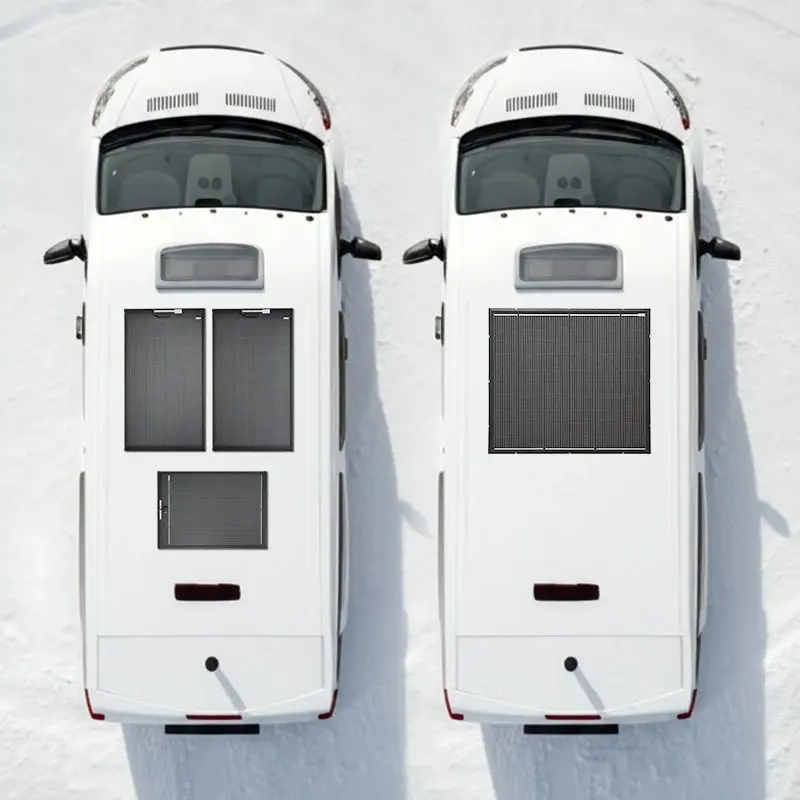
Here's where the math hits physical reality. You might calculate that you need 800W of solar—then discover your RV roof can only fit 600W once you work around the AC unit, vents, skylights, and antenna mounts.
Standard rigid panels are typically 65–70 inches tall and 39–44 inches wide. A 200W monocrystalline panel averages about 58" × 26.5" for the smaller form factor variants. Measure your usable flat roof sections—leave 4 inches clearance from edges and 6 inches around roof penetrations for airflow and maintenance access.
Curved Roofs: Why This Changes Everything
Airstream trailers. Fiberglass egg-shaped rigs. Vintage Winnebagos. Plenty of RVs have roofs that a standard rigid aluminum-frame panel simply cannot lay flat against. If you force a rigid panel onto a curved surface, you stress the frame, create uneven contact, and often void the warranty.
Flexible solar panels solve this—they conform to curves up to around 30 degrees of arc. The trade-off is real, though. Flexible panels typically run 2–5% less efficient than comparable rigid panels because they sit flush against the roof with no airspace underneath, which traps heat. That's why the "curved roof" scenarios in our formula include a slightly higher buffer factor.
Practical roof planning checklist:
- Measure usable flat or curved sections separately
- Check RV roof weight rating (most RV roofs handle 30–50 lbs per linear foot, but confirm with your manufacturer)
- Account for existing mount holes and sealant points
- If the roof is EPDM rubber, use manufacturer-approved mounting tape or non-penetrating mounts
- Shade from rooftop AC = roughly 20–30% output loss on the panels directly behind it
Rigid vs. Flexible Solar Panels for RV: Which Is Right for You? (2026)
The choice between rigid and flexible panels is one of those decisions that sounds simple until you actually dig into it. Here's the honest comparison:
| Factor | Rigid Monocrystalline | Flexible Monocrystalline |
|---|---|---|
| Efficiency | 20–23% (N-Type TOPCon up to 23%+) | 18–22% (slightly lower from heat) |
| Weight | 10–20 kg per panel | 2–5 kg per panel (~70–80% lighter) |
| Roof compatibility | Flat roof only | Curves up to ~30° |
| Lifespan | 25–30 years typical | 5–15 years (varies by brand/construction) |
| Heat performance | Better (air gap cools the panel) | Worse (no airflow underneath) |
| Installation | Requires mounting rails and brackets | Adhesive or lightweight brackets |
| Aesthetics | Raised profile, visible framing | Low-profile, nearly flush |
| Cost (per watt) | Lower to moderate | Moderate to higher |
| Best for | Flat-roof class A/C motorhomes, 5th wheels, permanent installs | Curved Airstream/fiberglass roofs, van conversions, weight-sensitive builds |
One thing worth knowing: the gap between rigid and flexible efficiency is narrowing. Modern flexible panels using N-Type TOPCon cells now deliver 21–22% efficiency—close enough that for a curved-roof RV, the mounting advantage of flexible panels outweighs the efficiency difference. Where rigid panels still clearly win is long-term degradation rates: they typically hold output better over 10+ years.
Why Partial Shade on Your RV Roof Hurts More Than You'd Expect
Standard solar panels are wired with cells in series. When one cell or group of cells is shaded, it acts like a bottleneck—the whole string's output drops to match the weakest link. In a worst case, 10% of your panel area shaded can cause 50%+ output loss across the entire string.
For RV roofs, shade sources are almost unavoidable:
- Rooftop AC unit (usually centered on the roof—worst possible location)
- Roof vents and exhaust fans
- Satellite dish or antenna mast
- Awning hardware
- Overhanging trees at campsites
The mitigation toolkit:
- Bypass diodes: Built into quality panels, they route current around shaded cell groups. Look for panels with 3 bypass diodes per panel—not just 1.
- Parallel wiring: Running panels in parallel (same voltage, additive current) means one shaded panel doesn't pull the whole array down. Works best with 12V systems.
- MPPT controller with shade optimization: Advanced MPPT algorithms scan for multiple power peaks in a partially-shaded string and lock onto the best one.
- Physical layout: If your roof allows, position the panel most likely to be shaded (the one closest to the AC) last in any series string.
How to Size Your RV Battery Bank: The Ah Math
Solar panels generate power during the day. Your battery bank stores it for nights, cloudy days, and early mornings. Getting this calculation right is just as important as the panel sizing—maybe more so.
The core formula:
Example: 1,500 Wh/day × 1.5 days × 1.2 ÷ (12V × 0.80 DoD) = 281 Ah usable capacity
→ Use a 300Ah LiFePO4 battery (or 2 × 150Ah)
DoD—Depth of Discharge—is the percentage of battery capacity you can actually use before risking damage or significant lifespan reduction:
| Battery Type | Recommended DoD | Usable % of Rated Ah | Typical Cycle Life | Weight (per 100Ah, 12V) |
|---|---|---|---|---|
| LiFePO4 (Lithium Iron Phosphate) | 80–90% | 80–90% | 3,000–5,000+ cycles | ~13 kg |
| AGM Lead-Acid | 50% | 50% | 400–800 cycles | ~30 kg |
| Flooded Lead-Acid | 50% | 50% | 300–700 cycles | ~30 kg |
| Gel Lead-Acid | 50–60% | 50–60% | 500–1,000 cycles | ~30 kg |
LiFePO4 wins on nearly every metric for RV use—lighter, more usable capacity per Ah rated, faster charge, and dramatically longer lifespan. The upfront cost is higher, but over 10 years of weekend use you'll typically replace a lead-acid bank 2–3 times. The math usually favors lithium for anyone camping regularly.
One thing that catches people off guard: a 12V system requires twice the Ah of a 24V system for the same watt-hour storage. If you're building a bigger system (1,500W+ of solar, 5kWh+ battery), designing around 24V or 48V reduces wire sizing costs and current-related losses significantly.
Choosing the Right Inverter: Surge Capacity and Pure Sine Wave Matter
The inverter converts your DC battery power to AC power for appliances like microwaves, AC units, and standard-outlet devices. Two things trip people up here.
First: surge vs. continuous wattage. Most appliances with motors—air conditioners, refrigerator compressors, water pumps—draw 2–4× their normal wattage when starting. A 13.5k BTU RV AC runs at ~1,500W but surges to 4,500–6,000W on startup. Your inverter must handle that surge, or it'll trip on startup and you'll wonder why your AC "doesn't work on solar."
Second: pure sine wave vs. modified sine wave. Modified sine wave inverters are cheaper but output a stepped waveform that some appliances reject. It can cause humming in AC motors, erratic behavior in variable-speed devices, and damage to some battery chargers and medical equipment. Unless you're running nothing but resistive loads (like a basic light or a simple fan), buy pure sine wave. The price gap has narrowed—there's little reason to compromise.
Inverter sizing quick guide:
- Light use (laptop, phone charging, LED lighting): 500–1,000W pure sine wave
- Medium use (+ microwave, small AC loads): 1,500–2,000W with 3,000W surge rating
- Heavy use (+ rooftop AC): 3,000W continuous with 6,000W+ surge
RV Solar Sizing by Usage Type: Weekend / Full-Time / Boondocking / AC-Heavy
Rather than abstract numbers, here's how sizing changes based on how you actually use your RV:
| Usage Type | Daily Energy (Wh) | Recommended Solar | Battery Bank | Inverter | Notes |
|---|---|---|---|---|---|
| Weekend warrior (fridge + lights + phones) | 600–1,200 | 400–600W | 100–200Ah LiFePO4 | 1,000W | Most starter kits work fine here |
| Full-time remote worker (+ Starlink + laptop) | 1,500–2,500 | 800–1,200W | 200–300Ah LiFePO4 | 2,000W | Prioritize Starlink power budget |
| Boondocking (off-grid, extended) | 1,000–2,000 | 1,000–1,500W | 300–400Ah LiFePO4 | 2,000W | Low PSH areas—go bigger on panels |
| AC-heavy (summer camping with rooftop AC) | 4,000–8,000+ | 1,500–3,000W+ | 400–800Ah LiFePO4 | 3,000W+ surge 6,000W | Generator hybrid usually needed |
| Vanlife / compact conversion | 500–1,500 | 400–800W (flexible panels) | 100–200Ah LiFePO4 | 1,000–1,500W | Weight and roof curve are key constraints |
| Winter / cold-weather camping | 1,500–3,000+ | 1,200–2,000W | 300–500Ah LiFePO4 | 2,000W+ | Use lowest local PSH (often 2–3h) for sizing |
System Expandability: Portable Panels + Generator Hybrid
One thing fixed-roof solar can't do is follow the sun when you park in a shady spot. Portable solar panels solve that specific problem. A 200W portable panel that you deploy on the ground, angled toward the sun, often outperforms a 300W roof-mounted panel in a partially shaded site.
The expansion path most experienced RVers land on:
- Start with roof panels sized for your base daily load (no AC)
- Add a portable panel (100–200W, foldable) for shady campsites and bonus charging
- Add a generator as a backup for extended cloudy stretches and AC-heavy days
- Expand battery bank before adding more solar if storage is the bottleneck
Generator hybrid systems make a lot of sense for full-timers. Run the generator for 2–3 hours on cloudy days to top off the battery, and solar handles everything else. The key is matching your charge controller's input capacity—don't add more solar than the controller is rated to handle, or you'll clip (waste) the excess power.
Three Real-World RV Solar System Examples
Example 1: Weekend Camper — Flat Roof Class C
Appliances: 12V fridge (50Ah/day), LED lights, 2 phones, laptop, small fan
Estimated daily use: ~900 Wh
Location: Southeast US, summer camping (PSH: 5.0)
Formula: (900 ÷ 5.0) ÷ 0.78 × 1.2 = 277W → Round up to 400W
System: 2 × 200W rigid monocrystalline panels, 40A MPPT controller, 100Ah LiFePO4 battery, 1,000W inverter
Cost range: $1,200–1,800
Example 2: Full-Time Remote Worker — Airstream with Curved Roof
Appliances: 12V fridge, Starlink, laptop ×2, LED lighting, microwave (brief use), phone charging
Estimated daily use: ~2,000 Wh
Location: Mix of Southwest and Pacific NW (conservative PSH: 4.0)
Formula: (2,000 ÷ 4.0) ÷ 0.75 × 1.3 = 867W → Round up to 1,000W
System: 5 × 200W flexible panels (curved roof), 60A MPPT controller, 200Ah LiFePO4, 2,000W pure sine wave inverter
Cost range: $2,800–4,500
Example 3: AC-Heavy Summer Tripper — Class A Motorhome
Appliances: All above + 13.5k BTU rooftop AC (4h/day), instant pot, electric coffee maker
Estimated daily use: ~6,000–7,000 Wh
Location: Southwest US (PSH: 6.0)
Formula: (6,500 ÷ 6.0) ÷ 0.78 × 1.3 = 1,808W → Round up to 2,000W
System: 10 × 200W rigid panels + generator hybrid, dual 60A MPPT controllers, 400Ah LiFePO4 (24V), 3,000W inverter (6,000W surge)
Cost range: $5,500–9,000+
Why Most Online RV Solar Calculators Get It Wrong
Online calculators are convenient, but most share the same flaw: they use optimistic default values. PSH defaults to 4–5 hours (reasonable for the US average but terrible for winter or the Pacific Northwest). Efficiency defaults to 80% (ignores temperature derating and wiring losses that could push it to 70%). Buffer? Often nonexistent or hardcoded at 10%.
The other common mistake is assuming all your AC loads run through an inverter at the same time. Real usage is staggered—you're not running the microwave, AC, and instant pot simultaneously. But a calculator that treats peak load as continuous load will oversell you on inverter size while underselling you on solar and battery.
| Variable | Optimistic Default (typical calculator) | Conservative Real-World Value | Impact on Sizing |
|---|---|---|---|
| PSH | 5.0 hours | 3.0–4.0 hours (winter/cloudy) | 25–40% more solar needed |
| System efficiency | 85% | 70–75% | 10–15% more solar needed |
| Safety buffer | 1.1× | 1.3–1.5× | 20–40% more solar needed |
| Appliance runtime | User estimate | +20–30% actual vs. guessed | 20–30% more capacity needed |
Stack all four optimistic assumptions and you can easily end up with a system 40–60% undersized for real conditions. That's why "I bought exactly what the calculator said and still ran out of power" is such a common complaint.
Finding the Right Panels: Sungold Solar RV Solutions
Once your wattage number is locked in, you still need to match the right panel type to your specific roof. Curved fiberglass, flat aluminum, a van rooftop with barely 40 square feet—each situation has a different answer. Here's how Sungold Solar's RV lineup maps to the scenarios we've been discussing.
TF Series — Step-On Flexible Panels
Built for RV roofs, yacht decks, and surfaces that see foot traffic. The reinforced composite structure passed a 14,700-step simulation with less than 3% power loss—no micro-cracks.
- Power range: 55W – 285W
- Cell efficiency: >22.7% (monocrystalline); SunPower option up to 24.4%
- Weight: 1.15 kg (55W) → 5.34 kg (285W)
- Waterproofing: IP68 (1 m / 60 min)
- Salt mist: 672 h resistance (IEC 61701)
- Flexibility: Bends to 260 mm arc, no damage
- Certifications: CE, RoHS
- Warranty: 6 years
View TF Series specs & quote →
PA219 Series — Ultra-Light Certified Flexible Panels
At just 3.3 kg/m²—roughly 35% of a glass-framed panel—the PA219 installs on roofs with as little as 5 kg/m² load capacity. TÜV and CSA certified, Class C fire-rated. The serious flexible panel for serious installs.
- Power range: 100W – 490W
- Cell efficiency: >25.0% (monocrystalline)
- Weight: 1.7 kg (100W) → 8.2 kg (490W)
- Thickness: 3 mm flush profile
- Fire rating: Class C (IEC 61730-2)
- Certifications: TÜV, CSA, CE, RoHS, IEC 61730 & 61215
- Anti-PID: Yes (frameless polymer design)
- Warranty: 10 years
View PA219 Series specs & quote →
Not sure which one fits your rig? A quick rule of thumb: if your roof sees foot traffic (walkaround for antenna or AC service), go TF Series. If weight is your primary constraint and your roof is a fiberglass curve or aging commercial structure, the PA219's 3.3 kg/m² and fire certification make it the safer long-term choice.
Complete RV Solar Kits — Pre-Configured and Ready to Integrate
If you'd rather not source components individually, Sungold's RV Solar Power Solutions page offers pre-configured kits that pair the right panel with an MPPT controller, wiring, and battery-ready connections. Three standard sizes cover most common builds:
200W RV Kit
- 1 × 200W panel
- 15A MPPT controller
- 1.2 kW inverter
- 2.56 kWh battery capacity
400W RV Kit
- 2 × 200W panels
- 30A MPPT controller
- 2 kW inverter
- 2.56 kWh battery capacity
600W RV Kit
- 3 × 200W panels
- 50A MPPT controller
- 3 kW inverter
- 2.56 kWh battery capacity
All three kits are OEM-customizable—panel type (rigid SGM, flexible PA219, or step-on TF), cable routing, connector type, and private-label branding are available for fleet integrators and vehicle manufacturers. The engineering team can also provide a regional pack (US/EU spec) with pre-wire, anti-shade, and thermal plans based on your specific roof layout.
Three Engineering Problems Sungold Specifically Designed For
RV rooftops aren't the same as ground-mount installations. Three things kill panels faster on a moving vehicle than almost anywhere else:
- Heat buildup: RV rooftops in direct sun can hit 60–80°C. Sungold's Cool-Back™ low-conductivity thermal backing slows heat transfer from the roof surface to the cells—keeping operating temperature lower and output more stable than standard direct-bond flexible panels.
- Partial shading from roof accessories: AC units, antennas, and luggage racks cast shadows that move as the sun tracks across the sky. Sungold's Shade-Smart™ cell-level shade management localizes losses to only the shaded cells, preventing whole-string collapse—a common failure point in conventional series-wired layouts.
- Road vibration and wind load: Continuous driving vibration fatigues solder joints and backing materials over time. Sungold modules use reinforced backing, segmented bonding, and optimized cable routing to maintain structural integrity across long-distance travel.
| RV Type / Scenario | Recommended Sungold Product | Key Specs / Why It Fits | Learn More |
|---|---|---|---|
| Curved fiberglass / Airstream roof | PA219 Flexible (100–490W) | 3.3 kg/m², bends to contour, TÜV certified, 10-yr warranty | PA219 → |
| Marine deck / walkable RV roof | TF Series Flexible (55–285W) | Step-on rated, IP68, 14,700-step tested, ETFE anti-yellow | TF Series → |
| Shady campsites / AC-shadowed roof | PA621 Anti-Shade Flexible | Cell-level Shade-Smart™ management, Cool-Back™ thermal layer | RV Kits → |
| Flat roof Class A / 5th wheel (permanent) | SGM Rigid Glass Panel | TÜV & UL certified, high rigidity, bracket-mount, easy maintenance | RV Kits → |
| Van conversion / ultra-weight-sensitive build | PA219 100W–200W Flexible | 1.7 kg (100W), 3 mm thin, adhesive-mount, no brackets needed | PA219 → |
| OEM / fleet / commercial RV manufacturer | Custom size + OEM branding (all series) | Custom dimensions, voltage, connector, private-label available | Get Quote → |
Frequently Asked Questions
What information does an RV solar panel size calculator need?
You need three core inputs: your total daily energy use in watt-hours (Wh/day), the Peak Sun Hours (PSH) at your location and season, and your system efficiency (typically 0.70–0.85). Add a safety buffer of 1.2–1.5× for real-world conditions. If you camp in cloudy areas or want 2-day battery autonomy, lean toward the higher end of that buffer range.
How many solar panels does a typical RV need?
Most weekend RVs run well on 400–800W (2–4 standard 200W panels). Full-timers with a fridge, Starlink, and laptop usually need 800–1,200W. If you want to run a 13.5k BTU rooftop AC, budget 1,500W or more of solar plus a large lithium battery bank and a generator for backup.
Which type of solar panel is best for an RV roof?
Rigid monocrystalline panels (especially N-Type TOPCon) offer the best efficiency and lifespan—ideal for flat roofs and permanent installs. Flexible panels are the right call for curved surfaces like Airstreams, fiberglass trailers, and van roofs where weight also matters. Best-in-class flexible panels now reach 21–22% efficiency, nearly matching entry-level rigid options.
Will partial shading cause significant power loss?
Yes—more than most people expect. In a standard series-wired string, shade on one panel can drop total output by 50–80%. Bypass diodes in quality panels limit damage to the shaded cell group rather than the whole string. For RVs with unavoidable shade sources (AC units, vents), parallel wiring or an MPPT controller with shade optimization reduces the hit considerably.
How much battery storage do I need?
Use: Ah = (Daily Wh × Autonomy Days × 1.2 buffer) ÷ (System Voltage × DoD). For a LiFePO4 battery at 80% DoD, a 1,500 Wh/day system on 12V with 1.5 days of autonomy needs: (1,500 × 1.5 × 1.2) ÷ (12 × 0.80) = 281Ah usable → a 300Ah LiFePO4 battery. For 24V systems, you need half the Ah for the same watt-hour storage.
Can solar panels keep up with Starlink running continuously?
Yes, during daylight. Starlink Standard averages 25–80W—up to 1,920Wh per day if running 24/7. Your panels easily cover that during peak sun hours. The issue is overnight: your battery must supply Starlink plus any other nighttime loads. Make sure your battery bank is sized for total overnight consumption, not just the solar coverage window.
References & Further Reading:
- NREL PVWatts Calculator — pvwatts.nrel.gov (solar resource data by location)
- Global Solar Atlas — globalsolaratlas.info (international PSH data)
- U.S. Department of Energy, "Photovoltaic Systems" — energy.gov
- Sungold Solar TF Series Flexible Panels — sungoldsolar.com/solar-panels/tf/
- Sungold Solar PA219 Flexible Panels — sungoldsolar.com/solar-panels/pa219
- Sungold Solar RV Solar Power Solutions — sungoldsolar.com/solutions/rv-solar-kits/
All wattage ranges in the appliance table are based on manufacturer specifications and third-party RV power consumption testing. Actual system performance will vary by installation, climate, and usage patterns.