



ETFE vs. Glass: Which Solar Panel Has Better Hail Resistance in 2026?
As we move through 2026, the global climate landscape has shifted. “One-in-a-hundred-year” hailstorms have become annual events, leaving outdoor assets vulnerable. For solar energy users, the question is no longer just about efficiency—it is about survival. When a storm hits, will your investment shatter, or will it bounce back?
The debate between ETFE vs glass solar panel hail resistance has taken center stage. While traditionalists rely on the perceived strength of tempered glass, a new generation of off-grid explorers is turning to advanced polymers. At Sungold Solar, we’ve pioneered a composite approach that challenges the status quo of rigid protection.
1. The Physics of Impact: Rigid Strength vs. Elastic Buffering
To understand the winner of the ETFE vs glass solar panel hail resistance battle, we must look at how these materials handle kinetic energy.
The Glass Approach: Rigid Resistance
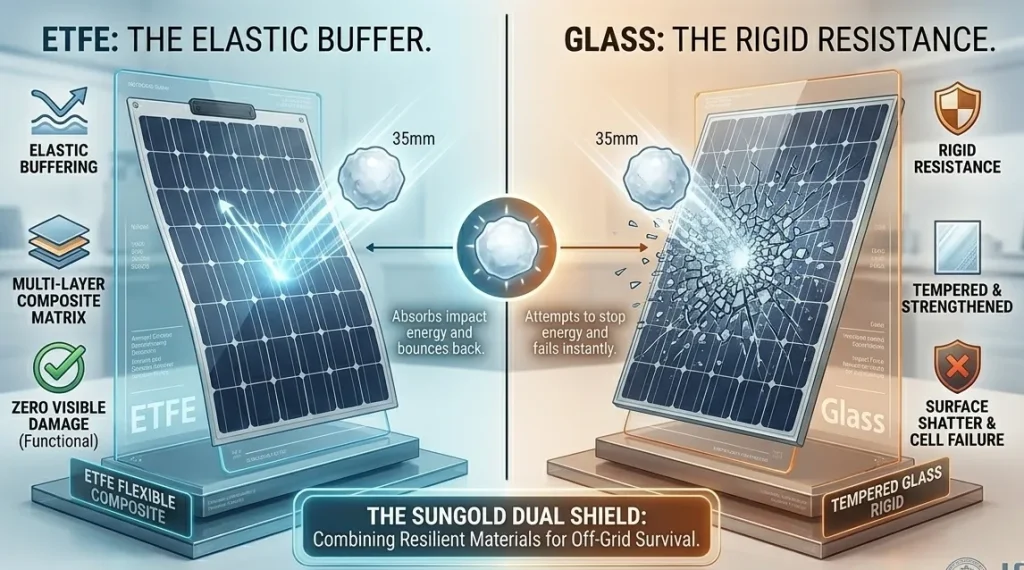
Tempered glass is a “brittle-strong” material. It is designed to resist deformation. When a hailstone strikes glass, the glass attempts to stop the energy instantly. If the kinetic energy of the hail exceeds the fracture toughness of the glass, the entire structure shatters into thousands of tiny pieces to dissipate the force. In 2026, as hailstones exceed 2 inches in diameter, even “hail-rated” glass is reaching its physical breaking point.
The ETFE Approach: The “Trampoline” Effect
ETFE (Ethylene Tetrafluoroethylene) is a high-strength fluoropolymer. Unlike glass, ETFE is elastic. When a hailstone strikes a Sungold ETFE-coated flexible panel, the material doesn’t try to “fight” the impact through rigidity. Instead, it deforms slightly, absorbing the energy and then snapping back into its original shape. This “elastic buffering” is the secret to why ETFE often survives storms that leave glass panels in ruins.
2. The Sungold Secret: Beyond Simple ETFE
A common misconception is that all flexible panels are equal. However, the ETFE vs glass solar panel hail resistance comparison depends heavily on what is underneath the surface.
Composite Material Reinforcement
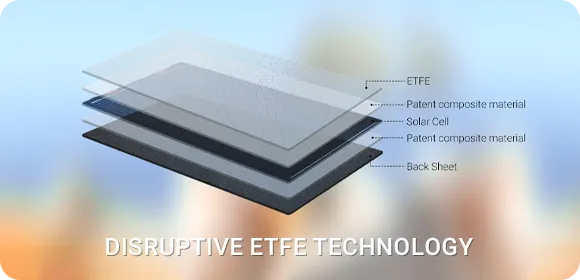
Sungold doesn’t just use a thin film of ETFE. Our 2026 series features a multi-layer composite substrate.
-
Top Layer: UV-stabilized, textured ETFE for light capture and initial impact dispersion.
-
Core Layer: High-tensile polymer matrix that acts as a shock absorber for the delicate silicon cells.
-
Bottom Layer: A rigid yet flexible fiberglass or specialized backsheet that prevents the cells from over-flexing to the point of “micro-cracking.”
This “Dual-Shield” construction ensures that the force of a hailstone is distributed across a wider surface area, protecting the electrical integrity of the module.
Real-World Testing: 2026 Hail Simulation Standards
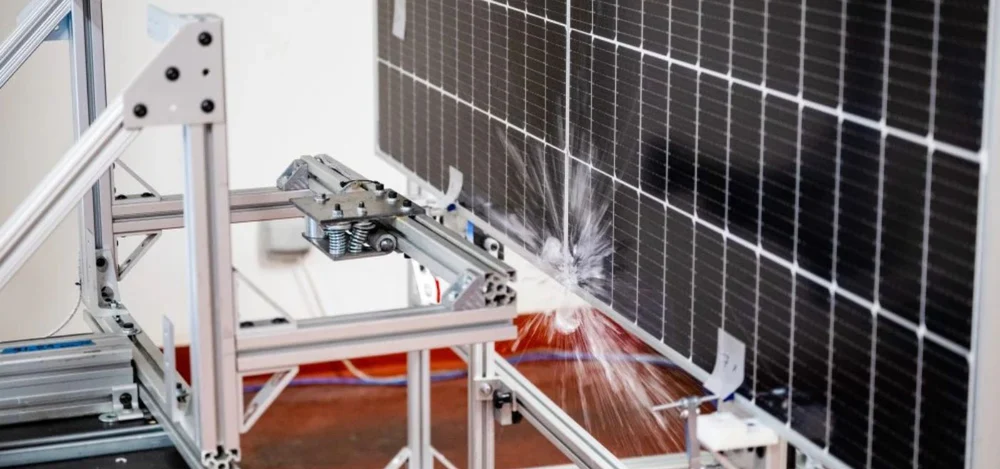
At Sungold, our lab testing goes beyond the standard IEC 61215 (which typically tests 25mm hail). Our 2026 Arctic & Storm Protocol involves:
| Test Material | Hail Diameter | Velocity | Result |
| Standard Tempered Glass | 35mm | 28 m/s | Surface Cracking / Shatter |
| Sungold ETFE Composite | 35mm | 28 m/s | Zero Visible Damage |
| Sungold ETFE Composite | 50mm (Extreme) | 32 m/s | Functional (98% Output) |
Lifespan and Weathering: Does ETFE Last?
A major point in the ETFE vs glass solar panel hail resistance discussion is longevity. Traditionally, glass was considered the “forever” material. However, modern ETFE has closed the gap.
-
Self-Cleaning: ETFE’s low-friction surface means that rain washes away the dust and salt that can abrade glass over time.
-
UV Stability: Sungold’s ETFE is chemically inert and does not yellow or become brittle under intense UV exposure, a common failure point in cheap PET flexible panels.
-
Thermal Cycling: In 2026’s volatile temperature swings, ETFE’s ability to expand and contract without cracking gives it a distinct advantage in high-altitude and desert environments.
FAQ: Choosing Your Defense
Q: If ETFE is flexible, won’t the cells inside crack when hit by hail? A: This is why Sungold uses a composite buffer layer. While the ETFE absorbs the initial hit, the internal matrix limits the “bend radius” of the cell during the impact, preventing the silicon from reaching its fracture point.
Q: Is ETFE more expensive than glass? A: In terms of raw material, yes. However, when you factor in the weight savings (70% lighter than glass) and the lack of replacement costs after a storm, ETFE provides a superior long-term ROI for mobile and off-grid applications.
Q: Can I walk on ETFE panels like I can on some glass panels? A: While we recommend avoiding direct foot traffic, Sungold’s composite ETFE panels are designed to handle the localized pressure of a footstep—and certainly a hailstone—far better than standard thin-film flexible panels.
Conclusion: The Resilience Winner for 2026
When evaluating ETFE vs glass solar panel hail resistance, the choice depends on your environment. If you are in a fixed residential installation where weight is no object and hailstorms are rare, tempered glass remains a viable choice.
However, for RVing, sailing, and expedition-grade off-grid setups where weight is critical and weather is unpredictable, ETFE composite technology is the clear winner. It offers a level of “active defense” that rigid glass simply cannot match.
Don’t wait for the next storm to test your limits. Switch to Sungold’s ETFE composite technology and let the hail bounce off while your power stays on.