 EN
EN
 Deutsch
 Italiano
 Español
 Français
 日本語
日本語
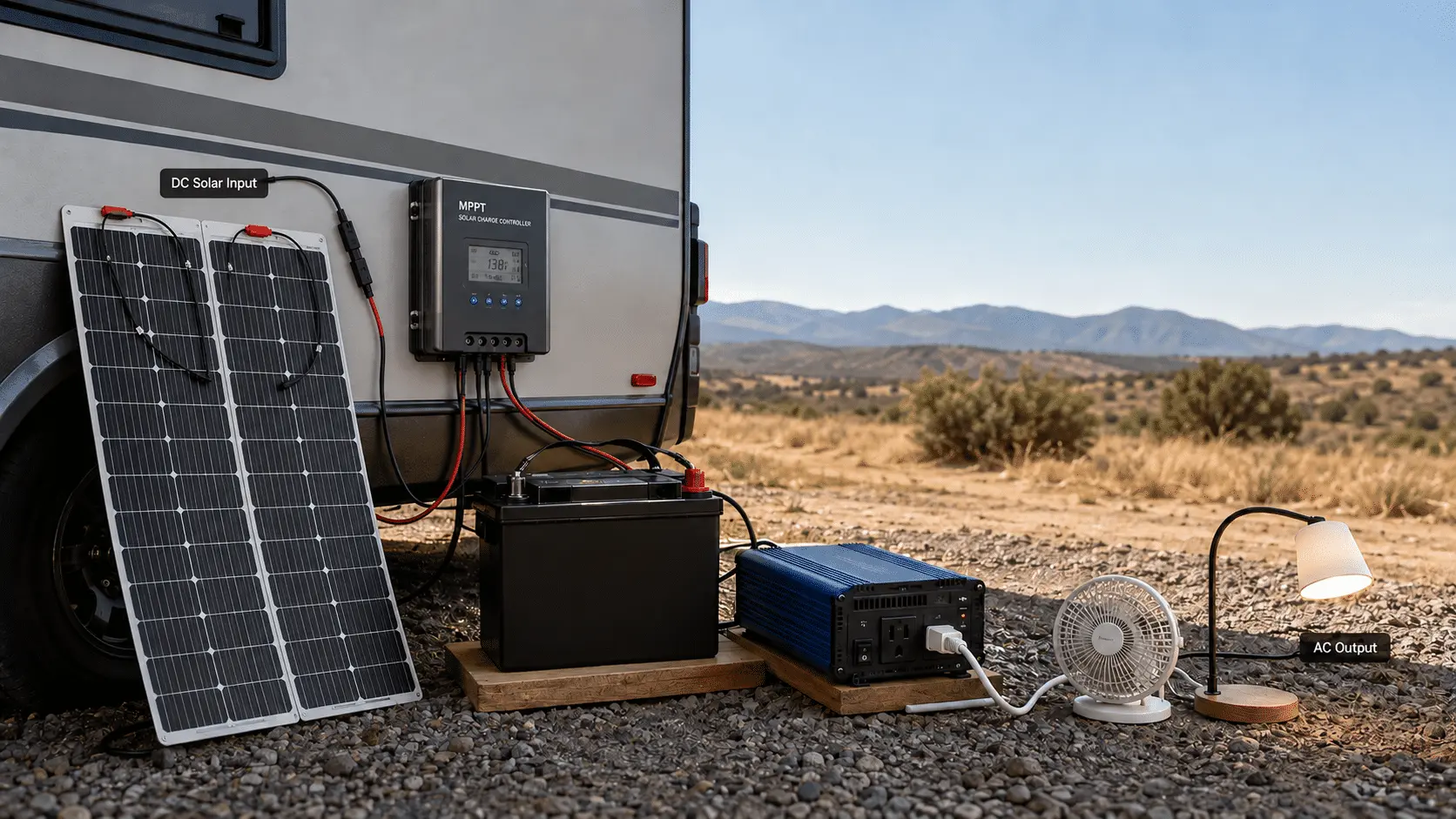
- Solar panels generate DC power first. The system may later convert that power into AC for appliances or grid-side use.
- A battery does not literally store AC power. In most cases, an “AC battery” means an AC-coupled battery system with inverter electronics.
- A DC-coupled system usually manages solar charging, battery charging, and power conversion on the DC side before final AC output.
- For solar kit buyers, the real check is not only AC vs DC. It is whether panel voltage, current, MPPT range, battery voltage, inverter limit, cable route, and load profile match the system.
- Sungold can support the solar panel side of the design, including panel format, wattage range, voltage matching, cable position, connector planning, and application fit.
AC vs DC battery systems for solar kits are often misunderstood because the words sound simple. In real projects, the issue is not whether a battery magically stores AC or DC. Battery cells store energy as DC. The important question is where the battery sits in the system and how the solar panel input is managed before power reaches the load.
That distinction matters for portable power stations, RV solar kits, off-grid packages, balcony solar products, marine charging systems, and OEM solar kits. A panel that works well with one battery architecture may not fit another one without changes to voltage, current, connector, controller, or cable routing.
What Do People Mean by AC Battery and DC Battery?
The phrase “AC battery” can be misleading.
A battery cell stores energy as DC. In the market, when people say “AC battery,” they usually mean a battery product or storage system that connects on the AC side of a solar or backup system. It may include a built-in inverter, AC input, AC output, or an AC-coupled connection method.
A “DC battery” usually means the battery is managed on the DC side. It may connect through a charge controller, hybrid inverter, battery management system, or DC bus.
So the better question is not, “Is the battery AC or DC?” The better question is, “Where does the battery connect in the system, and where does the solar panel input go?”
Why Solar Panels Produce DC Power First
Solar panels produce direct current. That is the starting point.
If the system needs to power AC appliances, an inverter converts DC power into AC power. The U.S. Department of Energy describes inverters as equipment that converts DC electricity from solar panels into AC electricity used by the grid and many electrical loads.
For buyers, this means the solar panel is only one part of the chain.
In another system, the path may look different:
Both can work. But they require different checks. Panel wattage alone is not enough.
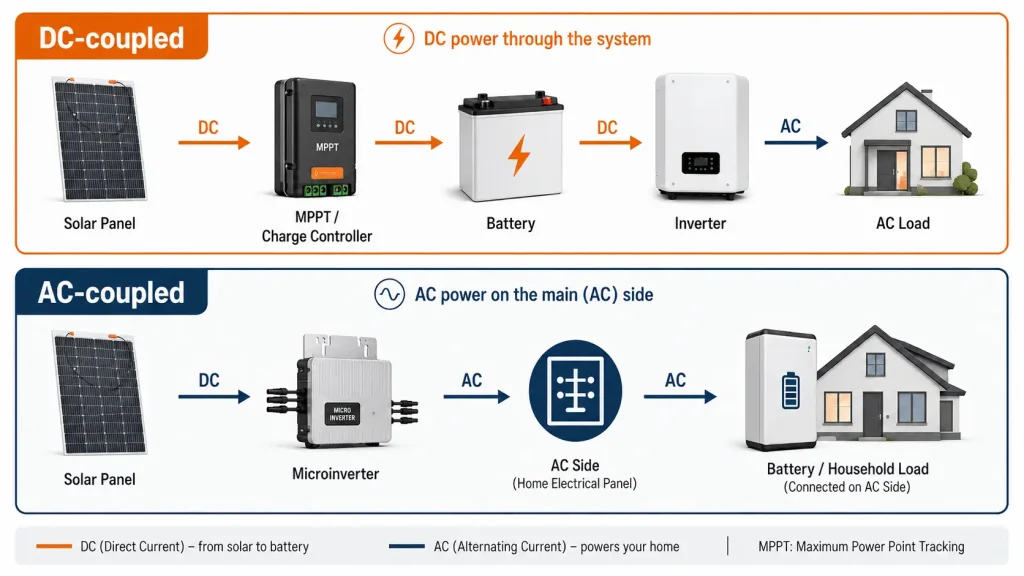
AC-Coupled vs DC-Coupled Solar Battery Systems
| Item | AC-Coupled System | DC-Coupled System |
|---|---|---|
| Basic idea | Solar power is converted to AC before storage or load management on the AC side. | Solar power is managed on the DC side before final AC conversion. |
| Common use | Existing solar systems, retrofit storage, some home backup systems. | New solar kits, RV, portable power, off-grid, and compact storage designs. |
| Panel-side check | Solar inverter or microinverter design, AC-side integration. | Panel voltage, current, MPPT range, controller input, and battery voltage. |
| Main benefit | Easier to add to some existing AC-side systems. | Often direct and practical for purpose-built solar charging systems. |
| Main risk | More conversion stages and more system-level compatibility checks. | Wrong voltage or current matching can reduce charging or trigger protection. |
| Buyer focus | Inverter compatibility, AC output, backup mode, and local rules. | PV input limits, battery voltage, wiring, charging profile, and protection. |
Neither design is always better. A balcony solar product, a portable power station, a marine charging kit, and a home backup system may all use different architectures. The right choice depends on the application, not the label.
Where the Solar Panel Connects in Each System
This is where many buyers make mistakes.
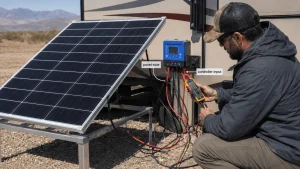
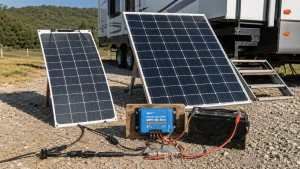
In a DC-coupled solar kit, the solar panel usually connects to a DC input, charge controller, MPPT controller, or hybrid inverter. The controller manages how solar power charges the battery.
In an AC-coupled system, solar panels may connect through a solar inverter or microinverter first. The battery system then interacts with the AC side.
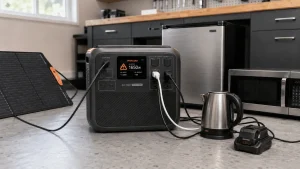
For example, a portable power station often accepts DC solar input through an MPPT range. An RV solar kit usually charges a 12V or 24V battery system through a controller. A balcony solar kit may use microinverters, batteries, or both, depending on the product design and local requirements.
For panel buyers, the connection point decides what panel voltage, current, and connector type can be used.
Why Panel Matching Still Matters
A buyer may ask for “a 200W panel” or “a 400W panel,” but that is not enough information for system matching.
A 200W panel can behave very differently depending on its voltage, current, size, cable length, and connection method. Two panels with the same wattage may not fit the same battery system.
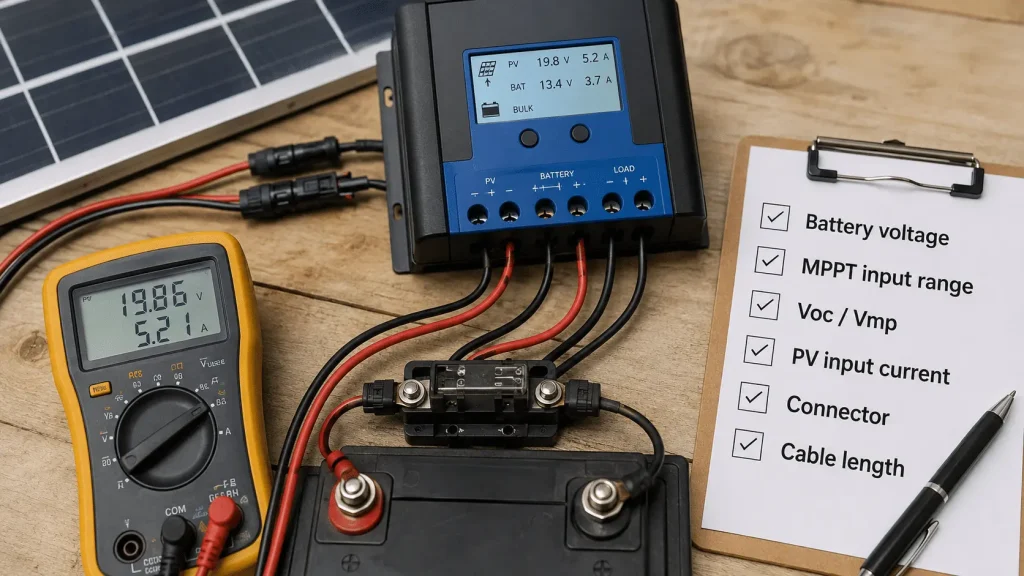
| Check Item | Why It Matters |
|---|---|
| Battery voltage | Affects controller selection and panel wiring method. |
| MPPT input voltage range | The panel Vmp and Voc must fit the input window. |
| Maximum PV input current | Prevents input overload or controller protection. |
| Open-circuit voltage | Important in cold conditions and series connections. |
| Cable length | Long cable routes can increase voltage drop. |
| Connector type | Affects installation, serviceability, and product package design. |
| Mounting space | Limits panel size, shape, and total wattage. |
| Load profile | Helps decide whether the panel input is realistic for daily use. |
A larger panel is not always the answer. If the controller input range is too narrow, the battery voltage is mismatched, or the cable route is poorly planned, the system may underperform even with a higher-wattage panel.
Use Case Comparison
| Application | Typical System Logic | What Buyers Should Check |
|---|---|---|
| Portable power station | DC solar input to internal MPPT. | Panel Voc, Vmp, current, connector, folding format, and input limit. |
| RV solar kit | DC charging into 12V or 24V battery system. | Roof space, weight, cable route, battery voltage, and controller. |
| Off-grid solar kit | DC-coupled or hybrid system. | Battery bank, inverter size, solar input, load profile, and backup charging. |
| Balcony solar + storage | Market-dependent AC/DC design. | Microinverter, plug assumptions, battery boundary, and local guidance. |
| Marine solar | DC charging with strict layout limits. | Salt mist, curved surface, cable route, flexible panel format, and waterproofing. |
| Commercial vehicle solar | Auxiliary battery support. | Vehicle voltage, vibration, roof area, controller, and cable protection. |
This is why the same solar panel cannot be recommended blindly across every project. A panel that works for an RV roof may not be the right choice for a balcony microinverter kit. A marine panel may need different surface material, cable exit position, and installation structure. A portable power product may need a folding panel with a specific open-circuit voltage range.
Common Mistakes Buyers Make
One common mistake is treating AC battery and DC battery as if they describe the battery cell itself. They do not. The battery system architecture is what matters.
Another mistake is choosing panel wattage before checking the MPPT input range. If the panel voltage is outside the input range, the system may not charge correctly.
Buyers also sometimes assume that a bigger battery solves every problem. It does not. A larger battery does not fix poor solar input, an undersized inverter, wrong controller selection, or heavy AC loads. If the project is still at the load-planning stage, the Solar Backup Sizing Guide gives a more direct way to compare solar input, battery reserve, and daily loads.
For balcony solar products, retailers should be especially careful. A simple plug-in solar panel, a microinverter kit, and a battery-connected balcony system may fall under different technical and market expectations. They should not be described as the same product.
What Solar Kit Brands Should Confirm Before Sampling
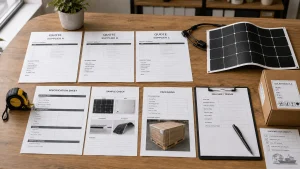
For distributors, system brands, and OEM/ODM buyers, the sampling stage should not begin with only a wattage request.
| RFQ Input | Why It Matters |
|---|---|
| Target application | RV, balcony, marine, portable, vehicle, and off-grid projects need different panel formats. |
| Battery architecture | 12V, 24V, 48V, portable power station, or hybrid system affects matching. |
| MPPT input range | Determines acceptable panel voltage. |
| Maximum input current | Helps avoid controller or power station input limits. |
| Panel size limit | Controls realistic wattage and layout. |
| Cable exit position | Important for mounting, waterproofing, and service access. |
| Connector requirement | Affects product package and user installation. |
| Certification target | Must be confirmed by model and market. |
This step reduces sample revisions. It also helps avoid the common problem where a panel looks correct in the catalog but does not fit the final system.
How Sungold Can Support the Panel Side
For solar kit brands, distributors, and OEM/ODM buyers, Sungold can support the panel-side review before sampling. This may include panel format, wattage range, voltage, current, cable position, connector type, mounting surface, and application environment.
For portable power products, the panel first needs to match the power station’s solar input window, connector type, and outdoor use conditions. Sungold’s portable solar panel options can be reviewed for this type of product package.
For off-grid projects, the panel decision should follow the battery voltage, controller input range, and load profile. Buyers can also review Sungold’s off-grid solar kits path when the project requires panels, batteries, controllers, and application planning to be discussed together.
Sungold supports solar panel and custom module planning. Battery, inverter, controller, BMS, grid connection, and complete system safety should be confirmed according to the actual project scope.
FAQ
Battery cells store energy as DC. In the market, an “AC battery” usually means an AC-coupled battery product or storage system with inverter electronics or AC-side connection.
Usually no. Most systems need a charge controller, MPPT controller, hybrid inverter, or power management system to regulate charging safely.
Neither is always better. AC-coupled systems may fit some retrofit or AC-side backup projects. DC-coupled systems are often practical for new solar kits, portable power stations, RV, marine, and off-grid charging designs.
Buyers should check battery voltage, MPPT input range, maximum PV input current, open-circuit voltage, cable route, connector type, mounting space, and load profile.
Not automatically. A larger battery increases storage capacity, but the solar panel still needs to match the controller, charging window, available space, sunlight conditions, and expected daily load.
Final Thoughts
AC vs DC battery is really a system architecture question.
For solar kit buyers, the practical decision is not about choosing a label. It is about understanding where the solar panel connects, how the battery is charged, what the inverter supports, and whether the electrical path fits the real application.
A good solar kit starts with system matching. Once the battery voltage, controller input range, load profile, cable route, and mounting space are clear, panel selection becomes much more reliable.
Source Notes
U.S. Department of Energy: Solar Integration: Inverters and Grid Services Basics
U.S. Department of Energy: Solar Systems Integration Basics