 EN
EN
 Deutsch
 Italiano
 Español
 Français
 日本語
日本語
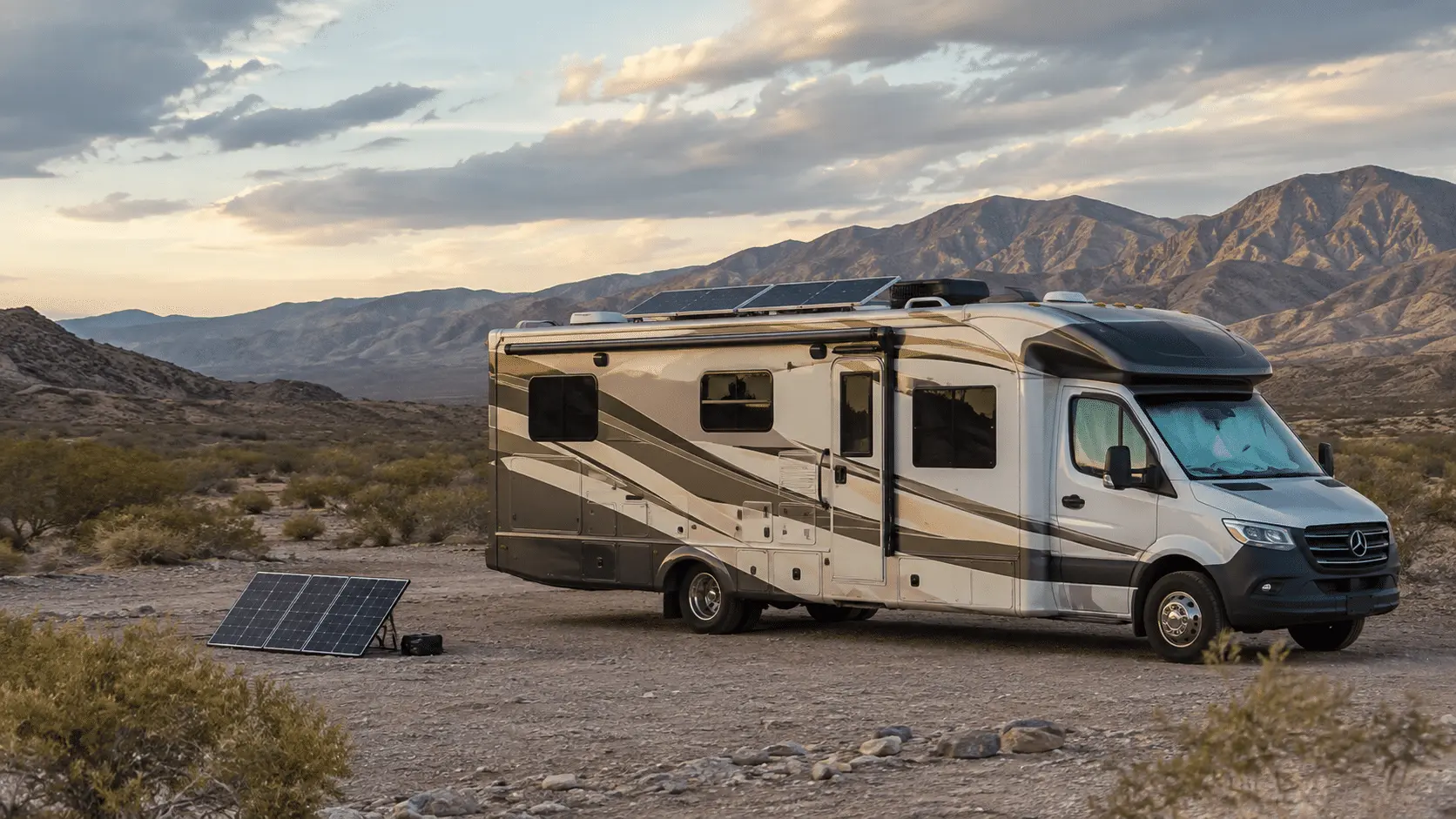
Size an RV boondocking system from the loads first. Then match the usable battery reserve, solar input, inverter power, and backup charging options to the number of nights you plan to stay off grid.
Solar panels replenish energy during the day. Batteries store energy for later. The inverter determines which AC loads can run at the same time. A system that works for one night may not support three nights, especially when the RV uses air conditioning, electric heating, a microwave, or other high-demand appliances.
There is no universal solar wattage or battery size for every RV. The design depends on the RV platform, load profile, weather, shade, and charging options.
Boondocking means camping without a reliable electrical hookup. The RV may still have access to propane, water, or a generator, but shore power is not available as the main energy source.
A weekend travel trailer and a full-time RV usually have very different electrical profiles. That difference should shape the system from the start.
What Does an RV Boondocking Solar System Need to Do?
The goal is not simply to install the largest solar array that fits on the roof. The system must cover essential DC loads, store enough energy for the night, replenish daytime consumption, and support selected AC loads through an inverter.
A practical design also includes a recovery path for poor solar conditions. That may be alternator charging, portable solar, shore power, or a generator.
- Cover essential DC loads.
- Store enough energy for the night.
- Replenish daytime consumption.
- Support selected AC loads through an inverter.
- Provide backup charging when sunlight or roof space is limited.
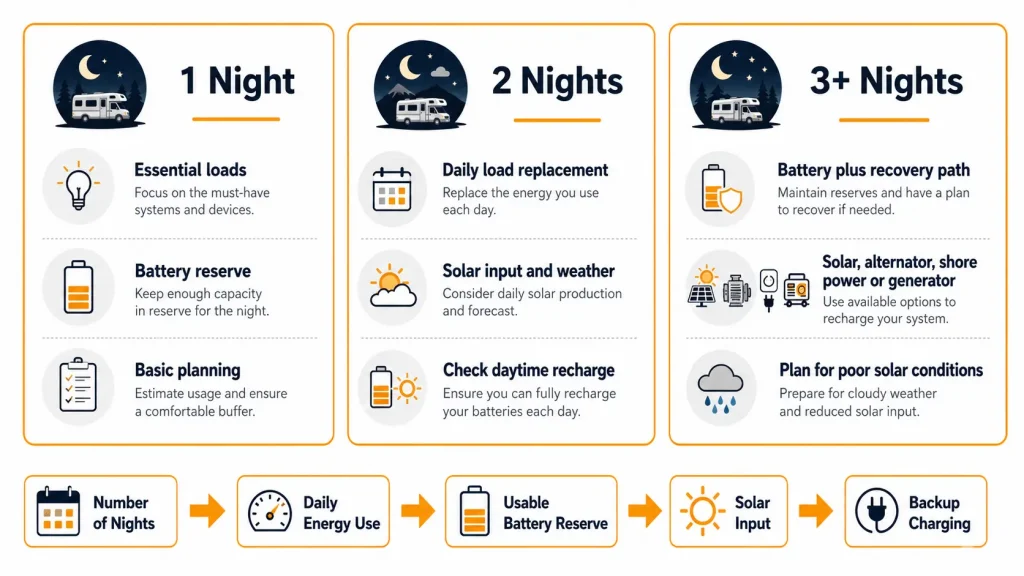
Start With the Number of Nights, Not Panel Wattage
The number of nights away from shore power shows how much energy must be stored before the next reliable charging opportunity.
One-Night Boondocking
A one-night trip may focus on interior lights, the water pump, refrigerator controls, ventilation fans, phones, laptops, and communication devices.
The main question is whether the battery has enough usable reserve to cover the evening and overnight period. Solar input still matters because it may need to replace the previous day’s energy use before the next night begins.
Two-Night Boondocking
Two nights require a closer look at daily consumption. Review the battery state of charge, estimated daily energy use, expected solar input, weather, and the use of AC appliances.
A battery may cover the first night but still be too small for the second if daytime solar cannot restore the energy used.
Three or More Nights
Longer stays require more than additional battery capacity. They also require a reliable way to restore energy. This may include more roof-mounted solar, portable solar input, DC-DC charging while driving, shore power, or a generator.
A larger battery extends the time before the system reaches a low state of charge. It does not create new energy. Solar, alternator charging, shore power, or a generator must eventually replenish the battery.
Separate Essential Loads From High-Demand Loads
A useful RV load review separates energy consumption from power demand. Energy consumption affects battery sizing. Power demand affects the inverter and the battery’s discharge capability.
| Load Type | Examples | Main Planning Question |
|---|---|---|
| Essential DC loads | Lights, water pump, controls, communication devices | Can the battery support them overnight? |
| Moderate loads | Refrigerator electronics, fans, laptops, small appliances | How many hours will they run each day? |
| High-demand AC loads | Air conditioner, microwave, induction cooker, electric heater | Can the inverter and battery support the load? |
| Startup loads | Compressors, pumps, and motors | Is the surge rating high enough? |
An appliance with modest running power may still have a higher startup demand. A battery can have enough energy capacity but still be unable to deliver the power required by a high-demand load.
The same applies to the inverter. A large battery does not automatically make a small inverter capable of running a larger appliance. For a broader load-based planning method, see the solar backup sizing guide.
How the RV Solar System Works Together
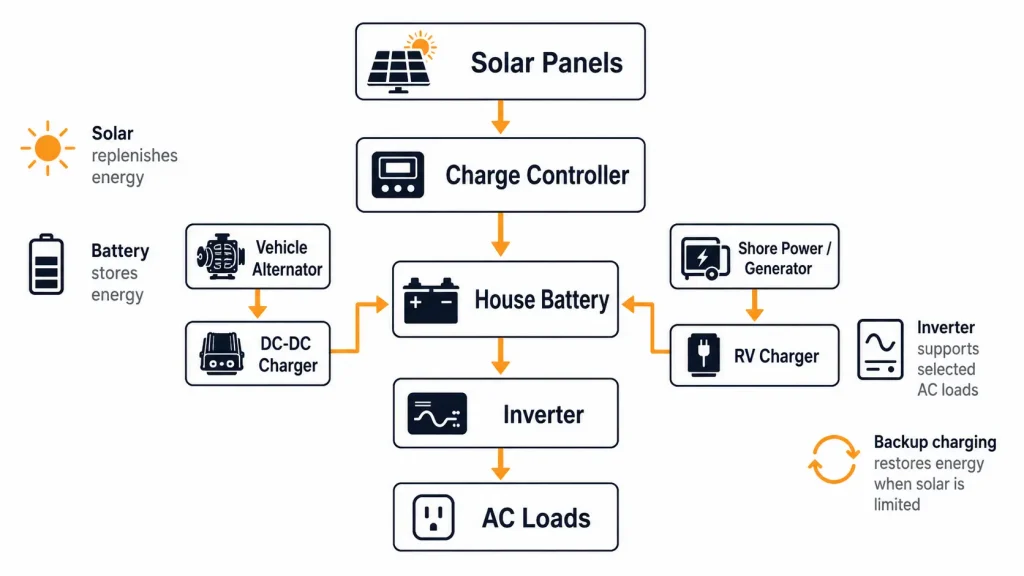
A typical RV solar system follows this path:
Many RV systems also use two additional charging paths:
Solar Panels
The panels convert sunlight into DC electricity. Their rated wattage is a reference value under defined test conditions. Actual output changes with sun angle, temperature, shade, dirt, orientation, cable losses, controller performance, and available charging hours.
Charge Controller
The charge controller regulates the connection between the solar array and the battery. Check the panel operating voltage, open-circuit voltage, short-circuit current, maximum controller input voltage, maximum controller input power, and battery system voltage.
Panel wattage alone is not enough to confirm compatibility.
Battery
The battery stores energy for later use. Its usable reserve depends on nominal capacity, battery voltage, chemistry, recommended depth of discharge, battery management system limits, temperature, age, and condition.
The capacity printed on the label should not automatically be treated as the energy available for daily use.
Inverter
The inverter converts DC power into AC power for compatible appliances. Check its continuous output, surge output, AC voltage, load type, battery discharge current, ventilation, and ambient temperature.
For a closer look at temperature-related system risks, see how heat affects inverter performance.
Match Solar Input With Battery Reserve
Battery Reserve Is Not the Same as Nameplate Capacity
Suppose an RV uses a measured 1,200 Wh per day. If the owner wants two days of reserve, the basic energy requirement is:
Adding a 20% planning reserve gives:
This is a planning example, not a universal battery recommendation. The final requirement must also account for usable capacity, conversion losses, temperature, and the battery manufacturer’s operating limits.
Solar Input Needs a Clear Assumption
A simple planning formula is:
For example, if the target is to replace 1,200 Wh per day, and the planning assumptions are four equivalent sun hours and a 75% system factor:
The four-hour and 75% values are assumptions for this example. They are not guaranteed field results.
Actual output can be lower when the roof is shaded, panels are installed flat, the vehicle is parked in the wrong direction, the weather is cloudy, the panels are hot or dirty, or the battery and controller limit charging.
Use a panel rating for planning, not as a promise of daily energy production.
Choosing Roof, Portable, Flexible, or Lightweight Panels
Roof-Mounted Rigid Panels
Roof-mounted rigid panels may suit RVs with sufficient roof area, a stable mounting structure, long-term fixed use, and adequate clearance around roof equipment.
Review the roof layout, weight allowance, mounting points, wind exposure, cable entry, and maintenance access. For a broader comparison of RV roof space, weight, and panel formats, see the RV solar panel selection guide.
Flexible Solar Panels
Flexible panels may be considered when the installation involves a curved roof, a low-profile requirement, a special surface, a custom panel shape, or limited clearance around roof equipment.
Flexibility does not remove the need for an installation review. Confirm the minimum bend radius, mounting method, surface temperature, cable exit position, maintenance access, and fit with the specific RV roof.
When roof curvature, clearance, or panel weight becomes a design constraint, buyers can review flexible formats such as Sungold’s PA219 flexible solar panel. Final compatibility still depends on the RV structure and electrical system.
Lightweight Solar Panels
Weight becomes more important when the roof has a limited load allowance, several panels are planned, or a dealer needs a repeatable package across different vehicle models.
The panel must still meet the required voltage, current, size, and installation conditions. Reducing weight does not replace electrical or structural verification.
Sungold’s PA621 lightweight solar panel can be reviewed for weight-sensitive RV and vehicle applications.
Portable Solar Panels
Portable panels can help when the RV is parked under trees or when the roof has limited usable space. They allow the panel to be moved into better sunlight while the RV remains in shade.
Portable solar also introduces new checks: cable length, connector type, trip hazards, storage, wind protection, theft risk, and controller compatibility. Do not connect a portable panel to an existing system until its voltage, current, controller, and connection method have been verified.
When Roof Solar Is Not Enough
DC-DC Charging While Driving
DC-DC charging can help recover energy while the RV is moving. It may be useful when the vehicle drives between campsites, the roof is shaded, several cloudy days are expected, or the RV has limited panel area.
The charger must match the vehicle and house-battery architecture. It should not be added only because the RV has a spare cable route.
Portable Solar Input
Portable solar is a useful supplement when a fixed array cannot receive enough sunlight. It is especially relevant for forested campsites and vehicles with many roof obstructions.
Portable panels help with shade, but the controller input range and connection design still have to match.
Shore Power or Generator Backup
A generator or shore connection may remain important when the RV needs air conditioning, electric heating, electric water heating, microwave use, induction cooking, high-power tools, or several AC loads at the same time.
Solar can reduce generator use. It does not automatically replace every backup source.
How Conditions Change the Design
Florida and Humid Coastal Areas
Review high ambient temperature, humidity, tree shade, coastal air, and cooling demand. The operating environment of the inverter, controller, and battery also matters.
Desert Regions
Desert locations may offer strong sun but still create challenges from high module temperature, dust, surface contamination, and large day-to-night temperature changes.
Mountain and Forest Camping
Mountain and forest locations often introduce tree shading, shorter solar windows, uneven parking, and more morning or afternoon obstruction. In these conditions, panel layout can matter as much as rated wattage.
A Practical RV Boondocking Planning Table
| Boondocking Pattern | Main Question | Priority Check |
|---|---|---|
| One night | Can the battery cover essential loads? | Usable battery reserve |
| Two nights | Can daytime solar replace daily use? | Solar input and weather |
| Three or more nights | What happens during poor solar conditions? | Backup charging path |
| High AC load | Can the inverter handle continuous and startup demand? | Inverter and battery compatibility |
| Shaded campsite | Can the panel be moved or supplemented? | Portable or secondary solar input |
What RV Buyers Should Check Before Choosing a Solar Package
Before selecting a panel package, check:
- RV battery voltage and chemistry
- Usable battery capacity
- Solar controller input range
- Panel operating voltage and open-circuit voltage
- Maximum solar input power
- Inverter continuous and surge output
- Cable length and connector type
- Available roof area and added roof weight
- Mounting surface and partial-shade conditions
- DC-DC charging compatibility
- Shore power and generator integration
- Documentation and wiring instructions
For RV Dealers and Solar Kit Brands
A repeatable RV solar package needs more than a panel specification.
Dealers and system brands should also review available roof dimensions, standard and optional panel formats, cable and connector variations, flexible versus lightweight construction, controller and battery architecture, installation instructions, product labeling, packaging, sample validation, warranty documentation, target-market requirements, and after-sales support.
For an OEM or system-brand project, the panel should be reviewed as part of the product package. Size, voltage, cable exit, mounting surface, and packaging may need to be adapted to the target RV platform.
For an RV kit or OEM project, Sungold can review the panel format against the proposed roof area, voltage, cable route, and system architecture. Product scope, certification, MOQ, lead time, and warranty terms should be confirmed for each project.
FAQ
There is no universal panel count. Start with daily energy use, usable battery reserve, available roof area, and expected solar conditions. Then check whether the controller and battery can accept the planned solar input.
It may be possible in some system designs, but air conditioning is usually a high-demand load. The battery, inverter, wiring, cooling conditions, and solar input must be reviewed together. A roof array should not be assumed to support continuous air conditioning.
Roof-mounted solar is convenient and can charge while the RV is parked. Portable solar can be moved away from shade and may help when the roof has limited space. Some RVs benefit from a combination of both.
Possibly, but the controller input range, panel voltage, current, cable size, connector type, battery charging limits, and mounting space must be checked first. Adding wattage without checking the controller can create a system mismatch.
It can still produce some energy, but shading reduces output. The impact depends on the shade pattern, panel layout, wiring, and controller design. A portable panel placed in a brighter area may help, but it needs a compatible charging path.
Final Thoughts
A practical RV boondocking solar system starts with the trip, not the panel catalog.
First, estimate how many nights the RV must operate without shore power. Then separate essential loads from high-demand appliances. After that, match usable battery reserve, solar input, inverter power, controller limits, and backup charging options.
For RV owners, the design should reflect real usage. For dealers and system brands, the package also needs repeatable dimensions, documented compatibility, clear installation guidance, and a realistic product boundary.
Solar panels are one part of the system. A usable design comes from matching the panel to the RV platform and the complete electrical architecture.