 EN
EN
 Deutsch
 Italiano
 Español
 Français
 日本語
日本語
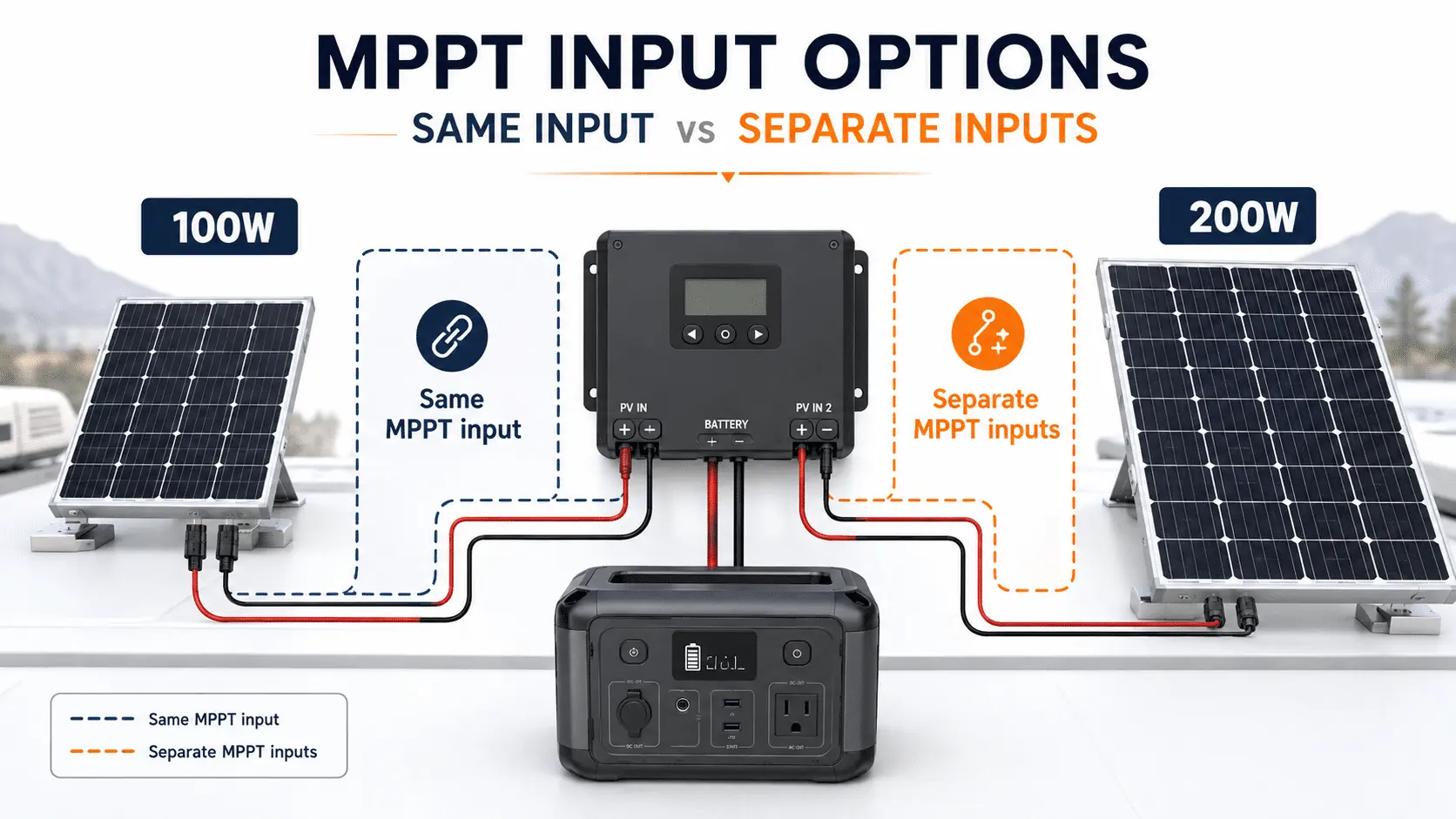
Can you mix solar panels with different wattages? Sometimes, but the answer depends on the complete electrical design.
A 100W panel and a 200W panel may work in the same project. That does not mean they should always be connected to the same controller input. The more useful question is whether the panels can operate within the same electrical window and under similar system conditions.
Two panels with different wattages may have similar operating voltages. They may also have very different voltage and current values. The result depends on the exact module datasheets and the equipment connected to the array.
For a broader explanation of Vmp, Imp, Voc, Isc, and panel-to-controller calculations, see Solar Panel Amps to Watts: Battery and Controller Sizing Guide.
Why Wattage Alone Is Not Enough
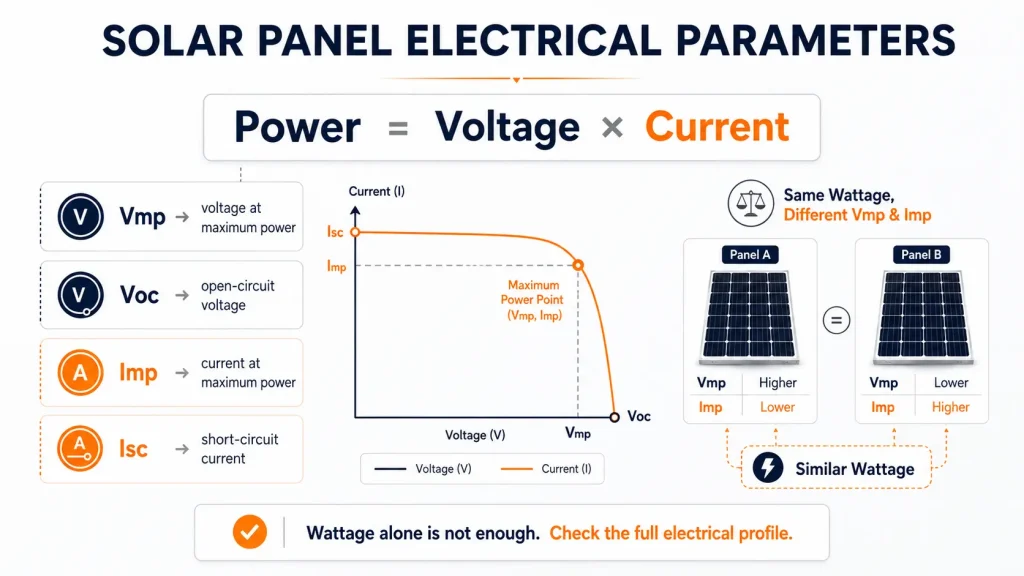
Solar panel wattage is calculated from voltage and current. A simplified relationship is:
This means two panels with the same wattage can have different electrical characteristics. One may use a lower operating voltage and higher current. Another may use a higher voltage and lower current. Both may have a similar nameplate wattage while behaving differently on the same input.
| Parameter | Why It Matters |
|---|---|
| Vmp | Voltage at the maximum power point. |
| Voc | Used when checking the maximum PV input voltage. |
| Imp | Current at the maximum power point. |
| Isc | Used for current and protection checks. |
| Rated power | Nameplate output under defined test conditions. |
| Temperature coefficient | Helps evaluate voltage changes under different temperatures. |
The Sandia PV Performance Modeling Collaborative uses these current-voltage points to model PV module behavior. Its model also accounts for irradiance and cell temperature, so electrical values are not fixed under every outdoor condition. See the PVPMC module performance model.
The First Decision: One MPPT or Separate MPPT Inputs?
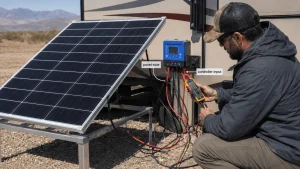
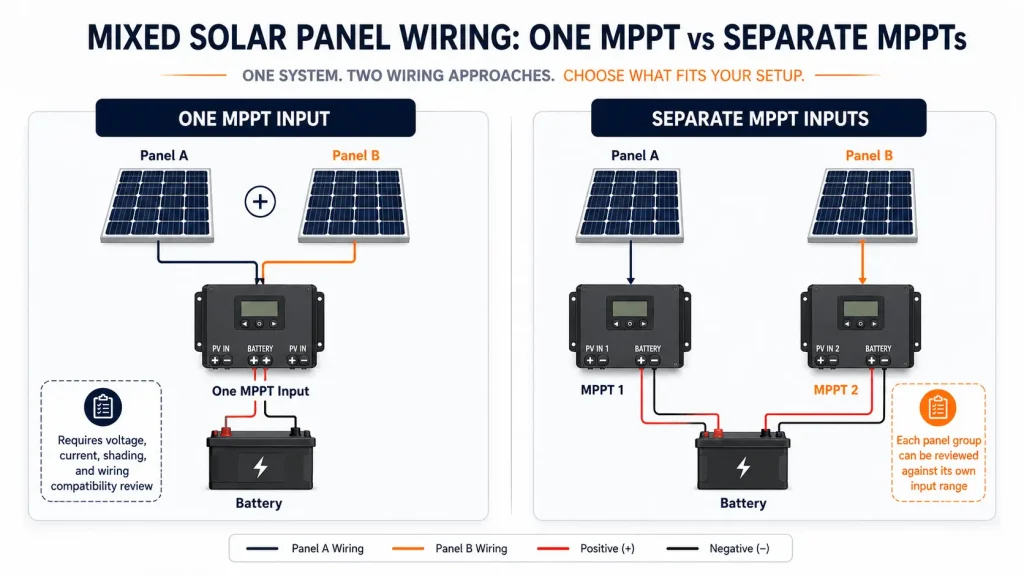
The most important design decision is whether the panels should share one MPPT input. A controller can only track the array within its own operating range.
| System Arrangement | When It May Fit | Main Check |
|---|---|---|
| Same MPPT input | Panel voltage and current are reasonably aligned. | Confirm the combined array stays within input limits. |
| Separate MPPT inputs | Panels have different voltage, orientation, or shade conditions. | Confirm each input range independently. |
| Separate charge controllers | Panels serve different battery or charging paths. | Check battery and controller coordination. |
| Separate microinverter inputs | Each panel or panel group has its own input path. | Follow the exact inverter input specifications. |
A controller manual may allow a PV array to operate at a higher voltage than the battery voltage, but the maximum PV voltage, current, and battery charge current remain model-specific. Victron documentation, for example, identifies the maximum PV voltage and maximum battery charge current for each controller model and describes series, parallel, and combined array configurations. Review the Victron MPPT documentation.
When Can Different-Wattage Panels Share One Input?
Different-wattage panels may be considered for the same input when the following conditions are satisfied:
- Their operating voltage is compatible.
- The combined current stays within the controller limit.
- The total open-circuit voltage stays within the maximum input voltage.
- The panels have similar orientation and sunlight exposure.
- The shading pattern is reasonably similar.
- The wiring, connectors, and protection devices are correctly rated.
- The controller manufacturer permits the proposed configuration.
This does not mean the panels will always operate at their individual maximum output. A mixed array may work safely while still experiencing some mismatch.
The design should therefore separate two questions:
- Is the configuration electrically acceptable?
- Is the configuration efficient and repeatable enough for the project?
For a private prototype, a small mismatch may be acceptable. For a distributor package or OEM system, repeatability is more important. The same configuration should behave predictably across production units.
When Should Panels Be Separated?
Separate inputs may be more appropriate when:
- One panel is often shaded while another receives direct sun.
- Panels face different directions.
- Panels are installed on different surfaces.
- Flexible and rigid panels have substantially different operating conditions.
- The panel voltage ranges are not well aligned.
- One panel group is intended for a different battery or controller.
- The system brand needs a consistent wiring and installation method.
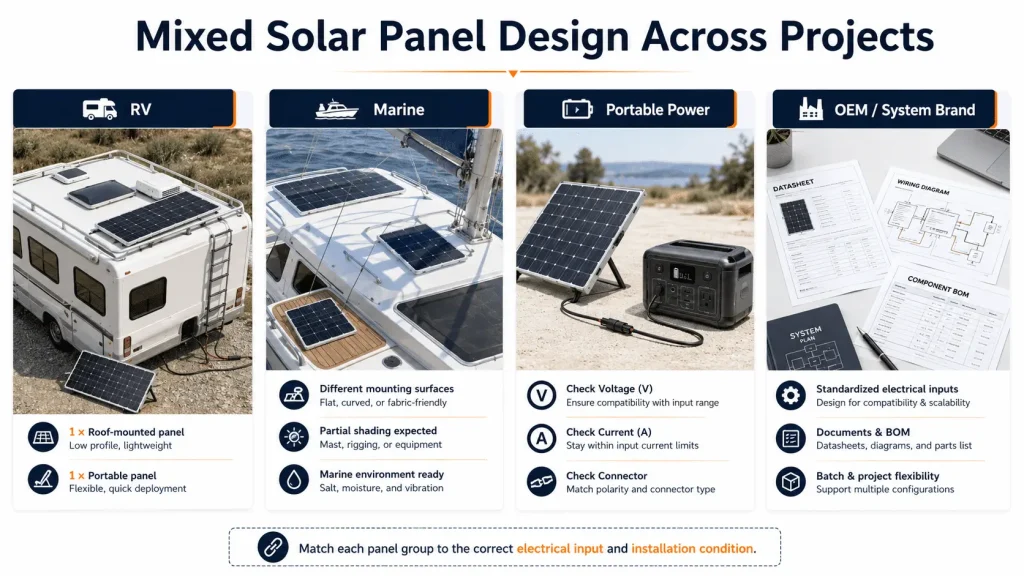
This is especially relevant for mobile and application-specific systems. An RV roof may have vents, racks, air-conditioning equipment, or storage boxes. A marine deck may include masts, rails, and rigging. A portable panel may be placed at a different angle from a roof-mounted panel.
In these situations, separate MPPT inputs can make it easier for each panel group to operate within its own conditions.
Can Flexible and Rigid Panels Be Used in the Same Project?
They can sometimes be used in the same overall system, but they should not automatically be placed on the same electrical input.
The project may combine:
- Flexible panels on a curved roof.
- Rigid panels on a fixed rack.
- Portable panels used only when parked.
- A lightweight panel on a vehicle roof.
- A separate panel group for a marine deck.
The main checks are Vmp, Voc, Imp, Isc, shading, orientation, cable length, connector type, mounting surface, controller input architecture, and environmental exposure.
The same project may use different panel formats for mechanical reasons. That does not mean the formats have to share the same MPPT.
How Does Mixed-Panel Design Apply to Different Projects?
RV and Van Projects
RV systems often have limited roof space. The usable area may also be interrupted by roof vents, air-conditioning equipment, antennas, storage boxes, and racks.
A buyer may want to combine a lightweight roof panel with a portable panel. The two panels may not receive the same sunlight or operate at the same angle.
Before combining them, review the battery voltage, controller input range, panel Vmp and Voc, cable route, roof shading, and portable-panel connection method. The RV Solar Panel Selection Guide provides the broader review of roof space, weight, panel format, and system matching.
Marine Projects
Marine systems may use more than one mounting area. A panel on a cabin top may have different exposure from a panel on a deck or rail structure.
The design should consider masts and rigging, salt-air exposure, curved surfaces, cable protection, moisture at connectors, access for inspection, and different orientations across the vessel.
A marine buyer should not combine panels only because their wattage appears similar. The electrical and mechanical installation conditions must also be reviewed.
Portable Power Systems
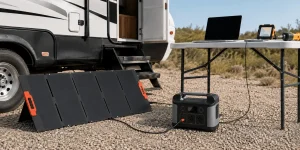
Portable power stations usually specify a permitted PV input range. This range may include maximum PV voltage, maximum PV current, maximum input power, connector requirements, and operating or startup voltage.
A panel may have a suitable wattage but an unsuitable voltage or current range for the power station.
OEM and System Brand Projects
For an OEM or system brand, mixed panels should be treated as a controlled product configuration.
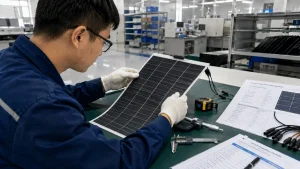
Before mass production, confirm which panels share one MPPT, which panels use separate inputs, the approved panel BOM, cable length, connector type, wiring diagrams, user instructions, product labels, sample configuration, and change-control requirements.
A change from one panel model to another should not be treated as a simple wattage substitution. The electrical values and mechanical layout should be reviewed again.
What Happens When Mixed Panels Are Poorly Matched?
Poor matching may cause:
- One panel to operate away from its preferred point.
- Lower usable output from the combined array.
- Less stable MPPT tracking.
- Input voltage or current limits to be reached.
- Greater sensitivity to shade or orientation differences.
- More complicated troubleshooting.
However, poor matching does not automatically mean that the system will fail or that equipment will be damaged. The result depends on the connection method, panel electrical values, controller design, battery architecture, protection system, and installation environment.
Mixed-Panel Review Sheet
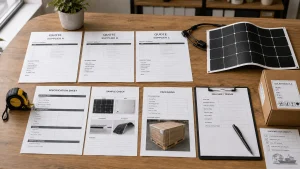
Before connecting panels with different wattages, buyers should prepare the following information:
| Checkpoint | What to Confirm |
|---|---|
| Panel data | Vmp, Voc, Imp, Isc, rated power, and temperature coefficient. |
| Input design | Same MPPT, separate MPPT, or separate controller. |
| Connection method | Series, parallel, or separate panel groups. |
| Orientation | Whether the panels receive similar sunlight. |
| Shading | Whether one panel has a different shade pattern. |
| Mounting | Whether the panels use the same or different surfaces. |
| Battery system | Nominal voltage, chemistry, and charging limits. |
| Cable system | Cable length, connector type, and protection. |
| Documentation | Datasheets, wiring diagrams, and installation instructions. |
| Final approval | Confirmation from the system designer or equipment provider. |
How Sungold Can Support Mixed-Panel Projects
Sungold can support the panel-side review for RV, marine, portable, vehicle, balcony, and off-grid projects after the system inputs have been defined.
For projects involving curved surfaces or flexible installation requirements, buyers can review PA219 flexible solar panels.
For projects where panel weight and available installation space are important, buyers can also review PA621 lightweight solar panels.
The project review should confirm the required panel format, electrical window, dimensions and weight, cable and connector layout, mounting surface, shade and temperature conditions, controller and battery architecture, and documentation requirements.
The final controller, battery, cable, fuse, grounding, protection, and complete-system compliance decisions must be confirmed by the responsible equipment provider or system designer.
FAQ
Sometimes. The answer depends on operating voltage, current, connection method, controller limits, and installation conditions. The wattage difference alone does not confirm compatibility.
They may require separate inputs or a different array configuration. Check Vmp, Voc, the MPPT operating range, and the controller’s maximum input limits before connecting them.
They can sometimes be used in the same project. However, they may be better placed on separate electrical inputs when their voltage, orientation, shading, or installation conditions differ.
Separate controllers may be considered when panels serve different battery paths, have clearly different voltage ranges, or operate under different sunlight and mounting conditions.
It may reduce the usable output of the combined array if the panels are poorly matched. The effect depends on electrical characteristics, controller, connection method, shade, temperature, and orientation.
Final Thoughts
Different-wattage solar panels can be used together, but the decision should not start with total watts.
Start with the actual module datasheets. Then check the connection method, MPPT input range, battery architecture, shading pattern, cable system, and installation surface.
For an RV, marine system, portable power product, or OEM package, the most reliable approach is to decide whether the panels should share one input or operate through separate inputs.
A mixed-panel design is acceptable only when the complete electrical and installation conditions are compatible. The final configuration should be confirmed before installation, sampling, or mass production.